Fire-Rated Cable Systems: Buyer Q&A
One wrong part can wipe out a 2-hour fire rating. If you buy fire-rated cable systems in the U.S., the main rule is simple: the listing applies to the full assembly, not just one product.
I’d boil this guide down to a few checks:
- Match the UL FHIT system number before buying
- Confirm every part in the assembly: cable, raceway, couplings, supports, anchors, and hardware
- Check the location rating: Dry, Damp, or Wet
- Verify support spacing, run direction, and tray fill
- Use the right firestop listing at walls and floors
- Reject field substitutions unless the listing shows them
A lot of buying mistakes come from mixing up three different things: a listed fire-resistive system, CI cable, and firestop products. They do different jobs, and the wrong one can lead to a failed inspection.
Here’s the fast version:
| Item | What I’d check first | Why it matters |
|---|---|---|
| Fire-resistive system | UL FHIT system number | Tells me the tested assembly |
| CI cable | Listed use in that FHIT system | Cable alone does not make the system compliant |
| Firestop seal | UL 1479 / ASTM E814 match | Needed at penetrations, but it does not keep the circuit working by itself |
I’d also keep an eye on a few field issues that show up often: support spacing tighter than 5 ft, dry-only systems used outdoors, mixed metals in corrosive areas, and retrofit trays that exceed NEC 392 fill limits after new cable is added.
If I were screening submittals or marketplace listings, I’d want three documents up front: the FHIT printout, the cut sheet, and the install instructions. No system number, no backup documents, or photo-only listings? That’s a red flag.
The rest of the article walks through how to read those listings, avoid bad substitutions, and line up the system with NEC 728, NEC 392, UL 2196, and the right firestop listing.
IEP -STI Firestop Ez Path Fire Rated Pathways
sbb-itb-501186b
Ratings and Listings: What a Fire Rating Actually Covers
Once the system scope is clear, the next step is simple: check whether the listing applies to one part or to the entire assembly.
That sounds like a small detail. It isn't.
UL FHIT identifies the tested assembly as a whole. That means the listing covers the cable, conduit, couplings, supports, and hardware tested together as one assembly. In a fire-rated application, that's the part that matters.
How Component Listings Differ from Listed Systems
Buyers often use these terms like they mean the same thing. They don't.
| Listing Type | What It Means | What to Verify in Submittals |
|---|---|---|
| Component listing | Approval for one component | Only the named component |
| Listed system | A tested assembly identified by system number | The exact listed assembly |
A component listing by itself is not enough for a fire-rated application.
The installed system has to match the listing. Not just in general terms, but in the exact way the listed system was tested. And only the listed manufacturer combination is allowed.
How a Listed System Can Become Noncompliant in the Field
The issue that shows up most often is substitution.
It happens all the time in the field: one swapped part, a different manufacturer, or support spacing that seems close enough. But if that change is not named in the listed system, the assembly no longer matches what was tested.
Reject any field substitution not shown in the listed system, including:
- components
- manufacturers
- support spacing
That’s the next thing buyers need to check: whether the listed system fits the actual installation environment.
Indoor, Outdoor, and Retrofit Conditions That Affect the Buying Decision
Start with the listing's location rating. If a system is rated Dry, you can't use it outdoors or in washdown areas. If site conditions don't match the listing, the installation is not compliant.
Indoor vs. Outdoor Use and Material Selection
Material matters, but it doesn't decide the whole job. The site itself can still rule out a listed system.
Every UL FHIT listing gives a location rating: Dry, Damp, or Wet. Check that rating in the UL FHIT system listing itself, not only in a manufacturer cut sheet or brochure.
Material choice should track the environment. In coastal or marine settings, 316 stainless steel is the better pick over 304 stainless and galvanized steel because it holds up better against chlorides and pitting. Galvanized steel is usually meant for dry indoor use and can corrode in wet or salty areas.
Use hardware that matches the listed tray material. Mixed metals can corrode, and they can also void the listing.
| Material | Typical Environment | Corrosion Performance | Listing Check for Outdoor Use |
|---|---|---|---|
| Galvanized Steel | Indoor / Dry | Moderate | Usually restricted to Dry Locations in FHIT listings |
| 304 Stainless Steel | Indoor washdown / mild chemicals | High | Verify hardware compatibility in the listing |
| 316 Stainless Steel | Outdoor / salt air / marine / harsh chemicals | Superior | Preferred for coastal installations; confirm stainless hardware is listed |
| Fiberglass (FRP) | Highly corrosive / chemical plants | Excellent | Use only when the listing specifically covers FRP |
| Coated Steel (Epoxy/PVC) | Industrial / chemical | High | Verify grounding and bonding requirements in the listing |
For washdown areas, check that the coating or finish is part of the listed assembly. It also can't interfere with the system's thermal performance during a fire event.
Retrofit Issues in Existing Tray and Conduit Runs
A listing can look right on paper and still fail in the field if the existing tray run can't match the tested assembly.
Retrofit only works when the existing run lines up with the listed system. Many trays installed for standard electrical service don't meet those fire-rated conditions as they sit.
Support spacing is usually the first problem. Compare the listed support spacing with what's already installed. In many cases, the listed spacing is tighter than standard tray spacing. If the tray doesn't meet that spacing, you may need to reinforce it or replace it before you can install the fire-rated system in a compliant way.
Cable fill is the next trouble spot. Check the listed fill limit before buying anything. If you add fire-rated cables to a tray that's already near full, you may push it past NEC 392.22 limits.
If replacing the existing tray isn't possible, fire-rated wrap may work. But there's a catch: wrap can increase operating temperature and may require ampacity derating. You also need enough clearance above the tray for fire-rated blankets or coatings to be installed the right way.
And when the tray passes through a wall or floor, the firestop listing has to match both the tray material and the wall condition. In washdown areas, the firestop also needs to be watertight.
Specs That Matter Most in Product Listings and Submittals
Once site conditions are nailed down, the listing details decide whether the product is compliant or not.
Compliance Specs vs. Secondary Specs
Start with the UL FHIT system number. That number links the cable, conduit, supports, and hardware to one tested assembly. It’s the main reference point for whether a product can be installed as listed.
Next, check the fire-resistance duration and the UL 2196 test standard. The listed duration needs to match the project requirement, and the system needs to be tested to UL 2196. The listing - not the marketing copy - decides compliance.
| Compliance Specs | Secondary Specs |
|---|---|
| UL FHIT System Number - the compliance reference for the listed assembly | Jacket color - useful for circuit ID, not a compliance factor |
| Fire rating duration - must match the project requirement | Named manufacturer - must match the FHIT listing |
| Approved raceway type and size - EMT, IMC, or rigid steel as listed | Packaging / spool size - logistics only |
| Support spacing - maximum distance between hangers, often 5 ft max | Weight per foot - relevant for shipping, secondary to support spec |
| Voltage rating - typically 600V; must match circuit requirements | Bend radius - affects installation ease, not fire rating |
How to Read Marketplace Listings Without Missing a Compliance Issue
Online listings often bury the details that matter. That’s why you should verify the system printout before you place an order. When sourcing components - including through Electrical Trader - the listing title by itself won’t tell you enough.
A product labeled as 2-hour fire-rated cable may only be valid when used with a specific conduit type, conduit size, and support layout. That’s where buyers get tripped up.
Look for:
- A PDF cut sheet
- The specific UL FHIT system printout
- The manufacturer’s installation instructions
If the FHIT system number is missing, or the listing is just a photo-only post with no backup documents, treat that as a red flag.
Before ordering, cross-check the FHIT number in the UL Product iQ database. Make sure the listing is active and that the conduit type, size, and hardware in your project match the tested setup.
One common procurement mistake is buying the listed cable, then pairing it with standard zinc or plastic couplings and supports. That breaks compliance. Use only the couplings, supports, and fasteners named in the FHIT listing. Hardware is part of the tested assembly, not something you sort out later.
Code References and Final Buying Takeaways
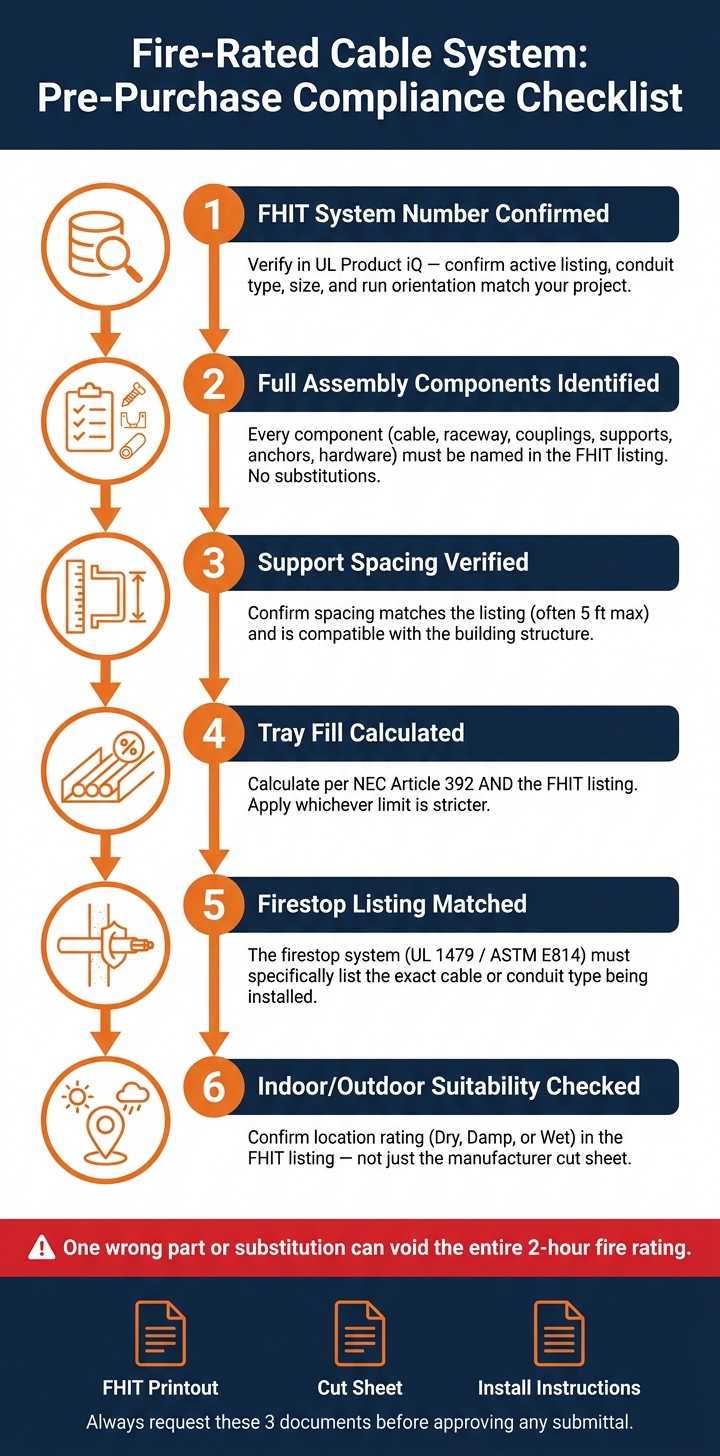
Fire-Rated Cable System Compliance Checklist: 6 Steps Before You Buy
Code and Installation Limits to Confirm Before Purchase
Once you've checked the product listing, the next step is simple: confirm the code limits that control installation. For a fire-rated cable tray or conduit system in the U.S., four references matter most: NEC Article 728, NEC Article 392, UL 2196, and the applicable UL 1479 / ASTM E814 firestop listing.
Start with NEC Article 728. It requires the installed system to match the listing exactly. That means no swapping in different hardware, couplings, or support spacing unless the listing names them. If it's not in the listing, don't use it.
Then look at capacity. Check tray fill against NEC Article 392 and the FHIT listing. If the two limits differ, follow the stricter one.
After that, verify the penetration detail. For rated walls and floors, use a firestop system listed for the exact cable or conduit type and assembly. Close isn't enough here. It has to match.
Also check whether the listing allows horizontal, vertical, or both kinds of runs. Some UL 2196 listings cover only horizontal runs. Others apply only to vertical ones. That small detail can turn into a big problem in the field.
The Short Checklist for Buying the Right Listed System
Use this short screen before approving submittals:
- FHIT system number confirmed in UL Product iQ - active listing and a match for conduit type, size, and orientation
- Full assembly components identified - every component is named in the listing
- Support spacing verified - matches the listing and works with the building structure
- Tray fill calculated per NEC Article 392 and the FHIT listing, using whichever limit is stricter
- Firestop listing matches the cable or conduit - the listed firestop system includes the exact cable or conduit type being installed
- Indoor/outdoor suitability checked - many listings are for dry locations only