

5 Community Microgrid Case Studies
If I had to boil this article down to one point, it’s this: community microgrids work best when the load, islanding plan, equipment, and funding all match from day one.
I’m looking at five U.S. projects that show this from different angles:
- Blue Lake Rancheria, CA: campus microgrid with 420 kW solar, 950 kWh battery storage, and 1 MW diesel backup
- Bronzeville, IL: urban neighborhood microgrid serving about 1,000 customers
- Borrego Springs, CA: town-scale setup serving about 2,800 customers with 1.8 MW solar and 4 MWh storage
- Cordova, AK: off-grid hybrid system with 4.7 MW hydro and 1 MWh battery storage
- Belle Haven, CA: community campus microgrid with 627 kW solar and 1,344 kWh battery storage
Here’s the short version of what these case studies show:
- Controls, switchgear, and protection often matter as much as solar panels and batteries
- Grid setup changes everything: some systems stay tied to the grid, some can island, and one is off-grid all the time
- Funding models vary a lot, from $4 million DOE support to $5 million state grants, utility spending, and local public funds
- Results depend on the job: lower outage time, lower fuel use, lower power bills, or backup power for shelters and community services
- Lead times are long: community-scale power projects can take 2 to 5 years to move through permitting and approvals
- Grid connection costs can account for about 4.7% of total capex
Overcoming Common Microgrid Development Hurdles - Ask Mayfield Anything
sbb-itb-501186b
Quick Comparison
5 U.S. Community Microgrids Compared: Size, Setup & Results
| Project | Main Setup | Grid Mode | Funding | Main Result |
|---|---|---|---|---|
| Blue Lake Rancheria | Solar + battery + diesel | Grid-tied + islanding | $5 million CEC grant + tribal funds | Kept power on during PSPS outages |
| Bronzeville | Solar + battery + controls | Grid-tied + neighborhood islanding | $4 million DOE grant + utility funds | Showed block-level outage support in a city |
| Borrego Springs | Solar + battery + diesel | Grid-tied + town islanding | Utility spending + public approvals/grants | Cut outage time and islanded during storm work |
| Cordova | Hydro + diesel + battery | Off-grid at all times | USDA, Alaska support, co-op funds | Saved about 35,000 gallons of fuel per year |
| Belle Haven | Solar + battery | Grid-tied + islanding | State grants + local public funds | Backup power for community services |
What matters most if you’re buying or planning one? I’d start with critical loads, interconnection gear, controls, storage size, and backup generation. Those choices shape both cost and outage performance.
The rest of the article walks through how each project made those tradeoffs in practice.
5 U.S. Community Microgrid Projects
Blue Lake Rancheria Tribal Microgrid, California
Blue Lake Rancheria shows what a community microgrid can do when resiliency is the top goal. The site runs a 420 kW solar PV system, a 950 kWh Tesla Powerpack battery, and a 1 MW backup diesel generator. It uses the Siemens Spectrum Power 7 microgrid management system and stays connected to PG&E during normal conditions, with the ability to island when needed.
The project was funded through a $5 million California Energy Commission EPIC grant plus tribal investment, with support from the Schatz Energy Research Center, PG&E, and Siemens. During PG&E PSPS events, the microgrid has kept the campus powered and kept a Red Cross-certified evacuation center in service.
The next projects show how ownership, climate, and utility partnerships can shape a microgrid in very different ways.
Bronzeville Community Microgrid, Chicago, Illinois
Bronzeville moves from a tribal resiliency campus to a dense urban setting. Commonwealth Edison (ComEd) built this grid-tied system in Chicago's Bronzeville neighborhood, combining rooftop solar PV, battery storage, and a control platform that can island a defined service territory.
This setup was designed to serve multiple city blocks, which made it one of the first urban community microgrids in the Midwest. Funding included a $4 million U.S. Department of Energy (DOE) grant, along with utility investment and grid integration support from ComEd.
The project showed that a utility-owned urban microgrid can separate and power a neighborhood-scale load during an outage while still operating as part of the grid during normal conditions.
Borrego Springs Microgrid, California
Borrego Springs sits in a remote desert area served by San Diego Gas & Electric (SDG&E). Its microgrid combines about 1.8 MW of solar PV, 4 MWh of battery storage, and a diesel backup generator, all managed through an advanced distribution management system.
Under normal conditions, the system stays grid-tied. During outages, it can island on its own, which matters a lot in an end-of-line service area where outages happen often. Funding came through SDG&E ratepayer investment with approval from the California Public Utilities Commission (CPUC).
The project cut outage duration by a large margin and showed that automated islanding can work at the distribution feeder level for a rural community.
Cordova Microgrid, Alaska
Cordova is a remote fishing community in Alaska, and it isn't connected to the statewide grid. That changes the whole equation. The Cordova Electric Cooperative runs a hybrid microgrid that combines about 4.7 MW of run-of-river hydropower, diesel generation, and a 1 MWh battery energy storage system.
The battery helps smooth swings in hydro output and cuts diesel runtime. In a place where fuel delivery is expensive, that matters in a very direct way. Funding came from a mix of USDA Rural Energy for America Program (REAP) grants, Alaska Energy Authority support, and cooperative investment.
The project lowered diesel use and fuel costs by a large amount, showing how storage can get more out of existing renewable generation in an islanded system.
Belle Haven Community Campus Microgrid, California
Belle Haven is a low-income neighborhood in Menlo Park, and its project centers on community services. This campus microgrid was developed through a partnership between Peninsula Clean Energy and local stakeholders. It pairs rooftop solar PV with battery storage sized to support critical facilities, including a community center and affordable housing units.
Like many community microgrids, it runs grid-tied during normal operations and can island during PG&E outages. Funding came from a mix of California Climate Investments program grants, Peninsula Clean Energy resources, and local government support.
What stands out here is the focus on energy equity. The project delivered backup power and lower electricity costs to a disadvantaged community that had faced reliability problems for years.
Side-by-Side Comparison: System Size, Equipment, Funding, and Results
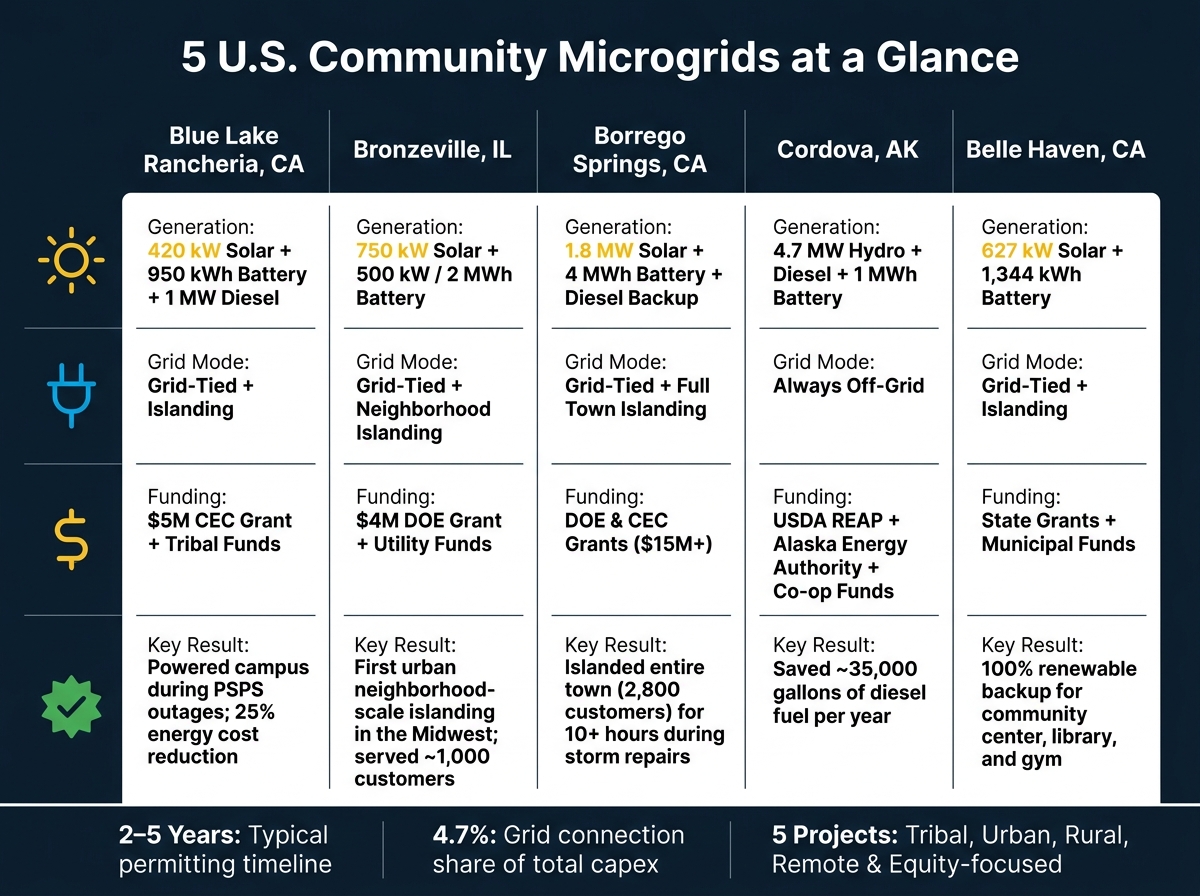
Comparison Table: 5 Community Microgrids at a Glance
The table below pulls the five projects into one view, with the details buyers usually care about first: scale, equipment, islanding setup, funding, and what each site delivered. Across all five, controls are the glue that keeps solar PV, storage, and backup generation working together.
| Project | State | Primary Load | Generation & Storage | Islanding Type | Operator | Funding Model | Key Result |
|---|---|---|---|---|---|---|---|
| Blue Lake Rancheria | CA | Tribal government, Red Cross shelter | 420 kW solar; 950 kWh BESS; 1 MW diesel | Full islanding for critical campus | Blue Lake Rancheria Tribe | $5M CEC EPIC grant + tribal funds | 25% reduction in energy costs; provided power during 2019 PSPS events |
| Bronzeville Community Microgrid | IL | 1,000 residential/commercial customers | 750 kW solar; 500 kW / 2 MWh BESS | Neighborhood-scale islanding (with IIT) | ComEd | $4M DOE grant + utility rate base | Showed utility-owned neighborhood-scale islanding |
| Borrego Springs Microgrid | CA | Entire remote town, 2,800 customers | About 1.8 MW solar PV; 4 MWh battery storage; diesel backup | Full town-scale islanding | SDG&E | DOE & CEC grants ($15M+) | Successfully islanded town for 10+ hours during storm repairs |
| Cordova Microgrid | AK | Isolated fishing community | About 4.7 MW run-of-river hydropower; diesel generation; 1 MWh battery storage | Always isolated (off-grid) | Cordova Electric Cooperative | DOE & Alaska Energy Authority | Eliminated diesel-only operation periods; 35,000 gallons of fuel saved per year |
| Belle Haven Community Campus | CA | Community center, library, and gym | 627 kW solar PV; 1,344 kWh BESS | Islandable community hub | Peninsula Clean Energy and local partners | Municipal funds + state grants | 100% renewable backup for emergency services and cooling center |
What the Comparison Means for Equipment Specification
Scale shapes equipment choices fast. Borrego Springs, with about 1.8 MW of solar serving 2,800 customers, sits near the large end of this group. Belle Haven, at 627 kW, is much smaller and built around a campus-style setup.
That gap matters because equipment scope changes a lot with both system size and islanding type. Blue Lake Rancheria and Belle Haven each needed switchgear upgrades at the utility interconnection so islanding could happen safely. There’s a simple reason for that: inverter-based resources like solar and batteries produce far less fault current than old-school generators. So when buyers write specs, advanced protective relays and switchgear should be near the top of the list.
Cordova shows a different use case. There, the 1 MWh battery helps fine-tune hydropower output and cut diesel use. Belle Haven’s 1,344 kWh BESS, by contrast, was sized to keep emergency services and the cooling center running on renewable backup power. Bronzeville adds another layer. Its neighborhood-scale setup needed more complicated control logic than a self-contained campus or an always-isolated system like Cordova. In practice, that often means predictive controls tied into utility SCADA systems.
Most community microgrids are built around critical loads first. That’s why buyers should pin down those loads before they size generation, storage, and controls.
Those choices affect procurement, lead times, and lifecycle planning.
Procurement and Project Delivery Lessons for Buyers
Common Equipment Packages Across These Projects
Those equipment differences show up fast in procurement. In project after project, buyers usually start with interconnection gear, controls, storage, and backup generation.
One line item can shape the whole plan: grid connection costs can represent about 4.7% of total capital expenditure in a community project. That affects both the budget and the timeline.
For teams buying breakers, transformers, controls, and other power gear, Electrical Trader offers new and used breakers, transformers, and related power equipment.
Cost, Lead Time, and Lifecycle Planning
Once the equipment list is set, the main delivery risks usually shift to schedule and contract terms. Budget planning also needs to leave room for timing issues. Regulatory and permitting processes for community-scale renewable assets often takes 2 to 5 years, so procurement needs to begin early.
Contract terms should line up with the asset’s 25-year life. That means looking past the purchase price and digging into the details that keep the project running over time.
Before any order goes out, project teams should confirm a few things:
- Commissioning support
- Spare parts
- Long-term O&M responsibility
Those details can matter just as much as the equipment list when the goal is a project that runs well for decades.
Conclusion: Key Patterns Across the 5 Case Studies
Across these five projects, one pattern keeps showing up: resilience works best when the operating goal shapes the DER mix, controls, protection, and funding model. In plain English, the project needs a clear job to do first. From there, the technical setup has to match that job. But the engineering side doesn’t stand on its own. It works when the community is behind it.
Ownership and clear community benefits played a big part in support. Local financial participation and plain, visible benefit-sharing helped improve buy-in. That support made the rest of the project easier to move forward. And once that backing was there, early equipment choices had an outsized effect.
Interconnection, metering, and controls need to be treated as early decisions, not late-stage fixes. Grid configuration should shape equipment specs from the start. If that part gets pushed off, teams often end up playing catch-up later.
There’s also a simple pattern with scale: as system size grows, equipment, controls, and islanding requirements get harder to manage. That’s why matching equipment to the load profile and the grid setup matters so much. It’s what helps these microgrids stay reliable over time.
FAQs
How do you size a community microgrid?
Sizing a community microgrid is a balancing act. You’re trying to line up power generation, storage, and demand in a way that keeps costs under control while also making sure the system can hold up when the grid goes down.
A good place to start is with the loads. Group them into:
- life-safety
- mission-critical
- deferrable
Then size the microgrid so it can cover at least the critical loads during islanded operation. That’s the baseline. If the system can’t keep those loads running on its own, it’s not doing the job you need it to do.
From there, engineers usually turn to modeling tools like NREL REopt or STEMM. These tools help sort out the best equipment mix based on local demand, utility tariffs, and the ups and downs of renewable power.
When should a microgrid be able to island?
A microgrid should be able to island during emergencies or grid disruptions so power stays on when the main grid goes down.
Once it disconnects from the utility grid, it can run on its own and keep critical infrastructure - such as hospitals, water systems, and emergency services - up and running. That means less downtime when it matters most, and a stronger, more resilient power setup overall.
What equipment matters most besides solar and batteries?
Beyond solar panels and batteries, a microgrid also depends on equipment that handles power flow and safety.
That usually includes inverters and charge controllers for power conversion, transformers for voltage regulation, and transfer switches that safely disconnect the system from the grid during outages.
You’ll also see core electrical parts like breakers, switches, fuses, combiner boxes, smart meters, communications systems, and control software. In some communities, diesel or biogas generators are added for backup power or black start capability.