



New & Used High-Voltage Breakers for Sale
In Stock Now
4 units · pulled live from inventory
Tell us what you need
Tell us the voltage class, kA rating, tank style, vendor, and timeline you need. We'll match you with supplier partner inventory before it's listed publicly.
What to Check Before Buying a High-Voltage Breaker
Voltage class & BIL rating
High-voltage breakers run 69kV through 500kV. Match both the kV class and the BIL to your substation design; on transmission gear the BIL governs clearances and insulation coordination, not the nominal kV alone.
Interrupting rating
Verify the breaker's symmetrical interrupting capacity, typically 40kA or 63kA, against your available fault current. Fault duty rises as generation is added nearby — size to the study, not to today's reading.
ANSI/IEEE compliance
US transmission breakers are built to the C37 series: C37.04 ratings, C37.06 preferred ratings, C37.09 test procedure. Ask for the type test reports and the nameplate, especially on imported units.
Condition of insulation & bushings
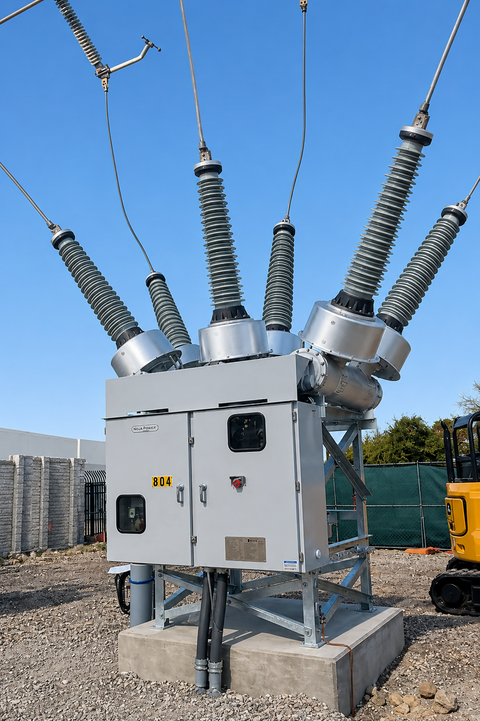
On dead tank units, bushings are the most common failure point and the most expensive single item to replace — request power factor / tan delta results on each. On live tank units, inspect the support and interrupter insulators for cracked porcelain, contamination, and moisture history.
SF6 maintenance
Confirm gas density readings, leak rate history, and whether the density monitor and alarms are functional. Plan for periodic gas quality testing and a certified SF6 handling partner as an ongoing ownership cost, not a one-time step.
POW (point on wave) closing
Also called controlled switching, synchronous closing, or zero-crossing closing. POW control times contact operation to the waveform to limit inrush and switching transients — essential for capacitor bank, reactor, and transformer switching duty. Confirm whether the unit has a POW controller and whether it is supported.