IP Ratings in Generators: Quick Guide
If I’m buying a generator, I treat the IP rating as a fast filter: first digit = dust, second digit = water. In plain terms, IP23 fits dry indoor rooms, IP44–IP55 fits many outdoor and work-site installs, and IP65–IP67 is for heavy dust, hose spray, or short-term flooding.
Here’s the short version:
-
IP ratings use 2 digits
- First digit: solids and dust
- Second digit: water
-
Higher isn’t always better
- More sealing can mean more heat, more cooling limits, and higher cost
-
I match the rating to the install spot
- Dry room: IP21–IP23
- Outdoor rain and light debris: IP44
- Dust + rain: IP54
- Hose spray: IP55
- Dust-tight + washdown: IP65/IP66
- Short-term immersion, often up to about 3.3 ft (1 m) for 30 minutes: IP67
-
One big catch: IP only covers dust and water entry
- It does not cover corrosion, impact, airflow, or bad cable-entry work
A lot of buyers miss one point: an IP55 generator can lose that protection if the conduit, glands, or cable entries are not sealed the right way. So I don’t just read the rating on the sheet. I check which part has that rating - the enclosure, alternator, controls, or connectors.
Quick comparison
| Rating | Best-fit use | Main water exposure | Main limit |
|---|---|---|---|
| IP23 | Sheltered indoor generator rooms | Light spray/drips | Not for dusty or exposed outdoor spots |
| IP44 | Basic outdoor use | Splashing rain | Not for hose spray or fine dust |
| IP54 | Outdoor standby and dusty areas | Splashes | Not for washdown |
| IP55 | Rough outdoor sites | Water jets | Not dust-tight |
| IP65 | Dusty industrial areas | Low-pressure jets | More sealing can mean more cost |
| IP67 | Flood-risk parts and low spots | Short-term immersion | Not for full-time underwater use |
My rule is simple: choose the lowest IP rating that still fits the site. That usually gives me the protection I need without paying for sealing and cooling limits I don’t.
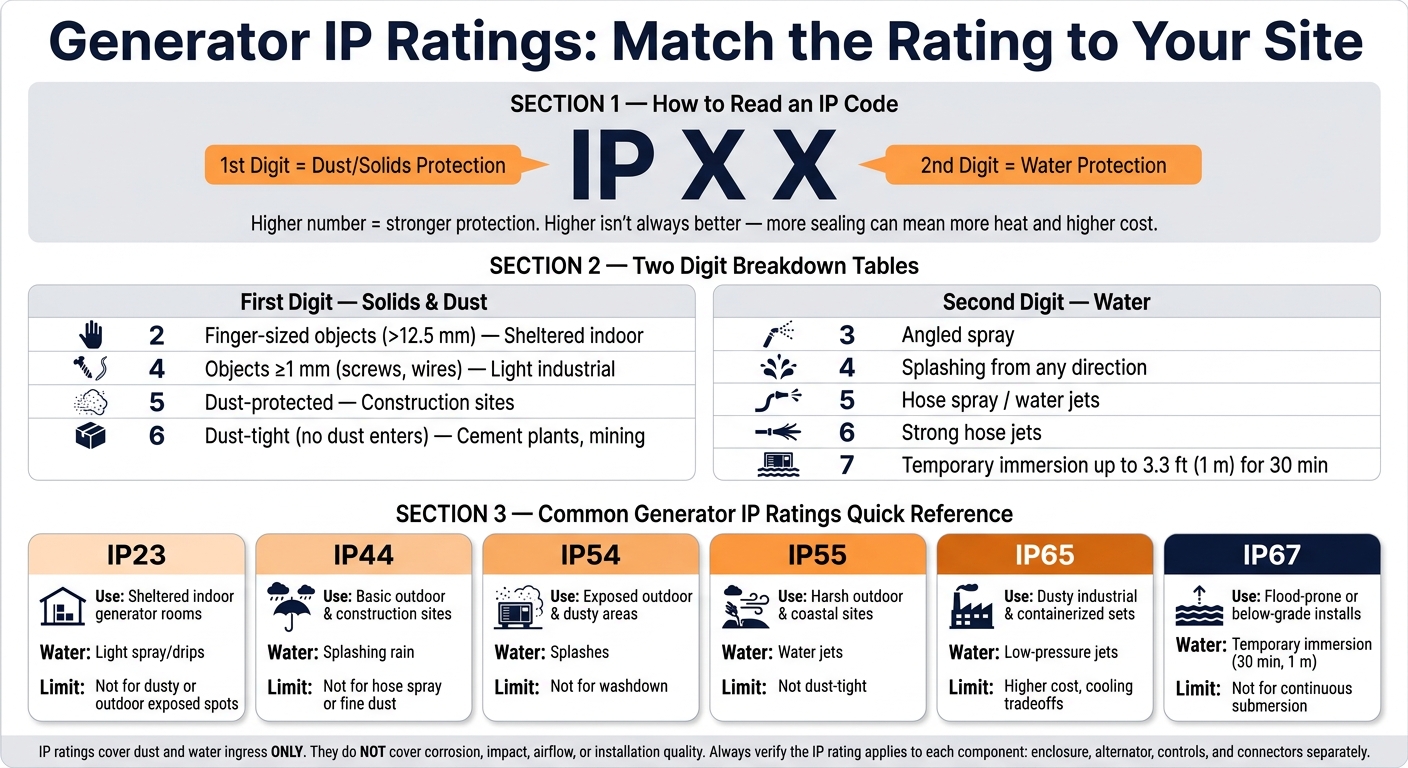
Generator IP Ratings Explained: Dust & Water Protection at a Glance
What is Ingress Protection - IP Protection in electrical!
sbb-itb-501186b
How to Read a Generator IP Code
An IP code uses two digits. The first shows protection against solids and dust. The second shows protection against water. So if you see IP54 on a spec sheet, that means dust rating 5 and water rating 4.
Simple rule: first digit = dust, second digit = water.
First Digit: Solids and Dust Protection Levels
For generator buyers, the main concern is pretty practical: can dust get into the enclosure, terminals, or cooling openings?
| First Digit | Protection Level | What It Blocks | Common Use |
|---|---|---|---|
| 2 | Finger-sized objects (>12.5 mm) | Fingers, large tools | Sheltered indoor use |
| 4 | Objects 1 mm and larger | Small wires, screws, coarse particles | Light industrial or commercial indoor environments |
| 5 | Dust-protected | Limits dust ingress so it can't interfere with operation | Construction sites, fabrication shops, busy warehouses |
| 6 | Dust-tight | No dust enters at all | Cement plants, bulk material handling facilities, mining operations |
Once you’ve got the dust side down, the second digit tells you how the enclosure deals with rain, spray, and wash-down.
Second Digit: Water Protection Levels
For generators, water protection matters most on sites where rain, spray, hose cleaning, or flood exposure is part of the job.
- 3 - Protected against angled spray.
- 4 - Protected against splashing water from any direction.
- 5 - Protected against hose spray.
- 6 - Protected against strong hose jets.
- 7 - IP67 covers temporary immersion, usually up to about 3.3 ft (1 m) for 30 minutes.
One detail trips people up: higher water numbers don't automatically include every lower-level test. Each digit comes from a separate test.
That’s the framework for comparing ratings like IP21, IP44, IP55, and higher in day-to-day generator use. The next step is turning those digits into the IP ratings you’ll see most often on generator spec sheets.
What Common Generator IP Ratings Mean in Practice
Here’s what the most common generator IP ratings look like on actual sites.
IP21 to IP23: Sheltered Indoor or Light-Exposure Use
You’ll usually see these ratings on open-type generators and standard alternators set up in clean, sheltered generator rooms. IP21 protects against straight-down drips from condensation or overhead leaks. IP22 covers drips at a slight angle, up to 15°. IP23 goes a step further with limited spray protection up to 60° from vertical, which is enough for light splashing but not sideways rain or hose spray.
On the ground, IP21–IP23 makes the most sense when the room stays dry, gets cleaned on a routine basis, and is shielded from wind-driven rain or process dust. If sawdust, concrete dust, or other airborne debris can get to the unit, these ratings won’t keep that contamination from building up on windings and terminals. The upside is better airflow and cooling in clean, sheltered rooms.
IP44 to IP55: Job Sites and General Outdoor Use
IP44 is a common starting point for outdoor generator use. It protects against objects larger than 1 mm and against splashing water from any direction. That means it can deal with normal rain, light spray, and incidental splashes on a construction site or at a temporary outdoor event. It works well as a baseline, but it isn’t meant for blowing dust or hose-down cleaning.
IP54 and IP55 show up a lot in more exposed outdoor and industrial setups. IP54 adds limited dust protection. IP55 adds resistance to hose jets, which helps with sideways rain and light rinse-downs. For permanent outdoor backup generators in storm-prone climates, IP55 is often the better long-term pick over IP44. This middle range fits most exposed sites. After that, it’s about matching the rating to the exact conditions on site.
IP65 to IP67: Dust, Hose-Down, and Flood-Risk Environments
All three of these ratings are dust-tight. What changes is the level of water protection.
| Rating | Water Protection | Typical Site |
|---|---|---|
| IP65 | Low-pressure water jets | Quarries, plant yards, and outdoor equipment that gets routine hose rinses |
| IP66 | Powerful water jets | Coastal sites, food processing areas, and heavy-industrial washdown zones |
| IP67 | Temporary immersion up to about 3.3 ft (1 m) for 30 minutes | Low-lying vaults, flood-prone yards, and below-grade junction boxes |
IP67 is tested in a different way than IP65 and IP66. IP65 and IP66 are meant for water hitting the enclosure from the outside. IP67 is meant for temporary immersion. That’s why it matters when flash flooding or pooled water can surround a ground-level component. Use IP67 for below-grade parts or in flood-prone spots where temporary immersion is the main risk. From there, the decision comes down to the kind of exposure the site actually has: dust, hose-downs, or immersion risk.
How to Choose the Right IP Rating for Your Site
Use the first digit to gauge dust exposure and the second digit to gauge water exposure. Then line up those two risks with the place where the unit will actually be installed.
Matching IP Ratings to Job Sites, Plants, and Backup Installations
Pick the rating based on site exposure, not the biggest number on the page.
For dry, sheltered indoor rooms, IP21–IP23 is often enough. If there’s nearby dust or the chance of light splash, step up to IP44.
Construction and mobile sites are rougher. They often deal with dust, rain, and washdown. In those cases:
- Use IP44 for light rain and loose debris
- Use IP54 for fine dust
- Use IP55 when routine hose spray is part of the site
For most outdoor standby setups, IP54/IP55 is the usual fit. Save IP65/IP66 for washdown zones, salt spray, or severe storm exposure.
Balancing Protection, Cooling, and Cost
A higher rating helps only if the site calls for it. More sealing usually means more cost and more cooling work.
An IP23 enclosure uses open louvers and simpler airflow. A dust-tight IP65 design needs more controlled ventilation paths and engineered ducting. That shift from an open-set or IP23 unit to a fully sealed IP65 package can push up both purchase and install cost in a meaningful way. It can also add labor for sealed conduits, cable glands, and any engineered ventilation needed on-site.
In many cases, IP54 or IP55 is the sweet spot. You get solid protection without making maintenance harder than it needs to be or driving costs too far up.
Reading Spec Sheets and Listings Carefully
Once you’ve picked the rating, check what part of the generator it actually covers.
On Electrical Trader, review the datasheet and drawing to see which component carries the IP rating. The alternator, control panel, enclosure, and connectors can all have different ratings within the same package. Ask for the IP rating to be listed separately for each one: enclosure, alternator, controls, and connectors.
Also check that the installation keeps that rating intact. An IP55 generator with unsealed cable entries or badly routed conduit penetrations won’t deliver IP55-level protection in the field.
Common Generator IP Ratings at a Glance
Use this table as a fast side-by-side reference. It works best after you understand how the IP code breaks down.
| Rating | Dust Protection | Water Protection | Common Generator Use | Main Limitation |
|---|---|---|---|---|
| IP23 | Limited solid-object protection | Light spray only | Canopy-covered standby units | Not suited for fully exposed rain or dusty job sites |
| IP44 | Small solids | Splash protection for general outdoor use | Construction-site gensets and general outdoor backup | Weak against heavy dust or water jets |
| IP54 | Dust-protected | Splash-resistant | Exposed outdoor installations and silent canopy units | Not meant for hose-down or very wet environments |
| IP55 | Dust-protected | Jet-resistant | Harsh outdoor sites, including coastal or dusty installs | Still not dust-tight or immersion-rated |
| IP65 | Dust-tight | Jet-resistant | Very dusty industrial sites and containerized generator sets | Usually higher cost, with enclosure and cooling tradeoffs |
| IP67 | Dust-tight | Temporary immersion | Flood-prone or extreme outdoor backup applications | For temporary immersion, not continuous underwater use |
The key is simple: match the rating to the conditions the generator will actually face. Think dust, rain, washdown, or temporary immersion. Don't just chase the highest number on the chart.
One more thing matters here. IP ratings only cover dust and water ingress. They do not tell you about corrosion resistance, impact strength, cooling, airflow, maintenance access, or installation quality. And the rating only applies when the unit is installed the right way.
Conclusion: Match the IP Rating to the Actual Installation Environment
An IP rating gives you a fast way to compare how well a generator enclosure stands up to dust and water.
Once you understand the code, pick the rating that fits the site, not the biggest number on the spec sheet. In most cases, IP23 works for sheltered installations, IP44 to IP55 covers many outdoor and job-site setups, and IP65 to IP67 makes sense for heavy dust, washdown, or flood-risk locations.
The smart move is to choose the lowest IP rating that still fits the site. A higher rating can limit airflow, push up cooling needs, and add cost without giving you better performance when the setting doesn’t call for it. Before you buy, write down the site’s dust, rain, cleaning, and flood exposure. Then check the full spec sheet, including the enclosure, cooling system, and cable-entry details.
Use the IP code as a matching tool. Pair the generator with the site’s dust, water, and installation conditions, and the enclosure can do its job without extra cost.
FAQs
How do I know which generator part the IP rating applies to?
The IP rating usually applies to the generator’s full enclosure. But that’s only part of the picture.
You also need to check every entry point, including cable glands, plugs, and connectors, to make sure each one meets the same IP standard.
If even one part falls short, it can weaken protection across the whole system. That’s why it’s smart to confirm this in the manufacturer’s certified test documentation - not just in marketing copy.
Is IP55 enough for year-round outdoor generator use?
An IP55 rating protects against dust and low-pressure water jets. That sounds decent on paper, but for year-round outdoor use in heavy rain, snow, or rough weather, it’s usually not enough.
It can work in some industrial spaces or covered outdoor areas where the equipment has some shelter. But if the installation will face the elements day in and day out, you’ll often need stronger weatherproofing.
The big thing is the setting. A unit under an awning in a mild climate faces a very different test than one exposed to driving rain, ice, or windblown debris. Looking at the actual environment helps lower the risk of equipment failure and supports safety code compliance.
Can installation mistakes void a generator’s IP rating?
Yes. Improper installation can void a generator’s IP rating if it breaks the enclosure seal.
Common mistakes include:
- Drilling extra holes
- Using the wrong cable glands or blanking plugs
- Leaving entries open
- Closing the enclosure with damaged gaskets or missing bolts
To keep the certified rating in place, follow the manufacturer’s instructions and use the listed accessories.