How to Protect Electrical Materials from Moisture
Moisture is one of the biggest threats to electrical systems. It can cause corrosion, reduce insulation resistance, and even lead to catastrophic failures like short circuits or flashovers. Whether you're dealing with coastal humidity, industrial washdowns, or daily temperature swings, protecting electrical materials from moisture is critical for longevity and performance.
Here’s how to protect your electrical systems:
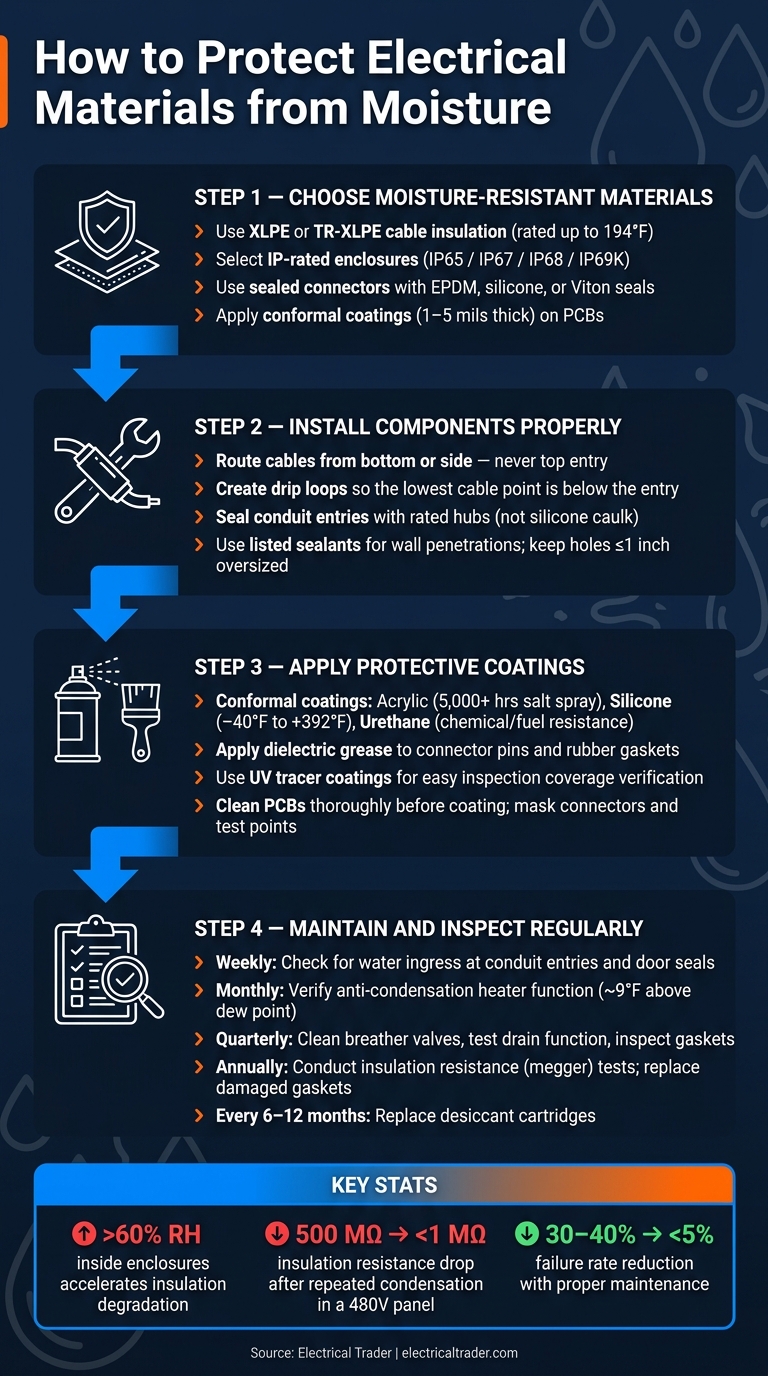
- Choose moisture-resistant materials: Use cables with water-blocking features (like XLPE insulation), sealed connectors, and IP-rated enclosures.
- Install components properly: Route cables with drip loops, seal conduit entries, and avoid top-entry cable installations.
- Apply protective coatings: Use conformal coatings on PCBs or dielectric grease for connectors to create an extra barrier.
- Maintain and inspect regularly: Test insulation resistance, clean breather valves, and replace worn gaskets to prevent small issues from escalating.
Key insight: Even moderate humidity (above 60%) can degrade insulation and lead to failures. Regular inspections and smart installation practices can drastically reduce risks and extend the life of your electrical systems.
For a detailed guide on materials, techniques, and maintenance schedules, keep reading.
How to Protect Electrical Materials from Moisture: 4-Step Guide
How Moisture Damages Electrical Materials
Common Ways Moisture Causes Damage
Moisture can wreak havoc on electrical systems through water ingress, condensation, and humidity-induced corrosion. The simplest form of damage happens when water physically enters an enclosure due to a broken seal or a poorly protected cable entry.
Condensation, however, is a major offender. When warm, humid air encounters a surface cooler than its dew point, water droplets form on internal components like busbars, terminal blocks, and PCBs. Mia Chen, a Mechanical Engineer at Top Cabinet, explains:
"Condensation forms inside electrical enclosures when warm, humid air contacts a surface cooler than its dew point - and it does not need a flood or a failed seal to cause damage."
Even a nightly temperature drop of 10–15°C (18–27°F) can trigger condensation. Over time, repeated cycles of this process can severely impact performance. For instance, a 480V control panel that initially tests at 500 MΩ when dry can drop to under 1 MΩ after repeated condensation cycles, leading to ground faults and system trips.
Humidity also speeds up corrosion and insulation breakdown, often causing damage before visible water is even present. Engineers generally consider 60% relative humidity inside an enclosure as the point where degradation starts to accelerate. At 92% relative humidity, capillary action can draw moisture into microscopic gaps in winding layers and insulation. Once inside, removing this trapped moisture becomes a significant challenge.
These issues highlight the importance of using materials designed to resist moisture damage.
Materials and Components Most at Risk
Certain components are particularly vulnerable to moisture-related damage. Here's a breakdown of the most at-risk materials and why they’re susceptible:
| Component | Primary Damage Mechanism | Why It's Vulnerable |
|---|---|---|
| PCBs | Conductive bridging, dendrite growth, Conductive Anodic Filament (CAF) | Tight track spacing allows moisture to cause short circuits |
| Terminal Blocks | Galvanic corrosion | Moisture accelerates oxidation between dissimilar metals |
| Cable Insulation | Resistance degradation | Absorbed moisture increases conductivity, leading to leakage currents |
| Generator Rotors | Capillary water storage | Winding components trap water in microscopic gaps |
| Carbon Steel Enclosures | Surface pitting | Rust forms quickly in humid conditions without protective coatings |
Copper conductors are also highly prone to corrosion. When humidity reacts with their surface, it reduces conductivity at connections and solder joints. On PCBs, moisture combined with ionic contamination can lead to dendrite growth - tiny metallic structures that form between conductors, causing intermittent faults. Another failure mode, CAF, occurs when moisture infiltrates the fiberglass-resin layers in multilayer PCBs, leading to internal shorts.
Even enclosure gaskets, often made from materials like Neoprene or EPDM, can become a weak point. Over time, these gaskets may develop a "compression set", losing their ability to maintain a proper seal. This allows humid air to seep in with every temperature fluctuation.
Environments Where Moisture Is a Major Concern
The operating environment plays a huge role in determining the level of protection needed. Some environments pose unique moisture-related risks that demand tailored solutions. Here are a few examples:
| Environment | Primary Moisture Risk | Why It Requires Special Attention |
|---|---|---|
| Coastal/Offshore | Salt mist and high humidity | Salt accelerates metal corrosion and breaks down insulation |
| Food Processing Plants | High-pressure washdowns | Water jets can force moisture into enclosures during cleaning |
| Outdoor Power Plants | Large daily temperature swings | Thermal cycling drives condensation on internal components |
| Tropical Warehouses | Sustained RH above 80% | Persistent humidity degrades insulation and promotes corrosion |
| Ocean Freight Transit | "Container rain" and temperature cycling | Equipment absorbs moisture during shipping due to condensation cycles |
Coastal and marine environments are especially harsh. Salt-laden air not only causes rust but can also form conductive films on critical components like busbars, increasing the risk of flashovers. In food processing facilities, high-pressure cleaning systems can push water past seals and cable openings. Outdoor substations face a "breathing effect", where enclosures expand and contract with temperature changes, pulling in humid air if seals are not perfect.
sbb-itb-501186b
How to Waterproof Electrical Connections - 3 Ways
Selecting Moisture-Resistant Materials and Components
Choosing materials and components designed to resist moisture is essential for avoiding damage in challenging environments.
Moisture-Resistant Cables and Insulation
Cross-linked polyethylene (XLPE) is a standout choice for insulation in high-humidity settings. Compared to standard PVC, XLPE can handle higher temperatures (up to 194°F) and resists water absorption. Its ability to remain stable under heat makes it ideal for outdoor substations and industrial areas with frequent temperature swings.
For 15 kV lines, Tree Retardant XLPE (TR-XLPE) is engineered to combat moisture-induced treeing. High-quality cables also feature non-wicking fillers and water-blocking tapes that swell to seal the cable core. In environments where moisture and mechanical stress intersect, cables with Aluminum Interlocked Armor (AIA) or Steel Wire Armour (SWA) offer extra protection by preventing jacket damage that could let water in. Always check for a wet-location rating, such as XHHW-2, to ensure compatibility with the intended environment.
To complement these cables, it's equally critical to use connectors and enclosures with robust sealing mechanisms.
Sealed Connectors and Enclosures
No matter how moisture-resistant the cables are, their performance can falter if paired with poorly sealed connectors or enclosures. Look for connectors with IP ratings suited to the environment and pair them with seals made from EPDM, silicone, or Viton, depending on exposure conditions:
| IP Rating | Protection Level | Typical Use Case |
|---|---|---|
| IP65 | Low-pressure water jets | Outdoor enclosures, general industrial |
| IP67 | Immersion up to 3 ft (approximately 1 m) for 30 min | Solar farms, outdoor robotics |
| IP68 | Continuous submersion | Marine settings, EV battery packs |
| IP69K | High-pressure, high-temperature spray | Food processing washdown |
EPDM and silicone seals work well outdoors, while Viton (FKM) is better for environments with fuels or chemicals. Additionally, sealed cable glands must fit the cable jacket diameter perfectly to preserve the enclosure's protection level.
For enclosures, pressure-equalizing vents with a Gore-Tex membrane are a smart addition. These vents balance pressure as temperatures fluctuate, keeping moisture out without compromising the seal.
"The weakest seal point determines your actual IP rating, not the component with the highest spec."
Investing in power distribution equipment with features like IP66-rated dual-lip silicone seals can increase costs by just 8–12% but may extend the lifespan of electrical connections by up to ten times.
Protective Coatings for Electronics
Protective coatings provide another critical layer of defense for electronics, especially when primary seals aren't enough. Conformal coatings, applied as thin films (1 to 5 mils or 25 to 250 µm thick), shield PCBs and other components from moisture, dust, and contaminants.
The type of coating depends on environmental demands:
- Acrylic coatings offer reliable moisture protection and can endure over 5,000 hours of salt spray testing.
- Silicone coatings are suited for extreme temperatures (−40°F to +392°F) and high-vibration settings, making them ideal for automotive and outdoor uses.
- Urethane coatings resist chemicals and fuel vapors, commonly used in aerospace and military applications.
Before applying coatings, clean PCBs thoroughly to ensure proper adhesion and prevent corrosion. Mask off components like connectors and test points that need to maintain electrical conductivity. Many conformal coatings include a UV tracer, which fluoresces under ultraviolet light, making it easy to spot any missed areas during inspection.
For simpler field applications, dielectric grease can be applied to connector pins and terminals as a quick, reapplicable moisture barrier.
For access to high-quality moisture-resistant components - ranging from cables to protective coatings - Electrical Trader offers a comprehensive marketplace tailored to electrical materials.
Installation Practices That Reduce Moisture Exposure
Even the most moisture-resistant materials can fail if they're not installed with care. The way you route cables, seal connections, and close off wall penetrations plays a critical role - just as important as the materials you select.
Cable Routing and Positioning
Cables should ideally be routed from the bottom. Side entry is acceptable, but avoid top entry to prevent water from seeping in.
Create a drip loop by ensuring the lowest point of the cable is below its entry point. This allows water to naturally drain off instead of pooling.
"There is no way to block moisture from a conduit system. The conduit system has to be designed with provisions to harmlessly expel the moisture." - Cable Tray Institute
Using cable tray systems can help reduce the "breathing" effect seen with conduits, where moisture gets pulled in. These systems also require less maintenance over time.
For raceways passing through areas with varying temperatures, sealing is essential. Warm, moist air can move toward colder sections, leading to condensation. The 2026 NEC now allows the use of listed fittings, like thermal break couplings, as an alternative to traditional sealants for controlling this movement.
"Traditionally, sealants were required to prevent warm air from entering colder parts of the raceway. Now, a new provision permits the use of listed fittings designed to prevent warm-air movement and condensation." - Ryan Jackson, NEC Instructor and Consultant
Additionally, make sure all conduit entries and wall penetrations are properly sealed to limit moisture exposure.
Sealing Connections and Wall Penetrations
For conduit entries, always use rated conduit hubs instead of relying on silicone caulk. Pack the sealant from inside the panel so that external water pressure reinforces the seal.
When sealing wall penetrations, use caulk or spray foam around wiring that passes through studs, top plates, or bottom plates. However, it’s crucial to select sealants specifically listed for electrical raceway use. Generic expanding foam can degrade conductor insulation over time. Also, keep holes cleanly cut and limit their size to no more than 1 inch larger than the wiring.
- Seal unused knockouts with listed closure plugs.
- Apply a thin layer of dielectric grease to rubber gaskets on outdoor covers to prevent them from drying or cracking between inspections.
- When tightening enclosure covers, apply even pressure. Overtightening can warp the cover, creating gaps in the gasket, while under-tightening leaves corners unsealed.
Inspection and Maintenance to Keep Protection in Place
Even the best seals, coatings, and installation methods won't last forever. Over time, wear and tear can lead to small problems - a compressed gasket, a blocked weep hole, or a saturated desiccant pack - that may escalate into expensive failures if left unchecked. Regular inspections and a planned maintenance schedule are key to keeping moisture protection effective.
Routine Visual Inspections
Start by checking the most at-risk components. Gaskets on enclosure doors are a common area of concern. Materials like Neoprene and EPDM can develop a compression set, meaning they lose their shape and allow humid air to seep through, even if the door looks properly closed. Frequent use can weaken these gaskets over time.
Beyond gaskets, inspect metal parts such as terminal blocks, DIN rails, and busbar supports for signs of rust, pitting, or galvanic corrosion. Ensure cable glands fit snugly around cables - oversized glands can create an entry point for moisture. Check that weep holes (typically 1/4" in diameter) at the bottom of enclosures are clear and that breather-drain valves are free of blockages. If your system uses desiccant packs, look for color changes, which indicate the need for replacement.
Once visual inspections are complete, electrical testing can help uncover hidden problems related to moisture.
Electrical Testing and Diagnostics
Electrical testing goes beyond what the eye can see, helping to identify moisture-related issues early. Insulation resistance testing, also known as meggering, measures how well insulation is holding up against moisture damage. Regular testing can catch problems early, reducing the risk of unexpected failures. For environments with 70%–85% relative humidity, test insulation resistance every five years. For areas with higher humidity (above 85%), testing every two years is recommended.
For critical assets like transformers, Dielectric Frequency Response (DFR) testing can provide deeper insights, distinguishing moisture-related degradation from other aging factors.
Setting Up a Maintenance and Repair Schedule
Routine inspections and electrical tests lay the foundation for a proactive maintenance plan. The table below outlines key maintenance tasks and their recommended intervals:
| Frequency | Task | Target Components |
|---|---|---|
| Weekly | Check for water ingress after rain or cleaning | Conduit entries, door seals, gaskets |
| Monthly | Verify anti-condensation heater function and thermostat settings (~9°F above ambient dew point) | Anti-condensation heaters, hygrostats |
| Quarterly | Clean breather valves, test drain function, and inspect gaskets | Breather-drain valves, weep holes |
| Annually | Conduct insulation resistance tests and replace damaged gaskets | Enclosure doors, motor windings, transformers |
| Every 6–12 months | Replace desiccant cartridges | Sealed outdoor enclosures, PCB storage |
The cost of regular maintenance is small compared to the price of failure. For example, conditioning a 25 kW industrial heating bundle typically costs $500–$800, while moisture-related failures - including emergency repairs and downtime - can far exceed the asset's original value. According to Tempco Electric Heater Corporation, unconditioned heaters in moist environments can have failure rates of 30–40% in their first year, but with proper maintenance, this drops to below 5% over their lifetime.
"The damage is not always dramatic or immediate, which is why condensation failures are frequently misdiagnosed as component faults rather than environmental ones." - Mia Chen, Mechanical Engineer, TopCabinet
Make sure to update your maintenance schedule regularly. If you notice faster corrosion, environmental changes, or specific events like flooding or prolonged shutdowns, adjust your inspection and repair intervals accordingly.
Conclusion: Steps to Keep Electrical Materials Safe from Moisture
Keeping electrical materials safe from moisture boils down to three key actions: selecting the right components, ensuring proper installation, and staying on top of maintenance. For wet or corrosive environments, opt for enclosures rated NEMA 4X or IP66/IP67. Pair these with IP-rated cable glands that fit snugly to each cable’s outer diameter, and always route cables from the bottom or side, incorporating drip loops to divert water away from entering the enclosure. To combat condensation, maintain internal temperatures at least 9°F above the dew point using a low-wattage heater controlled by a thermostat. Together, these steps form a reliable shield against moisture damage.
Why is this so important? Because even moderate humidity levels - above 60% inside an enclosure - can accelerate corrosion and degrade insulation. Left unaddressed, condensation can reduce insulation resistance in a 480V control panel from 500 MΩ to less than 1 MΩ, which often leads to ground faults. Regular megger testing can catch this kind of deterioration early, saving you from costly emergency repairs or unplanned downtime.
By combining the right installation techniques with ongoing monitoring, you can prevent long-term damage. Starting with moisture-resistant components makes protection more manageable in the long run. For a wide range of electrical equipment, including transformers, breakers, and power distribution hardware designed for challenging environments - whether industrial, coastal, or outdoor - check out Electrical Trader.
Investing in smart design and consistent maintenance ensures your electrical systems remain dependable for years to come.
FAQs
How do I choose the right IP rating for my enclosure?
When picking an IP rating for your enclosure, it's crucial to align its protection level with the environment it will face.
- The first digit (ranging from 0 to 6) tells you how well it guards against solids like dust.
- The second digit (ranging from 0 to 9) indicates its resistance to liquids, such as water.
For most outdoor applications, an IP65 rating is typically sufficient. However, if the enclosure will endure harsher conditions, like heavy rain, you might need a rating of IP66 or higher.
It’s worth noting that IP ratings don’t cover everything. Factors like corrosion, freezing temperatures, and extreme heat aren’t addressed by these standards. If these conditions are part of your setup, make sure to account for them to ensure the enclosure's long-term performance.
What’s the easiest way to stop condensation inside a panel?
The best way to combat condensation is by using a thermostat-controlled enclosure heater. By maintaining the internal temperature 5–10°C above the ambient dew point, you can effectively prevent moisture from forming on components. Pair this with a properly sealed, NEMA-rated enclosure to minimize air infiltration and maintain a controlled environment.
For setups where heat isn't a primary option, desiccant breathers can help manage moisture levels. If you need more precise control, dehumidifiers are an excellent choice. Electrical Trader provides a variety of components to help implement these solutions effectively.
How can I tell if moisture is lowering insulation resistance?
Moisture impacts insulation resistance by allowing more leakage current to flow, which results in lower megohm readings. To identify moisture issues, diagnostic tests such as the polarization index (PI) or dielectric absorption ratio (DAR) are highly effective. For the most accurate insulation resistance tests, aim to perform them when relative humidity is between 50% and 65%. Additionally, tracking resistance trends over time can reveal early signs of insulation degradation.