How UV Exposure Affects Electrical Enclosures
UV exposure can weaken outdoor electrical enclosures, putting the systems they protect at risk. Here's what you need to know:
- UV Damage: Direct sunlight breaks down materials, causing discoloration, brittleness, cracking, and structural failure.
- Key Risks: Compromised enclosures allow water, dust, and heat to infiltrate, leading to short circuits, corrosion, and overheating.
- Best Materials: Polycarbonate and fiberglass are durable and UV-resistant, while ABS and PVC degrade faster without treatments.
- Solutions: Use UV-resistant materials, apply protective coatings, and position enclosures in shaded areas to minimize damage.
- Maintenance: Regular inspections can catch early signs of wear, extending the lifespan of enclosures.
How UV Radiation Damages Electrical Enclosures
How UV Damage Occurs
UV radiation carries enough energy to break down the molecular bonds in enclosure materials, leading to gradual deterioration. When UV rays hit the surface, they interact with chromophores, triggering the formation of free radicals. These free radicals then accelerate chemical degradation across the material.
This process starts with surface-level changes, like discoloration and yellowing. Over time, the material’s elasticity and strength diminish, leaving flexible plastics rigid and brittle - making them more prone to cracking.
The damage follows a clear progression. Early exposure results in cosmetic effects like color fading and bleaching. Extended exposure weakens the material’s flexibility and impact resistance. Eventually, cracks develop on the surface, creating entry points for moisture and contaminants. In extreme cases, non-stabilized plastics can undergo total structural failure, revealing internal fibers or collapsing entirely.
This microscopic deterioration sets the stage for larger structural issues, underscoring the importance of UV protection to preserve the enclosure’s durability.
Results of UV Damage
As UV exposure erodes the material’s stability, the consequences become apparent. Structural damage from UV radiation goes far beyond surface appearance. Cracks and fractures allow water, dust, and debris to infiltrate the enclosure, jeopardizing the electrical components inside. This can lead to internal corrosion, short circuits, and even complete system breakdowns.
The safety risks are just as concerning. As the enclosure material becomes brittle and compromised, it loses its ability to insulate, potentially exposing live electrical components. This creates serious hazards, including electric shocks and fire risks. Additionally, solar radiation can raise the enclosure’s internal temperature - often reaching about 18°F higher than the surrounding ambient temperature. This heat buildup can lower the current-carrying capacity of electrical equipment and speed up its failure.
Accelerated weathering tests highlight these risks. Simulating 25 years of solar exposure (3,000 to 5,000 hours under xenon arc lamps), non-stabilized materials showed significant structural weakening. Prysmian notes:
"The reduction in mechanical properties that result from this aging are likely to lead to premature failure of the sheath, often seen in the form of cracking in extreme cases".
Clash of the Enclosures: Fibox Polycarbonate vs. Stainless Steel (UV Resistance)
Material Comparison: UV Damage Resistance
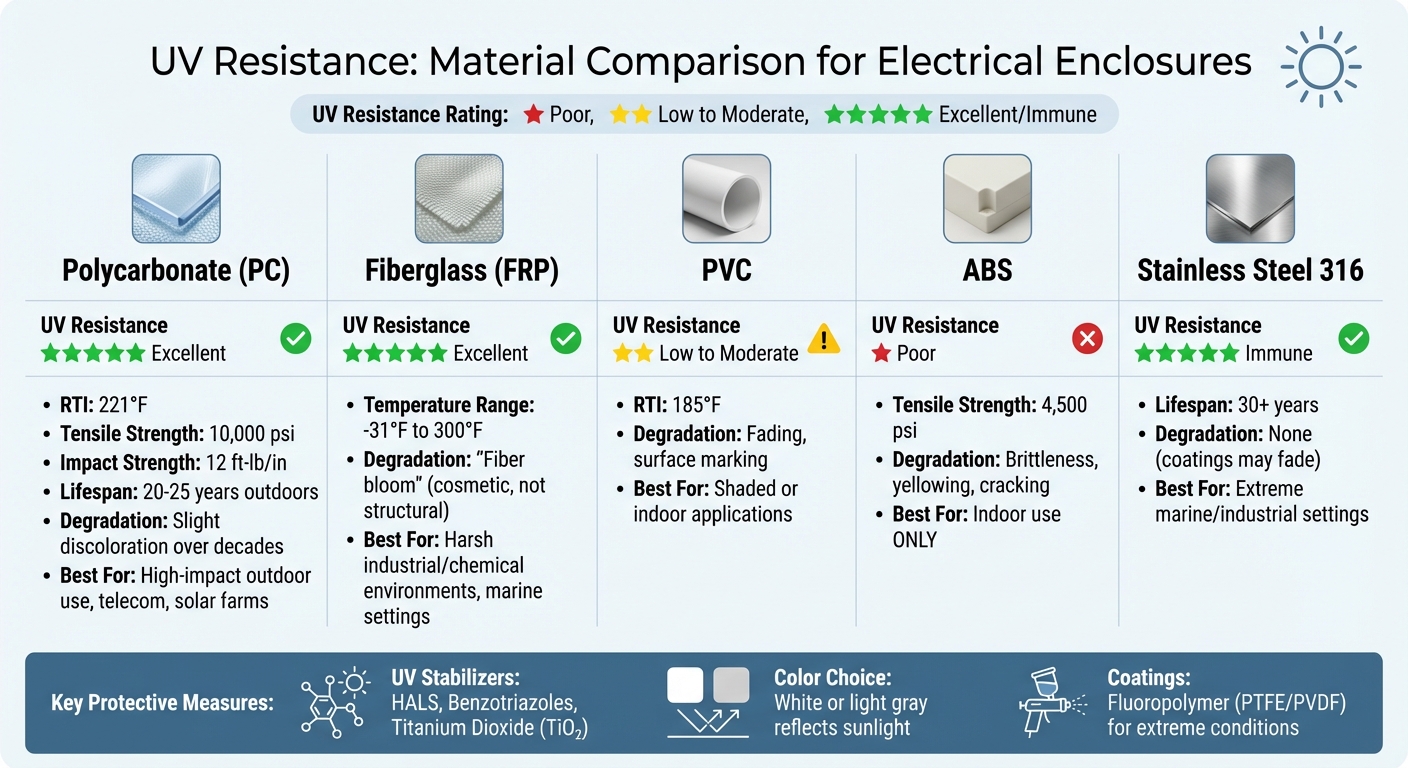
UV Resistance Comparison of Electrical Enclosure Materials
UV Resistance by Material Type
The ability of enclosure materials to withstand UV damage varies significantly. Polycarbonate (PC) and Fiberglass Reinforced Polyester (FRP) stand out for their durability, thanks to UV inhibitors that stabilize their molecular structure. Polycarbonate, for example, complies with UL 746C f1 standards and has a Relative Thermal Index (RTI) of 221°F. In tests simulating 25 years of sunlight exposure (5,000 hours under xenon arc lamps), polycarbonate not only held up but actually improved in tensile strength, increasing from 2,290 N to 2,381.6 N.
On the other hand, ABS (Acrylonitrile Butadiene Styrene) struggles under UV exposure. Without built-in UV resistance, ABS quickly yellows, becomes brittle, and cracks when exposed to sunlight. As Integra Enclosures notes:
"ABS is not UV resistant and will quickly discolor and degrade in the sunlight".
With a tensile strength of only 4,500 psi - compared to polycarbonate's 10,000 psi - ABS is better suited for indoor environments.
PVC (Polyvinyl Chloride) offers moderate resistance to UV damage, with an RTI of 185°F, making it a decent choice for shaded or indoor use. Meanwhile, Fiberglass (FRP) excels in demanding industrial settings, performing well across a temperature range of -31°F to 300°F. However, prolonged exposure can lead to surface wear known as "fiber bloom", where glass fibers become visible. Shauna Adams from NEMA Supply highlights its strengths:
"Choose fiberglass when you need chemical durability, thermal stability, and UV toughness for outdoor or corrosive environments".
A real-world study conducted by Fibox compared two enclosures under identical conditions. A GRP (fiberglass) enclosure installed in 2016 showed significant surface deterioration and exposed glass fibers by 2024. In contrast, a Fibox EK polycarbonate enclosure remained intact after more than 25 years of exposure.
Material Comparison Table
Here’s a quick breakdown of UV resistance, common degradation issues, and ideal applications for each material:
| Material | UV Resistance | Primary Degradation Symptoms | Expected Suitability |
|---|---|---|---|
| Polycarbonate (PC) | Excellent | Slight discoloration over decades | Best for high-impact outdoor use |
| Fiberglass (FRP) | Excellent | "Fiber bloom" (exposed glass fibers) | Best for harsh industrial/chemical |
| ABS | Poor | Brittleness, yellowing, cracking | Indoor use only |
| PVC | Low to Moderate | Fading, surface marking | Shaded or indoor applications |
| Stainless Steel | Immune | None (coatings may fade) | Extreme marine/industrial settings |
To further enhance UV protection, consider specifying additives like Hindered Amine Light Stabilizers (HALS), Benzotriazoles, or Titanium Dioxide (TiO₂), which help absorb or reflect harmful UV rays. Additionally, selecting light-colored enclosures, such as white or light gray, can reduce heat absorption and slow degradation.
Choosing the right material is key to ensuring long-term performance. The next section will delve into protective coatings and treatments that offer additional layers of UV defense.
sbb-itb-501186b
Solutions: UV-Resistant Materials and Protective Coatings
Materials Built for UV Resistance
When it comes to materials that can handle prolonged exposure to UV light, polycarbonate and fiberglass are standout options. Polycarbonate, particularly the UL 746C f1 certified variety, is built to endure outdoor conditions, resisting both UV radiation and water damage. It’s designed to last 20–25 years in direct sunlight and boasts an impressive 12 ft-lb/in impact strength. This makes it a go-to choice for demanding applications like telecom infrastructure and solar farms. These characteristics also make polycarbonate an excellent candidate for pairing with protective coatings to further combat UV wear.
Fiberglass (FRP) is another material that naturally holds up well under UV exposure. According to Allied Moulded Products Inc:
"Fiberglass is a common nonmetal material for outdoor applications because it is already UV-resistant. While fiberglass is prone to bleaching in the sun, that amounts to discoloration rather than a loss of structural integrity".
This resilience makes FRP ideal for tough industrial environments, such as chemical processing facilities and marine settings.
On the other hand, stainless steel and aluminum provide excellent structural strength but often rely on protective coatings to minimize heat absorption and shield against surface degradation in high-UV areas.
Protective Coatings and Treatments
Protective coatings play a crucial role in shielding materials from UV damage. These coatings work by absorbing or reflecting UV rays before they can harm the underlying material. Additives like HALS (Hindered Amine Light Stabilizers) and benzotriazoles are especially effective, as they neutralize UV-induced free radicals, reducing the molecular breakdown that can lead to cracking and brittleness.
Opaque pigments, such as Carbon Black and Titanium Dioxide (TiO₂), are also highly effective at blocking UV rays. Opting for light-colored enclosures - like white or light gray - can further slow degradation by reflecting more sunlight and absorbing less heat. For extreme conditions, fluoropolymer coatings like PTFE or PVDF provide exceptional UV resistance and durability.
When using polycarbonate components with a one-sided protective coating, it’s essential to position the treated side toward the sun to prevent issues like premature yellowing. Additionally, physical barriers such as sunshields or overhangs can provide extra protection, significantly extending the lifespan of electrical enclosures exposed to harsh sunlight.
Installation and Maintenance for UV Protection
Installation Location and Positioning
To guard enclosures against UV damage, it's best to keep them out of direct sunlight. Placing them under opaque shades, weatherproof canopies, or building overhangs provides complete protection from UV exposure.
If shading isn’t an option, positioning becomes crucial. Mounting enclosures on the north side can significantly reduce direct sunlight exposure. For setups that must face the sun, a door-over-door design can provide an extra shield for sensitive components like transfer switches. To further minimize UV impact in these cases, consider applying opaque paints, resins, or polycarbonate films to the top surfaces.
Additionally, choose locations that allow natural airflow to help dissipate heat and manage local temperature extremes. This prevents overheating, which can add stress to the enclosure. Opting for light-colored enclosures can also slow down UV-related wear and tear, as they reflect more sunlight and absorb less heat.
While proper positioning reduces UV exposure, regular inspections are key to ensuring long-term protection.
Maintenance Schedules and Inspections
Routine inspections are essential for catching UV damage early and prolonging the life of outdoor electrical enclosures. For carbon steel enclosures, a full recoating every 5–10 years is necessary to maintain their protective layer. Once the coating deteriorates, corrosion can set in quickly, accounting for about 15–20% of maintenance issues in harsh environments.
Different materials show distinct signs of UV damage. Fiberglass often displays cosmetic bleaching before structural problems arise. Polycarbonate enclosures, on the other hand, may develop "crazing" (fine surface cracks) or yellowing, signaling that UV exposure is weakening the material. If polycarbonate becomes brittle, it’s critical to replace it to maintain protection against water and dust.
Even materials known for their durability - like stainless steel 316, aluminum, and fiberglass - benefit from occasional inspections. For instance, high-quality stainless steel 316 enclosures can last over 30 years, whereas carbon steel enclosures typically last only 10–15 years in similar conditions.
Conclusion
UV exposure is a serious concern for electrical enclosures, as it triggers photodegradation that weakens materials and compromises their structural integrity. When enclosures fail, internal components are left vulnerable to moisture and contaminants, which can result in short circuits, corrosion, or even complete system failures. This makes careful material selection and design choices critical to preventing costly issues like system breakdowns, electric shocks, or fires caused by deteriorated insulation.
The foundation of long-term protection lies in choosing the right materials. Fiberglass and UV-stabilized polycarbonate are excellent options for outdoor durability. On the other hand, standard ABS or PVC should be avoided unless they’ve been specifically UV-treated. If standard materials are used, applying protective coatings or opaque paints can help block UV radiation. Additionally, opting for white or light gray enclosures can reflect sunlight, reducing heat absorption and slowing thermal degradation.
"UV protection in electrical materials is a critical factor to ensure their durability and performance in outdoor applications." – Solera
Beyond material and coating considerations, proper installation and regular maintenance play vital roles in protecting enclosures. Positioning enclosures under overhangs or on shaded sides of structures can significantly reduce direct UV exposure. Routine inspections are equally important for spotting early signs of damage, such as chalking, yellowing, or surface cracks. For carbon steel enclosures, recoating every 5–10 years helps maintain their protective layer and prevents rapid deterioration. These practices complement the use of durable materials and protective treatments.
Investing in UV protection pays off in the long run. For example, stainless steel 316 enclosures can last over 30 years with minimal upkeep, while poorly protected carbon steel enclosures may fail within 10–15 years. By combining the right materials, coatings, and maintenance strategies, you can significantly extend the lifespan of electrical enclosures and ensure their reliability over time.
FAQs
What materials are best for outdoor electrical enclosures exposed to UV radiation?
For outdoor electrical enclosures, fiberglass and UV-stabilized polycarbonate stand out as top choices. Fiberglass naturally holds up against UV damage, retaining its strength and shape even after years of sun exposure, though it might experience some fading over time. UV-stabilized polycarbonate, enhanced with special additives or pigments, is another sturdy option that resists cracking and discoloration, making it perfect for extended outdoor use.
If you need other polymers, selecting materials with UV stabilizers - like carbon-black pigments or UV-absorbing additives - can greatly enhance durability by minimizing brittleness and fading. For transparent enclosures, acrylic is a solid option thanks to its natural UV resistance, although it doesn’t offer the same level of impact resistance as polycarbonate.
When choosing an enclosure, make sure it meets the necessary NEMA or IP rating for your specific project. For a variety of UV-rated enclosures, check out Electrical Trader, which provides both new and used options designed for U.S. applications.
How does UV exposure impact electrical enclosures, and how can I protect them?
UV exposure can gradually degrade electrical enclosures, leading to discoloration, cracks, and weakened structural strength. To keep your enclosures in good condition and extend their lifespan, here are some practical tips:
- Opt for UV-resistant materials: Select enclosures made from fiberglass or UV-stabilized polycarbonate. These materials are specifically designed to handle prolonged exposure to sunlight without significant wear.
- Apply a protective coating: If your enclosure material isn’t naturally UV-resistant, use a UV-blocking paint or a clear protective coating to shield it from damage.
- Reduce direct sunlight: Place enclosures in shaded locations or install canopies to minimize direct sun exposure and prevent overheating.
- Perform routine inspections: Examine your enclosures at least twice a year for any signs of fading, cracking, or other damage. Reapply coatings or replace parts as necessary.
For reliable, UV-resistant enclosures and accessories, look to well-known suppliers like Electrical Trader. Taking these precautions can save you from costly repairs and ensure your enclosures remain dependable over time.
Why is regular maintenance crucial for outdoor electrical enclosures?
Regular upkeep is key to keeping outdoor electrical enclosures safe, long-lasting, and fully operational. UV exposure can take a toll on non-metallic materials, leading to discoloration, brittleness, and failing seals. When seals give out, moisture, dust, and corrosive elements can sneak in, putting equipment at risk of damage, short circuits, and expensive downtime.
By conducting routine inspections, you can catch early signs of wear - like fading, cracking, or seal issues - before they turn into bigger problems. Maintenance also ensures protective features, such as UV-resistant coatings or fiberglass reinforcements, continue to do their job. Swapping out worn parts like gaskets or hinges is much simpler when you have access to dependable components. Electrical Trader offers a broad range of new and used parts to make repairs hassle-free. Taking a proactive approach helps extend the life of your enclosures and keeps disruptions to a minimum.