

How to Choose Insulation for Voltage Equipment
Insulation is key to ensuring electrical systems operate safely and efficiently. Choosing the right insulation involves balancing voltage needs, thermal performance, and environmental factors. Here’s a quick breakdown to help you decide:
- Voltage Stress: High-voltage systems require materials with strong dielectric strength to prevent breakdown.
- Thermal Class: Match insulation to the system's operating temperature. Overheating can degrade materials quickly.
- Environmental Conditions: Moisture, UV exposure, and contaminants can weaken insulation. Use protective materials for harsh settings.
- Material Options: XLPE, EPR, PVC, silicone rubber, and mica each serve specific purposes based on cost, flexibility, and durability.
- Safety Standards: Ensure compliance with UL, OSHA, and IEEE certifications for long-term reliability.
Quick Comparison Table
| Material | Dielectric Strength | Max Temp (°C) | Cost | Applications |
|---|---|---|---|---|
| XLPE | High (≥30kV/mm) | 90–250 | Moderate | Power cables, MV/HV systems |
| PVC | Low to Moderate | 70–105 | Low | Low-voltage building wires |
| EPR | Moderate | 90–150 | High | Flexible cables, harsh conditions |
| Mica | Very High | 180–220+ | Moderate | Motors, fire-survival cables |
| Silicone Rubber | Good to High | 180–200+ | High | Outdoor, high-heat applications |
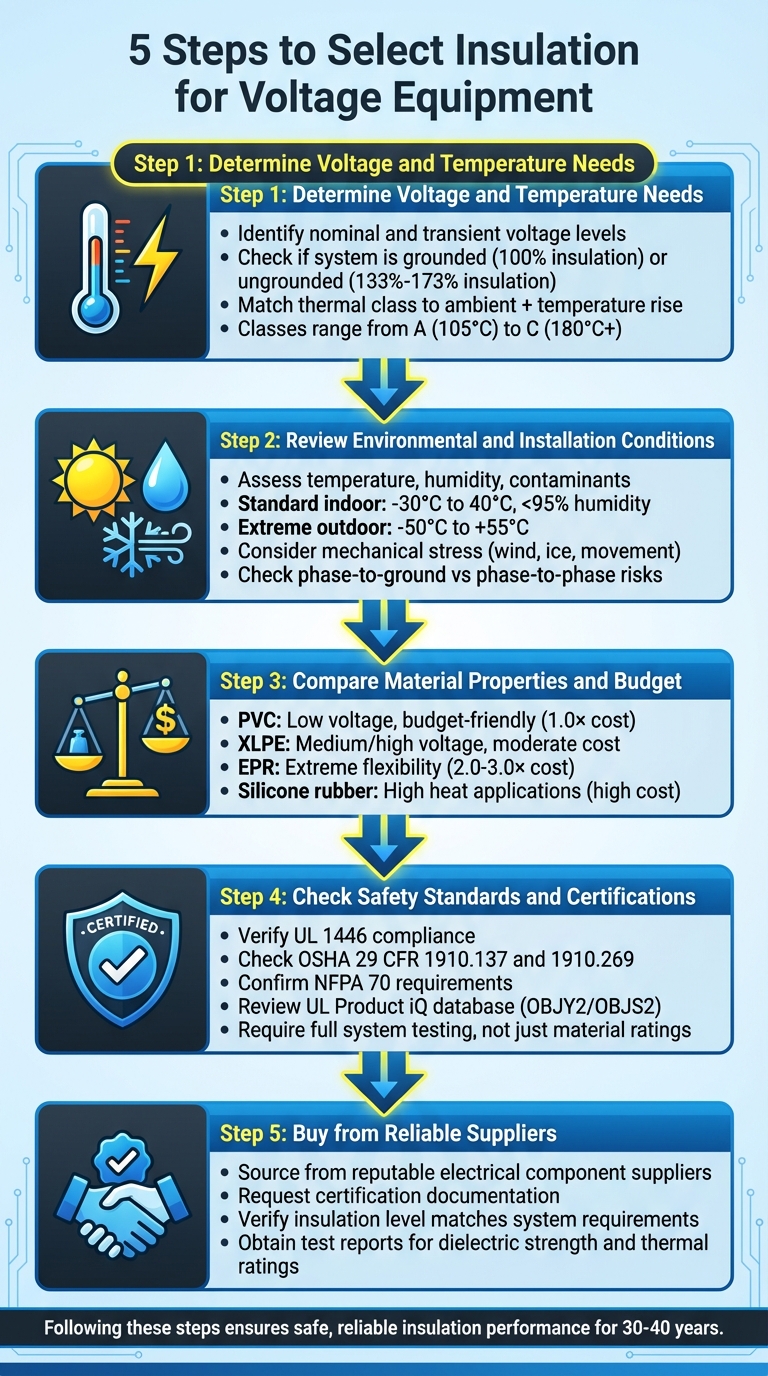
5-Step Process for Selecting Electrical Insulation for Voltage Equipment
Master Guide to Electrical Insulating Materials
Key Factors in Insulation Selection
Selecting the right insulation means carefully weighing factors like voltage stress, thermal limits, and exposure to environmental conditions. These elements directly influence the safety, reliability, and longevity of your equipment, ensuring it operates efficiently over time. Let’s break down the key considerations that guide this process.
Voltage Ratings and Dielectric Strength
Dielectric strength refers to the maximum voltage an insulating material can handle before breaking down, typically measured in volts per mil (0.001 inch). For low-voltage systems, insulation requirements are less demanding, but medium-voltage applications (2,001 V to 35,000 V) demand a much higher level of material precision and consistency.
In systems up to 2,000 V, insulation is often over-specified, so the exact material choice might not be critical. However, for medium-voltage systems, insulation homogeneity becomes a must. Air pockets or inconsistencies in the insulation can concentrate electric fields, leading to corona discharge or arcing - both of which can damage equipment.
The grounding configuration of your system also plays a role in determining the required insulation thickness. Below is a table summarizing insulation levels based on voltage ratings and grounding configurations:
| Voltage Rating (kV) | 100% Level (mils) | 133% Level (mils) | 173% Level (mils) |
|---|---|---|---|
| 5 | 90 | 115 | 140 |
| 8 | 115 | 140 | 175 |
| 15 | 175 | 220 | 260 |
| 25 | 260 | 320 | 420 |
| 35 | 345 | 420 | 580 |
It’s important to note that as insulation thickness increases, its dielectric strength tends to decrease because voltage breakdown behaves non-linearly. Additionally, layering different insulation materials without proper engineering can cause uneven electric field distribution due to mismatched dielectric constants. These principles are a critical part of Step 1 in selecting the right insulation.
Temperature and Thermal Class Requirements
Heat is one of the biggest challenges in electrical equipment design. To ensure insulation performs as expected over its lifespan, it’s essential to consider its thermal class. Thermal classes define the maximum temperature an insulator can handle while retaining its properties. The total thermal load combines the ambient temperature, expected temperature rise, and any hot spot allowance. While standards like NEMA and IEC use a 40°C ambient reference, real-world conditions can vary.
Thermal classes range from Class A (105°C) for basic needs to Class C (above 180°C) for extreme conditions. For example:
- Class B (130°C) is common in industrial motors and transformers.
- Class F (155°C) is used in automotive and high-efficiency systems.
- Class H (180°C) is reserved for aerospace or heavy-duty industrial applications.
Specifying a thermal class higher than necessary can lead to unnecessary costs and added weight, as materials for higher classes are generally more expensive. On the other hand, exceeding a material’s thermal rating can cause it to degrade faster. The Relative Thermal Index (RTI) provides a useful benchmark, indicating that a material retains 50% to 60% of its initial properties after 60,000 hours at its rated temperature. These thermal considerations are a vital part of Step 1 in insulation selection.
Environmental and Mechanical Stress
Environmental factors like moisture, contaminants, and UV exposure can significantly impact insulation performance. For instance, underground or oily environments can lead to leakage and degradation. In such cases, cables with protective nylon jackets, like THHN/THWN types, are often used to shield against oil or grease that might dissolve plasticizers.
The Edison Tech Center highlights the importance of insulation integrity:
"Insulator failure is a primary reason why electrical devices stop working."
Outdoor installations face additional challenges. UV exposure can make insulation brittle and prone to cracking, while coastal environments introduce salt spray, which accelerates wear. For harsh conditions, materials like Perfluoroalkoxy (PFA) are excellent choices, offering superior resistance and up to four times the dielectric strength of standard PTFE.
Mechanical stress is another critical consideration. Insulation must endure the wear and tear of installation while staying flexible through years of thermal expansion and contraction. Polymeric insulators are popular for transmission applications because they are lightweight, resistant to vandalism, and perform well in contaminated settings. However, it’s essential to balance flexibility and durability - materials that excel in one area might fall short in another. These environmental and mechanical factors are carefully assessed in Step 2 of the selection process.
Common Insulation Materials Compared
To help you make an informed choice, here's a detailed comparison of commonly used insulation materials, highlighting their strengths, limitations, and ideal applications.
Types of Insulation Materials
Cross-linked Polyethylene (XLPE) stands out for medium and high-voltage cables. With a dielectric strength of ≥30kV/mm, it allows for thinner insulation layers - just 0.7 mm for a 1.5 mm² conductor compared to 0.8 mm for PVC and 1.0 mm for EPR. XLPE can handle continuous temperatures of 90°C and short-circuit spikes up to 250°C, making it a solid choice for demanding environments.
Ethylene Propylene Rubber (EPR) is prized for its flexibility, making it ideal for mining cables, marine installations, and wind turbines. It performs well in extreme cold, maintaining its properties down to –50°C, unlike PVC, which becomes brittle at such temperatures. However, EPR requires thicker insulation layers than XLPE for similar voltage ratings and costs significantly more - about 2–3 times the price of PVC.
Polyvinyl Chloride (PVC) is a cost-effective option for low-voltage building wires (up to 1,000V) due to its flame-retardant properties. Its dielectric loss (Tan Delta) is higher, ranging from 0.05 to 0.10, compared to XLPE's 0.0004. While PVC performs well in wiring for residential and commercial spaces where temperatures stay below 105°C, it isn't suitable for high-voltage or extreme temperature applications.
Mica-based Materials excel in high-voltage and high-temperature settings. Known for their exceptional heat resistance and dielectric strength, mica-based insulation is commonly used in high-voltage motors, generators, and fire-survival cables. As Electrolock notes:
Mica remains a cornerstone of electrical insulation, particularly in high-voltage and high-temperature applications.
These materials can handle temperatures from 180°C to over 220°C, covering insulation classes H to R.
Silicone Rubber offers flexibility and excellent weather resistance, making it a preferred choice for outdoor insulators and high-heat wire applications. It performs reliably at Class H temperatures (around 180°C) and provides strong corona resistance for high-voltage systems. However, its higher cost compared to XLPE limits its use to specialized applications.
Sulfur Hexafluoride (SF6) Gas is valued for its high dielectric strength in gas-insulated switchgear, enabling compact equipment designs. While most applications use solid or rubber insulators, SF6 offers a space-saving alternative. However, it requires hermetic sealing and careful handling due to environmental and health concerns.
The table below provides a quick comparison of these materials' properties.
Material Properties Comparison Table
| Material | Dielectric Strength | Max Temp Range | Relative Cost | Typical Applications |
|---|---|---|---|---|
| XLPE | High (≥30kV/mm) | 90°C–250°C | Moderate | Power distribution cables, MV/HV installations, EV batteries |
| PVC | Low to Moderate | 70°C–105°C | Low (1.0× baseline) | Low-voltage building wires, residential/commercial wiring |
| EPR | Moderate | 90°C–150°C | High (2.0×–3.0×) | Mining cables, marine installations, flexible cords, wind turbines |
| Mica Tape | Very High | 180°C–220°C+ | Moderate to High | High-voltage motors, generators, fire-survival cables |
| Silicone Rubber | Good to High | 180°C–200°C+ | High | Outdoor insulators, high-heat wire, extreme temperature environments |
| SF6 Gas | Very High | N/A | High (system cost) | Gas-insulated switchgear, compact substations |
| Fiberglass | Good | High range | Moderate | Motor windings, structural insulation |
| Air | Low | N/A | Free | Open-air substations, overhead transmission lines |
When selecting insulation materials, keep in mind that copper or aluminum conductors can make up 70–80% of a cable's total cost. Opting for XLPE over PVC may allow for smaller conductor sizes due to its higher thermal ratings, potentially reducing overall project costs despite its slightly higher insulation expense.
sbb-itb-501186b
5 Steps to Select Insulation for Voltage Equipment
Using the factors discussed earlier, follow these five steps to choose the right insulation for your voltage equipment.
Step 1: Determine Voltage and Temperature Needs
Start by identifying your system's nominal and transient voltage levels. Medium-voltage setups often face much higher voltage stress.
Next, figure out whether your system is grounded or ungrounded. Grounded systems typically require 100% insulation levels, while ungrounded systems may need 133% or 173%, depending on how quickly faults are cleared.
Also, match the insulation to the correct thermal class. Combine your system's ambient operating temperature with the maximum expected temperature rise. If the total temperature nears the limit of an insulation class, opt for a higher-rated material to ensure reliability.
Step 2: Review Environmental and Installation Conditions
Once you’ve assessed voltage and thermal needs, evaluate the environment where your equipment will operate. Consider factors like temperature, humidity, contaminants, and mechanical stresses. For example, high temperatures can speed up gas breakdown and reduce flashover voltage, while lower atmospheric pressure at high altitudes increases the risk of electric arcs. Standard indoor conditions typically assume relative humidity below 95% and temperatures ranging from –30 °C to 40 °C. Outdoor or extreme conditions, however, may vary from –50 °C to +55 °C.
As Schneider Electric highlights:
Designing and specifying with environmental and operating conditions in mind can reduce maintenance needs. It also can extend the life of equipment.
Don’t forget to account for mechanical stresses like wind, ice accumulation, and conductor movement, which could affect minimum approach distances. Check whether your equipment is exposed to phase-to-ground or phase-to-phase risks, and choose insulation rated for the higher voltage.
Step 3: Compare Material Properties and Budget
With your electrical and environmental requirements in hand, compare insulation materials based on their properties and cost. For low-voltage wires under 1,000 V, PVC is a budget-friendly option with decent flame-retardant capabilities (at a baseline cost of 1.0×). For medium- and high-voltage applications, where thinner insulation and better thermal performance are needed, XLPE offers good value at a moderate price. Premium materials like EPR (which can cost 2.0–3.0× more) or silicone rubber should be reserved for situations requiring extra flexibility or resistance to extreme temperatures.
Step 4: Check Safety Standards and Certifications
Make sure the insulation materials you select comply with essential safety standards. Look for adherence to UL 1446, the main standard for insulation systems in motors, transformers, and solenoids. Keep in mind that simply using Class H materials doesn’t guarantee compliance - complete system testing is necessary. As Jimmy Walker from Electrical Specialties Group explains:
Each apparatus should be tested in a full UL and or IEEE system to truly confirm that the apparatus meets a specific classification; various UL systems are available from manufacturers of varnishes and flexible insulation.
For live-line work, ensure compliance with OSHA standards 29 CFR 1910.137 and 1910.269, which cover electrical protective equipment and power generation safety. You can also consult the UL Product iQ database to confirm whether your Electrical Insulation System is recognized under Category Control Numbers (OBJY2 or OBJS2). Additionally, verify that the insulation meets NFPA 70 requirements for your specific installation type.
Step 5: Buy from Reliable Suppliers
Finally, purchase insulation materials from reputable suppliers specializing in electrical components. For instance, Electrical Trader (https://electricaltrader.com) offers a wide range of new and used electrical equipment, including transformers, breakers, and voltage equipment, from trusted manufacturers. Their categorized listings and resource center can help you find products tailored to your voltage and temperature needs.
Before placing an order, confirm that the supplier provides documentation for safety certifications and ensures the insulation level (100%, 133%, or 173%) matches your system’s requirements. Request test reports that detail dielectric strength, thermal class ratings, and compliance with relevant UL or IEEE standards to ensure you’re making an informed purchase.
Insulation Recommendations by Application
Building on the essential steps for selecting insulation, here’s a breakdown of the best insulation choices for various applications.
Power Distribution and Transformers
For oil-immersed transformers, enamel-coated wire paired with kraft paper is the standard insulation choice. In environmentally sensitive areas, traditional mineral oil is being replaced by natural and synthetic esters, which offer safer flash points and better biodegradability.
Dry-type transformers often rely on epoxy resin encapsulation or aramid-based papers like Nomex for their ability to withstand high temperatures. Nomex has a proven track record as a high-temperature insulator. For instance, a ventilated dry-type transformer with an 80K temperature rise and Nomex insulation can handle continuous operation at 133% of its rated load. In regions with high humidity or corrosive conditions, epoxy resin or silicone-based systems are preferred for their durability.
Cables and Cable Joints
When transitioning to cabling systems, material selection becomes critical.
For medium-voltage cables (2,001–35,000V), XLPE is a cost-effective choice, while EPR is better suited for applications requiring tighter bends. To protect cables under mechanical stress, epoxy resins and varnishes are excellent for abrasion resistance. In extreme temperatures, aramid-based materials like Nomex provide outstanding heat resistance. When using encapsulants such as epoxy or silicone, removing air pockets is crucial to avoid corona discharge and long-term insulation degradation.
High-Voltage Transmission Equipment
For high-stress, long-term applications like high-voltage transmission lines and substations, durability is key.
Materials like high-density polyethylene (HDPE) and cross-linked polyethylene (XLPE) are commonly used, with breakdown voltages of 100 KV/mm and 50 KV/mm, respectively. SF₆ gas enables compact switchgear designs but must be housed in hermetically sealed systems due to its environmental impact - it’s a potent greenhouse gas and can form toxic byproducts during arcing. In installations where environmental concerns are a priority, air-insulated designs with larger clearance distances or alternative gas mixtures may be better options. For bushings and support structures in humid conditions, epoxy resin systems provide excellent moisture resistance and mechanical strength.
Conclusion
Choosing the right insulation requires balancing voltage stress, thermal limits, and exposure to environmental factors. As Jimmy Walker from Electrical Specialties Group of Motion Industries explains:
One of the first things an electrical engineer will learn is that the number-one enemy of designing and manufacturing any electrical/electronic product is heat.
This underscores the importance of matching your insulation's thermal class - such as Class F (155°C) or Class H (180°C) - with the actual hot-spot temperature at the insulation level, not just the ambient temperature.
To simplify the process, consider following a structured approach to ensure no critical details are overlooked. Start by identifying your voltage and temperature requirements. Then, evaluate environmental factors like moisture, UV exposure, or potential chemical interactions. Compare material properties against your budget, confirm compliance with safety standards like UL 1446, and source materials from reputable suppliers.
For instance, 15 kV cables endure much higher voltage stress. It's essential to ensure all insulation components work together seamlessly to maintain optimal performance.
After confirming all technical specifications, finalize your choice by purchasing certified products. Electrical Trader is a reliable marketplace offering transformers, high-voltage equipment, and power distribution tools built to meet international standards. Their UL-certified materials feature verified flame resistance and Relative Thermal Index ratings, providing safe and durable performance for 30–40 years. Following these steps will help ensure your insulation delivers consistent and reliable performance for decades.
FAQs
What should I consider when choosing insulation for high-voltage equipment?
When choosing insulation for high-voltage equipment, several factors need careful consideration to ensure both safety and performance. One of the most important aspects is dielectric strength - this measures how well the material can handle electrical stress without breaking down. Keep in mind that factors like insulation thickness and the shape of the conductor can influence this property.
It's equally important to select materials that are uniform and free from voids or air pockets, as these imperfections can reduce reliability. Pay attention to the operating temperature range of the insulation, ensuring it can withstand thermal stress without losing its integrity. You should also evaluate how well the material resists external conditions, such as moisture, pollution, and other environmental challenges that might impact its durability. Lastly, make sure the insulation meets all the necessary safety and reliability standards required for your specific application.
How do environmental factors influence the choice of insulation for voltage equipment?
Environmental conditions significantly influence the choice of insulation for voltage equipment. Temperature extremes are often a primary concern. For instance, cross-linked polyethylene (XLPE) stands out for its ability to handle intense heat while staying flexible in freezing temperatures, making it a reliable choice for outdoor or refrigerated settings. On the other hand, thermoplastic PVC may not hold up well under such extreme conditions, as it tends to degrade.
Other factors, such as moisture, UV exposure, and chemical environments, also play a major role in insulation performance. In areas with high humidity or offshore locations, moisture-resistant materials like silicone-based or oil-filled systems help prevent dielectric breakdown. For regions exposed to pollution or harsh chemicals, durable materials such as fluoropolymers or specialized coatings are commonly chosen to resist corrosion and maintain longevity.
To meet these diverse environmental needs, Electrical Trader provides a wide range of insulation options, including PVC, XLPE, and specialty materials tailored for high heat, moisture resistance, and chemical durability. This ensures engineers can select the right insulation without sacrificing safety or performance.
Why is it essential to follow safety standards like UL and IEEE when selecting insulation for voltage equipment?
Adhering to UL and IEEE safety standards is essential because these certifications signify that the insulation has undergone thorough testing for safety, performance, and reliability. This helps minimize risks such as electrical fires, shocks, or equipment malfunctions while ensuring compliance with regulatory guidelines.
Opting for insulation that meets these standards gives you peace of mind, knowing it can handle demanding conditions and provide lasting protection for both your equipment and your team.