Top 10 Industrial Energy Storage Brands 2026
If I were buying industrial battery storage in the U.S. in 2026, I’d sort brands into three buckets first: cell giants, full-system suppliers, and grid/integration specialists. That matters more than brand fame. The market is now about $188.5 billion, global installed storage is above 500 GWh, and the U.S. added 57.6 GWh in 2025 alone.
Here’s the short version: CATL, Tesla, and BYD lead on scale. Fluence, Wärtsilä, and Hitachi Energy stand out for controls and grid work. Sungrow, LG Energy Solution, and Samsung SDI fit buyers who care about bankability, U.S. supply, and safety paperwork. AnengJi Power is more of a C&I and EV-charging pick than a utility-scale name.
If I were narrowing a shortlist, I’d compare brands on:
- Project fit: utility-scale, behind-the-meter, microgrid, or backup
- Chemistry: mostly LFP
- Cycle life: often 6,000 to 15,000 cycles
- Round-trip efficiency: often 85% to 90%+
- Safety paperwork: UL 9540, UL 9540A, NFPA 855
- Software and dispatch: market bidding, EMS, grid-forming support
- Lead times, service, and financing fit
The 10 brands covered are:
- CATL
- Tesla
- BYD
- Fluence
- Sungrow
- LG Energy Solution
- Samsung SDI
- Wärtsilä
- Hitachi Energy
- AnengJi Power
Experts rank worlds Top 10 Energy Storage Companies - Tesla first
sbb-itb-501186b
Quick Comparison
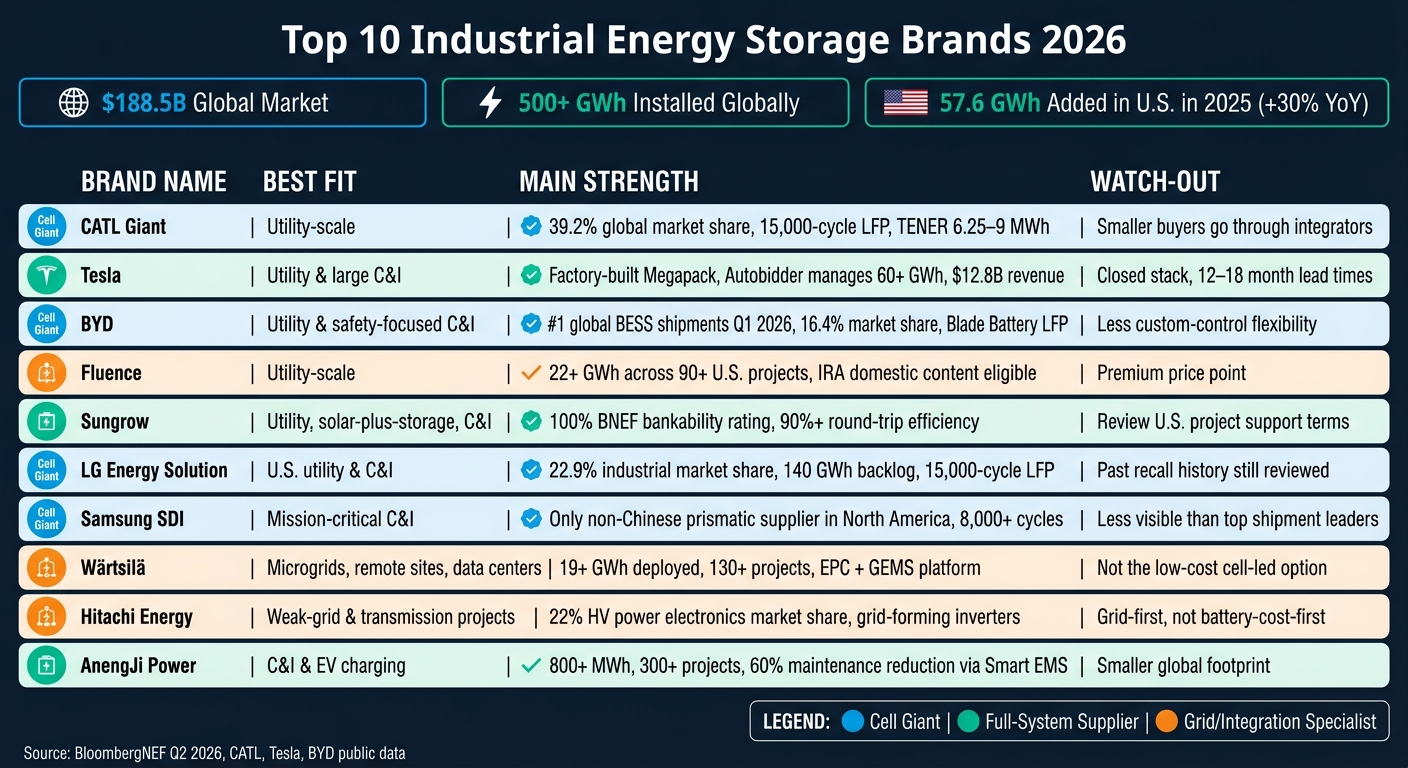
Top 10 Industrial Energy Storage Brands 2026: At-a-Glance Comparison
| Brand | Best Fit | Main Strength | Watch-Out |
|---|---|---|---|
| CATL | Utility-scale | Market share, lender comfort, high-capacity platforms | Smaller buyers may need to go through integrators |
| Tesla | Utility and large C&I | Factory-built systems and Autobidder software | Closed stack and 12–18 month lead times |
| BYD | Utility and safety-focused C&I | Vertical integration and Blade Battery safety | Less of a custom-control play |
| Fluence | Utility-scale | Integrator model, software, U.S. project base | Higher price point |
| Sungrow | Utility, solar-plus-storage, C&I | Inverter depth, bankability, AC-block options | Buyers should still review U.S. project support terms |
| LG Energy Solution | U.S. utility and C&I | North American supply and shift to LFP | Past recall history still comes up in reviews |
| Samsung SDI | Mission-critical C&I | Non-Chinese prismatic supply and safety focus | Less visible than top shipment leaders |
| Wärtsilä | Microgrids, remote sites, data centers | EPC + controls + hybrid system management | Not the low-cost cell-led option |
| Hitachi Energy | Weak-grid and transmission-linked projects | Grid-forming power electronics | More grid-first than low-cost battery-first |
| AnengJi Power | C&I and EV charging | Mid-market fit and low-maintenance EMS | Smaller global footprint than top-tier utility brands |
My takeaway: don’t pick from this list by headline rank alone. Match the brand to your duty cycle, interconnection pain points, software needs, and insurance requirements first. Then compare warranties, service coverage, and safety reports line by line.
How Industrial Energy Storage Is Used in U.S. Projects
The U.S. installed a record 57.6 GWh of battery storage in 2025, up 30% year over year. That jump says a lot about the market. It also helps explain why brand choice comes down to use case, not just name recognition.
The main applications are utility support, demand reduction, backup power, and microgrids.
Utility-scale grid support is one of the biggest uses. Systems like Tesla's Megapack and Fluence's Gridstack Pro help with grid stabilization, frequency regulation, and day-to-day grid balancing. In solar-plus-storage projects, batteries make renewable output more steady and move delivery into peak demand windows. Wind firming does the same kind of job, smoothing swings in output from wind turbines and other hybrid renewable sites.
Behind-the-meter (BTM) systems are built to cut demand charges for factories and large commercial properties. Those charges can account for 30% to 50% of a power bill. The basic idea is simple: batteries discharge when site demand spikes, which trims the charge tied to peak usage. If you want to size a system the right way, you need at least 12 months of 15-minute interval meter data. Anything less can leave blind spots.
Microgrids and backup power fill out the rest of the picture. Hospitals, university campuses, data centers, and remote industrial sites, including mining operations, use battery systems to keep power on during grid events or to run in island mode. For backup and frequency regulation, response times of 10 to 20 milliseconds are standard. That kind of speed matters when even a short outage can cause major disruption.
From there, project performance comes down to efficiency, cooling, and cycle life.
Lithium-ion systems usually deliver 85% to 90% round-trip efficiency. Liquid cooling is now standard in industrial projects because it keeps temperature within ±2°C and extends service life compared with air cooling. Most industrial systems are built for 10 to 20 years of service, and LFP often supports 6,000 to 8,000 cycles.
Safety and insurability can make or break a deal. Compliance with UL 9540, UL 9540A, and NFPA 855 is required for permitting and insurance in major U.S. markets, including California and New York.
Those project needs set the stage for the brand rankings that follow.
1. CATL
For U.S. utility-scale buyers, CATL is the name many teams measure against. It sits at the top of this list for scale and bankability. In March 2026, CATL held 39.2% of the global battery energy storage market, and it has a financing record that lenders and EPCs already know well.
Its product lineup includes EnerOne, EnerC, and TENER. CATL also supplies cells and systems to major integrators such as Tesla and Fluence.
For U.S. utility-scale projects, TENER is the main product to watch. It's CATL's flagship platform for large U.S. deployments. The 20-foot, 6.25 MWh unit uses liquid cooling and LFP chemistry, while the newer TENER Stack pushes that up to 9 MWh in a single cabinet.
That scale matters, but so do the operating claims. Both systems come with a zero-degradation claim for the first five years. On top of that, CATL says its LFP cells have reached 15,000 cycles through biomimetic SEI technology.
CATL mostly serves the utility-scale market, so smaller buyers tend to run into the brand through integrators instead of buying direct. If you're reviewing a large BESS proposal, it's smart to confirm whether the system uses CATL Tier 1 cells. That detail can shape financing and insurance rates.
So if you're comparing storage vendors for a large project, CATL works as a useful reference point.
| Metric | CATL Performance |
|---|---|
| Global Market Share | 39.2% |
| Flagship Product | TENER (6.25 MWh–9 MWh) |
| LFP Cycle Life | 15,000 cycles |
| Degradation Guarantee | Zero capacity degradation for first 5 years |
| Grid Switching Speed | ~20 ms |
2. Tesla
Tesla is the U.S. yardstick for grid-scale battery storage. In 2024, it held about 39% of the North American energy storage market. And in 2025, its energy generation and storage segment brought in roughly $12.8 billion in revenue.
Its main industrial product is Megapack, a factory-built BESS platform made for fast rollouts. The system bundles batteries, inverters, thermal management, and controls into one package. That setup helps buyers move from planning to installation with less site work and fewer moving parts.
Here’s how the lineup breaks down:
| Product | Capacity | Key Specs |
|---|---|---|
| Megapack 2XL | 3.9 MWh | 1.9 MW output, 6,000+ cycles, liquid cooling |
| Megapack 3 | 5 MWh | Integrated inverter, LFP chemistry |
| Megablock | Up to 20 MWh | 4× Megapack 3, integrated transformer, 23% faster install |
At the product level, Megapack 2XL offers 3.9 MWh. Megapack 3 steps up to 5 MWh. Then there’s Megablock, which combines four Megapack 3 units into a 20 MWh block with an integrated transformer. That design can cut construction costs by up to 40% and install about 23% faster than earlier setups.
Tesla’s edge comes down to software. Autobidder uses software that automatically bids stored energy into wholesale markets. That matters because battery storage isn’t just about storing power. It’s also about deciding when to charge, when to discharge, and where revenue is highest. As of 2026, Autobidder manages more than 60 GWh of energy storage globally.
Tesla also uses LFP chemistry across its stationary storage lineup for better fire safety and cycle life. For buyers running large sites, that can make a big difference over years of daily cycling.
That said, there are two tradeoffs industrial buyers should weigh. First, Tesla’s closed hardware/software stack can limit third-party integrations and custom hardware configurations. If your site needs a lot of custom control logic or outside equipment tied in, that can be a sticking point. Second, lead times can stretch to 12–18 months, which may be a problem if you need capacity on a tight project schedule.
3. BYD
BYD is another brand buyers should pay close attention to when they're comparing scale, integration, and safety. The company ranked No. 1 in global BESS shipments in Q1 2026 and held a 16.4% global market share in March 2026.
One of BYD's biggest strengths is its vertical integration. It controls more of the chain, from lithium supply to enclosure assembly. In plain English, that means fewer moving parts, tighter cost control, and less sourcing friction. It can also make EPC coordination easier than it is with brands that depend on outside cell or enclosure suppliers.
Its flagship industrial product is the MC Cube-T, which uses BYD's Cell-to-System (CTS) technology. By removing the usual module layer, the design increases space utilization by 33% compared with standard modular setups. The system also uses BYD's Blade Battery, an LFP chemistry built for strong thermal stability and able to pass nail-penetration tests. That matters for commercial and industrial sites where fire-code demands are strict.
BYD's systems also support:
- Sub-10 ms grid switching
- Remote monitoring
- Compatibility with mainstream PCS and EMS platforms
That mix makes BYD a strong fit for projects where safety and cost control matter more than deep customization.
In 2025, BYD signed a 12.5 GWh storage contract, and BloombergNEF ranked it a Tier 1 manufacturer in Q2 2026.
4. Fluence
Unlike CATL and BYD, Fluence is a pure-play system integrator, not a cell maker. That matters because its platform uses cells from multiple Tier-1 suppliers. For developers, that means more sourcing flexibility and less supply chain risk.
Fluence has deployed more than 22 GWh across 90+ U.S. projects. That kind of track record gives the company strong bankability with major lenders.
You can see that scale in its product lineup. Gridstack Pro is built for utility-scale grid services, with 4.9–5.6 MWh in a 20-foot enclosure, and it qualifies for the IRA domestic content bonus. Edgestack is aimed at smaller setups, scaling from 100 kWh to 2 MWh for peak shaving and backup power. Smartstack adds a 7.5 MWh modular option for larger industrial and utility sites.
On the software side, Mosaic handles AI-driven bidding and dispatch optimization, while Nispera focuses on predictive maintenance and performance tracking. Fluence systems are rated for about 8,000 cycles, 85% to 89% round-trip efficiency, and UL 9540A fire safety certification.
The tradeoff is price. Fluence tends to sit at the premium end, which can make it a harder sell for simpler mid-sized commercial projects.
5. Sungrow
Sungrow is one of the top three global energy storage suppliers by shipment volume in 2026. For U.S. industrial buyers, it stands out because it pairs deep inverter experience with storage platforms built for utility-scale and C&I use. BloombergNEF has ranked Sungrow as the world's most bankable inverter and energy storage brand, with a 100% bankability rating.
Its product range covers utility-scale, C&I, and smaller backup projects. PowerTitan 3.0 is the utility-scale platform. It uses a factory-assembled AC block design, liquid cooling, and silicon-carbide power electronics. PowerStack 255CS is aimed at C&I sites and delivers 514 kWh per cabinet with more than 90% round-trip efficiency. For smaller backup needs, PowerKeeper scales from 50 kWh to 1,000 kWh and supports 2 to 8 hours of backup.
Sungrow systems are built for UL 9540 and UL 9540A compliance, which helps with U.S. permitting and insurance review. Its industrial systems are rated for 20 years and 6,000+ cycles to 80% capacity.
Software is another strong point. iSolarCloud handles monitoring and AI-driven diagnostics, while the embedded EMS helps optimize dispatch for peak shaving, demand charge management, and frequency response. Sungrow also supports grid-forming functions for weak-grid facilities, microgrids, and black-start use.
6. LG Energy Solution
For U.S. industrial buyers, LGES stands out for three simple reasons: bankability, North American output, and its move to LFP. In 2026, LG Energy Solution holds an estimated 22.9% share of the industrial and utility-scale storage market. It also starts 2026 with a 140 GWh backlog and a 50 GWh delivery target.
LGES also has a strong position across the stack. Through LG ES Vertech, it handles work from cells to system integration, which helps cut supply-chain risk on large projects and supports bankability for billion-dollar financing. That matters when buyers want fewer moving parts and lenders want more certainty.
You can see that in its U.S. deals. In May 2026, LG ES Vertech signed a supply agreement with DTE Energy to develop 6 GWh of battery storage across eight Michigan projects using Michigan-made cells to support domestic content requirements. LGES has five North American production sites, and more than 80% of its ESS capacity is in North America.
The chemistry shift is another big piece of the story. LGES is moving its stationary storage portfolio from NMC to LFP, with advanced LFP pouch cells rated for up to 15,000 charge-discharge cycles. For buyers focused on long life and lower safety concern, that move is hard to ignore.
That shows up across the product line:
- JF2 4HR LINK is a 5.11 MWh utility-scale package with LFP batteries, liquid cooling, EMS, and NFPA 855/UL 9540 certification.
- For C&I applications, Enblock E is a modular, cabinet-based LFP system built for indoor and outdoor deployment.
- The AEROS™ suite adds on-prem controls, cloud analytics, a digital twin, bid optimization, and ≤99% availability assurance.
Past safety recalls still affect how some buyers view the brand, and that history hasn’t just vanished. LGES’s move to LFP is the direct answer to those concerns.
7. Samsung SDI
Samsung SDI is the main non-Chinese prismatic ESS supplier in North America. That gives U.S. developers a practical option for PFE compliance and domestic-content planning. And that edge is starting to show up in new U.S. deals.
In late 2025 and early 2026, Samsung SDI picked up new U.S. supply wins tied to domestic production at its Indiana joint venture. That link to U.S. manufacturing helps projects line up with domestic-content rules tied to federal tax credits.
"Samsung SDI has strengthened its ESS battery business in the US by capitalizing on its position as the only non-Chinese prismatic battery supplier in the region." - Kim Yoon-tae, Executive Vice President of Finance, Samsung SDI
Its product lineup follows the same theme: safety and U.S.-linked supply. Samsung SDI's PrismStack platform uses metal-cased prismatic cells with multi-tier safety vents. The SBB 1.5 packs 5.26 MWh into a standard 20-foot container, a 37% jump in energy density versus the prior model. The newer SBB 2.0 adds to Samsung SDI's LFP prismatic lineup for utility-scale projects.
Safety features go further than cell design alone. Samsung SDI uses Enhanced Direct Injection (EDI) cooling and Samsung Battery Intelligence (SBI), an AI-based monitoring system that spots cell abnormalities before they turn into bigger problems.
On the integration side, Samsung SDI supports projects from cell supply through turnkey delivery, which can cut commissioning friction. Its BMS tracks state of charge and battery health, and its systems include frequency control for grid stability. For durability, utility-scale platforms are built for at least 8,000 cycles. Commercial ESS setups are rated for at least 6,000 cycles at 90% depth of discharge. Both come with 10-year capacity warranties and end-of-life retention targets of at least 70%.
8. Wärtsilä
Wärtsilä is a long-established European industrial supplier with 15+ years in energy storage integration. In the Q2 2026 BloombergNEF rankings, it was one of only 10 non-Chinese Tier 1 Global Energy Storage Manufacturers. The company has 19+ GWh deployed or contracted across 130+ projects worldwide. That gives Wärtsilä a strong place in markets like microgrids, utility support, and large sites that need tight, coordinated power control.
One thing that sets Wärtsilä apart is its dual role as both an integrator and EPC contractor. Its GridSolve™ BESS lineup includes Quantum High Energy, Quantum2, and Quantum3. Each one targets a different use case:
- Quantum High Energy is built for 4–8 hour discharge
- Quantum2 is a 4 MWh DC block for utility deployment
- Quantum3 is a 5 MWh AC block with rack-level monitoring and control
Safety is a major part of the pitch too. Wärtsilä includes advanced noise attenuation, a multi-tier BMS for module isolation, and fire safety systems aligned with NFPA 855.
Beyond the battery hardware, GEMS runs the whole site. Wärtsilä's GEMS Digital Energy Platform coordinates batteries, gas engines, solar, and wind inside one managed system. It's hardware-agnostic, certified to IEC 62443-4 and SOC 2 Type 1, and it captures more operational data than standard SCADA systems.
In the U.S., this systems-first model is showing up in utility-scale and data-center work. In April 2026, Wärtsilä announced a 790 MW off-grid project with integrated BESS for a Texas data center. Then in June 2026, it announced a 50/50 JV with RCT Solutions GmbH to expand its storage platform and support U.S. manufacturing.
9. Hitachi Energy
If grid connection is the main headache, Hitachi Energy is one to keep on your list. The company is known for grid integration in battery storage rather than low cell pricing. That makes it a strong fit for older grids or sites with limited grid capacity. That focus also helped it land on the BloombergNEF 2026 Q2 Global Tier 1 Energy Storage Manufacturer Ranking, where it was one of just 10 non-Chinese companies on the list.
Its main strength is grid-forming inverters. These inverters mimic inertia and help steady grid frequency without spinning turbines. That matters for U.S. projects tied to congestion management or weak-grid conditions. Hitachi Energy also held a 22% market share in the high-voltage power electronics market as of 2026.
You can see that grid-first approach in its product lineup, which is built for both C&I and utility-scale use.
| Product | Scale | Best For |
|---|---|---|
| PQpluS™ | 150 kW – 360 kW | C&I, EV charging, grid-constrained sites |
| PQstorI™ R3 | 30 kW – MW scale | C&I, compact deployments |
| Power Conversion Solutions | 3 MW – GW scale | Utility-scale grid stabilization |
| e-mesh™ | System-wide | Software control for distributed energy resources |
e-mesh™ brings batteries, solar, wind, and other distributed assets under one control layer. It includes IEC 62443 cybersecurity and integrated fire protection. In 2026, Hitachi Energy supplied a BESS project for Baltimore Gas and Electric in rural Maryland.
10. AnengJi Power
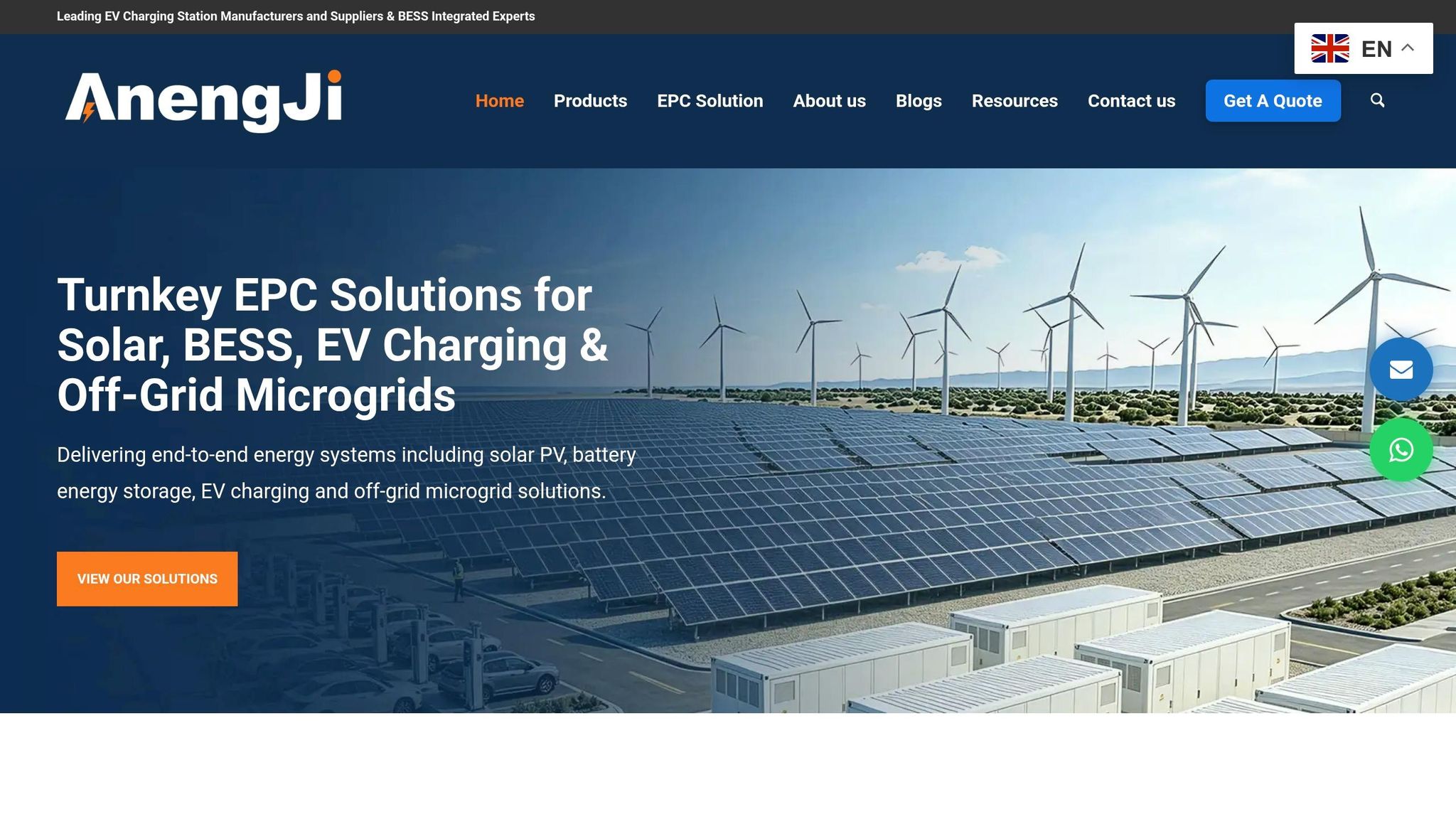
AnengJi Power takes the #10 spot as a mid-market C&I brand. It lands here because it fits niche C&I use cases well, not because it leads the global utility-scale market. The company focuses on pairing battery storage with EV charging infrastructure. That makes it a solid pick for industrial sites that need to control energy costs while charging EV fleets at the same time. Its main strength is straightforward C&I deployment, especially for sites that also run EV charging.
The company has delivered more than 800 MWh across 300+ projects in 100+ countries. Its lineup covers systems from 100 kWh cabinets to 5 MWh containerized units.
| Product Category | Capacity Range | Best For |
|---|---|---|
| Commercial Cabinet | 100 kWh – 261 kWh | Peak shaving, EV charging support |
| Containerized BESS | 1 MWh – 2.17 MWh | Grid services, solar-plus-storage |
| Utility-Scale BESS | Up to 5 MWh | Frequency regulation, EPC integration |
All systems use LFP chemistry with ≥8,000 cycles and response times below 100 ms. Liquid cooling keeps cell temperature spread within ±3°C. On the safety side, AnengJi uses a three-layer setup with six protection categories. That includes early warning sensors, rack-level aerosol fire suppression, and explosion-pressure relief venting. Its systems also carry UL 9540A, IEC 62619, and TUV certifications.
AnengJi's Smart Cloud-Edge EMS supports predictive maintenance and remote diagnostics, which cuts on-site maintenance time by 60%. In March 2026, the company deployed a 3.54 MWh containerized BESS in Romania for industrial peak shaving and solar self-consumption. It also deployed a 1 MW / 2 MWh system in Ukraine that provides backup transfer in under 20 ms.
For U.S. C&I buyers that want storage and EV charging in one setup, AnengJi stands out for uptime and low maintenance. It makes the most sense to judge this brand on C&I fit, not on utility-scale range.
Brand Comparison at a Glance
These brands play different roles in the market: some make cells, some package full systems, some focus on controls, and some handle grid-side engineering. That matters because peak shaving, backup, microgrids, and grid services don’t all need the same kind of partner.
The table below gives you a quick way to match each brand to the project types covered above.
| Brand | Primary Technology | Typical Project Scale | Key Applications | Primary Buyer Segment |
|---|---|---|---|---|
| CATL | LFP cells and integrated platforms | Utility-scale | Renewable integration, grid regulation | Utilities, large EPCs |
| Tesla | Factory-built AC-block systems | Utility and large C&I | VPPs, arbitrage, 24/7 carbon-free energy | Utilities, large C&I operators |
| BYD | Blade Battery (cell-to-system) | Utility and high-safety C&I | Urban C&I, industrial parks | Utilities, C&I developers |
| Fluence | Software-led integration | Utility-scale | Grid stability, long-duration (4–8 hours) | Utilities, IPPs |
| Sungrow | Integrated power electronics | Utility and solar-plus-storage | Hybrid plants, peak shaving | Utilities, solar developers |
| LG Energy Solution | Modular LFP cabinets | C&I and utility | Retail, office buildings, IRA projects | U.S. C&I and utility buyers |
| Samsung SDI | High-reliability prismatic cells | Mission-critical C&I | AI data centers, semiconductor fabs | Mission-critical C&I buyers |
| Wärtsilä | Microgrid systems | Remote utility and microgrid | Mining, islands, VPP management | Remote and off-grid operators |
| Hitachi Energy | Grid-forming power electronics | Transmission-scale grid support | Grid modernization, hybrid power plants | Transmission and grid operators |
| AnengJi Power | C&I storage with integrated EMS | C&I and EV charging | Logistics hubs, fleet charging | C&I sites and EV-charging fleets |
The big divide is role. Cell makers, software-led integrators, and grid engineering specialists each fit different project needs. If you line up the brand’s role with your use case first, your shortlist gets much smaller, much faster.
Use this snapshot as a first filter before you compare cost, certification, and delivery terms.
Key Factors U.S. Industrial Buyers Should Compare
Once brand fit is clear, compare bids against the same operating and safety standards. That’s what separates a bankable system from one that looks fine on paper but falls apart under review.
Start with chemistry, cycle life, and efficiency. In the U.S., LFP is the default for stationary storage because it’s safer than NMC. Look for systems rated for 4,000–6,000+ cycles at 80% depth of discharge, along with the highest verified round-trip efficiency you can get. That last point matters more than many buyers think. A 2% bump in round-trip efficiency can lead to meaningful yearly energy savings on MW-scale projects. So efficiency shouldn’t be buried in the fine print.
Safety certifications are a hard gate for U.S. projects. UL 9540A, UL 9540, UL 1973, and NFPA 855 are the baseline for U.S. permitting and insurance. Send UL 9540A reports to your insurance broker before you sign a contract. Insurability often decides whether a project’s ROI model works at all.
Then look at installation and dispatch. This is where plenty of bids start to wobble. AC-block designs can cut installation time and make commissioning simpler. The EMS should line up with the revenue plan, whether that’s peak shaving, arbitrage, or VPP dispatch. If the site sits on a weak grid or runs as a microgrid, grid-forming capability may justify the added capital spend.
Warranty terms, service coverage, and supplier strength carry more weight than most buyers expect. Compare performance warranties, service coverage, and BNEF Tier 1 bankability. If you only look at device warranties, you’ll miss the bigger risk. And don’t gloss over balance-of-system parts like transformers, breakers, and switchgear. Those pieces often control the schedule. Sourcing them through Electrical Trader can help manage lead times and cost. Treat them as schedule-critical parts of the project, not side items.
Conclusion
After looking at scale, safety, and service, brand fit matters more than brand name. These 10 brands play different roles in the market: some focus on cells, some sell end-to-end systems, and some lean hard into software and integration. The right pick comes down to what your project actually needs. A large utility-scale build and a smaller behind-the-meter industrial system don’t ask for the same thing. They differ in capacity goals, software needs, permitting paths, and O&M work.
Even then, a good match can fall apart if the safety and support basics aren’t there. For U.S. buyers, two checks stand out. First, verify the UL 9540A report before you sign anything. Second, confirm long-term service support for firmware, battery management updates, and replacement parts.
Industrial storage is a long-term service decision, not a one-time equipment purchase. Use the brand profiles and comparison criteria as your starting point. Then stack each shortlisted bid against your site conditions, duty cycle, and financing.
FAQs
Which brand is best for my project type?
The right brand comes down to your project size and what you need the system to do.
Tesla is a strong fit for large utility-scale projects that need standardized, turnkey systems backed by advanced software. Fluence is often chosen for bankability and AI-driven grid performance.
For commercial and industrial projects in the 100 kWh to 2 MWh range, Sungrow, BYD, and specialized manufacturers can offer more room to tailor the setup. Installers and integrators may also lean toward CATL, Avepower, or EVE Energy when they want cell supply and modular hardware.
What certifications should I verify before buying?
Verify UL 9540 for system safety, UL 9540A for fire safety performance, and UL 1973 for battery modules. You should also confirm compliance with NFPA 855 and any CEC listing rules that apply to grid-tied setups.
It’s also worth checking for ISO 9001 quality management certification and compliance with IRA domestic content rules if you want to qualify for federal tax incentives.
How do I compare software, warranty, and service?
Compare software across four areas: AI-driven energy management, predictive analytics, real-time market participation, and digital twin features.
For warranty and service, confirm defect coverage and energy retention guarantees, which usually run 10 to 20 years. It also helps to favor vendors with strong bankability, global deployment, local O&M support, and the financial strength to stand behind long-term service agreements.