Global Motor Efficiency Regulations: Key Updates
If you buy, spec, import, or install motors in the U.S., the big date to watch is June 1, 2027. That’s when most 1–750 hp motors move to IE4 / NEMA Super Premium. Then on January 1, 2029, the rule reaches some 0.25–3 hp motors in frames 42, 48, and 56.
Here’s the short version: Europe is already at IE4 for some 75–200 kW motors, the U.S. follows in 2027, and other markets like China, India, Japan, Brazil, Mexico, and Saudi Arabia all have their own dates, labels, and test rules. That means a motor that looks fine in one country may still fail in another if the test method, nameplate, or certification does not match.
If I were planning purchases now, I’d focus on these points first:
- U.S.: IE4 for most 1–750 hp motors starts June 1, 2027
- U.S.: some small motors shift next on January 1, 2029
- EU: IE4 already applies to some 75–200 kW three-phase motors
- Canada: likely to track U.S. timing
- Asia and Latin America: rules differ by country, power range, and label program
- Cross-border shipments: matching efficiency class alone is not enough
- Plant upgrades: check the motor, VFD, starter, breaker, and transformer together
- Cost: motor purchase price is small next to long-term power use, so even a small efficiency jump can cut spend over time
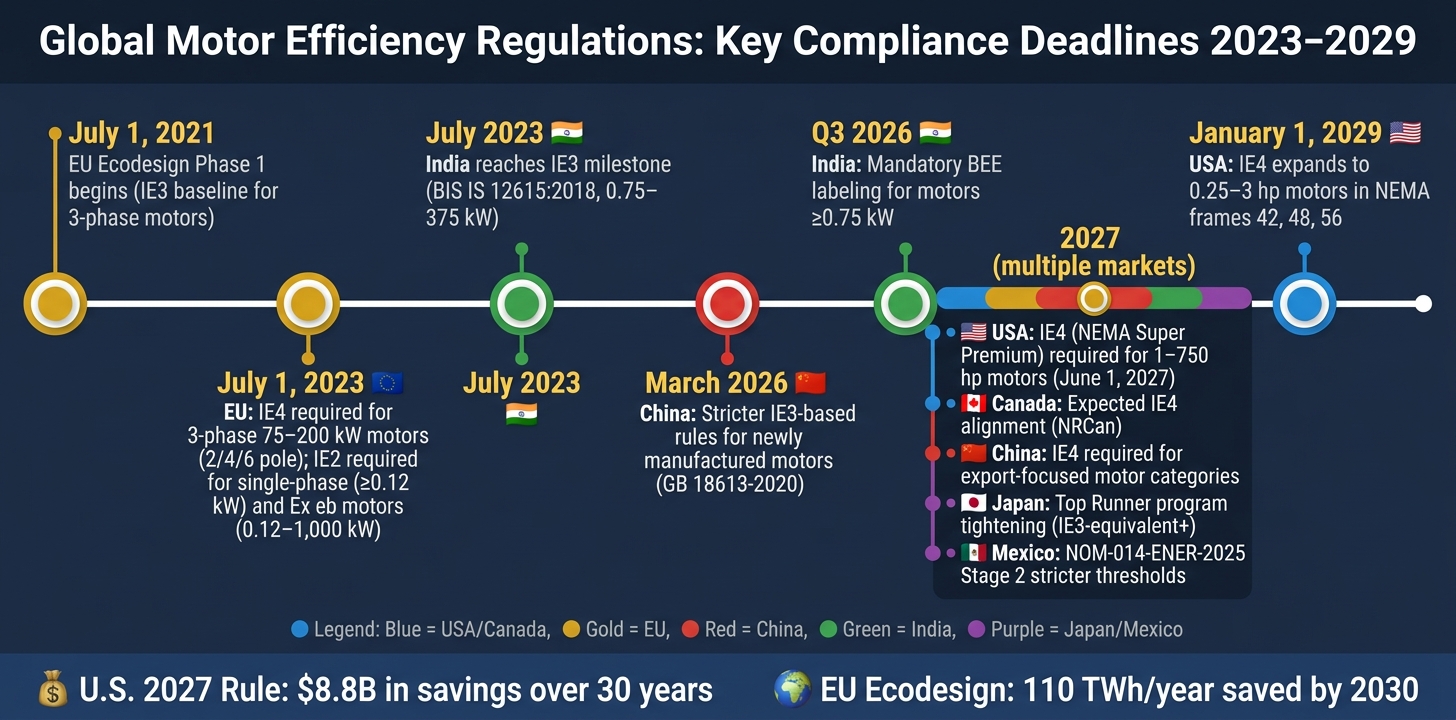
Global Motor Efficiency Regulations: Key Compliance Deadlines 2023–2029
Ready for IE4 – Regulations & Future Outlook
sbb-itb-501186b
Quick Comparison
| Market | Current Main Direction | Key Date |
|---|---|---|
| United States | IE4 for most general motors | June 1, 2027 |
| United States (small motors) | Expanded scope for some fractional hp motors | January 1, 2029 |
| European Union | IE4 already in force for some 75–200 kW motors | July 1, 2023 |
| Canada | Expected alignment with U.S. IE4 path | 2027 expected |
| China | Stricter IE3-based rules, then IE4 for some export lines | 2026 / 2027 |
| India | IE3 plus motor labeling step | Q3 2026 |
| Japan | Top Runner tightening | 2027 |
| Mexico | Stage 2 tighter thresholds | 2027 |
Bottom line: I’d update motor specs now, line up DOE and CE/IEC paperwork before buying, and review inventory plans before 2027 demand puts more pressure on lead times and pricing.
Europe and North America: Key Recent Compliance Deadlines
The biggest near-term deadlines are in Europe and North America. In both places, efficiency rules now decide which motors can be sold, installed, or exported. The fine print changes by region, but the effect on buyers is pretty simple: motor specs now depend on the deadline and the test method.
EU Ecodesign: IE3 and IE4 Requirements by Motor Range
EU Ecodesign Regulation 2019/1781 has rolled out in phases since July 2021. Then, on July 1, 2023, it hit a major milestone: the EU became the first large market to require IE4 for three-phase, 75–200 kW, 2-, 4-, and 6-pole motors.
That same 2023 phase also pulled in two motor types that had not been covered before:
- Single-phase motors (≥0.12 kW), which now need at least IE2
- Ex eb increased safety motors (0.12–1,000 kW), which now need at least IE2
The EU says these Ecodesign measures will save 110 TWh of electricity per year by 2030. That's about the same as the Netherlands' total yearly electricity use. The expected drop in energy bills is about €20 billion per year.
| Motor Category | Pre-July 2023 Requirement | Requirement from July 1, 2023 |
|---|---|---|
| 3-Phase (75–200 kW, 2/4/6 pole) | IE3 | IE4 (Super Premium) |
| Single-Phase (≥0.12 kW) | No requirement | IE2 |
| Ex eb Increased Safety (0.12–1,000 kW) | No requirement | IE2 |
For U.S. manufacturers shipping motors to Europe, this changes the checklist. Products in the 75–200 kW band need to meet the required IEC efficiency levels and carry the CE marking.
North America is on a similar path, but the test rules and labeling requirements are not the same.
U.S. DOE and Canada NRCan: Current Standards and Next Compliance Steps

In the U.S., general-purpose motors stay at IE3 until June 1, 2027. On that date, a DOE rule will require IE4 (NEMA Super Premium) efficiency for motors in the 1–750 hp range. Then, on January 1, 2029, the rule expands to 0.25–3 hp motors in NEMA frames 42, 48, and 56.
The DOE estimates that the 2027 rule will save U.S. businesses $8.8 billion and avoid 92 million metric tons of CO₂ over 30 years. Canada's NRCan program usually tracks with U.S. DOE rules, and it is expected to adopt similar IE4 requirements by 2027.
| Motor Category | Power Range | U.S. DOE Requirement | Canada NRCan | EU Cross-Reference | Next Confirmed Date |
|---|---|---|---|---|---|
| Mid-range motors | 1–750 hp | IE4 from June 1, 2027 | Expected IE4 alignment | IE3 now; IE4 for 75–200 kW | June 1, 2027 |
| Fractional motors | 0.25–3 hp (frames 42, 48, 56) | IE3 now; expands in 2029 | IE3 | IE2 for <0.75 kW | Jan. 1, 2029 |
U.S. compliance note: U.S. compliance calls for testing under 10 CFR Part 431 Subpart B and a DOE certification number on the nameplate. EU compliance, by contrast, uses IEC 60034-2-1 test methods. So even if the motor looks like a match on paper, one test does not cover both markets. If you're managing cross-border inventory or writing specs for more than one region, keep both certification sets on file.
Outside Europe and North America, other markets are tightening rules in different ways.
Motor Efficiency Policy Updates in Asia, Latin America, and the Middle East
China, India, and Japan: Efficiency Expectations in Major Manufacturing Markets
After Europe and North America, the next wave of compliance changes is shifting global sourcing. Asia, Latin America, and the Middle East are becoming key pressure points, as local labels and export rules now affect what buyers can source and ship.
China is moving fast. As of March 2026, newly manufactured motors must meet stricter IE3-based requirements. Then, by 2027, export-focused motor categories must hit IE4 to line up with EU requirements. For U.S. buyers, this is the kind of rule change that can turn into shipment delays or customs holds if supplier checks happen too late.
India reached its IE3 milestone in July 2023. The next big step is a mandatory BEE labeling rule for motors ≥0.75 kW, which takes effect in Q3 2026. India’s 2026 Energy Conservation Building Code (ECBC) also requires IE3 or higher for all new commercial buildings with a load of 100 kW or more.
Japan takes a different path. Instead of fixed IE thresholds, it uses performance benchmarking through the Top Runner program, which sets targets based on the best-performing motors already sold in the market. Japan has kept an IE3-equivalent standard since 2015, and those requirements are set to tighten again starting in 2027.
Brazil, Mexico, and Saudi Arabia: Regional Rules Affecting Trade and Specifications
Outside Asia, a few major trade markets are tightening minimum motor efficiency levels too.
Brazil has required IE3 as the minimum efficiency level for motors from 0.75 kW to 375 kW since 2019, enforced through INMETRO. Mexico updated its minimum energy performance standards in 2025 with NOM-014-ENER-2025. The rule applies to single-phase, squirrel-cage, air-cooled AC motors from 0.180 kW to 2.238 kW, and stricter Stage 2 thresholds arrive in 2027. Saudi Arabia uses SASO IEC 60034-30, with broader IE3 requirements continuing to move beyond government projects.
| Region | Regulation | Min. Efficiency Level | Main Power Range | Last Major Update | Next Known Deadline |
|---|---|---|---|---|---|
| China | GB 18613-2020 / 2026 Plan | IE3 (stricter IE3-based for new mfg.) | 0.55–1,000 kW | 2021 | 2026 (stricter IE3); 2027 (IE4 for exports) |
| India | BIS IS 12615:2018 | IE3 | 0.75–375 kW | July 2023 | Q3 2026 (BEE Labeling) |
| Japan | Top Runner Program | IE3 Equivalent | 0.75–375 kW | 2015 | 2027 (Increased stringency) |
| Brazil | INMETRO | IE3 | 0.75–375 kW | 2019 | None confirmed |
| Mexico | NOM-014-ENER-2025 | Stage 1 (IE2-equiv.) | 0.180–2.238 kW | 2025 | 2027 (Stage 2) |
| Saudi Arabia | SASO IEC 60034-30 | IE3 (Gov. projects) | Varies | Ongoing | Expanding IE3 scope |
For cross-border sourcing, it’s smart to verify test methods and labels country by country. Also ask for test reports from accredited laboratories, so claimed IE3 or IE4 ratings match the target market’s rules.
What These Updates Mean for U.S. Facilities, Purchasing, and Sourcing
Compliance Planning: Motor Inventory, Retrofit Timing, and Cost Impact
For U.S. facilities, this comes down to timing: what to replace now, what to hold off on, and what needs to be written into specs for 2027 and 2029. Those dates now shape inventory plans, retrofit schedules, and sourcing decisions.
Motors already in service do not need to be replaced. But any new motor manufactured or sold after those deadlines must comply. That changes the math for projects in design today. If a project is being planned now but installed after the deadline, it makes sense to specify IE4 early.
Moving early can cut retrofit risk and start the savings clock sooner. Waiting until the deadline can do the opposite: more price pressure, less stock, and fewer easy options.
More than 160 U.S. utility programs offer motor rebates, and DSIRE can help you search by ZIP code for local programs.
| Factor | Early Upgrade to IE4 (Pre-2027) | Waiting Until June 2027 |
|---|---|---|
| Capex | Higher upfront investment, usually 15%–30% more than IE3/NEMA Premium, but current rebates can help offset the gap | Mandatory higher cost; potential price pressure as demand spikes near the deadline |
| Energy Savings | Immediate 10%–15% reduction in power use | Delayed savings until replacement |
| Regulatory Risk | Low; future-proofs new installs against the 2027/2029 rules | High; non-compliant designs may require redesign |
The next procurement cycle is a good window to lock in compliant specs before demand starts to climb.
Sourcing Compliant Motors and Reviewing Related Power Distribution Equipment
Once you know when a motor will be replaced, the next step is checking whether the rest of the electrical system is ready for it.
A motor swap doesn't stop at the motor. Breakers, starters, transformers, and VFDs all need a look before installation. IE4 motors can change starting current and thermal behavior. If that sounds small, it isn't. A motor may fit on paper and still create trouble upstream if connected gear wasn't reviewed first.
There's also a performance angle here. Pairing an IE4 motor with the right VFD can lift total energy savings to 20% to 30% compared with fixed-speed operation.
Before purchase, match the motor nameplate to the connected equipment and confirm the right certification mark for the target market.
For multi-site upgrades, Electrical Trader can centralize sourcing for motors, breakers, transformers, and other power equipment.
Conclusion: Compliance Dates and Decisions to Watch
Global motor efficiency rules are getting tighter, and the big issue now is timing. Compliance depends on the market and the deadline, not just the motor type. IE4 is becoming the main target worldwide. In the U.S., the DOE will require IE4 for motors in the 1–750 hp range starting June 1, 2027, with fractional horsepower motors (0.25–3 hp) in NEMA frame sizes 42, 48, and 56 following on January 1, 2029.
For buyers, the key detail is the installation date, along with the scope of certification. Order date matters less. A motor ordered today but installed after June 1, 2027 still has to meet the new rule. Some specialty motors are exempt in many cases, but if an efficiency level is claimed, DOE certification is still required. And if you're sourcing for projects across borders, make sure NEMA horsepower is converted to IEC kilowatts with care. IE3 and IE4 thresholds are set under IEC 60034-30-1.
The expected impact is large: the 2027 rule is projected to save U.S. businesses $8.8 billion and prevent 92 million metric tons of CO₂ emissions over 30 years. For U.S. facilities, the clearest near-term step is simple: update engineering specs for motors in the 1–750 hp range to IE4 before 2026 design work starts.
For imports and exports, check the IE class, DOE certification number, and CE mark, and keep accredited test reports on file. Update specs now, verify certifications before purchase, and match each motor to its target market.
FAQs
Which motors are exempt from the new U.S. IE4 rules?
Under upcoming U.S. Department of Energy regulations, these motor categories are exempt from mandatory IE4 efficiency standards:
- liquid-cooled
- submersible
- synchronous
- inverter-only motors
- component sets
That said, there’s an important catch. If any efficiency claims are made for these exempt motor types, those claims still need to be formally certified under DOE procedures.
How do I verify a motor is compliant for cross-border shipments?
Identify the destination country’s energy-efficiency rules and certification requirements, such as EU Ecodesign, U.S. NEMA Premium, or India’s BEE labeling mandate. Then check the motor’s rated IE class on the nameplate to make sure it clears the required threshold for that market and power range.
That part matters more than it may seem. A motor can look fine on paper, but if the nameplate rating falls short of the local rule, it can run into trouble at import, sale, or installation.
Also check the required documentation. In most cases, that means:
- accredited lab test reports
- a Declaration of Conformity
- applicable certification marks
- technical files in the required local language
If one of those pieces is missing, the shipment can get stuck fast. The safest move is to match the motor, the paperwork, and the target market before anything ships.
Should I upgrade to IE4 now or wait until 2027?
You don’t need to move to IE4 right away unless you sell into places like the European Union or Taiwan, where IE4 rules already apply to some motor sizes.
In the U.S., IE4 won’t be required until June 1, 2027 for motors from 100 to 250 hp. Still, now’s the time to plan. IE4 motors usually cost 15% to 25% more than IE3 models, so it makes sense to update 2026 budgets and engineering standards for projects that will wrap up after that date.