




VFD Efficiency Standards: What Buyers Need
Variable Frequency Drives (VFDs) are essential for controlling motor speed and improving energy efficiency in industrial systems. But not all VFDs are created equal. Understanding efficiency standards, compliance requirements, and proper selection can save energy, reduce costs, and extend equipment life. Here’s what you need to know:
- Efficiency Ratings: Modern VFDs typically operate at 95%-98% efficiency, but performance can vary depending on load, speed, and operating conditions.
- Energy Savings: VFDs can significantly lower electricity costs, especially in systems like pumps and fans. For instance, reducing motor speed by 20% can cut energy use by 50%.
- Standards and Compliance: U.S. regulations like NEMA and international IEC standards ensure VFDs meet efficiency and safety benchmarks. Look for certifications like UL and CE.
- Key Factors in Selection: Match the VFD to your load type (variable or constant torque), consider environmental conditions, and ensure proper installation to avoid efficiency losses.
Investing in the right VFD and following efficiency standards can lead to faster ROI, lower energy bills, and improved system reliability. Keep reading for a detailed breakdown of how to choose and maintain your VFD.
How VFD Efficiency Is Rated
How Efficiency Ratings Are Measured
The efficiency of a Variable Frequency Drive (VFD) is calculated as the ratio of its power output to power input, expressed as a percentage. Most modern VFDs operate within a range of 95% to 98% efficiency when running at or near their rated load. However, this rated efficiency doesn't always reflect real-world performance, as efficiency can drop under varying load and speed conditions.
Several factors influence efficiency, including load, speed, and carrier frequency. For instance, a VFD running at partial load or very low speed often delivers lower efficiency than its nameplate rating. This is especially true if the VFD is oversized for the application, which can lead to higher energy costs and a reduced return on investment (ROI).
Internally, VFDs experience power losses across three key conversion stages:
- Rectifier: Converts AC power to DC.
- DC Bus: Stores and smooths the energy.
- Inverter: Converts DC back into variable AC.
Within these stages, two primary types of losses occur: conduction losses, caused by current flowing through components, and switching losses, which happen each time the drive's transistors switch on and off.
Carrier frequency also plays a role in efficiency. Higher frequencies (8–20 kHz) help reduce motor noise but increase switching losses, while lower frequencies (2–4 kHz) enhance efficiency when noise reduction isn't a priority. These factors highlight the complexity of measuring and understanding VFD efficiency in real-world applications.
What Causes Efficiency Loss in VFDs
Efficiency losses in VFDs aren't limited to their internal conversion stages. Several external and operational factors also contribute. For example, using Pulse Width Modulation (PWM) for speed control introduces harmonic and core losses, which can reduce motor efficiency by 1–3 percentage points compared to a direct connection. This penalty becomes more noticeable at full speed, impacting energy performance. As Jason IP, Professional Engineer at Industrial Monitor Direct, explains:
"The claim that 'an inverter driven motor running at full speed is less efficient than a motor with ATL starting' is technically correct."
When combined, a VFD and motor system typically experience a total power-line-to-shaft loss of 8% to 12%. While speed reduction can offset this loss in some applications, systems running at full speed continuously may see increased energy costs compared to simpler across-the-line starters.
Environmental conditions also play a role. High ambient temperatures or altitudes can reduce a VFD's cooling efficiency, often requiring a derating of 10% to 15% of its rated capacity. Poor installation practices, like improper grounding, excessive cable lengths, or the absence of harmonic filters, can further increase losses. For example, when motor cables exceed 50–150 feet, installing a dv/dt filter can help protect motor insulation from voltage spikes caused by the drive's high-speed switching.
Understanding these loss factors is essential for anyone looking to maximize energy savings and ROI when using VFDs. Proper sizing, installation, and environmental considerations all play a role in achieving optimal performance.
sbb-itb-501186b
How VFDs Actually Save You 50% on Motor Energy (The Physics Explained)
Key Efficiency Standards and Compliance Requirements
VFD standards play a crucial role in managing energy costs, ensuring equipment safety, and adhering to regulatory guidelines.
NEMA and IEC Standards
In the U.S., the National Electrical Manufacturers Association (NEMA) provides the primary framework for motor and drive efficiency. Globally, the International Electrotechnical Commission (IEC) classifies efficiency using an IE scale ranging from IE1 (standard) to IE5 (ultra-premium). These classifications align as follows:
| NEMA Efficiency Level | IEC Efficiency Class |
|---|---|
| Standard Efficiency | IE1 |
| High Efficiency | IE2 |
| Premium Efficiency | IE3 |
| Super Premium | IE4 |
| No Formal NEMA Standard | IE5 |
For motors handling VFD voltage spikes, NEMA MG1-Part 31 outlines insulation requirements. For example, if you're operating at 460V with cable runs over 60 feet or carrier frequencies above 4 kHz, choosing a motor rated to NEMA MG1-Part 31 is critical.
John Yoon, Senior Staff Electrical Engineer at McGuire Engineers, explains:
"The energy savings associated with properly addressing these load management concepts overshadow the few percentage points of efficiency that may exist between different manufacturers' VFDs."
U.S. Department of Energy Regulations

Federal regulations in the U.S. significantly influence VFD and motor efficiency standards. The Energy Policy Act (EPACT) of 1992 set minimum efficiency levels for general-purpose three-phase induction motors between 1 and 200 HP, making compliance mandatory. Later, EISA-2007 raised the bar by requiring these motors to meet NEMA Premium (IE3) efficiency levels. Oversight for energy efficiency programs, including motors and drives, falls under the Department of Energy's 10 CFR Part 431 framework.
Erin Keating, P.Eng, Senior Electrical Engineer at Hedgehog Technologies, highlights the impact:
"The U.S. Department of Energy reports that 26% of the country's total retail sales electricity usage comes from the industrial sector. Approximately 60% of that electricity consumption within an industrial facility is used by electric motors."
Beyond motor efficiency, the IEEE 519 standard addresses Total Harmonic Distortion (THD), which refers to the electrical noise a VFD can send back to the power grid. Excessive THD can disrupt other equipment and reduce overall system reliability.
Certification Marks to Look For
Certification marks provide an extra layer of assurance that a VFD meets performance and safety standards. In the U.S., look for the UL (Underwriters Laboratories) mark, which indicates independent testing compliance. For equipment used internationally or exported to Europe, the CE (Conformité Européenne) mark confirms adherence to European Economic Area requirements.
While EPACT compliance is mandatory for motors in the 1–200 HP range, the NEMA Premium designation is a voluntary marker indicating that a motor exceeds minimum efficiency requirements. A common misconception is associating the NEMA Design letter (A, B, C, D, or E) with efficiency. For example, while Design E motors are optimized for VFD use, their efficiency should still be independently verified.
Energy Savings and ROI for VFDs
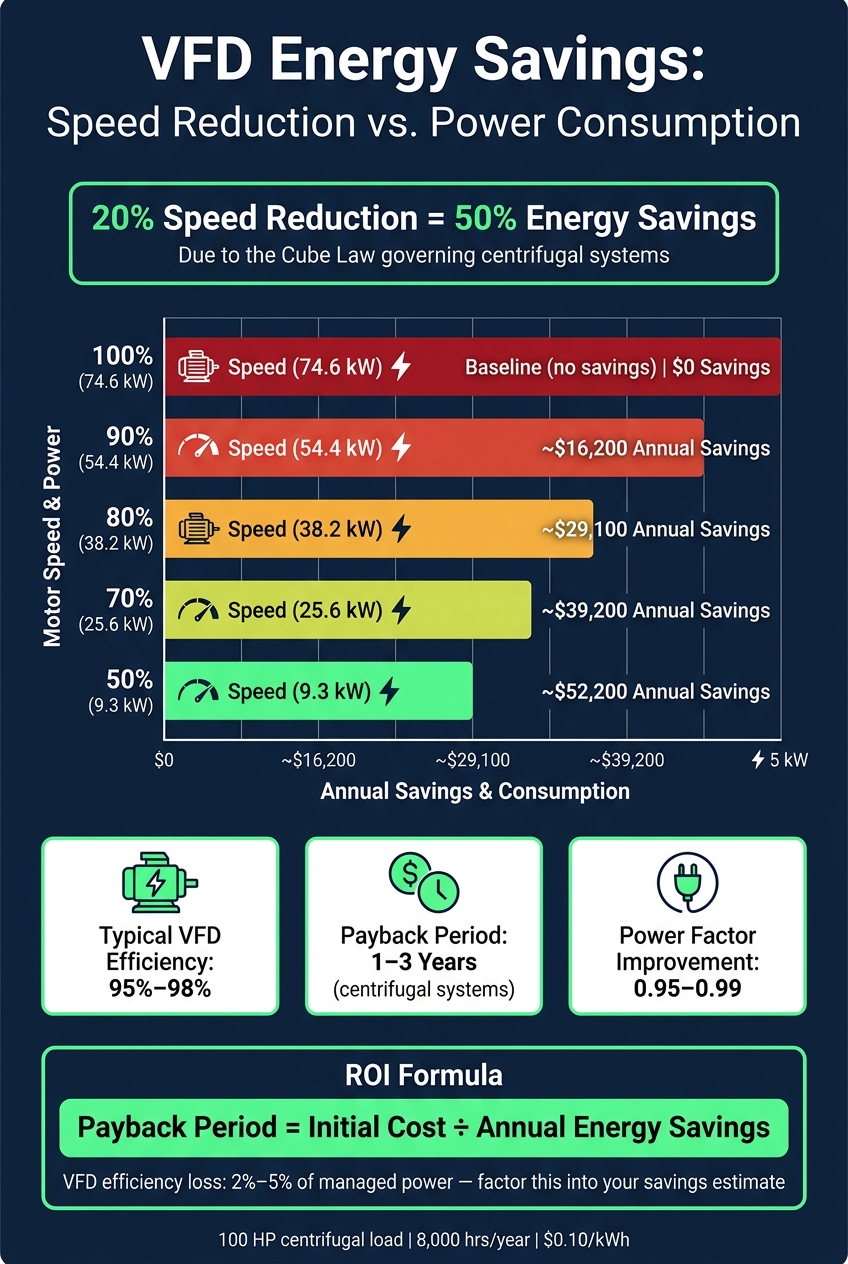
VFD Energy Savings: Speed Reduction vs. Power Consumption
How Much Energy VFDs Can Save
VFDs (Variable Frequency Drives) offer impressive energy savings, especially for centrifugal systems like fans and pumps. This is because their power consumption follows the cube law: even a slight reduction in speed results in a significant drop in energy use.
"A 20-percent reduction in motor speed produces a 50-percent energy savings." - Richard G. Lubinski, President, Think Energy Management LLC
The table below illustrates the savings for a 100 HP centrifugal load operating 8,000 hours annually at $0.10 per kWh:
| Speed Ratio | Power Consumed (kW) | Annual Cost Savings |
|---|---|---|
| 100% (Baseline) | 74.6 kW | - |
| 90% | 54.4 kW | ~$16,200 |
| 80% | 38.2 kW | ~$29,100 |
| 70% | 25.6 kW | ~$39,200 |
| 50% | 9.3 kW | ~$52,200 |
These savings align with the efficiency standards for VFDs and their ability to nearly eliminate reactive power penalties by improving the power factor to 0.95–0.99. Additionally, VFDs reduce inrush current during startup, which can lower peak demand charges. This combination of benefits helps VFD systems achieve a rapid return on investment (ROI).
How to Calculate VFD ROI
The formula for calculating ROI is straightforward:
Payback Period = Initial Cost ÷ Annual Energy Savings.
However, accuracy is key when estimating both the initial cost and the savings. For example, the cost of a VFD itself might be around $7,000 for a 135 HP unit, but you’ll need to factor in additional expenses like labor (approximately $1,500) or a full VFD panel, which could cost up to $25,000. Don’t forget to adjust your savings projection to account for the VFD’s own efficiency loss, which is typically 2% to 5% of the power it manages.
When calculating savings, use your system's average operating speed or flow rate instead of peak values. Systems often run at partial loads, and overestimating average speed can falsely shorten the payback period. Another critical step: check with your local utility before buying a VFD. Many demand-side management (DSM) rebate programs require pre-approval, and skipping this step could mean missing out on financial incentives.
"The purchase cost is only 5 percent of lifecycle costs. The other 95 percent is energy used and a small amount for maintenance and repairs." - Richard G. Lubinski, President, Think Energy Management LLC
For centrifugal systems, payback periods typically range from 1–3 years, with high-use systems recovering costs in as little as 3–10 months.
How to Choose the Right VFD
Matching VFDs to Load Types
Selecting the right VFD (Variable Frequency Drive) is all about matching it to your specific load type. This isn't just a technicality - choosing the wrong VFD can lead to wasted energy and higher costs. Not all VFDs are created equal, and the type of load they’ll be driving plays a huge role in determining the ideal choice.
Loads generally fall into two categories: variable torque loads and constant torque loads. For example:
- Variable torque loads: These include fans and pumps, which usually need a VFD with a 120% overload capacity for one minute. The energy savings here can be substantial, as power consumption follows the cube of the speed - slowing down just a little can save a lot.
- Constant torque loads: Think conveyors, extruders, and positive displacement pumps. These require a VFD with a slightly higher overload capacity, around 150%.
Control methods also matter. A basic V/Hz (Volts per Hertz) approach works fine for simpler applications like fans. However, more complex tasks - like hoists or drilling - demand vector control for precision. And when sizing your VFD, don’t just look at the motor’s horsepower; focus on its Full Load Amps (FLA). Motors with different RPM ratings can draw varying currents, so this ensures proper sizing.
Finally, consider harmonic distortion. If your system is sensitive to voltage spikes, look for drives with integrated filtering to manage those issues effectively.
Operating Conditions and Maintenance Factors
Where you install your VFD can have a surprising impact on its performance and lifespan. Heat, for instance, is the number one cause of VFD failures. Excessive heat can degrade components, reduce efficiency, or even trigger a shutdown to prevent damage.
To avoid these issues, choose the correct enclosure rating for your environment:
- NEMA 1/IP20: Ideal for clean, dry indoor spaces.
- NEMA 12/IP54: Suited for dusty manufacturing floors.
- NEMA 4X: Designed for wash-down areas or corrosive environments.
"Monitoring the temperature can help identify VFD problems before they do too much damage." - Cole Casteel, PE, Electrical Engineer, CDM Smith
Routine maintenance is another key to keeping your VFD running smoothly. Cleaning filters and inspecting vents regularly can go a long way in extending its life.
Other factors to keep in mind include altitude and motor cooling. If your installation is above 3,300 feet or in temperatures over 104°F (40°C), you may need to de-rate the VFD. Additionally, at very low motor speeds, the internal fan might not provide enough cooling. In these cases, an auxiliary cooling fan or an inverter-duty rated motor - built with stronger insulation to handle VFD voltage stresses - can be a smart choice.
Where to Source Reliable VFDs
Once you’ve nailed down the technical requirements, it’s time to find a trustworthy source for your VFD. Electrical Trader is a solid option, offering both new and used VFDs alongside a variety of other electrical components. For those working with tighter budgets, used units can be a cost-effective alternative without compromising reliability.
When purchasing, make sure the VFD meets all necessary certifications, including UL, NEMA, and IEEE 519. Also, avoid oversizing the unit. A VFD operating at less than 40% of its rated load can lose efficiency, cutting into the energy savings you’re aiming for.
Conclusion
VFD efficiency standards go beyond just meeting regulatory requirements - they provide a roadmap for smarter, more informed purchasing. By understanding ratings, compliance standards, and load compatibility, you can sidestep costly mismatches and maximize the value of your investment.
These insights also lead to real energy savings. The energy efficiency of VFDs is undeniable. As Scott Sullivan, Field Service Engineer at Electronic Drives and Controls, explains:
"Drive energy costs versus energy costs of running the motor are typically less than 3% and are more than offset by your energy savings."
Following standards like IEEE 519, NEMA MG1 Part 31, and UL/IEC 61800-5-1 isn’t just about avoiding penalties. It’s about safeguarding your equipment, maintaining power quality, and ensuring system reliability. Integrating a VFD with an inverter-duty rated motor, managing cable distances effectively, and addressing harmonics early on all contribute to extending equipment lifespan and keeping operating costs predictable.
Ana Mircevska, Engineering Team Lead at E Tech Group, highlights the broader impact:
"With VFDs, manufacturers can align operational performance with sustainability goals, paving the way for a more energy-efficient future."
FAQs
What efficiency number matters for my real operating load?
When it comes to real-world performance, what truly counts is the motor's load-specific efficiency. This metric evaluates how well the VFD (Variable Frequency Drive) handles the motor during its actual operating conditions, rather than focusing solely on its peak efficiency.
Do I need harmonic mitigation to meet IEEE 519 at my facility?
Harmonic mitigation is often necessary to comply with IEEE 519 standards, especially since non-linear loads like variable frequency drives (VFDs) generate harmonics. These harmonics can interfere with reactive power compensation and potentially cause problems with equipment performance. To manage these issues, careful system design and the use of harmonic filters are typically required.
When should I choose an inverter-duty motor (NEMA MG1 Part 31) with a VFD?
When your application demands consistent performance with a variable frequency drive (VFD), opt for an inverter-duty motor that complies with NEMA MG1 Part 31 standards. This choice is key to avoiding problems like insulation breakdown or overheating, especially in use cases like EV conversions, precise speed adjustments, or handling variable loads.





