Transformer Efficiency Standards: What to Know
The Department of Energy (DOE) has updated its transformer efficiency standards to improve energy savings and reduce carbon emissions. Here's what you need to know:
- Compliance Deadline: The latest standards, finalized in 2024, must be followed by April 23, 2029.
- Energy Savings: Expected to save $14 billion in energy costs and reduce CO₂ emissions by 8 million metric tons over time.
- Impact on Transformers: New designs may increase transformer weights by 2%–25%, requiring adjustments in installation and infrastructure.
- Testing Requirements: Efficiency is measured at 35% load for low-voltage units and 50% for medium-voltage and liquid-immersed transformers.
- Material Advancements: About 75% of transformers are expected to use grain-oriented electrical steel, balancing performance and cost.
The DOE's stricter standards aim to modernize aging infrastructure, cut energy waste, and meet growing electricity demands. For manufacturers and buyers, understanding these changes is critical for compliance and long-term savings.
Effects of Harmonics on Distribution Transformer Efficiency
sbb-itb-501186b
DOE Transformer Efficiency Standards Overview
DOE Transformer Efficiency Standards Timeline 2007-2029
History of Efficiency Standards
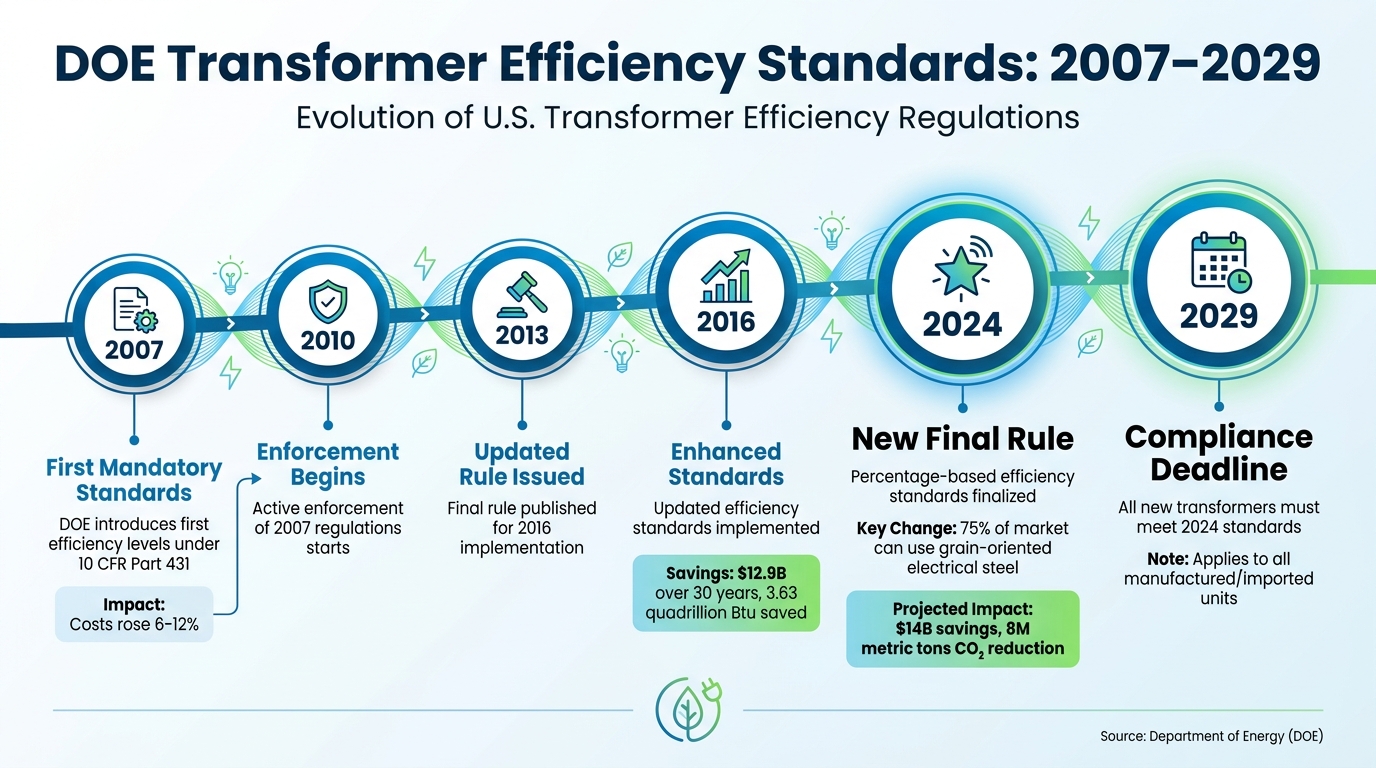
The Department of Energy (DOE) began regulating transformer efficiency in 2007 with its first official rule under 10 CFR Part 431. This rule introduced mandatory efficiency levels for both dry-type and liquid-filled distribution transformers, which officially went into effect in 2010. These initial regulations marked a significant step forward, pushing advancements in core materials and transformer design.
The 2007 standards caused transformer costs to rise by 6% to 12%, based on material market conditions at the time. In 2016, the DOE updated these standards, following a final rule issued in 2013, to further promote the use of better core materials and improved designs.
| Year | Key Event |
|---|---|
| 2007 | Introduction of the first mandatory efficiency levels |
| 2010 | DOE began active enforcement of regulations |
| 2016 | Implementation of updated efficiency standards |
| 2024 | Finalization of new percentage-based efficiency standards |
| 2029 | Deadline for compliance with updated standards |
These developments paved the way for the significant changes introduced in the 2024 final rule.
2024 Final Rule and What It Means
The 2024 final rule builds on past standards by introducing new material usage guidelines. Notably, it permits 75% of the market to incorporate grain-oriented electrical steel. By 2029, these regulations will apply to all transformers manufactured or imported into the U.S.
The DOE estimates these new standards will save $14 billion in energy costs and reduce carbon emissions by 8 million metric tons. These measures align with broader efforts to enhance energy efficiency across the power grid.
U.S. Secretary of Energy Jennifer Granholm highlighted the importance of these updates:
Currently, there are over 60 million distribution transformers mounted on utility poles and pads in neighborhoods nationwide, and a lot of these have been running for decades and just need to be replaced.
With electrification trends expected to drive a 160% to 260% increase in transformer capacity by 2050, these standards aim to address rising energy demands while minimizing environmental impact.
The industry is expected to incur conversion costs of $187 million for liquid-immersed transformers, $36.1 million for low-voltage dry-type units, and $5.7 million for medium-voltage dry-type transformers. However, these upfront costs are offset by the long-term energy savings and environmental benefits the updated standards promise to deliver.
Efficiency Requirements by Transformer Type
Liquid-Immersed vs. Dry-Type Transformers
To meet DOE efficiency standards, it's important to understand how different transformer types are evaluated. Low-voltage dry-type transformers have been regulated by the DOE since 2007, while liquid-immersed and medium-voltage dry-type transformers have been under regulation since 2010. Testing for low-voltage units is conducted at 35% load, while for liquid-immersed and medium-voltage dry-type transformers, testing occurs at 50% load. These testing conditions are designed to reflect the typical operating environments of each transformer type.
Efficiency Standards by kVA and Voltage
Efficiency requirements increase with the kVA rating. For instance, a 15 kVA transformer must achieve 97.7% efficiency for single-phase units and 97.89% for three-phase units. Medium-voltage dry-type transformers have additional criteria based on the Basic Impulse Insulation Level (BIL). For example, a 225 kVA three-phase transformer must meet 98.82% efficiency at a BIL of 20–45 kV, while at a BIL of 96 kV or higher, the requirement adjusts to 98.57%. These variations highlight the balance between insulation demands and efficiency goals.
No-Load and Load Loss Limits Comparison
The DOE sets minimum efficiency standards based on load conditions, with load losses adjusted to 75°C. Here's a breakdown of the requirements:
| Transformer Type | kVA Rating | Minimum Efficiency (%) | Test Load |
|---|---|---|---|
| LV Dry-Type (Single-Phase) | 15 | 97.7 | 35% |
| LV Dry-Type (Single-Phase) | 100 | 98.6 | 35% |
| LV Dry-Type (Three-Phase) | 15 | 97.89 | 35% |
| LV Dry-Type (Three-Phase) | 75 | 98.60 | 35% |
| LV Dry-Type (Three-Phase) | 500 | 99.14 | 35% |
| MV Dry-Type (20–45 kV BIL) | 225 | 98.82 | 50% |
| MV Dry-Type (20–45 kV BIL) | 1,000 | 99.28 | 50% |
| MV Dry-Type (≥96 kV BIL) | 500 | 98.89 | 50% |
| MV Dry-Type (≥96 kV BIL) | 2,500 | 99.33 | 50% |
Todd Benadum from ELSCO Transformers highlights the strict accountability manufacturers face:
Manufacturers are required to measure the efficiency of their new transformers and certify them to be in compliance with the DOE efficiency standards prior to shipment.
These standards provide a clear framework for testing and compliance, ensuring manufacturers adhere to regulations while optimizing transformer performance.
Testing and Compliance Procedures
Testing Standards and Load Conditions
Precision in testing and compliance is essential for meeting the Department of Energy's (DOE) efficiency standards, which continue to evolve. The DOE specifies detailed testing protocols in Appendix A to subpart K of Title 10 of the Code of Federal Regulations (CFR) 431. Manufacturers are required to test efficiency at 35% PUL (percent of the unit load) for low-voltage transformers and 50% PUL for medium-voltage and liquid-immersed transformers. These tests must be conducted under standard conditions, with results certified before shipment.
Testing is conducted at 60 Hz using a pure sinusoidal waveform at the transformer's rated voltage. For medium-voltage dry-type transformers, testing is performed at a Power Factor (PF) of 1. Additionally, all test equipment must undergo regular calibration, with the ability to detect even a 0.1% change in winding resistance. This level of precision ensures accurate efficiency calculations and consistent compliance across manufacturers. Such rigorous standards enable standardized performance evaluations, which are further refined through temperature corrections.
Temperature Correction for Efficiency Evaluation
Standardized temperature corrections are applied to ensure uniformity in efficiency comparisons across different testing environments. These corrections allow manufacturers to adjust loss evaluations to a defined internal temperature, ensuring consistent and fair comparisons regardless of the ambient conditions during testing. When tests are conducted at temperatures that differ from the reference points, manufacturers must apply correction factors to align the results with standard conditions.
The reference temperatures vary depending on the type of transformer. For both low-voltage and medium-voltage dry-type transformers, the reference temperature is 20°C for no-load loss and 75°C for load loss. For liquid-immersed transformers, the reference points are 20°C for no-load loss and 55°C for load loss. These standardized baselines make it easier to compare efficiency ratings across various products and manufacturers, creating a level playing field within the industry.
Impact of Efficiency Standards on Energy Savings and Industry
Expected Energy Savings and Loss Reductions
The updated efficiency standards, built on comprehensive testing, promise even greater energy and cost savings for consumers. The Department of Energy (DOE) projects substantial long-term benefits. For instance, the 2016 standards were estimated to save $12.9 billion over 30 years, with energy savings of 3.63 quadrillion Btu. These savings also translate to avoiding 265 million metric tons of carbon dioxide emissions - similar to removing 52 million cars from the road annually.
The 2024 final rule takes these efforts further, targeting 10–30% reductions in energy losses across various transformer types. Notably, low-voltage dry-type single-phase transformers face the highest reduction goal of 30%, while smaller liquid-immersed, single-phase transformers below 100 kVA aim for 5% loss reductions. U.S. Secretary of Energy Jennifer Granholm highlighted the broader impact:
This improved final rule will save Americans over $14 billion in energy costs, and it'll also slash nearly 8 million metric tons of carbon dioxide pollution.
Efficiency gains become even more impactful over time. For instance, a single three-phase 75 kVA transformer, operating at an average 35% load over 25–30 years, can save approximately $166 annually (based on $0.12 per kW-Hr) and cut 1.19 metric tons of CO₂ emissions each year - equivalent to saving 121 gallons of gasoline. Additionally, more efficient transformers generate less heat, which can lower cooling costs in facilities where they’re installed.
Advanced Materials and Design Changes
The push for higher efficiency has driven advancements in materials and design, leading to significant improvements in transformer performance. Manufacturers are now adopting cutting-edge materials to meet these updated standards. One major innovation is the shift from traditional grain-oriented electrical steel (GOES) cores to amorphous metal (AM) cores, which significantly cut no-load core losses. Although the initial 2024 proposal aimed for 90% adoption of amorphous cores, the final rule allows about 75% of the market to continue using GOES, balancing efficiency goals with domestic supply chain considerations.
Other design enhancements include using lower-resistance copper conductors and transitioning to 80°F and 115°F-rise configurations from the standard 150°F-rise. These low-temperature-rise models maintain better efficiency at higher loads, remaining nearly two percentage points more efficient when operating above 80% capacity. However, these advancements come with challenges: higher-quality materials increase both the upfront cost and the physical weight of transformers. To help manufacturers adapt, the compliance deadline for adopting amorphous ribbon technology has been extended to 2029, providing a five-year window to update production processes.
Sourcing High-Efficiency Transformers
What to Consider When Purchasing
When buying DOE-compliant transformers, it’s essential to confirm a few technical details. Transformers made on or after January 1, 2016, must adhere to the energy efficiency standards outlined in 10 CFR Part 431. These standards apply to low-voltage dry-type, medium-voltage dry-type, and liquid-immersed transformers. The specific efficiency requirements depend on whether you need a single-phase or three-phase unit, along with its kVA rating and voltage class.
Testing conditions also differ based on the transformer type. Low-voltage dry-type transformers are evaluated at 35% load, while medium-voltage dry-type and liquid-immersed models are tested at 50% load. For instance, a 1,000 kVA three-phase low-voltage dry-type transformer must achieve at least 99.28% efficiency at 35% load. High-efficiency transformers typically require more core material, making them heavier - sometimes by as much as 2%–25%. For example, a 167 kVA single-phase overhead transformer might weigh 21% more than a standard model.
"Every increment in the transformer's efficiency equates to additional material and manufacturing costs. Some of these costs are inevitably passed on to the consumers." - Daelim Transformer
Before making a purchase, check if your application qualifies for one of the 13 exempt categories, such as autotransformers, rectifier transformers, or welding transformers. Additionally, ensure the unit has the necessary certifications, like UL/cUL or CSA listings, and complies with ANSI/IEEE C57 or IEC 60076 standards. For installations in areas sensitive to noise, consider transformers that meet NEMA ST-20 sound level standards, which are typically 3 to 5 dB quieter than standard levels [[12]](https://bidmanager.eaton.com/BidManager/Help/Sales/en-US/TakeOff_Help_Files/DTX Transformers Help/DTX Transformers Help/DTX_Transformers_Help.htm). Following these guidelines ensures your transformer meets DOE requirements and contributes to long-term energy savings.
For a smoother buying experience, consider using a reputable online marketplace.
Using Electrical Trader for High-Voltage Equipment
Electrical Trader makes it easier to find DOE-compliant transformers by offering a centralized marketplace. You can filter listings by kVA ratings, voltage classes, and BIL to quickly find models that suit your project needs. Whether you're looking for a standard three-phase transformer for commercial applications or specialized substation equipment, the platform provides a range of options. These include baseline DOE-compliant models and NEMA Premium units, which deliver about 30% lower losses compared to older NEMA TP-1 standards [[12]](https://bidmanager.eaton.com/BidManager/Help/Sales/en-US/TakeOff_Help_Files/DTX Transformers Help/DTX Transformers Help/DTX_Transformers_Help.htm).
The platform also highlights specialized features for unique applications. For facilities with high non-linear loads - like those caused by electronics or variable frequency drives - you can find transformers with K-factor ratings or harmonic-mitigating designs [[12]](https://bidmanager.eaton.com/BidManager/Help/Sales/en-US/TakeOff_Help_Files/DTX Transformers Help/DTX Transformers Help/DTX_Transformers_Help.htm). Additionally, transformers with lower temperature rise ratings, such as 80°C or 115°C instead of the standard 150°C, are available to help reduce winding losses under heavy loads [[12]](https://bidmanager.eaton.com/BidManager/Help/Sales/en-US/TakeOff_Help_Files/DTX Transformers Help/DTX Transformers Help/DTX_Transformers_Help.htm). For outdoor or harsh environments, you can choose from models with NEMA 3R weather-protected or NEMA 4X stainless steel enclosures [[12]](https://bidmanager.eaton.com/BidManager/Help/Sales/en-US/TakeOff_Help_Files/DTX Transformers Help/DTX Transformers Help/DTX_Transformers_Help.htm).
This streamlined approach eliminates the need to contact multiple suppliers and even offers used equipment options, which can lower upfront costs while still meeting mandatory efficiency standards.
Conclusion
Final Thoughts on Transformer Efficiency Standards
The DOE transformer efficiency standards are a major step toward cutting energy waste across the U.S. Since transformers operate continuously for 25–30 years at an average load of around 35%, even minor improvements in efficiency can lead to significant long-term savings. Current standards mandate efficiency levels between 98% and 99% for most transformers, which translates to considerable energy and cost reductions while also lowering carbon emissions.
"Considering the life expectancy of a transformer and the fact that the transformer will be on 24 hours a day, 7 days a week for the next 25-30 years, even small energy efficiency improvements will pay dividends for decades." - Hammond Power Solutions
These benefits highlight why adhering to DOE standards is essential for achieving long-term operational efficiency.
Understanding these standards allows for smarter purchasing decisions, helping to minimize both energy costs and environmental impact. While high-efficiency transformers come with higher upfront costs due to premium materials, they produce less heat and result in lower energy bills over their lifespan, ultimately offsetting the initial investment. By making informed choices based on these standards, users can select transformers that provide both economic and energy-related advantages.
Platforms like Electrical Trader simplify the process of finding DOE-compliant and NEMA Premium transformers. Whether you're replacing outdated equipment or planning a new project, prioritizing total cost of ownership over initial price - and utilizing services like Electrical Trader - ensures both financial savings and environmental responsibility in the long run.
FAQs
Do existing transformers need to be replaced by April 23, 2029?
By April 23, 2029, all existing transformers must comply with the updated energy conservation standards. While adherence to these regulations is mandatory, it doesn’t mean every transformer needs to be replaced. Instead, they simply need to meet the new requirements.
How do I verify a transformer is DOE-compliant before buying it?
To ensure a transformer complies with Department of Energy (DOE) standards, start by checking if it meets the energy efficiency requirements established on January 1, 2016. Look for certification marks or labels that indicate compliance.
Make sure the specific transformer type - whether it's low-voltage dry-type, liquid-immersed, or medium-voltage dry-type - is included under the DOE regulations. If you're uncertain, consult the supplier and request documentation that verifies compliance.
Will higher-efficiency transformers require changes to pads, poles, or handling equipment?
Higher-efficiency transformers often come with unique design and installation requirements, which might necessitate modifications to pads, poles, or handling equipment. These adjustments are tied to updated energy efficiency standards and could affect the existing electrical infrastructure.