Historical Price Trends: Breakers and Transformers
Transformer and circuit breaker prices have surged significantly between 2019 and 2026 due to increased demand, raw material costs, and supply chain challenges. Here's a breakdown of the key trends:
- Transformer Prices: Up by 45%–95%, with lead times stretching to 3 years for high-voltage units. Used transformers can save 30%–60% upfront but may lead to higher long-term energy costs.
- Circuit Breaker Prices: More stable, increasing by 47% since 2021, with less severe supply shortages compared to transformers.
- Raw Materials: Copper prices rose 70%, and grain-oriented electrical steel (GOES) costs nearly doubled, driving up production expenses.
- Market Gaps: The U.S. faced a 30% shortfall in power transformers and 10% in distribution units by late 2025.
- Energy Costs: Older transformers can cost $11,000 more per year in energy compared to newer models.
Key Insight: Buyers are turning to surplus and reconditioned equipment to cut costs and avoid long lead times, though trade-offs in efficiency and lifespan must be considered. Platforms like Electrical Trader help connect buyers with ready-to-ship options.
Transformer and Circuit Breaker Price Trends 2019-2026
Price Changes from 2019 to 2026
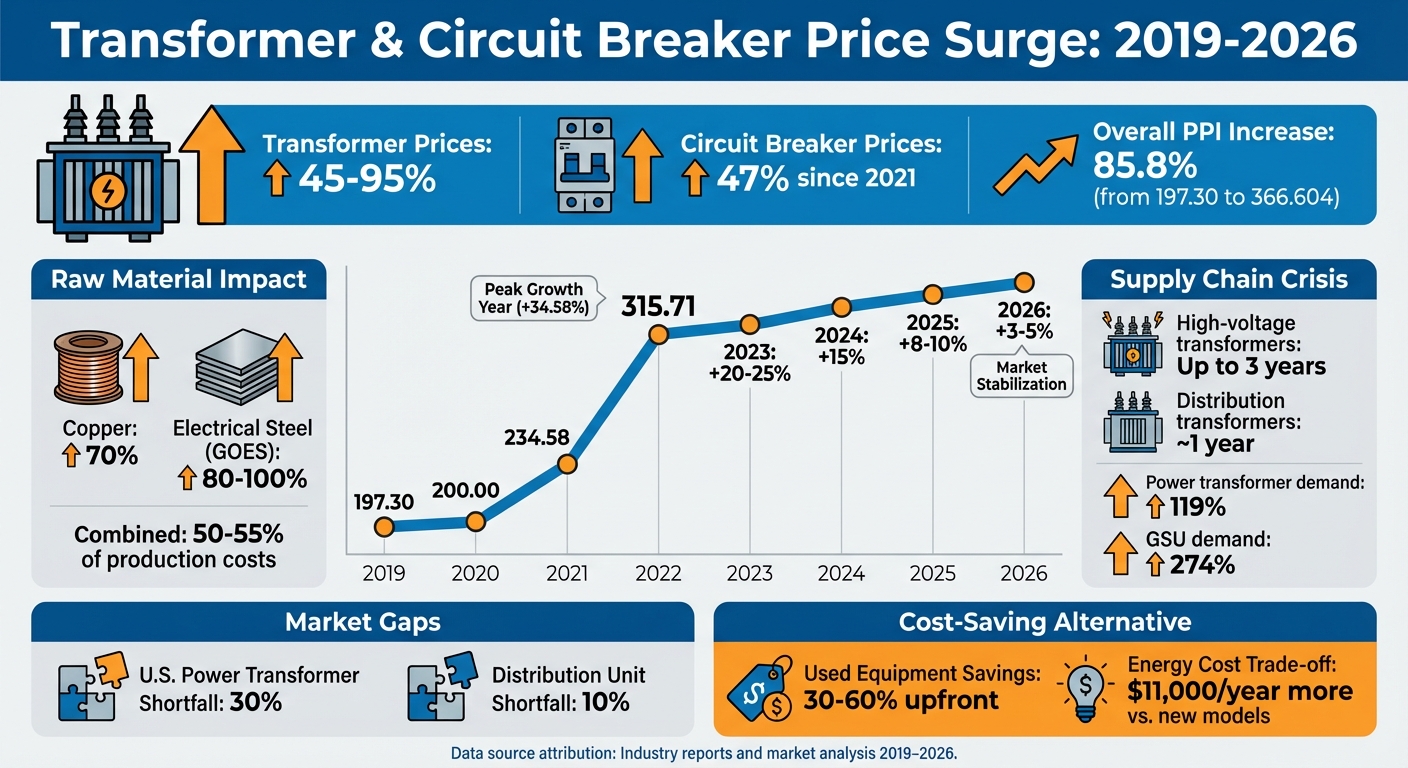
Between 2019 and 2026, the prices of power transformers and circuit breakers saw substantial increases. Power transformer prices climbed by 77%, while circuit breaker prices rose 47% since 2021. The Producer Price Index (PPI) for power and distribution transformers jumped from 197.30 in December 2019 to 366.604 by January 2026 - an overall increase of 85.8%. These numbers highlight the sharp price shifts during this period.
Breaking it down further, annual trends reveal significant changes. From December 2021 to December 2022, the PPI for distribution transformers surged by 34.58%. The highest annual growth rates were recorded in 2023, ranging between 20–25%, before slowing to 15% in 2024 and 8–10% in 2025. By 2026, the market stabilized, with forecasted price increases of 3–5% as new manufacturing capacity came online.
| Year (End of Period) | Transformer PPI (Index Dec 1999=100) | Annual % Change |
|---|---|---|
| 2019 | 197.30 | – |
| 2020 | 200.00 | 1.37% |
| 2021 | 234.58 | 17.29% |
| 2022 | 315.71 | 34.58% |
| 2025 (Sept) | 351.192 | 11.24% (from 2022) |
| 2026 (Jan) | 366.604 | 4.39% (from Sept 2025) |
Data sourced from.
Other key product categories also experienced notable price hikes. GSU (generator step-up) transformer prices increased by 45% since 2019, while medium-voltage switchgear prices rose by 50% since 2021. Demand for power transformers surged by 119% between 2019 and 2025, with GSU demand skyrocketing 274% during the same timeframe. According to Wood Mackenzie, "Extended lead times and elevated costs will become the new normal, potentially derailing grid modernization efforts". These challenges were further intensified by rising raw material costs.
Raw material inflation played a critical role in driving up prices. Copper prices rose by over 70% between 2020 and 2025, while grain-oriented electrical steel prices increased by 80–100%. Combined, these two materials account for 50–55% of a transformer's total production cost. By Q2 2025, lead times for power transformers averaged 128 weeks, with GSUs reaching 144 weeks. These detailed trends underscore the complexity of the market, setting the stage for examining brand-specific pricing differences in the next section.
sbb-itb-501186b
Price Patterns by Brand
Between 2019 and 2026, major manufacturers like Siemens, ABB, Schneider Electric, Eaton, and GE saw their prices increase by 45%–95%, depending on the model and specifications. These price shifts were driven by differences in supply chains, production locations, and exposure to raw material costs.
Each brand responded differently to these challenges. Siemens Energy, for instance, took a proactive approach to address supply constraints. In June 2025, the company announced plans to start manufacturing large power transformers in the United States by 2027. This move aimed to address a reported 30% shortfall in transformer supply, as noted by Reuters.
The rising costs of essential raw materials, such as electrical steel and copper, played a significant role in these price hikes. Since these materials make up a large portion of production costs, manufacturers had little choice but to pass these increases on to customers.
Beyond raw material costs, the industry saw a shift in priorities. Extended lead times and inflation in material costs pushed the focus away from competitive pricing and toward the ability to deliver products on time. As a result, the pricing differences between brands began to narrow, reflecting the shared pressures across the industry.
Import tariffs also added to the pricing challenges, particularly for international brands. ABB and Schneider Electric, which relied heavily on overseas manufacturing through 2025, faced duties on finished goods and electrical components. Domestic producers, however, were able to avoid some of these costs. Additionally, a reshoring trend began to reshape the market. By 2025, 20 manufacturers had announced plans to expand production facilities in the U.S., further influencing brand pricing dynamics. These evolving strategies highlight the broader market changes already in motion.
Factors Affecting Prices
Raw material costs play a significant role in the pricing of both circuit breakers and transformers, though the impact varies between the two. Transformers rely heavily on copper for windings and silicon steel for cores, making their prices particularly sensitive to fluctuations in commodity markets. Circuit breakers, while also using copper and steel, incorporate silver for contacts and are more influenced by the costs of switching mechanisms, electronic components, and meeting safety standards. Since 2020, some transformer models have seen price hikes ranging from 100% to 200%, whereas circuit breakers have experienced more moderate increases. These material cost challenges are further compounded by supply chain complexities.
Supply chain disruptions have created distinct hurdles for transformers and breakers. High-voltage transformers now face lead times of up to three years, while distribution transformers typically require about one year. The U.S. imports a significant portion of its transformers - 80% of high-voltage models and 40–50% of distribution units - leaving the market vulnerable to shipping delays and trade restrictions. Adrienne Lotto, Senior Vice President of Grid Security at the American Public Power Association, highlighted the issue:
On average, it takes three years to acquire high-voltage transformers and one year for distribution transformers.
One of the biggest constraints for transformers is the supply of grain-oriented electrical steel (GOES). Cleveland-Cliffs is the only domestic producer of this material, and imports from Japan and South Korea are subject to a 25% tariff. Circuit breakers, on the other hand, are less affected by GOES shortages, as they typically use more common steel grades. Still, supply chain issues add another layer of complexity to the pricing landscape.
Market demand has surged due to the rapid growth of AI data centers, renewable energy initiatives, and semiconductor manufacturing. These trends have pushed demand for both transformers and breakers to new levels. Building on the earlier price increases, this heightened demand has further widened the pricing gap between the two product categories. Benjamin Boucher, Senior Data Analyst at Wood Mackenzie, explained:
The explosive growth we've seen in renewables over the past five years has been a huge boost in demand for transformers.
He further noted:
Given how much demand is outpacing supply, there's not much risk of anyone being burned in the next two or three years.
This combination of soaring demand, tariffs on imported goods, and supply constraints has created a challenging pricing environment for both transformers and circuit breakers.
Comparison Table
Between 2019 and 2026, transformers have shown unpredictable pricing trends, while circuit breakers have remained relatively steady. Transformer prices have surged dramatically - rising between 45% and 95%, depending on the model - while circuit breakers have exhibited more stable behavior within the $11 billion high-voltage equipment market.
Here’s a breakdown of the pricing and market behavior for both equipment types:
| Equipment Type | Pros (Pricing & Market Behavior) | Cons (Pricing & Market Behavior) |
|---|---|---|
| Transformers | High resale value for Tier 1 brands like ABB, Siemens, and Schneider; buying used can save 30–60% on upfront costs. | Prone to extreme price hikes (up to 95%); highly affected by fluctuations in copper and electrical steel prices; lead times can exceed two years. |
| Breakers | Operate within a stable $11 billion market; experience less severe supply shortages compared to transformers. | Susceptible to price increases driven by demand spikes and commodity costs. |
These distinctions highlight the challenges and opportunities for managing costs in this market.
For instance, opting for used transformers can result in significant savings upfront. A 10 MVA unit might save $45,000 initially, but it could lead to an additional $100,000 in energy expenses over ten years. On the other hand, circuit breakers don’t carry the same long-term operational cost risks, making the used market a safer bet for buyers. This dynamic has pushed many companies to turn to surplus and reconditioned equipment to stay on track with their projects.
Conclusion
The pricing landscape for transformers has seen a dramatic shift between 2019 and 2026. Prices surged by 45–95%, driven by rising demand from AI data centers, renewable energy projects, and the need to replace aging infrastructure. These factors, combined with brand-specific pricing variations, have reshaped the market in significant ways.
However, the challenge isn't limited to rising costs - availability has become a major hurdle. Lead times for transformers have ballooned from 6–8 months before 2020 to 18–36 months for larger units. This has contributed to a 30% shortfall in power transformers across the U.S., forcing procurement teams to plan purchases 2–3 years in advance.
In response, the surplus and reconditioned transformer market has become a vital resource. Platforms like Electrical Trader (https://electricaltrader.com) connect buyers with pre-verified, ready-to-ship transformers and substation equipment. By bypassing lengthy manufacturing delays, these options not only save time but also offer upfront cost reductions of 30–60% compared to new equipment.
For those considering high-efficiency models, EcoDesign Tier 2 transformers are worth noting. While they cost about 10% more initially, they deliver annual energy savings of $15,000–$25,000. On the other hand, when buying used equipment, it’s critical to verify testing documentation - such as dissolved gas analysis (DGA), breakdown voltage (BDV), and insulation resistance reports - to ensure reliability and prevent expensive failures.
Organizations that streamline their sourcing strategies - whether by adopting standardized designs, integrating digital monitoring, or utilizing Electrical Trader’s marketplace - are better positioned to navigate the challenges of cost and supply in the high-voltage equipment market.
FAQs
How do I decide between buying new, used, or reconditioned transformers?
When deciding between new, used, or reconditioned transformers, several factors come into play: cost, reliability, safety, and the specific demands of your project.
- New transformers provide peak performance, meet the latest safety and efficiency standards, and typically offer a longer lifespan. These are a great choice for critical applications or projects requiring long-term reliability.
- Used or reconditioned transformers are more budget-friendly and often available on shorter timelines. However, they may show signs of wear or adhere to older standards, so a thorough inspection is essential before use.
Ultimately, your decision should focus on balancing safety, reliability, and the unique needs of your application.
Which specs impact transformer and breaker pricing the most?
Transformers and breakers are priced based on several key factors. For transformers, capacity and voltage ratings are major drivers of cost. Materials like the core and winding components also contribute significantly. Beyond these, pricing is influenced by design type, market conditions, supply chain factors, and any required customization. Together, these elements shape the final costs across various brands and models.
What tests should I require before buying a used transformer?
Before buying a used transformer, it's important to run a few critical tests to assess its condition and performance:
- Insulation Resistance Test: Verifies the strength and reliability of the insulation system.
- Turns Ratio Test: Ensures the windings have the correct ratio to function properly.
- Winding Resistance Test: Identifies any potential damage or irregularities in the windings.
- Dielectric Withstand Test: Confirms the transformer's ability to handle normal operating voltages safely.
- Oil Testing (for oil-filled transformers): Detects internal problems, such as contamination or degradation, in transformers that use oil.
These checks are essential to ensure the transformer operates safely and efficiently.