How Raw Material Costs Affect Breaker and Transformer Prices
Raw material costs heavily impact the prices of breakers, transformers, and power distribution equipment. Key materials like copper and grain-oriented electrical steel (GOES) make up 50–70% of a transformer's cost, meaning even slight price changes can significantly affect equipment prices. For example:
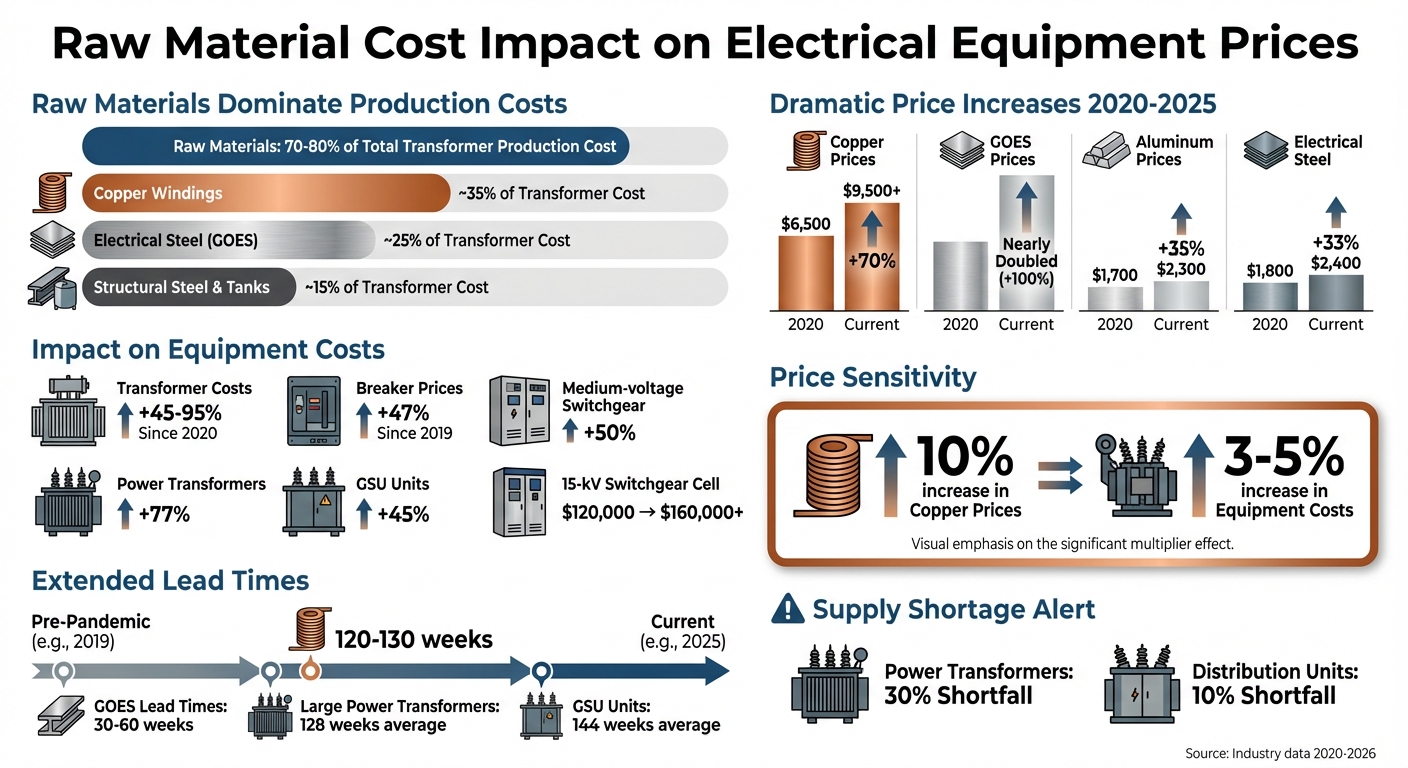
- Copper prices rose 70% since 2020, driving transformer costs up by 45–95%.
- GOES prices nearly doubled, contributing to higher costs and longer lead times (now 120–130 weeks for large transformers).
- A 10% increase in copper prices can raise equipment costs by 3–5%.
Manufacturers face rising material costs, tariffs, and supply chain delays, while buyers struggle with extended procurement timelines and price volatility. Strategies like monitoring commodity prices, negotiating flexible contracts, and exploring surplus or reconditioned equipment can help manage these challenges.
How Raw Material Costs Impact Transformer and Breaker Prices: Key Statistics
Transformers: Pricing, Procurement, and Best Practices
sbb-itb-501186b
Primary Raw Materials Used in Breakers and Transformers
Raw materials make up 70% to 80% of the total production cost of a power transformer, making them the biggest factor in determining equipment pricing. Copper, electrical steel, and aluminum are the three key materials that influence both performance and cost. Let’s break down their roles and cost implications.
Copper: The Backbone of Conductivity
Copper is the go-to material for transformer windings and breaker components, thanks to its impressive conductivity of 59.6 MS/m and thermal conductivity of 401 W/m·K. These properties help minimize resistive losses and disperse heat almost twice as effectively as aluminum. Its tensile strength, ranging from 200–250 MPa, is nearly double aluminum’s 70–120 MPa, allowing copper windings to endure the intense electromagnetic forces that occur during short-circuit events.
The Copper Development Association highlights copper’s reliability:
Copper is the standard conductor metal against which all other conductor materials are measured... Copper oxide is a relatively good conductor, whereas aluminum oxide is an insulator.
This reliability reduces the need for frequent maintenance. Copper windings typically account for roughly 35% of a transformer's total cost, and copper prices are projected to range between $8,000 and $10,000 per ton in 2025. These factors directly influence the pricing of both breakers and transformers.
Electrical Steel (GOES): The Heart of Transformer Cores
Grain-oriented electrical steel (GOES) is the material of choice for transformer cores, where it efficiently conducts magnetic flux and plays a major role in overall energy efficiency. Designed to minimize hysteresis and eddy current losses, even a small reduction of 0.1 W/kg in core loss can improve transformer efficiency by 0.15% to 0.25%. For a 100 MVA transformer, this translates into over $50,000 in lifetime energy savings.
As noted by Qualitrol Corp:
GOES is the engineered heart of most distribution and many power transformers; its magnetic properties determine core losses and efficiency, making it essential for production.
Electrical steel typically represents about 25% of a transformer's manufacturing cost. Standard grades are priced around $2,400 per ton, but high-permeability (Hi-B) GOES, which can cut no-load losses by 25% compared to conventional grades, costs more - ranging from $6.50 to $12.00 per kg. In North America, limited supply is a challenge, as Cleveland-Cliffs/AK Steel is the only domestic producer, and bottlenecks are expected to continue until 2026–2027.
Aluminum and Steel: Supporting Roles
Aluminum is often used as a cost-effective alternative to copper in some windings. While it offers just 61% of copper’s conductivity, its density is only 30% of copper’s, allowing for significant cost savings - about 45% less than copper. However, aluminum requires larger cross-sections to match copper’s current-carrying capacity, which increases transformer size and necessitates more insulation, larger steel tanks, and additional cooling oil.
Structural steel, on the other hand, provides the mechanical backbone for transformers and breakers. It’s used in tanks, housings, and frames to protect internal components from environmental and mechanical stresses. Structural steel and tank components generally account for 15% of a transformer’s total cost. In breakers, steel and aluminum housings ensure durability while keeping the weight manageable for easier installation and maintenance. These material choices directly influence the overall costs discussed in the next section.
How Raw Material Price Changes Affect Equipment Costs
Shifts in raw material prices have a direct and immediate impact on the cost of equipment like breakers and transformers. Since raw materials make up a significant portion of production costs, even small price changes can lead to noticeable fluctuations in what buyers pay. Copper, electrical steel, and aluminum are the three primary materials driving these cost changes, each influencing pricing in its own way. Here’s a closer look at how these materials affect equipment costs.
Copper Price Fluctuations and Their Effects
Copper price swings are a major factor for transformer and breaker manufacturers. Between 2020 and 2025, copper prices rose by 46%, climbing from $6,500 to $9,500 per ton. By January 2026, copper reached a record high of $13,387.50 per ton. Since copper windings account for roughly 35% of a transformer's cost, these price changes can alter transformer prices by about ±10–15%.
The breaker and switchgear market is similarly impacted. For example, the Producer Price Index (PPI) for switchgear manufacturing rose 26% from 2021 to March 2025, reaching 332.801. This increase has pushed the price of a 15-kV metal-clad switchgear lineup from $120,000 per cell to over $160,000. Anticipation of 15% to 25% tariffs on refined copper in mid-2026 led U.S. buyers to stockpile supplies early in the year. High copper costs have also driven manufacturers to substitute aluminum in non-critical applications to manage expenses.
Electrical Steel Price Increases and Transformer Costs
Electrical steel price hikes have also reshaped transformer costs. Between 2020 and 2025, prices increased by about 33%, rising from $1,800 to $2,400 per ton. In some cases, grain-oriented silicon steel (GOES) prices nearly doubled due to supply shortages and higher energy costs, with spikes as high as 180% in 2020 alone.
Electrical steel typically makes up 15% to 30% of a transformer's material costs. These price increases have extended lead times dramatically, from 30–60 weeks before the pandemic to 120–130 weeks. As Taishan Transformer explains:
Transformer costs directly reflect fluctuations in copper, silicon steel, and oil prices, which constitute over half of total production costs.
New efficiency regulations, such as the EU EcoDesign Tier 2 and DOE 2023 standards, have added further pressure. These regulations require manufacturers to use higher-grade electrical steel, increasing unit prices by 8–12%. Upgrading to high-grade GOES (M2) or amorphous alloys for even a 1% improvement in steel loss performance can raise material costs by 3–4%.
Steel and Aluminum Tariffs: Added Cost Pressures
Aluminum prices have also climbed, rising 35% from $1,700 to $2,300 per ton between 2020 and 2025. Structural steel, which accounts for 10–15% of total material costs, faces additional pricing pressures from import tariffs and domestic content requirements.
Northfield Transformers highlights:
The tariff effects on prices extend beyond direct material costs. Import tariffs on finished transformers have prompted utilities to seek domestic alternatives, but limited domestic manufacturing capacity means longer lead times and premium pricing.
The Infrastructure Investment and Jobs Act (IIJA) has further tightened supply chains by mandating domestic content. With the U.S. projected to rely on imports for 80% of power transformers by 2025, these policies have created bottlenecks. Transformers made in the U.S. or Europe now cost 25–40% more than those from Asia. Combined with rising raw material costs and surging demand from AI data centers and grid updates, transformer prices have increased 45–95% since 2020. These tariff-driven pressures add another layer of price volatility for both breakers and transformers.
Recent Price Trends and How Manufacturers Respond
Recent Price Increases for Breakers and Transformers
Equipment prices have continued their upward climb, driven by volatile raw material costs. Since 2019, breaker prices have jumped 47%, medium-voltage switchgear has risen 50%, power transformers have surged 77%, and GSU units are up 45%. Some distribution transformer models have seen price increases ranging from 45% to 95%, depending on their specifications.
The cost of raw materials is a major factor. Copper prices increased by 10% to 15% in 2025 compared to the previous year, while silicon steel (GOES) prices climbed about 5%. Grupo Edmar highlights the impact:
In some power transformers, copper can represent up to 40% of the total cost of materials, so any increase in its price has an immediate impact on the value of the final product.
The Producer Price Index (PPI) for electric power and specialty transformer manufacturing hit 451.847 in January 2026, underlining ongoing inflationary pressures.
Lead times have worsened alongside price hikes. By mid-2025, large power transformers had average lead times of 128 weeks, while GSU units reached 144 weeks. Wood Mackenzie has warned:
Extended lead times and elevated costs will become the new normal, potentially derailing grid modernization efforts.
The industry is also grappling with supply shortages, with a 30% shortfall in power transformers and a 10% shortfall in distribution units reported as of late 2025. These conditions have forced manufacturers to adopt new strategies to address rising costs and supply chain challenges.
How Manufacturers Manage Cost Changes
To combat soaring prices and prolonged lead times, manufacturers have made substantial investments and adjusted their strategies. Since 2023, they have poured nearly $2 billion into expanding North American production. Key projects include:
- Hitachi Energy’s $457 million plant in South Boston, Virginia, as part of a $1 billion investment.
- Siemens Energy’s $150 million facility in Charlotte, North Carolina.
- Eaton’s $340 million plant in South Carolina.
These investments aim to boost capacity while addressing the persistent impact of raw material costs. Manufacturers are also employing several cost-control measures, such as:
- Financial hedging for metals to manage price volatility.
- Optimizing designs to reduce material waste.
- Long-term supplier contracts to stabilize procurement costs.
Some companies are exploring material substitutions, like using aluminum instead of copper in non-critical applications, though this involves trade-offs in design. Others, like Sunbelt Solomon, are focusing on repair and recycling facilities to refurbish existing transformers, sidestepping the raw material supply chain altogether.
To further adapt, manufacturers are moving away from fixed-price quotes. They now rely on monthly pricing updates and flexible clauses tied to material indices, ensuring they can respond to market fluctuations more effectively.
How Buyers Can Manage Raw Material Cost Impacts
As manufacturers contend with fluctuating prices and extended lead times, buyers can take proactive steps to handle these challenges effectively.
Track Commodity Markets for Material Prices
Keeping a close eye on commodity prices is a smart way for buyers to reduce risks tied to raw material volatility. For example, the London Metal Exchange (LME) provides daily price updates for copper and aluminum, which together make up 35–45% of a transformer's total cost. When copper prices climb above $10,000 per ton, manufacturers often raise their quotes by 3–5%. Recent trends show copper prices continuing to rise.
By understanding these price movements, buyers can better plan their purchases. Monitoring the "should cost" - a calculation that factors in materials, labor, and energy - enables buyers to verify supplier pricing. This kind of market awareness also sets the stage for negotiating contracts that are more adaptable to price fluctuations.
Negotiate Flexible Pricing Terms
With solid market data in hand, buyers can work toward contracts that account for changing material costs. Fixed-price contracts are increasingly risky in today’s unpredictable market. Many organizations hedge prices or lock in long-term agreements to cushion against sudden cost increases. Collaborating with suppliers to include pass-through clauses for raw material fluctuations ensures both parties are shielded from unexpected price swings.
Buyers should also request monthly quote updates and confirm effective dates to avoid surprises. Opting for standard models instead of fully custom designs can cut costs by as much as 20%. Additionally, taking advantage of government incentives for high-efficiency equipment may cover up to 30% of the extra expense for premium, low-loss transformers.
Use Online Marketplaces to Find Better Prices
Long lead times for new equipment are driving buyers to explore surplus and reconditioned options. Platforms like Electrical Trader (https://electricaltrader.com) offer access to verified listings of ready-to-ship inventory throughout North America. This strategy helps buyers sidestep the multi-year waits and high costs tied to new equipment.
Electrical Trader helps by... connecting buyers with verified listings of surplus and reconditioned transformers and reducing procurement times compared to traditional channels.
These online marketplaces make it easier to compare suppliers, check prices, and review inventory. Purchasing surplus equipment also avoids the impact of current commodity price hikes. However, buyers should confirm the condition and testing records of surplus units to ensure they’re reliable and won’t lead to higher maintenance costs down the road.
Conclusion
The cost of equipment in the electrical industry is heavily influenced by raw material prices. For instance, materials account for 70–80% of production costs for power transformers. While breakers have a different composition, their pricing still reflects commodity market trends. Copper and Grain-Oriented Electrical Steel (GOES) are particularly impactful - just a 10% rise in copper prices can lead to a 3–5% increase in overall equipment costs. Recent spikes in commodity prices have caused transformer costs to jump by 60–95%.
Keeping an eye on commodity markets is essential for buyers. Using tools like the London Metal Exchange to track copper prices or monitoring trends in electrical steel can provide a clear picture of market conditions. This data-driven approach allows buyers to negotiate more effectively, basing discussions on real market indices rather than relying on supplier estimates.
"In the electrical industry, anticipation is key. Cost management is not just an accounting task, but a comprehensive strategy that defines a company's reputation and strength." - Grupo Edmar
Given the current market dynamics, adopting flexible sourcing strategies is critical. With lead times for large units stretching to 120–210 weeks and prices expected to remain "high but steady" through 2026, buyers need to explore multiple options. These include standardizing specifications, considering total lifecycle costs over initial expenses, and utilizing verified surplus equipment through platforms like Electrical Trader (https://electricaltrader.com) when new equipment timelines are impractical.
Ultimately, understanding the link between raw material costs and equipment pricing helps industry players strike a balance between cost, efficiency, and delivery timelines. In a market facing supply constraints and growing infrastructure needs, strategic decisions grounded in raw material trends can ensure reliable performance and long-term success.
FAQs
Why do transformer prices rise faster than copper or steel prices?
Transformer prices are rising at a faster pace than copper or steel, and the reason lies in their intricate manufacturing process. Unlike raw materials, transformers require high-grade components like electrical steel and pure copper, which already come at a premium. Add to that the need for precision engineering, skilled labor, and rigorous testing, and the costs climb even higher.
On top of that, supply chain disruptions and extended lead times make the situation even more unpredictable. These factors mean transformer prices are not just tied to raw material costs - they're far more reactive to production challenges.
How can I estimate a quote increase from a copper price spike?
To gauge a potential quote increase, it’s essential to evaluate copper’s role in transformer costs. For instance, if copper prices jump by 20%, you can expect transformer quotes to rise by a similar percentage or slightly more. Industry data reveals that transformer costs have surged between 45% and 95% since 2019, largely driven by material price increases. Keep a close eye on current copper prices and factor its proportionate impact on overall costs when adjusting quotes, while also considering broader industry trends.
When does buying surplus or reconditioned equipment make more sense than ordering new?
When raw material costs - like copper and steel - spike or supply chain delays make new equipment pricey and hard to get, opting for surplus or reconditioned equipment can be a much smarter move. These items are usually more budget-friendly and readily available. Plus, when they've been thoroughly tested and refurbished, they offer reliable performance. This makes them an excellent option when navigating high prices or logistical hiccups.