

NFPA 110 Compliance Checklist for 2026
If your EPSS file is missing test data, you can fail an audit even when the generator runs fine.
I’d boil this checklist down to five jobs: confirm the EPSS rating, finish acceptance testing, follow the weekly/monthly/annual test plan, check fuel and batteries closely, and keep 36 months of records. The article also points out a few numbers you need to know right away: 30 minutes, 30% load, 5-minute retransfer, 5-minute cooldown, 75% fuel before testing, and a 4-hour triennial test for Level 1 systems.
Here’s the short version of what you need to verify:
- EPSS scope: I’d treat the generator, ATS, controls, batteries, charger, and fuel system as one code-covered system.
- Code baseline: I’d confirm Level, Type, and Class against the nameplate, drawings, and O&M records before reviewing tests.
- Startup proof: I’d make sure acceptance testing shows start, transfer, loaded run, alarms, retransfer, and shutdown data with actual readings.
- Recurring tests: I’d check weekly inspections, monthly runs, monthly ATS exercise, battery testing, annual fuel review, and the Level 1 36-month / 4-hour test.
- Fuel and battery focus: I’d pay close attention here because many no-start problems come from bad fuel, weak batteries, charger issues, or heater problems.
- Records: I’d keep logs with numbers, not just “pass” or “OK,” and track every fault through repair and retest.
A few 2026 points stand out. The article says the 2025 edition of NFPA 110 is the active base for 2026 work, some sites may use RCM if it is written into the maintenance program, and some AHJs may still ask for a 2-hour annual load bank test, so I’d verify local rules before closing the file.
In other words: if you want a clean NFPA 110 review, I’d focus on ratings, test intervals, measured results, and record gaps first.
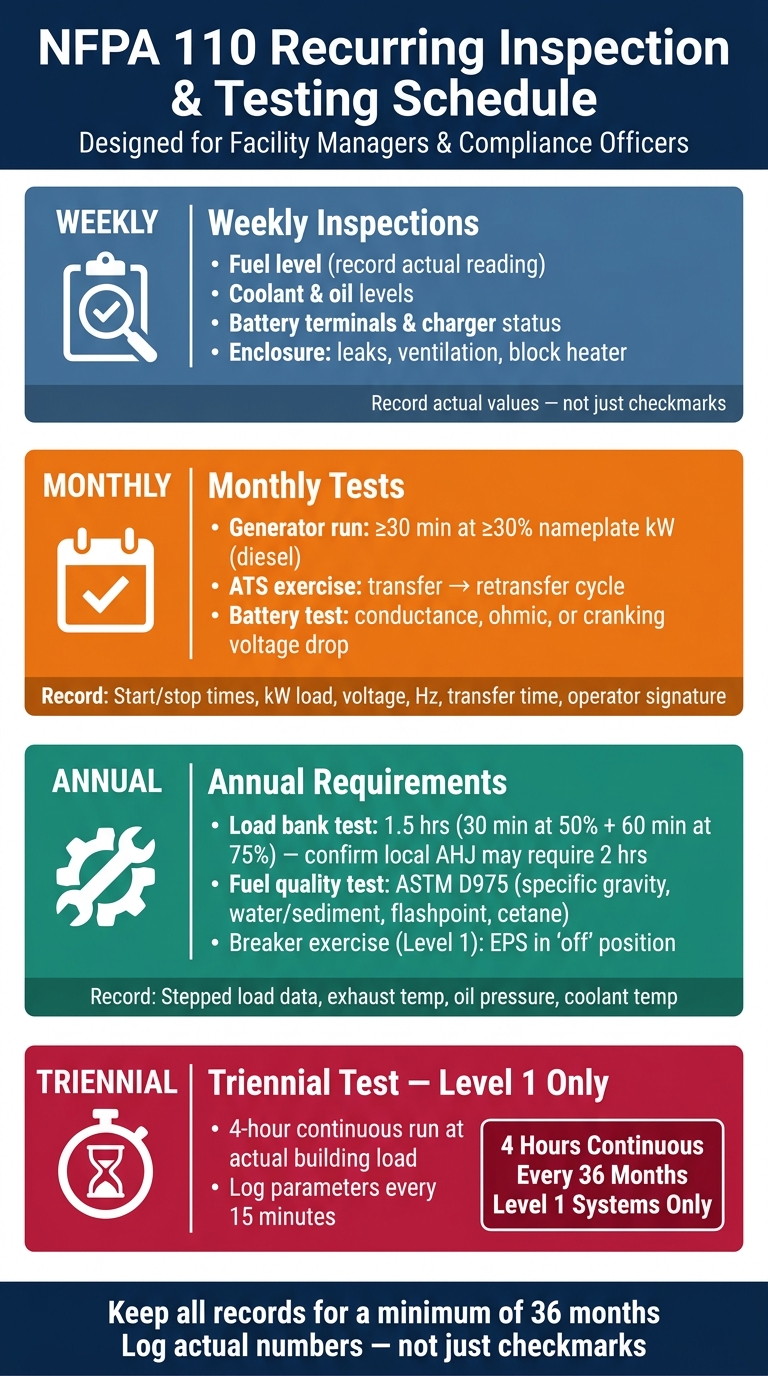
NFPA 110 Compliance: Recurring Test Schedule at a Glance
1. Verify EPSS Classification and Compliance Baseline
Start by treating the EPSS as a system, not just a generator. First, lock in the required performance rating. Level, Type, and Class tell you how the system is supposed to perform, how fast it must transfer, and how long it must run.
Confirm Level, Type, and Class Ratings
Each EPSS carries three designations that work together to describe the system's reliability and performance requirements.
| Designation | What It Defines | Common Example |
|---|---|---|
| Level 1 | Life-safety impact: failure could result in loss of human life | Hospitals, ICU, life-safety systems |
| Level 2 | Life-safety impact: failure is less critical to human life | Industrial processes, optional standby |
| Type 10 | Transfer time: power must restore within 10 seconds | Emergency lighting, surgical suites |
| Type 60 | Transfer time: power must restore within 60 seconds | Legally required standby loads |
| Class 48 | Runtime: system must run 48 hours at rated load without refueling | Tier III data centers |
| Class X | Runtime: exceeds 48 hours and is site-specific | Critical infrastructure, remote sites |
Cross-check the designation against the project documents, the nameplate, and the O&M records. Those three should line up. If they don't, fix that before you go any farther. For example, if the nameplate says Type 60 but the facility's life-safety loads call for Type 10, that's a problem you need to settle first.
Renovations can shift the compliance baseline too. Add a new wing or expand a suite, and you may end up with transfer time demands that go past the rated Type.
Review AHJ Rules and Manufacturer Instructions
NFPA 110 sets the national floor. The Authority Having Jurisdiction (AHJ) can set a higher bar. Local amendments, site-specific approval conditions, and state adoptions may all bring stricter rules than the base standard text. Check which edition of NFPA 110 your jurisdiction has adopted and whether local amendments apply at your site.
Then match the EPSS to both the AHJ rules and the manufacturer's instructions. The 2025 edition of NFPA 110 - the active standard for 2026 compliance - allows Reliability-Centered Maintenance (RCM). That gives facilities room to align maintenance intervals with actual safety and cost outcomes instead of sticking only to fixed schedules.
If your team is moving to RCM, make sure the written maintenance program required under Section 8.1.1 says that plainly. A posted schedule or a vendor contract does not count as a written maintenance program.
"Most NFPA 110 citations do not stem from equipment failure. They stem from documentation deficiencies - missing test months, incomplete log fields, no written maintenance program, and no deficiency tracking." - Uptime Compliance
Also record any nonstandard starting battery chemistry in the compliance baseline and verify listed cranking performance.
Once the baseline is set, you can move into acceptance testing.
sbb-itb-501186b
2. Complete Installation Acceptance and Startup Testing
With the baseline in place, the next step is to prove the EPSS can do its job under load before you accept it for service. Acceptance testing confirms the EPSS is ready for emergency use. Before the system goes live, test it under actual or simulated load.
Check Load Transfer, Start, Run, and Shutdown Performance
Begin by simulating a utility outage with the ATS test switch or by opening the normal source breaker. The engine must pick up the load within the transfer time tied to the site's Type rating.
Run the generator at 30% of nameplate kW for 30 continuous minutes. During that run, record voltage on all phases, frequency (Hz), oil pressure, and coolant temperature. Write down the measured values. For AHJ review, simply marking a test as "passed" is not enough.
Also confirm:
- a 5-minute retransfer delay before the system returns to normal power
- a 5-minute cooldown before the unit goes back to standby
If acceptance testing turns up any deficiency, log it with a corrective action and a resolution date before sign-off. If the system uses block heaters, verify they hold 100–120°F to support fast starting.
| Acceptance Test Item | Requirement | Reference |
|---|---|---|
| Startup & Load Transfer | Level 1: ≤ 10 sec; Level 2: ≤ 60 sec | NFPA 110 Type 10/60 |
| Minimum Load | ≥ 30% of nameplate kW rating | NFPA 110 §8.4.2 |
| Run Duration | ≥ 30 continuous minutes at operating temperature | NFPA 110 Ch. 8 |
| Retransfer Delay | ≥ 5 minutes before returning to normal power | NFPA 110 Ch. 8 |
| Shutdown Cooldown | ≥ 5-minute cooldown before returning to standby | NFPA 110 Ch. 8 |
| Alarms & Controls | All safety shutdowns and remote annunciators verified | NFPA 110 / NFPA 99 |
Document Re-verification After Repairs or Replacement
After any repair or component replacement that affects the EPSS, document re-verification. The point is simple: if a major part changes, you need a clear record showing the system still meets its original design specs and code rules.
Update your Standard Operating Procedures and maintenance manuals to reflect the new component. That includes its ratings, battery chemistry, and any changes to arc-flash labeling.
Keep acceptance results, repair logs, replaced parts, and corrective actions for at least 36 months. Electronic records should be secure, backed up, and ready for inspection.
After acceptance, move into the recurring inspection and testing schedule.
3. Follow the Recurring Inspection and Testing Schedule
Once acceptance testing is done, move to the recurring schedule that keeps the EPSS in compliance.
Weekly and Monthly Required Checks
Each week, a technician should inspect fuel level, coolant and oil levels, battery terminals and charger status, and the enclosure for leaks, ventilation problems, or block heater issues. Write down the actual readings - not just checkmarks.
Each month, the generator must run for at least 30 minutes under load. For diesel units, the load has to reach at least 30% of the nameplate kW rating or meet the manufacturer's stated load criteria. If the building load can't hit 30%, bring in a supplemental portable load bank. Natural gas and propane units only need to run until oil pressure and water temperature stabilize.
The ATS also needs a monthly exercise: transfer to the alternate source, then retransfer to normal power. Rotate ATS exercise points across units so you can verify the full signal chain.
Annual and Multi-Year Tasks Organized in One Schedule Table
Use the schedule below as the compliance baseline.
| Frequency | Task | Load/Duration | Required Records |
|---|---|---|---|
| Weekly | Visual inspection | No run required | Fuel and oil levels, battery terminals/charger status, leaks, enclosure condition, ventilation, block heater function |
| Monthly | Operational test (diesel) | ≥30 min at ≥30% nameplate kW | Start/stop times, kW load, voltage, frequency, transfer time, operator signature |
| Monthly | ATS exercise | Transfer/retransfer cycle | Time delay settings, contact condition, operator signature |
| Monthly | Battery test | Voltage, conductance, or ohmic testing | Measured values per battery type |
| Annual | Load bank test (2026: 1.5 hrs; some AHJs still require 2 hrs - confirm locally) | 1.5 hrs (30 min at 50%, 60 min at 75%) | Stepped load data, exhaust temperature, oil pressure, coolant temperature |
| Annual | Fuel quality test | ASTM D975 conformance | Specific gravity, water/sediment, flashpoint, cetane number |
| Annual | Breaker exercise (Level 1) | EPS in "off" position | Breaker ID, date, operator name |
| 36-Month | Triennial test (Level 1) | 4 hrs continuous | Parameters logged at 15-minute intervals, actual building load |
Each log entry should include hard numbers like actual kW load, voltage, frequency, transfer time, and the technician's name. Keep those records for at least 36 months. If load data is missing, you can end up with citations, corrective action, and re-testing.
4. Inspect Fuel, Batteries, and Engine Support Systems
Start with the parts that fail most often: fuel, batteries, cooling, and exhaust. This is where hidden problems tend to show up, even when weekly and monthly checks look fine on paper.
Fuel System Condition and Supply Readiness
Before any operational test, make sure the tank is at at least 75% of usable capacity. Tank level alone isn't enough. You also need to confirm fuel quality.
Perform a fuel quality test at least once a year using ASTM D975 standards. That test should flag contamination, degradation, and other fuel issues. If the system uses day tanks, verify day-tank refill and transfer pump capacity under sustained load.
"Fuel quality and fuel management are concerns since many generator failures are attributed to poor fuel quality, contamination, and other fuel system problems." - Curtis Power Solutions
For natural gas or propane units, the focus shifts a bit. Instead of stored fuel quality, inspect the piping, valves, and supply reliability.
After fuel checks are done, move to the battery and engine support systems.
Battery, Charger, Cooling, and Exhaust Checks
Battery problems cause a lot of no-start events, especially sulfation, loose connections, and age-related wear. Weekly checks should cover clean terminals, tight connections, and normal charger status. If the charger shows any alarm, log it right away.
Monthly testing needs to go deeper. For all Level 1 facilities, conductance, ohmic, or cranking voltage drop testing is required, no matter what battery type is installed. That's a big deal because a battery can pass a start test and still fail cranking voltage drop limits.
Replace starting batteries every 3 to 5 years even if they seem fine. NFPA 110 updates for 2025/2026 also allow nickel-zinc and lithium-ion batteries for starting systems, as long as they meet cranking performance and voltage drop criteria.
Use the table below to track the support-system items that have a direct effect on starting and run reliability:
| System | Weekly Inspection Item | What to Record |
|---|---|---|
| Cooling | Coolant level, leaks, block heater function | Heater warm to the touch; coolant at full mark |
| Lubrication | Oil level, visible leaks, oil condition | Oil level reading, any leak locations |
| Exhaust | Leaks, soot buildup, signs of wet stacking | Exhaust color, visible deposits |
| Enclosure/Air | Ventilation louvers clear, room temperature, shutter operation | Louver condition, room temp in °F |
Check that the block heater is warm. If it's cold, that's a deficiency. Also, record the actual oil pressure, coolant temperature, and exhaust temperature instead of writing "OK". Any abnormal reading should be logged with the monthly test record.
5. Maintain Records, Correct Deficiencies, and Close the Checklist
Once testing is done, the job isn't over. You still need to close the compliance loop with clean records and clear corrective-action tracking. In plain terms: finish the EPSS file with records, corrective actions, and retention controls.
Keep Inspection Logs, Test Results, and Repair Records Organized
Keep 36 months of test, inspection, and maintenance records ready for AHJ review.
Each monthly log entry should include the date, time, duration, kW load, load percent, voltage, frequency, transfer time, fuel level, battery voltage, and operator name. Entries like "OK" or "passed" are too vague. They don't prove compliance.
If a component is repaired or replaced, record the date, the people involved, the parts replaced, and the results of the post-repair operational test. Then retest with ATS initiation for 30 minutes at operating temperature. If there's no retest, the deficiency stays open.
Keep one set of Level 1 instructions at the equipment and one secure backup copy.
Final Compliance Review Before an AHJ Visit or Internal Audit
Use the checklist below to make sure the file is audit-ready.
| Verification Category | What to Confirm |
|---|---|
| EPSS Classification | Level, Type, and Class are labeled and match the test records. |
| Acceptance Testing | Initial commissioning records exist for pre-commissioning, cold start, loaded run, and ATS integration. |
| Monthly Test Logs | 36 months of entries with full quantitative data and no missing months. |
| Annual Requirements | Load bank test report is documented if monthly load stayed below 30%, along with annual ASTM D975 fuel quality results. |
| Triennial Test | A 4-hour continuous run is documented for Level 1 systems. |
| Deficiency Tracking | Every anomaly is paired with a corrective action, parts list, and retest result. |
Most audit failures come from log gaps, not equipment failures. That's the part that trips people up. A generator may run fine, but if the paperwork has holes, you're still exposed.
Before an AHJ visit, review the last three years of records for missing months. Also check that each ATS shows up as the test initiator at least once in the log history.
File a written maintenance program under Section 8.1.1 that lists testing protocols, frequencies, acceptance criteria, responsible personnel, and retention periods. Put that written maintenance program at the end of the file, then confirm the full record set is complete.
FAQs
What happens if my test logs are missing months?
Missing test logs are one of the most common reasons facilities fail compliance. Under NFPA 110, you need 36 months of accurate, quantitative records. If those records have gaps, you can end up with non-compliance citations, conditional accreditation, or tight corrective-action deadlines.
If entries are missing, the fix usually starts with a plan of correction. In plain terms, that means going back and validating as much past data as you can, then retraining staff so new logs include the details inspectors expect, such as load readings, transfer times, and operator identification.
When do I need a load bank test?
Under NFPA 110, a load bank test is required every year if your monthly operational tests consistently stay below 30% of the generator’s nameplate kilowatt rating.
This test checks that the generator can deliver its full rated output. It also helps prevent wet stacking, which can happen when a generator runs for long periods under light load.
Does NFPA 110 require 36 months of records?
Yes. NFPA 110 requires at least 36 months of testing and inspection records to be kept on-site.
Inspectors usually review that full three-year window to confirm compliance. If records are missing, logs are incomplete, or performance readings don’t include hard numbers, that can lead to non-compliance citations.