




Checklist for NFPA 110 EPSS Compliance
NFPA 110 compliance is mandatory for emergency and standby power systems (EPSS) in the U.S. to ensure safety and reliability. Non-compliance can lead to costly fines, operational risks, and even life-threatening situations. Here's what you need to know:
Key Points:
-
System Classification: Ensure your EPSS meets Level, Type, and Class requirements based on criticality, transfer time, and runtime.
- Level 1: For life safety (e.g., fire pumps, life support) with 10-second transfer time.
- Level 2: For non-critical systems (e.g., HVAC) with 60-second transfer time.
- Class 96: Common in healthcare, supports 96 hours of operation at full load.
- Installation Standards: Follow strict guidelines for generator rooms, ventilation, clearance, emergency lighting, and fire resistance.
-
Fuel and Batteries:
- Maintain 133% of anticipated fuel consumption for Level 1 systems.
- Conduct annual fuel tests and regular battery maintenance to prevent failures.
- Testing: Perform cold start, load testing, and acceptance testing to verify compliance. Document results and retain records for at least 36 months.
- Routine Maintenance: Establish a schedule for weekly, monthly, and extended runtime inspections to ensure reliability.
- Recordkeeping: Detailed logs are critical for compliance. Missing or incomplete documentation is a common cause of citations.
Why It Matters: Non-compliance can result in fines up to $100,000 per event and hospital downtime costs of $7,500 per minute. Proper planning, testing, and documentation are essential for uninterrupted operation and safety.
This checklist covers everything from classification and installation to fuel management, testing, and documentation to help you stay compliant and avoid penalties.
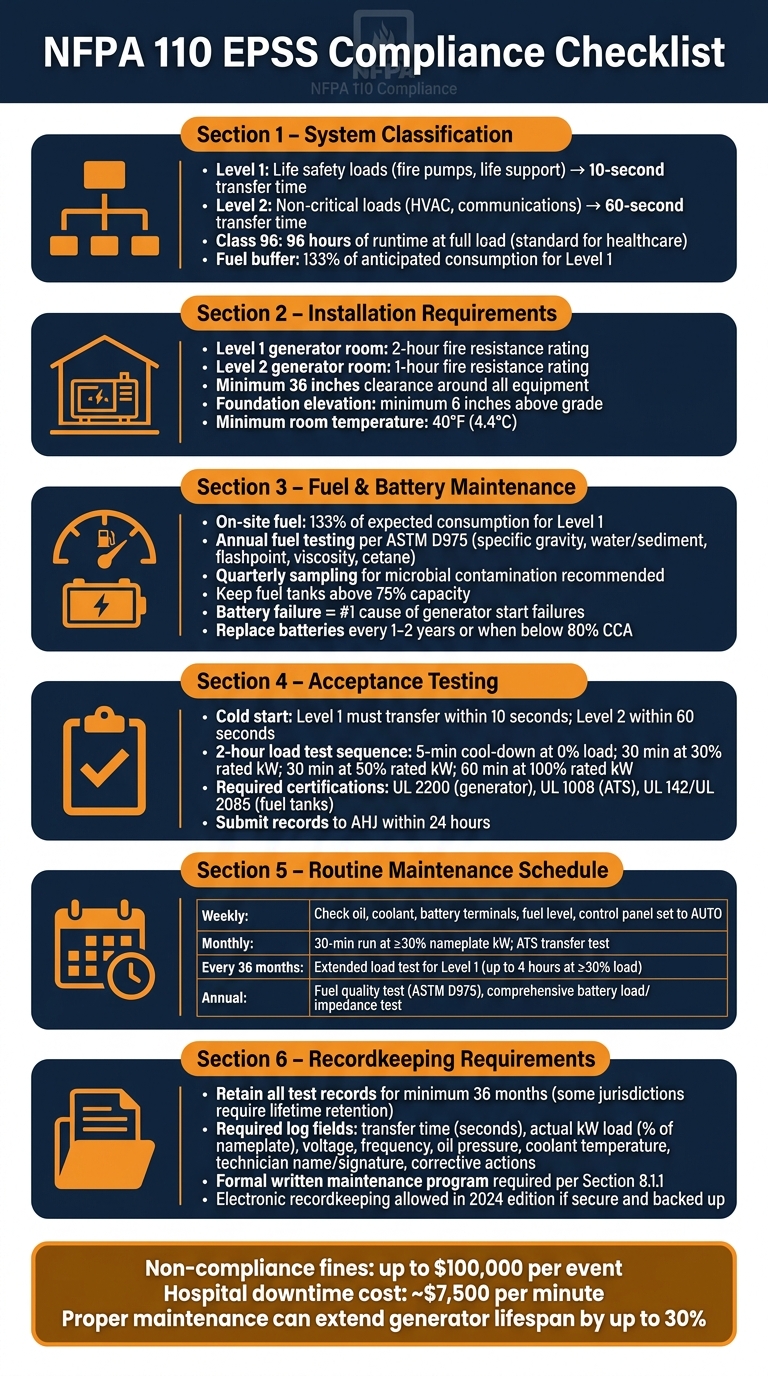
NFPA 110 EPSS Compliance Checklist: Key Requirements at a Glance
NFPA 110 Level 1 EPSS Equipment Explained Generator and ATS
sbb-itb-501186b
EPSS Classification and Scope
Make sure your system is correctly classified according to NFPA 110's Level, Type, and Class parameters. These classifications depend on building codes, the type of occupancy, and the Authority Having Jurisdiction (AHJ). Misclassification - like assuming a Level 2 system is sufficient when a Level 1 system is required - can result in non-compliance and poor system performance.
NFPA 110 organizes Emergency Power Supply Systems (EPSS) into three key categories:
- Level: Determines how critical the load is.
- Type: Specifies the maximum time allowed to restore power.
- Class: Defines the minimum runtime at full load without refueling.
All three categories must align with the demands of the loads the system supports.
Level 1 vs. Level 2 Systems
Level 1 systems are designed for critical loads, such as fire pumps and life support, while Level 2 systems are intended for non-critical loads like HVAC or communications.
"The consistent theme of NFPA 110 is one of reliability, making a level 1 standby emergency power system as reliable and robust as possible to prevent harm or loss of life to building occupants." - Richard A. Vedvik, Senior Electrical Engineer, IMEG Corp
| Feature | Level 1 EPSS | Level 2 EPSS |
|---|---|---|
| Criticality | Life safety (risk of death or injury) | Economic or operational loss |
| Max Transfer Time | 10 seconds (Type 10) | 60 seconds (Type 60) |
| Typical Loads | Fire pumps, egress lighting, life support, fire alarms | HVAC, communications, security, sewage pumps |
| Fuel Buffer | 133% of anticipated consumption | As required by the AHJ |
Class and Type Requirements
The Type category specifies how quickly power must be restored after a utility outage, while the Class category defines how long the system must operate at full load without refueling. For healthcare facilities regulated by CMS, the standard combination is Type 10 and Class 96. This means power must transfer within 10 seconds, and the fuel supply must support 96 hours of operation at full load. Additionally, fuel supplies should include a safety buffer of 133% of the anticipated consumption.
| Class | Minimum Runtime |
|---|---|
| Class 2 | 2 hours |
| Class 6 | 6 hours |
| Class 48 | 48 hours |
| Class 96 | 96 hours (common in healthcare) |
| Class X | As required by code or AHJ |
Class X is used when runtime requirements deviate from standard categories, often dictated by specific codes or the AHJ. This is common in areas with high seismic activity (Category C or higher), where fuel delivery might be delayed beyond typical planning scenarios.
Ensure your system meets these classifications before moving on to verify its installation and location requirements for compliance.
Installation and Location Requirements
Ensuring your EPSS is installed correctly is key to keeping it operational and compliant with NFPA 110 standards. These guidelines outline the physical requirements for both indoor and outdoor setups, helping you avoid potential issues and penalties.
Indoor Installation Requirements
For Level 1 systems, the generator room must have a 2-hour fire resistance rating, while Level 2 systems require a 1-hour rating. The space must be dedicated solely to the EPSS and its supporting equipment - no unrelated storage or systems like building HVAC are permitted.
"The rooms or enclosures containing EPSS equipment shall also be designed to minimize the possibility of damage to the EPSS equipment and permit sufficient room for access for inspection, repair, maintenance, cleaning or replacement." - Curtis Power Solutions
Key installation elements to address:
- Ventilation: Air supply must come directly from outside. For Level 1 systems, the enclosure must be fire-rated (2-hour) and exclude fire dampers unless motor-operated dampers are used, which must default to open if power is lost.
- Generator foundations: Elevate at least 6 inches to prevent flooding and ease maintenance.
- Clearance: Ensure at least 36 inches of working space around all sides of the equipment.
- Emergency lighting: Install battery-powered lighting in the generator room, wired from the load side of the transfer switch to ensure functionality during outages.
- Remote manual E-Stop: Position this outside the generator room and protect it from accidental activation.
- Room sharing restrictions: Level 1 EPSS equipment cannot share space with normal service equipment rated above 150V to ground and 1,000 amps or more.
- Temperature control: The room must always be kept at a minimum of 40°F (4.4°C).
Outdoor installations are subject to equally strict requirements to ensure reliability and safety.
Outdoor Installation Requirements
Outdoor EPSS enclosures must be fully weatherproof, capable of withstanding rain, snow, and high wind speeds. For Level 1 systems, the enclosure must maintain a 40°F (4.4°C) minimum temperature, often requiring a heating system.
Additional outdoor installation considerations include:
- Generator foundations: Must be raised at least 6 inches above grade. If the fuel tank design raises access doors, a 36-inch-wide platform with railings and stairs must be installed.
-
Raised platform requirements:
"A raised platform with a minimum width of 36 inches from the generator rails must be installed with railings and stairs to allow full access to the maintenance doors." - Curtis Power Solutions
- Seismic zones: Use seismic mounts and flexible connections for fuel, exhaust, and electrical lines. Flexible sections between unit-mounted radiators and exterior louver boots are also necessary to absorb vibrations and prevent cracking.
- Louver placement: Design louver locations carefully, accounting for prevailing winds that could interfere with radiator fan discharge. This is a common oversight that can reduce cooling efficiency under load.
Following these guidelines ensures your EPSS is both operationally reliable and compliant with NFPA 110 standards.
Fuel, Batteries, and Supporting Systems
The reliability of an EPSS (Emergency Power Supply System) hinges on two critical factors: maintaining clean fuel and ensuring dependable batteries. These are common failure points, but with proper care, they are entirely avoidable.
Fuel System Compliance
For Level 1 systems, on-site fuel storage must meet 133% of the expected fuel consumption for the required runtime at full rated load. As BackupPower.ai highlights:
"The 133% factor is not optional - it's a hard requirement of the standard."
Type 96 systems, commonly used in healthcare, must run continuously for 96 hours. To support this, day tanks need automatic filling systems, level controls, and overfill protection to ensure effective fuel management.
NFPA 110 Section 8.3.7 requires annual fuel testing using ASTM D975 standards. These tests evaluate factors like specific gravity, water and sediment content, flashpoint, viscosity, and cetane number. Additionally, quarterly sampling for microbial contamination is highly recommended. Why? Because biological growth in diesel tanks can clog injectors and filters long before an annual test might catch it.
BackupPower.ai also notes:
"Most inspection failures come from fuel quality documentation gaps - not equipment problems."
It’s important to remember that adding fresh diesel to old fuel doesn’t improve its quality. In fact, as RB Barnett, a Certified Electrical Safety Compliance Professional, explains:
"Adding new fuel will typically increase oxidation, further degrading the fuel."
To minimize issues, keep fuel tanks as full as possible. This reduces the empty space where condensation and oxidation can occur, helping to maintain fuel quality over time.
Battery Maintenance and Reliability
While clean fuel is crucial, batteries are just as important for ensuring a generator starts promptly during emergencies. Battery failure is the leading cause of generator start failures. Curtis Power Solutions puts it plainly:
"A major cause of problems when starting generator sets is the lack of battery maintenance."
Regular maintenance is the key to avoiding these failures. Below is the recommended NFPA 110 battery maintenance schedule:
| Interval | Tasks |
|---|---|
| Weekly | Inspect terminals for corrosion; verify charger is in float mode; check electrolyte levels (Level 1); ensure engine block heaters are operational and coolant temperature stays between 100°F and 120°F |
| Monthly | Perform a conductance or specific gravity test; check electrolyte levels (Level 2) |
| Quarterly | Confirm terminals are clean and tight; perform a battery load test |
| Annual | Conduct a comprehensive load or impedance test to verify cranking performance |
If a battery is defective, it must be replaced immediately. Although NFPA 110 doesn’t mandate a specific replacement interval, many facilities opt to replace starting batteries every 1 to 2 years as a preventative measure. Additionally, any battery that drops below 80% of its rated Cold Cranking Amps (CCA) should be replaced without hesitation.
Acceptance Testing and Commissioning
After verifying installation and supporting systems, the next step is acceptance testing to ensure the Emergency Power Supply System (EPSS) meets NFPA 110 performance standards. This process is critical for confirming the system's functionality. As Clayton Costello, Operations Manager at CK Power, explains:
"Your EPSS is not considered compliant upon installation - you must prove its function and ability to carry all emergency loads through a series of on-site installation acceptance tests and a two-hour load test."
Installation Acceptance Testing
Before testing begins, confirm that key certifications are in place: UL 2200 for the generator, UL 1008 for the Automatic Transfer Switch (ATS), and UL 142/UL 2085 for fuel tanks. Missing any of these certifications will result in inspection failure. Early coordination with the Authority Having Jurisdiction (AHJ) is crucial, as they oversee the final approval of the EPSS. Notify the AHJ of your test schedule in advance so they can witness and approve the process. As Curtis Power Solutions emphasizes:
"It is the responsibility of the authority having jurisdiction (AHJ) to provide final approval of the EPSS. Be sure to check with the AHJ early and notify them of the test date in case they want to be present for the tests."
Testing begins with a cold start to simulate a primary power failure. This ensures the system starts promptly and transfers the load correctly. For Level 1 systems, the entire process - including engine cranking, speed run-up, and ATS operation - must occur within 10 seconds. For Level 2 systems, the window is 60 seconds. Any deviation from the 10-second requirement for Level 1 systems is unacceptable.
Once the cold start is successfully completed, the next step is load testing.
Load Testing Requirements
After the cold start, allow a 5-minute cool-down period before starting the two-hour load test. The load test is divided into three phases:
| Test Phase | Duration | Load Level |
|---|---|---|
| Cool-down Period | 5 minutes | 0% (no load) |
| Phase 1 | 30 minutes | 30% of rated kW |
| Phase 2 | 30 minutes | 50% of rated kW |
| Phase 3 | 60 minutes | 100% of rated kW |
If the building load is less than 100%, certified load banks must be used to achieve the required levels. For facilities with multiple generators, each unit must independently complete this two-hour sequence. Passing this test is not only essential for compliance but may also be required to activate the equipment warranty.
During the test, record critical data such as voltage, frequency, oil pressure, and ambient conditions. These records must be provided to the AHJ within 24 hours and retained for at least 36 months, though some experts recommend keeping them for up to 10 years. Once the testing is complete and successful, immediately begin documenting and implementing a routine maintenance and testing program. This ensures the EPSS is ready for operation and meets NFPA 110 standards.
Routine Inspection, Exercise, and Documentation
Acceptance testing is just the first step in ensuring the reliability of an Emergency Power Supply System (EPSS). As Curtis Power Solutions explains:
"Random inspection and testing are not a basis for maintaining the dependability of an EPSS. The continued reliability of the EPSS is dependent on an established program of routine maintenance and operational testing."
To maintain the reliability achieved during acceptance testing, regular inspections and operational tests are critical.
Weekly and Monthly Inspections
Weekly inspections focus on confirming the generator's readiness. This includes checking engine oil and coolant levels, inspecting battery terminals for corrosion, verifying that the battery charger is energized, and ensuring the control panel is set to "AUTO" mode. Fuel tanks should always be kept above 75% capacity, as 36% of generator failures are linked to fuel degradation or contamination.
Monthly, diesel generators must run for at least 30 minutes at a minimum of 30% of their nameplate kW rating, or long enough to reach the manufacturer's recommended exhaust temperature. This prevents wet stacking, a condition caused by unburned fuel accumulating in the exhaust. For spark-ignited units, the test should continue until oil and water pressures stabilize. Additionally, each monthly test should include operating the Automatic Transfer Switch (ATS) from primary to alternate power and back. If there are multiple transfer switches, rotate which one initiates the test to ensure all units are verified over time.
Extended Runtime Testing and Maintenance
Routine maintenance goes beyond monthly exercises. Level 1 EPSS systems must undergo an extended load test every 36 months. This test should last for the duration of the system's assigned class, up to 4 hours, at a minimum of 30% load. If monthly tests fall below the 30% load threshold, an annual 2-hour test at 100% load capacity is required. This clears carbon buildup in the engine and ensures the system is ready for emergencies.
Starting batteries should be replaced every 2 to 3 years, as battery failure is the leading cause of generator start-up issues. Additionally, an annual fuel quality test is necessary to check for microbial growth, water contamination, and fuel degradation, following ASTM D975 standards. Facilities should also keep critical spare parts, such as air filters, oil filters, and belts, in a secure, labeled cabinet within the generator room. This ensures that repairs can be made quickly during emergencies.
Routine inspections and regular testing ensure the reliability established during initial installation and load testing is upheld.
Documentation and Recordkeeping
Proper documentation is essential to maintaining compliance and supporting all inspection and maintenance activities. According to Uptime Compliance:
"Most NFPA 110 citations do not stem from equipment failure. They stem from documentation deficiencies - missing test months, incomplete log fields, no written maintenance program, and no deficiency tracking."
Chapter 8 requires detailed data, not just checkboxes. Test logs must include specific measurements such as voltage, frequency, oil pressure, coolant temperature, kW load as a percentage of the nameplate rating, transfer times, and the technician's name. For example, a regional medical center faced non-compliance issues despite having a fully operational 2MW generator. Their records, spanning 36 months, only included "passed" checkboxes without detailed readings or transfer times. This led to a citation and a mandatory Plan of Correction, requiring them to redesign testing logs and retrain operators.
Facilities must also maintain a formal written maintenance program as outlined in Section 8.1.1. This document should clearly define testing protocols, schedules, responsible parties, and procedures for corrective actions. A simple vendor contract or calendar is insufficient. Records must be kept for at least 36 months, though some jurisdictions may require retention for the equipment's entire lifespan. The 2024 edition now allows electronic recordkeeping, provided the system is secure, backed up, and accessible during inspections.
| Required Log Field | Record |
|---|---|
| Transfer Time | Seconds from power loss to emergency power delivery |
| Load Data | Actual kW and percentage of nameplate rating |
| Operating Parameters | Voltage, frequency, oil pressure, and coolant temperature |
| Personnel | Name and signature of the technician performing the test |
| Corrective Action | Description of any deficiency observed and the repair completed |
Conclusion
NFPA 110 compliance isn’t just a box to check off - it’s an ongoing responsibility. It involves everything from system classification and proper installation to fuel management, regular testing, and thorough recordkeeping. Overlooking even one part of this checklist can lead to system failure, which could result in CMS citations ranging from $50,000 to $100,000 per event and hospital downtime that costs about $7,500 per minute.
As the Facility Compliance Hub editorial team explains:
"Compliance is not simply a regulatory checkbox - it is a commitment to the safety and continuity of the people and processes within your facility."
Sticking to a regular maintenance schedule can also boost the lifespan of a standby generator by up to 30%, proving that a structured compliance approach pays off in the long run.
Using a detailed checklist ensures no requirement is overlooked - from confirming block heater functionality to documenting transfer times with the technician’s name. It creates a consistent, repeatable process that keeps your facility aligned with every aspect of NFPA 110 compliance.
When it’s time to replace components like transfer switches, starting batteries, or load bank equipment, check out Electrical Trader for a wide range of new and used power generation tools and electrical equipment.
FAQs
How do I know if my EPSS should be Level 1 or Level 2?
Your Emergency Power Supply System (EPSS) level depends on factors like building codes, the type of occupancy, and guidance from your local Authority Having Jurisdiction (AHJ). It's crucial to get written confirmation from your AHJ to ensure your system meets all necessary requirements.
- Level 1 systems: These are mandatory in situations where a power failure could result in loss of life, such as in hospitals or critical care facilities.
- Level 2 systems: These are used for less critical applications where power interruptions carry lower safety risks.
Always confirm the specific requirements for your facility to stay compliant.
What records do I need to keep to pass an NFPA 110 inspection?
To comply with an NFPA 110 inspection, you need a written maintenance program that outlines your testing procedures, schedules, and any corrective actions. Accurate record-keeping is crucial. For monthly tests, logs should include details like:
- Test date and duration
- Load specifics (kW and percentage)
- Voltage and frequency readings
- Fuel levels and battery voltage
- Ambient temperature
- Operator's name
- Any observed anomalies
Additionally, annual documentation must confirm successful load bank testing. If you're looking for tools to help you stay compliant, Electrical Trader provides equipment tailored for these requirements.
When do I need a load bank instead of using building load?
If your building load isn’t enough to properly exercise the generator, a load bank becomes necessary to avoid problems like wet stacking or carbon buildup. According to NFPA 110, if monthly testing doesn’t hit at least 30% of the generator’s nameplate kilowatt rating, an annual load bank test is mandatory. Furthermore, Level 1 systems must complete a full-load test using a load bank every three years, no matter how well they perform during monthly tests.





