




NFPA 110 Battery Testing Checklist
Battery failures are the top reason emergency generators don't start. NFPA 110 sets strict guidelines to ensure Emergency Power Supply Systems (EPSS) are ready when needed. Here's what you need to know:
- Weekly: Visual inspections to check for leaks, corrosion, and charger status.
- Monthly: Specific gravity or conductance testing to assess battery health.
- Annually: Load tests to verify performance under real conditions.
Key requirements include:
- Level 1 systems (critical for life safety): Must deliver power within 10 seconds.
- 36 months of records are required for compliance inspections.
Regular testing and maintenance prevent small issues from becoming major failures. Follow NFPA 110's schedule to ensure your EPSS is reliable during power outages.
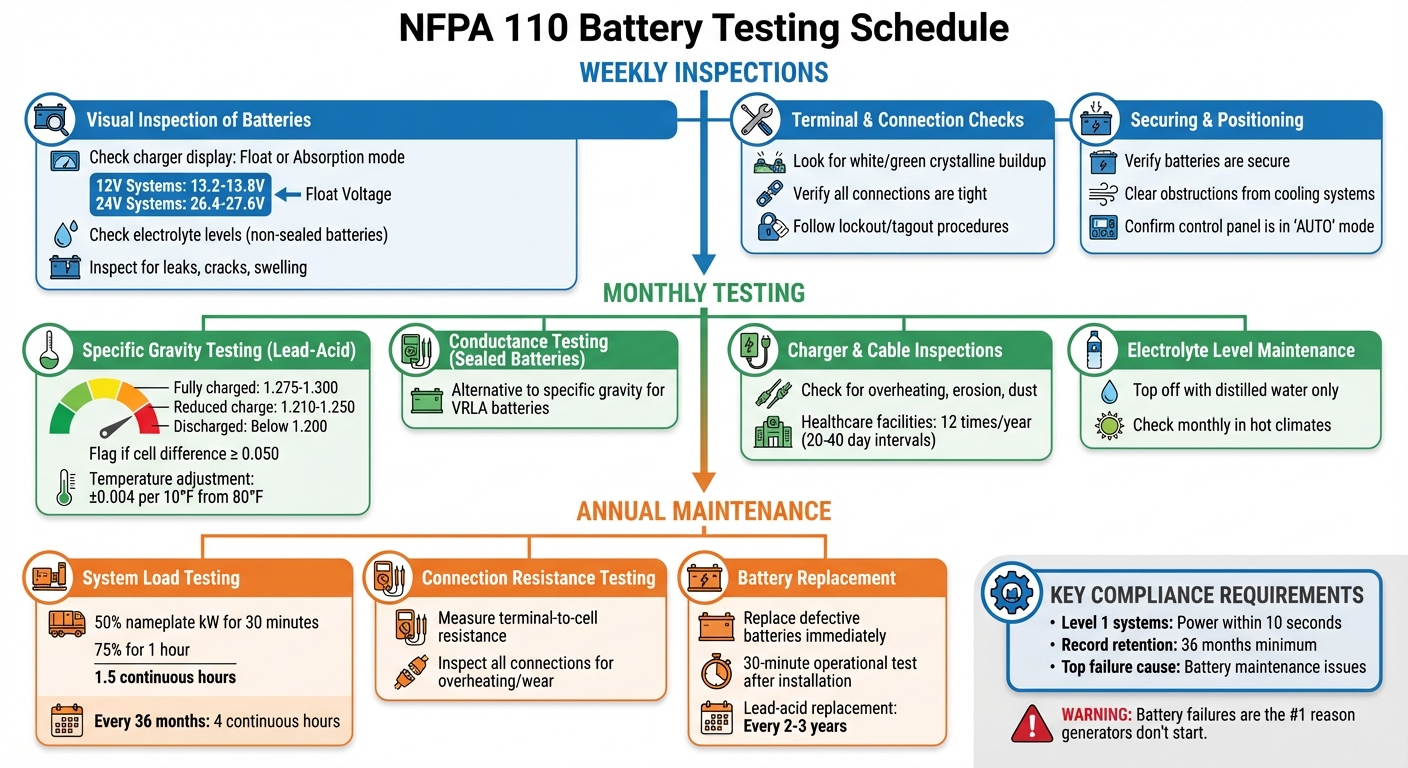
NFPA 110 Battery Testing Schedule: Weekly, Monthly, and Annual Requirements
Battery Specific Gravity and Conductance Tests
sbb-itb-501186b
Weekly Battery Inspection Checklist
Regular weekly inspections are crucial for meeting NFPA 110 standards and preventing battery issues before they escalate. As outlined in NFPA 110 Sections 8.3.6 and 8.4.1, storage batteries must be maintained according to the manufacturer's recommendations. During these inspections, avoid running the generator to prevent wet stacking.
Visual Inspection of Batteries
Start by checking the charger’s display for "float" or "absorption" mode. Jhon Polus of Oxmaint emphasizes, "A charger showing fault or offline status is the leading cause of generator start failures under real emergency conditions at commercial facilities". For 12V systems, ensure the float voltage is between 13.2–13.8 V, and for 24V systems, it should range from 26.4–27.6 V.
For non-sealed (flooded) batteries, confirm that the electrolyte levels fully cover the plates. Look for any wet spots or stains on the generator base frame, which could indicate leaks, and inspect the battery case for cracks, swelling, or other visible damage. If any issues are found, replace the defective batteries immediately.
Once you’ve completed the visual checks, proceed to examine the battery terminals and connections.
Battery Terminal and Connection Checks
Check the battery terminals for any white or green crystalline buildup, which can signal charging inefficiencies or sulfation. Clean the terminals if necessary and confirm that all connections are tight, as loose connections can reduce starting power. Always follow your facility’s lockout/tagout procedures when working on terminals. Keep tools like a voltmeter, flashlight, rags, and a recording log handy for this process.
Securing and Positioning of Batteries
After inspecting the terminals, verify that the batteries are securely positioned to avoid damage from vibrations. Ensure the EPS room is well-organized and free of unrelated items, as NFPA 110 Section 7.11.1 states, "the room in which the EPS equipment is located shall not be used for other purposes that are not directly related to the EPS". Clear the area of any loose materials that might obstruct cooling systems, such as radiator or alternator ducts. Finally, double-check that the control panel is set to "AUTO" mode. Leaving it in manual could prevent the generator from starting automatically during an emergency.
Monthly Battery Testing Checklist
Monthly battery testing is essential to go beyond surface-level inspections and evaluate actual battery performance. According to NFPA 110 Section 8.3.6, monthly testing and recording of electrolyte specific gravity is mandatory for lead-acid batteries to ensure compliance. This type of testing helps uncover hidden issues and addresses one of the most common causes of generator failures: poor battery maintenance.
Specific Gravity and Voltage Testing
Specific gravity testing measures the sulfuric acid concentration in the battery's electrolyte, which directly reflects its charge level. A fully charged cell should read between 1.275 and 1.300, while readings between 1.210 and 1.250 indicate a reduced charge. If the reading falls below 1.200, the cell is discharged. Additionally, if the readings between any two cells differ by 0.050 or more, the lower-reading cell should be flagged as problematic.
Here’s how to perform the test:
- Ensure the battery is fully charged.
- Remove the filler caps and use a hydrometer to draw electrolyte into the device until it reaches the maximum fill line.
- Hold the hydrometer vertically at eye level and note where the electrolyte surface meets the scale.
- Record readings for each cell - 3 cells for a 6V battery and 6 cells for a 12V battery.
For hydrometers without automatic temperature compensation, adjust readings by adding or subtracting 0.004 points for every 10°F above or below 80°F to meet NFPA 110 standards. Basic hydrometers are cost-effective, typically priced around $20, making them an affordable tool for maintaining compliance.
For sealed batteries, NFPA 110 allows battery conductance testing as an alternative to specific gravity testing. This method is particularly useful for batteries where the electrolyte is inaccessible. If any battery is found defective during testing, it must be replaced immediately.
Once testing is complete, move on to inspect the charger and its wiring to ensure the system's reliability.
Charger and Cable Inspections
The battery charger and its wiring play a critical role in maintaining battery health. Inspect these components for signs of overheating, erosion, or dust buildup. Damaged cables or loose connections can prevent the charger from maintaining the correct voltage, potentially leaving the battery unable to function when needed. Healthcare facilities are required to perform these inspections 12 times per year at intervals of 20 to 40 days to comply with NFPA 110.
Key points to check include:
- Ensuring cables are routed and secured properly to avoid chafing or vibration damage.
- Verifying that connectors are mounted correctly, as improper installation is a frequent compliance issue.
All inspections and maintenance should be conducted by qualified personnel trained to handle the hazards of live electrical systems and the explosive gases associated with batteries.
Electrolyte Level Maintenance
Monthly maintenance also involves checking and maintaining electrolyte levels. Inspect the electrolyte in all cells and top them off using distilled water only - never use tap water. The electrolyte must fully cover the plates to prevent damage. However, always measure the specific gravity before adding water, as adding water first will dilute the electrolyte and lead to inaccurate readings.
In hotter climates, electrolyte levels should be checked monthly, as high temperatures accelerate water loss. To ensure even acid distribution, mix the electrolyte by drawing and releasing the fluid with a hydrometer. Always wear acid-proof gloves, protective eyewear, and an apron when handling batteries, and keep baking soda on hand to neutralize any spills. Once you've added water and completed the tests, securely reinstall the filler caps to keep contaminants out of the cells.
Annual and Periodic Battery Maintenance
Annual maintenance is all about testing your battery system's performance under load. It goes beyond routine checks by putting the system through real-world conditions to confirm it's ready for long-term use.
System Load Testing
The NFPA 110 2025 Edition outlines a specific two-step load test: run the system at 50% of its nameplate kW for 30 minutes, followed by 75% for 1 hour. This totals 1.5 continuous hours of testing.
"The annual load bank test is the corrective measure. Pushing the engine through higher loads to burn off deposits and verify performance." – MGI
During these tests, it's important to rotate the initiating Automatic Transfer Switch (ATS) to ensure the starting signal chain works as expected. Load banks should be set up to automatically switch to essential loads if there's a power failure. Additionally, Level 1 EPSS circuit breakers need to be exercised annually with the EPS in the "off" position to confirm they function mechanically.
Every 36 months, conduct a more extensive system test lasting 4 continuous hours (or the designated duration). This extended test ensures the system can reliably handle sustained loads over time.
After completing these load tests, always check that all electrical connections maintain the proper resistance levels.
Connection Resistance Testing
Annual maintenance should also focus on inspecting battery connections for any signs of overheating or wear. While NFPA 110 requires weekly visual inspections and monthly specific gravity tests, the annual checks should go deeper. Measure the terminal-to-cell connection resistance to catch any deteriorated contacts before they cause bigger issues. This includes inspecting connections at the battery terminals, inside transfer switches, and within paralleling gear. These tests must be conducted by qualified personnel.
Battery Replacement and Documentation
If a battery is defective, replace it right away. After installing a new battery, conduct a 30-minute operational test at normal temperature, initiated by an ATS, to confirm the system operates correctly.
"When components of an EPSS are repaired or replaced, an operational test is necessary to verify the proper operation of the system." – NFPA 110 (8.3.2)
Always document the battery's manufacture date from its label and record the installation date in your generator asset records. For lead-acid batteries, plan replacements every 2 to 3 years to avoid unexpected failures. Keep detailed records, including the service date, technician identification, any issues found, corrective actions taken (like parts replaced), and post-repair testing results. Most jurisdictions require these records to be kept for at least 3 years.
Battery Types and Testing Variations
NFPA 110 requires weekly inspections for all storage batteries, but the testing methods vary depending on the battery's chemistry.
Comparison Table of Battery Testing Procedures
| Battery Type | Weekly Inspection | Monthly Testing | Primary Testing Method |
|---|---|---|---|
| Lead-Acid (Flooded) | Check electrolyte levels and battery voltage | Specific gravity testing | Hydrometer or conductance testing |
| Lead-Acid (VRLA) | Visual inspection and voltage check | Conductance or voltage testing | Conductance tester |
| Nickel-Cadmium | Check electrolyte levels and battery voltage | As per manufacturer specifications | Voltage and service test |
| Lithium-Ion | Visual inspection and voltage check | As per manufacturer specifications | Manufacturer-specific diagnostics |
The table highlights the differences in testing procedures, which are explained further below.
Lead-acid batteries have the most detailed requirements under NFPA 110. For flooded lead-acid batteries, monthly specific gravity testing is necessary to assess electrolyte concentration. In contrast, sealed VRLA batteries require conductance testing since their cells cannot be opened for specific gravity measurements.
Nickel-cadmium and lithium-ion batteries follow a different approach. These types do not rely on specific gravity to measure the state of charge. Instead, NFPA 110 defers to the manufacturer's recommended maintenance protocols. This includes voltage checks and manufacturer-specific diagnostics, depending on the battery type. Following the correct testing method for each battery is key to maintaining system reliability.
The importance of proper battery maintenance cannot be overstated. Curtis Power Solutions underscores this point:
"A major cause of problems when starting generator sets is the lack of battery maintenance."
Since battery failure is the leading reason for generator non-starts, sticking to the manufacturer’s protocols for testing and maintenance is critical. Tailoring your approach to each battery type ensures compliance with NFPA 110 and helps maintain a dependable emergency power supply system.
Documentation and Compliance Best Practices
Keeping accurate records is a cornerstone of NFPA 110 compliance, as AHJs prioritize reviewing documentation during inspections. In fact, incomplete or missing test records are the most frequently cited violations in these reviews. As Jhon Polus from Oxmaint explains:
"The gap between what the standard requires and what facilities actually document is the gap that regulators, insurers, and accreditation bodies close during an audit."
Thorough documentation helps identify system issues early by establishing performance baselines, such as recording specific values like 13.4V float voltage or specific gravity. This process not only supports audits but also aids in maintaining and improving system performance over time.
Integration with Generator Testing
To create a unified view of EPSS performance, integrate battery records with your EPSS asset register. This includes tracking charge current, voltage readings, and ATS-initiated load test data at 10-minute intervals during the 30-minute run. Combining battery data with generator testing results provides a more comprehensive understanding of overall system health.
If weekly inspections uncover unresolved battery issues, monthly load tests should be postponed. These tests must start from the Automatic Transfer Switch (ATS) rather than the generator panel to ensure the entire battery-dependent start sequence is verified. For systems with multiple ATS units, rotate the initiating switch each month to confirm the functionality of all components over time.
Record-Keeping Practices
According to NFPA 110 Section 8.5.3, all records must include the report date, the names of servicing personnel, notes on any unsatisfactory conditions, and details of corrective actions taken. Recording precise numerical values - such as voltage, current, and cranking amps (CCA) - is essential for trend analysis. While NFPA 110 doesn’t mandate a specific retention period, most AHJs and accreditation bodies require at least 3 years of accessible records.
The 2024 edition explicitly allows for digital record-keeping systems, which offer key advantages. These systems timestamp entries, attribute them to specific technicians, and prevent modifications after sign-off. Polus underscores the importance of proper closeout procedures:
"A generator left in manual mode after a test is a compliance failure point at every AHJ inspection."
Documentation should confirm that the generator is returned to "AUTO" mode after testing, along with all other post-test procedures. Maintaining consistent and detailed records aligns with NFPA 110's preventive maintenance approach, ensuring your EPSS remains dependable.
Conclusion
Battery failure is the leading reason for generator start issues, making routine testing and maintenance a critical part of ensuring Emergency Power Supply System (EPSS) reliability. Without properly functioning batteries, even the most advanced systems can't meet the crucial 10-second start requirement.
The NFPA 110 battery testing checklist acts as a structured safeguard against system-wide failures. Weekly visual inspections help catch early problems like corrosion or low electrolyte levels. Monthly tests, such as specific gravity checks and load testing, confirm that batteries can handle the demands of starting under real conditions. Annual comprehensive testing, including connection resistance checks, ensures the entire EPSS remains dependable over time. These regular practices collectively ensure compliance with NFPA 110 standards.
For facilities in industries that rely on life-safety systems - like healthcare, nursing homes, and data centers - following this checklist isn't optional. It's a requirement for federal certification and state licensure. The Authority Having Jurisdiction enforces these standards because even a single battery failure can disable an entire emergency power system, leaving critical operations vulnerable during power outages.
Consistent record-keeping and integration with generator testing complete a well-rounded approach to maintaining EPSS reliability. Midwest Electric and Generator LLC emphasizes this point:
"Maintenance and testing are critical to the continued reliability of your emergency generator and must be performed in accordance with manufacturer's recommendations... and the minimum requirements of NFPA 110".
To maintain compliance and readiness, replace any defective batteries immediately and document all testing activities thoroughly.
FAQs
What battery test results mean I should replace the battery now?
If the battery fails testing, cannot hold a charge, or does not meet NFPA 110 standards for operational readiness, it’s time to replace it. These issues signal that the battery is no longer dependable and could jeopardize compliance with NFPA 110 maintenance and testing guidelines.
How do I test sealed (VRLA) generator batteries if I can’t measure specific gravity?
If measuring the specific gravity of sealed (VRLA) generator batteries isn’t possible, an open circuit voltage (OCV) test is a practical alternative. To perform this, first fully charge the battery, then wait at least 24 hours before measuring the OCV. The OCV reflects the electrolyte's specific gravity, providing insight into the battery's charge level. For instance, a fully charged cell with a specific gravity of 1.300 usually shows an OCV of approximately 2.14 VDC.
What should I do if my generator passes load testing but still won’t start within 10 seconds?
If your generator successfully passes load testing but struggles to start within 10 seconds, the issue could lie in the starting system or the transfer timing. Begin by checking the battery and the starting system components to rule out any obvious problems. Then, inspect the transfer switch to ensure it's functioning properly. It's also a good idea to review maintenance logs for any irregularities that might point to the root cause. If the issue remains unresolved, consider running a diagnostic test or consulting a technician to ensure the generator meets NFPA 110 standards.





