Smart Power Distribution with Modular IoT Panels
If I had to sum this up in one line: modular IoT power panels give you more visibility, less downtime, and a simpler path to add capacity later.
Here’s the short version:
- I see three main gains from these systems: live circuit data, faster fault response, and easier expansion
- Compared with fixed panels, modular setups are usually 15% to 25% more expensive upfront, but many sites see payback in 3 to 5 years
- In one factory retrofit, energy use dropped by 35%, reliability reached 99.9%, and annual outage losses fell from about $275,000 to about $27,000 after conversion from the source figures
- In growth-focused sites like data centers, front-access modular boards can save floor space by removing the need for 3 to 4 feet of rear service clearance
- For U.S. projects, I’d put code checks first: NEC 230.62(C), NEC 240.87, NFPA 70E, and NFPA 70B
What matters most is simple: these panels combine protection, metering, local control, and communications in one setup. That means you can track loads at the branch level, spot heat issues early, send alarms to staff phones, and add new sections without replacing the whole board.
If you’re comparing options, this is the core split I’d keep in mind.
| Criteria | Fixed Panels | Modular IoT Panels |
|---|---|---|
| Expansion | Slower, often needs rewiring or new enclosures | Add sections with less disruption |
| Monitoring | Basic main-level checks | Circuit-level live data |
| Maintenance | Mostly manual and reactive | Condition-based, with alarms and thermal tracking |
| Retrofit work | Often more invasive | Can use split-core CTs and gateways |
| Space use | More clearance needs in many older setups | Front-access layouts can save room |
| Upfront cost | Lower | Higher |
| Long-term value | Lower for growing sites | Better fit for sites planning load growth |
So if you expect load growth, want better fault visibility, or need to update aging gear without a full rebuild, modular IoT panels are often the better fit. The article backs that up with one retrofit case, one expansion case, and a clear list of U.S. design points to check before buying.
Fixed Panels vs. Modular IoT Panels: Cost, Performance & ROI
How Modular IoT Panels Are Built and How They Differ from Fixed Panels
Measurement, Edge Control, and Communications in One Panel Architecture
A modular IoT panel puts four jobs in one enclosure: metering, protection, edge control, and communications. That setup matters more than it may seem at first glance. The way those layers sit together inside the panel affects how easy it is to scale, service, retrofit, and expand later.
The next piece is the internal layout - and why that layout changes retrofit and expansion planning.
On the measurement side, CTs and VTs send real-time data to a local controller. That controller calculates RMS voltage, current, and other branch-level power metrics. Multi-point meters push that detail even further, giving circuit-level accuracy across individual circuits.
Edge controllers handle local actions like load shedding, phase balancing, and source switching without waiting for the cloud to respond. If the central link goes down, failsafe logic keeps local control running.
Communication flows in two directions. Upstream links send data to SCADA or cloud dashboards. Downstream links connect to field devices inside the panel.
Modern modular panels bundle all of this into a standard enclosure. Retrofit kits take a different path. They use split-core CTs and wireless gateways so teams can add monitoring and control without tearing into existing wiring.
Fixed Panels vs. Modular IoT-Enabled Panels: A Direct Comparison
This is where the gap between fixed and modular panels becomes easy to see.
| Feature | Fixed Panels | Modular IoT-Enabled Panels |
|---|---|---|
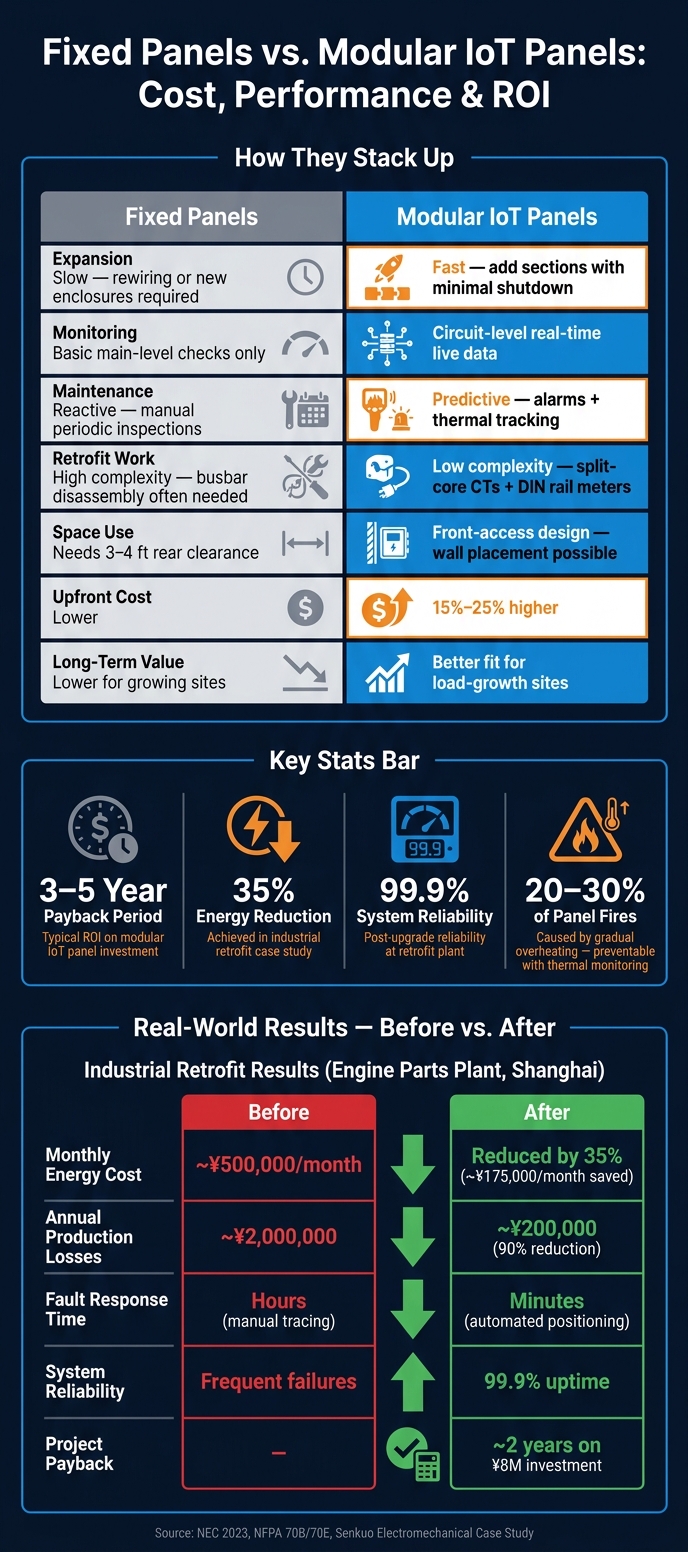
| Expansion Speed | Slow; requires rewiring or new enclosures with a full power-off | Fast; branch modules added with minimal shutdown |
| Monitoring Depth | Basic; limited to main lug readings or manual checks | Circuit-level real-time data |
| Maintenance Approach | Reactive; periodic inspections | Predictive; real-time fault and thermal monitoring |
| Retrofit Complexity | High; often requires busbar disassembly or full cabinet swap | Low; split-core CTs and DIN rail meters fit existing infrastructure |
| Lifecycle Flexibility | Low; fixed busbars and frame sizes limit future growth | High; extendable chassis, firmware updates, and modular hardware swaps |
There is a tradeoff, of course. Smart panels usually cost 15% to 25% more upfront than fixed panels. But the payback period is typically 3 to 5 years, driven by lower maintenance costs and energy savings. For sites planning capacity growth or electrification, that tradeoff often points to modular panels from day one.
Those architecture differences show up clearly in the two case studies that follow.
sbb-itb-501186b
Case Study 1: IoT-Enabled Low-Voltage Switchgear in an Industrial Park
Initial Problems and System Design Choices
Those architecture differences show up most clearly during actual retrofit work.
At an engine-parts plant in Pudong, Shanghai, aging 2010 switchgear had become a costly problem. The site was losing about ¥2 million per year from outages, while energy costs sat at about ¥500,000 per month. Maintenance teams still depended on manual inspection rounds, and there was no real-time data to show what was happening inside the system.
Senkuo Electromechanical led the upgrade. The team chose a three-layer distributed architecture:
- A field equipment layer with sensors and meters
- A network communication layer using RS485/Modbus-RTU for local cabinet links and 4G DTU gateways for cloud transmission
- A station-level control layer for centralized monitoring
To avoid tearing up the site for new conduit work, the team split the existing network into VLANs. The plant also replaced its old equipment with ZK-GCK smart low-voltage switchgear and ZK-PLC300 controllers.
In plain terms, the plant got a modern monitoring setup without rebuilding the full distribution backbone.
Installation, Alarm Setup, and Results
The project took four months. Installation was scheduled during production gaps so the plant could limit disruption. The team also set up a tiered alarm structure that matched the seriousness of each issue: abnormal alerts for small voltage or current deviations, minor fault alerts for overheating in cables or busbars, and emergency fault alerts for overcurrent events or breaker trips. Those alerts went straight to maintenance staff on mobile devices, which removed the need for routine physical inspection rounds.
Smart gateways handled part of the workload at the edge. They filtered and grouped data locally, then sent only status changes upstream. That cut server load and trimmed a lot of useless signal noise.
Here’s what changed:
| Metric | Before Upgrade | After Upgrade |
|---|---|---|
| Energy Consumption | ~¥500,000/month | Reduced by 35% (~¥175,000/month saved) |
| System Reliability | Frequent failures | 99.9% reliability |
| Fault Response | Hours (manual tracing) | Minutes (automated fault positioning) |
| Annual Production Losses | ~¥2 million | ~¥200,000 (90% reduction) |
The total project investment was about ¥8 million, and the payback period was roughly two years.
This case gives a clear picture of what modular IoT panels can do in older facilities: better visibility, faster fault handling, and far less downtime.
Case Study 2: Modular Digital Switchgear for Scalable Smart Power Distribution
Capacity Growth, Compact Design, and IoT Integration
The first case focused on retrofit gains. This one shows something different: how a growing facility can add power capacity in a clean, staged way without overbuilding or stopping day-to-day work.
When Switch Datacenters expanded its colocation capacity in Amsterdam in June 2026, it worked with NordicEPOD and Eaton to deploy factory-built power modules. Each module arrived with the UPS, switchgear, and monitoring already built in, and delivery took 18 weeks from design sign-off. The modules were also factory-tested and commissioned before arrival, which cut on-site integration risk and helped avoid commissioning delays.
One of the biggest design calls was the move to front access. That matters more than it may sound at first.
Traditional UL 1558 switchgear needs 3 to 4 feet of rear clearance for maintenance. Modular UL 891 switchboards are front-accessible, so teams can place them against a wall. In a data center, where every bit of floor space counts, that’s a big win. It also makes service work simpler.
These modular boards can support main bus ratings of 4,000 to 6,000 amps while still keeping a compact footprint. They also include branch circuit monitoring, which gives operators real-time feeder-level data on:
- Voltage
- Power factor
- Thermal status
That monitoring layer is a big part of why the setup scales well later. Operators can see what’s happening at the feeder level instead of guessing, which makes future expansion much easier to plan.
The main draw here is staged growth. Instead of building for peak demand on day one, the facility can add sections as load increases.
Outcomes and Design Tradeoffs
The upside is clear: faster deployment and better use of space. The tradeoff shows up earlier in the process. To make modular growth work, teams need tighter standardization up front across busbars, breaker families, and expansion stages.
Lessons for U.S. Industrial Upgrades and Key Takeaways
Design Guidelines for Future-Ready Smart Power Distribution
The retrofit plant and the Amsterdam expansion land on the same point: set compliance, communications, and thermal monitoring before procurement. Modular panels only pay off when code, heat, and communications are part of the design from day one.
For U.S. facilities, code compliance should come first. NEC 2023 added line-side barrier requirements under Section 230.62(C) and arc energy reduction requirements under Section 240.87 for breakers rated 1,200 A or higher. PESDs also matter here. They let teams test for absence of voltage through closed doors, which can cut lockout/tagout time by up to 40 minutes while still supporting NFPA 70E and OSHA requirements.
After compliance, heat is often the next weak spot. Gradual overheating causes 20% to 30% of fires in U.S. low-voltage distribution panels. That’s not a small risk. Continuous thermal monitoring with non-conductive sensors under NFPA 70B can spot hot areas before they turn into failures.
Communication support needs the same kind of attention. Any new panel should work with the protocols already used on site, including Modbus RTU/TCP, BACnet, Profinet, EtherNet/IP, and MQTT. In plain terms, the panel and gateway should fit the site’s current PLC, SCADA, and building automation setup instead of forcing a messy workaround later.
Sourcing Components and Summary of Key Points
Once the technical requirements are locked in, component sourcing gets much simpler. Smart panels usually cost 15% to 25% more upfront, but they often pay back that added cost in 3 to 5 years through lower maintenance and energy savings. For U.S. buyers, domestic manufacturing can also help with Buy America compliance on federally funded projects and shorten lead times by 20% to 30% compared with custom-engineered UL 1558 gear.
Electrical Trader brings together breakers, transformers, and low- and high-voltage distribution equipment for projects that need more than one component type.
| Design Choice | Expected Outcome | Key Compliance Need |
|---|---|---|
| Modular UL 891 chassis | Smaller footprint; faster deployment | UL 891 certification; front-access design |
| Integrated PESDs | Faster LOTO; closed-door voltage testing | NFPA 70E; UL 61010-listed devices |
| Branch circuit monitoring | Real-time load and power-factor visibility | Modbus-enabled smart RPPs |
| Arc energy reduction (AERMS) | Personnel safety during live maintenance | NEC 240.87 compliance |
| Continuous thermal monitoring | Fewer unplanned outages; fire risk reduction | NFPA 70B |
| Domestic-sourced components | Shorter lead times; federal funding eligibility | Buy America compliance |
FAQs
Are modular IoT panels worth the higher upfront cost?
Yes. Upfront costs are often 15% to 25% higher than with standard systems. But modular IoT panels can earn that money back sooner through lower maintenance costs, better energy efficiency, and less unplanned downtime.
They also support a pay-as-you-grow model. That means facilities can add capacity as needed instead of buying too much too soon or paying for expensive rework later. In many cases, these panels pay for themselves within three to five years.
Can these panels be added to existing electrical systems?
Yes. Modular, IoT-enabled panels and components can be added to existing electrical systems, which means you don't have to replace your entire setup.
In many cases, older cabinets can be retrofitted with smart functions. That can include modules that mount onto existing bus stacks, along with smart meters or sensors that use split-core current transformers and wireless communication. The big upside is simple: less new cabling and fewer major shutdowns.
What code checks should I review before buying?
Before you buy, check that the assembly complies with IEC 61439 for low-voltage switchgear and controlgear assemblies.
Focus on these points:
- Temperature rise under Clause 10.10
- Short-circuit withstand under Clause 10.11
- Dielectric properties under Clause 10.9, including clearance and creepage distances
You should also confirm that the enclosure’s IP rating matches the conditions where it will be installed, based on IEC 60529.