How Smart Switchgear Improves Energy Efficiency
Smart switchgear is a modern solution that helps reduce energy waste and operational costs by combining real-time monitoring, automated controls, and predictive maintenance. Unlike older systems, it uses sensors, microprocessor-based relays, and IoT connectivity to track energy usage, identify inefficiencies, and prevent equipment failures.
Key benefits include:
- Precise energy tracking: 0.5% voltage/current accuracy and 1% energy metering accuracy.
- Preventing downtime: Sensors detect issues like overheating or insulation problems before failures occur.
- Lower costs: Predictive maintenance can cut maintenance expenses by 40% and improve uptime by 9%.
- Automated load management: Reduces peak demand charges, which can make up 30% of energy bills.
With advanced tools like AI, edge computing, and digital twins, smart switchgear can optimize energy distribution, enhance reliability, and extend equipment life. Whether upgrading or retrofitting, these systems offer a long-term return on investment by improving efficiency and safety.
Smart Switchgear - Lets go digital - Webinar recording
sbb-itb-501186b
What Is Smart Switchgear and How Does It Work?
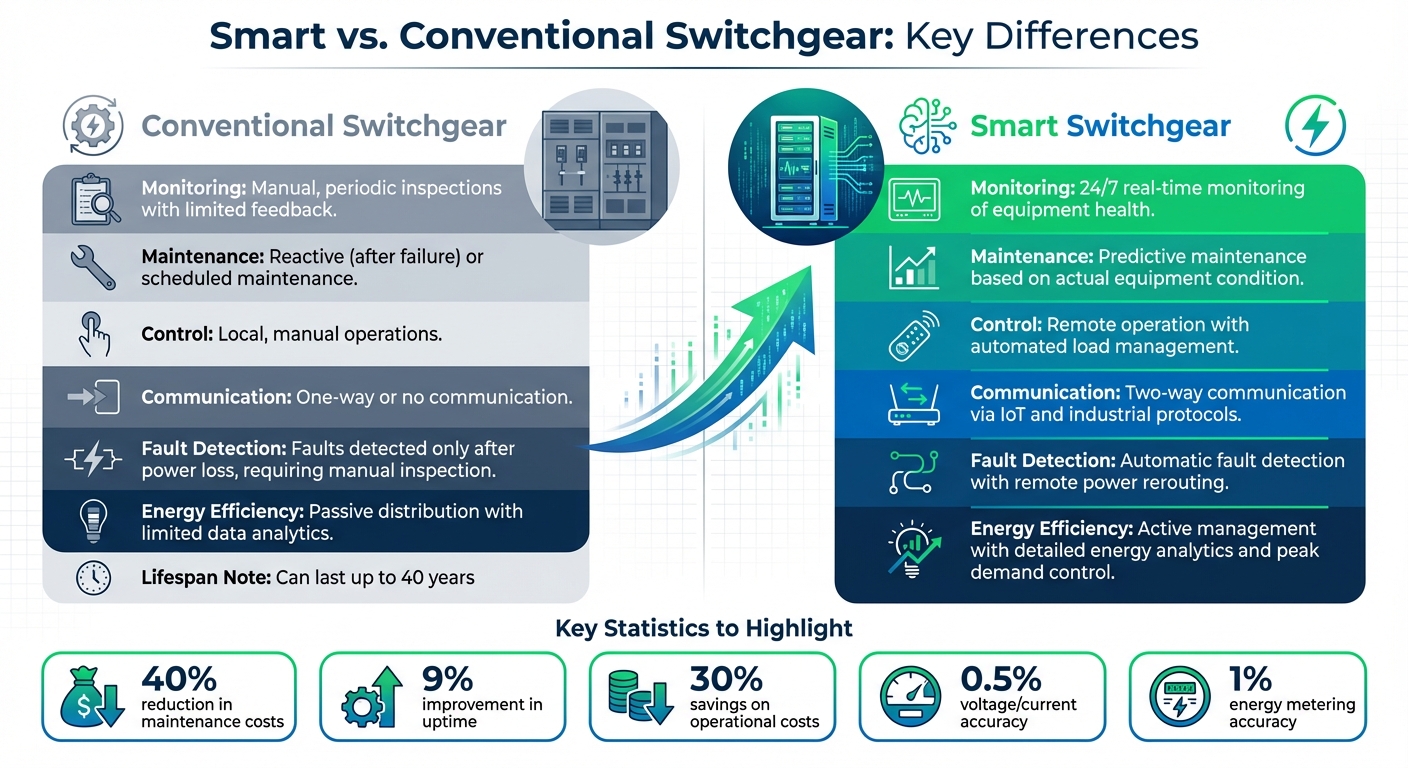
Smart vs Conventional Switchgear: Key Differences and Benefits
Smart switchgear combines traditional components like circuit breakers, fuses, and switches with advanced technologies such as microprocessor-based relays, intelligent electronic devices (IEDs), and sensors. This integration allows for constant monitoring, predictive maintenance, and dependable power distribution. Instead of waiting for equipment to fail, these systems act proactively, making automated decisions to prevent issues before they arise.
Here's how it works: Sensors continuously track real-time data on voltage, current, temperature, humidity, vibration, and partial discharge (a key indicator of insulation problems that could lead to arc flash incidents). This data is transmitted using communication protocols like Modbus TCP, IEC 61850, and DNP3, ensuring that devices from different manufacturers can work together seamlessly. The information is then sent to facility control systems, cloud platforms, or network operations centers, where operators can monitor performance and make adjustments remotely.
Unlike traditional systems, which operate independently with minimal feedback, smart switchgear facilitates two-way communication between utilities, customers, and control centers. This means operators can remotely perform tasks like opening or closing breakers, managing loads, or racking equipment. Schneider Electric highlights the need for modern switchgear to be "digitally intelligent", adaptable, compact, and capable of operating in challenging environments. The combination of continuous monitoring and remote control makes smart switchgear a game-changer for energy management.
Core Components That Enable Smart Functionality
Three key components bring smart switchgear to life.
- Sensing devices: These include thermal, humidity, vibration, and partial discharge sensors. They continuously monitor conditions to predict and prevent failures.
- Control and protection components: Microprocessor-based relays and smart trip units handle metering with high accuracy (0.5% for voltage/current, 1% for energy/power), record events, and clear faults quickly.
- Communication infrastructure: Gateways, network switches, and IEDs ensure data flows smoothly from substations to higher-level systems.
Together, these components optimize energy use and minimize waste. For example, high-speed arc-quenching devices integrated into smart switchgear can extinguish arcing faults over 10 times faster than standard power circuit breakers, drastically reducing energy released during incidents. Some systems even include built-in racking motors, allowing operators to work safely outside the arc flash boundary using digital controls. Additionally, a Device Configuration Management System (DCMS) securely stores device settings, making it easier to recover after equipment replacement or cyberattacks.
Smart vs. Conventional Switchgear: Key Differences
The table below highlights how smart switchgear outperforms conventional systems in several critical areas:
| Feature | Conventional Switchgear | Smart Switchgear |
|---|---|---|
| Monitoring | Manual, periodic inspections with limited feedback | 24/7 real-time monitoring of equipment health |
| Maintenance | Reactive (after failure) or scheduled maintenance | Predictive maintenance based on actual equipment condition |
| Control | Local, manual operations | Remote operation with automated load management |
| Communication | One-way or no communication | Two-way communication via IoT and industrial protocols |
| Fault Detection | Faults detected only after power loss, requiring manual inspection | Automatic fault detection with remote power rerouting |
| Energy Efficiency | Passive distribution with limited data analytics | Active management with detailed energy analytics and peak demand control |
Although traditional switchgear can last up to 40 years, this longevity often leads to hesitation in adopting newer technologies. For operators not ready for a full upgrade, existing systems can be retrofitted with modern components like IEDs, standalone sensors, and communication gateways. This approach allows for incremental adoption of smart capabilities without the need for a complete replacement.
How to Improve Energy Efficiency with Smart Switchgear
Integrating smart switchgear with your energy management system ensures smarter energy distribution and helps cut down on both energy consumption and operational waste. Here’s how to implement it effectively in three steps.
Step 1: Set Up Real-Time Monitoring
Start by installing sensors to monitor key parameters like voltage, current, temperature, and insulation. Aim for high precision - 0.5% accuracy for voltage and current and 1% for energy and power metering. Connect these sensors to a cloud-based platform or an energy management system (EMS) using industrial protocols like Modbus TCP, IEC 61850, or DNP3. These tools will automatically generate reports, giving you insights into energy consumption patterns.
Pay special attention to thermal monitoring in areas such as bolted joints, cable lugs, and bus connections. These spots are prone to heat-related energy losses, which can lead to higher electrical resistance and wasted power.
According to ABB's Gunnar Zank, "Accessing all data from the smart devices in the switchgear allows the operator to identify small symptoms and to act before it becomes a more serious problem, thus moving to a predictive maintenance approach".
Real-time monitoring doesn’t just improve efficiency - it can lead to up to 30% savings on operational costs by allowing for smarter, more intuitive decision-making. Once monitoring is in place, you can move on to managing loads more effectively.
Step 2: Implement Automated Load Management
Divide your electrical loads into two categories: essential and non-essential. This lets you automatically shed non-critical circuits during times of peak demand. Why does this matter? Peak demand charges can account for over 30% of your electricity bill, so reducing them can significantly lower costs.
Use Intelligent Electronic Devices (IEDs) to open or close circuits based on real-time data. For instance, you can set rules to shut down non-essential loads when nearing contractual demand limits or during power shortages. Digital time switches can also help by scheduling equipment operation during off-peak hours. If your utility offers Time-of-Use (TOU) tariffs, take advantage of them to shift energy use to cheaper periods automatically.
For facilities with diverse power sources - like the grid, solar panels, generators, or batteries - load-sharing algorithms can balance usage across these resources. By implementing smart sub-distribution systems, you could reduce electricity costs by as much as 20%. Additionally, set up real-time alerts to notify operators whenever automated load adjustments occur, ensuring oversight without constant manual intervention.
Step 3: Apply Predictive Maintenance to Reduce Waste
Building on the foundation of monitoring and load management, predictive maintenance takes efficiency to the next level. By addressing potential issues before they escalate, predictive maintenance can cut maintenance costs by up to 40% and improve equipment uptime by an average of 9%. Equipment that runs efficiently consumes less energy and produces less waste heat, enhancing overall energy performance.
Install continuous thermal sensors on critical components to catch temperature trends that might signal developing problems. For medium-voltage systems, monitor partial discharge to detect insulation issues early and avoid arc flash incidents. Modern smart circuit breakers can track fault interruptions, providing a "health" status that tells you when maintenance is truly needed, rather than relying on fixed schedules.
As Schneider Electric emphasizes, "The most valuable tool in maintenance isn't a wrench - it's foresight".
Predictive maintenance also improves power quality by identifying inefficiencies like harmonics and reactive power circulation, which can cause premature equipment aging and unnecessary heat buildup. This proactive approach ensures your system operates efficiently throughout its lifecycle, minimizing waste and maximizing performance.
Advanced Technologies in Smart Switchgear
These advanced technologies build on the core benefits of smart switchgear, enhancing its role as a vital tool for improving energy efficiency. By incorporating AI and edge computing, smart switchgear can make instant, localized decisions, ensuring uninterrupted operation even during network failures. This is especially important when you consider the U.S. has over 70,000 electrical substations currently in operation.
AI and Edge Computing for Energy Distribution
AI-powered controllers analyze sensor data - like temperature, vibration, and gas levels - to spot problems early. Instead of sticking to rigid maintenance schedules, machine-learning algorithms identify signs of wear, such as partial discharge in bushings or circuit-breaker degradation. This condition-based maintenance not only saves time but also reduces costs.
When it comes to energy distribution, AI takes things a step further. Digital controllers use load-sharing algorithms to match power generation with real-time demand. This approach lowers fuel use and cuts carbon emissions while ensuring reliable energy delivery. For example, in December 2024, Pacific Gas and Electric Company (PG&E) collaborated with Itron to test edge computing with Level 2 EV chargers in homes equipped with 100-amp panels. The system enables real-time communication between chargers and the grid, preventing overloads. By early 2025, the program had 1,000 participants and aimed to address PG&E's anticipated 3.5 GW increase in capacity demands from data centers by 2029.
"Edge processors or industrial servers host lightweight inference models that continue operating even when the network is down", explains William Conklin, Associate Publisher of Electricity Today.
Deploying AI models on local servers ensures critical protection functions remain active during outages. Beyond this, digital twin simulations provide another layer of optimization for system design and performance.
Digital Twins for Energy Usage Simulation
After AI optimization, digital twins step in to simulate operations for better planning. These virtual models create a real-time, digital replica of your switchgear. They allow you to test various scenarios - like thermal stress, component aging, or long-term usage patterns - before they occur in the real world. By predicting potential failures, digital twins enable maintenance planning based on actual conditions rather than guesswork.
"A digital twin models the behavior of a physical asset, updating continuously with sensor input. When combined with machine-learning algorithms, it becomes a powerful tool for predictive maintenance", says William Conklin.
Digital twins also help optimize switchgear layout and thermal performance during the design phase.
| AI Application | Benefit to Switchgear | Data Source |
|---|---|---|
| Oil-Gas Analysis | Detects transformer insulation breakdown | Chemical sensors |
| Wear Prediction | Estimates circuit-breaker contact life | Operation counts & resistance |
| Load Shedding | Prevents grid collapse during peak demand | Real-time consumption data |
| Thermal Imaging | Identifies hotspots and energy inefficiencies | Infrared sensors |
Where to Source Smart Switchgear Components
Now that smart switchgear technologies are defined, the next step is finding the right components. Choosing the right parts means paying close attention to compatibility, quality, and cost. Ensure that the components you select support standard industrial protocols like Modbus TCP, IEC 61850, or DNP3. It's also essential to verify that they meet the required precision standards.
Cost Considerations for New and Used Equipment
When planning your budget, keep in mind that new medium-voltage switchgear typically costs between $100,000 and $250,000 for basic 5kV systems. For higher-end 27–35kV units, prices can climb to $400,000–$800,000 or more. If you're considering used equipment, the cost is usually 30%–60% of the price of new units. Fully refurbished equipment, often sold with warranties, generally costs 50%–70% of new prices.
Online Marketplaces for Smart Switchgear
One reliable source for both new and used electrical equipment is Electrical Trader. This platform specializes in medium-voltage switchgear (1.1kV to 36kV), transformers, circuit breakers, and microprocessor-based protection relays. The site is designed to simplify the search process, allowing you to filter by voltage, capacity, and features. For instance, you might find a refurbished 300 KVA transformer for $18,500, while new pole-mounted transformers are listed between $13,000 and $23,000. Investing in high-quality components is vital for maintaining consistent real-time monitoring and predictive maintenance, which help reduce energy waste.
Tips for Buying Used Components
If you're considering used components, always request full maintenance records. This includes details like circuit breaker operation counts and diagnostic test results such as contact resistance measurements. Make sure that the voltage ratings and interrupting capacities match your system's requirements. To strike a balance between cost and performance, look for factory-reconditioned units that come with warranties and documented testing.
Additional Costs to Keep in Mind
Beyond the equipment itself, there are other expenses to consider:
- Testing and certification: $10,000–$30,000
- Transportation and rigging: $10,000–$50,000
- Installation and commissioning: $20,000–$100,000
If you're opting for equipment with advanced digital features, expect to pay a premium of 15%–25% on top of the base costs.
Conclusion
Smart switchgear combines real-time monitoring, automated load management, and predictive maintenance to cut down on energy waste and operating expenses. As Gunnar Zank from ABB highlights, digital switchgear can lead to substantial savings in operational costs.
These advancements also bring long-term financial advantages. By adopting condition-based maintenance, facilities can avoid expensive emergency repairs and unplanned downtime. Remote monitoring further reduces the need for manual inspections, cutting labor costs while improving safety. Additionally, smart switchgear aligns with sustainability goals by enabling the use of renewable energy sources and incorporating SF6-free insulation to reduce environmental impact.
From a financial perspective, investing in smart switchgear makes sense over the long haul. With an average lifespan of about 30 years, these systems deliver decades of optimized performance. The combination of extended asset life, decreased energy usage, and lower maintenance expenses ensures a strong return on investment for facilities of all sizes.
If you're considering upgrading to a more efficient and sustainable electrical infrastructure, check out Electrical Trader. They offer a wide range of new and refurbished smart switchgear components, including medium-voltage equipment, microprocessor-based protection relays, and transformers designed to integrate seamlessly with modern energy management systems.
FAQs
Can my existing switchgear be retrofitted to become “smart”?
Yes, it's possible to upgrade existing switchgear to become "smart" by integrating digital controls, sensors, and communication modules. These additions allow for features like remote monitoring, predictive maintenance, and enhanced control, which can help improve energy efficiency and minimize waste.
What data should smart switchgear send to an energy management system (EMS)?
Smart switchgear offers real-time insights into critical metrics like voltage, current, temperature, insulation levels, fault detection, and operational status. By delivering this data, it allows for better monitoring, predictive maintenance, and remote control, which in turn helps improve energy efficiency and cut down on waste.
How do I estimate ROI from smart switchgear in my facility?
When calculating ROI, weigh the upfront cost of smart switchgear against the long-term savings it can deliver. These savings often come from reduced maintenance expenses, minimized downtime, and lower energy waste. In fact, smart switchgear can help trim costs by as much as 30%, thanks to features like predictive analytics, enhanced reliability, and fewer emergency repairs.
To get a clear picture, assess the savings over time and figure out the payback period. This will help you decide if the investment supports your facility's operational and financial goals.