

Smart Features in Circuit Breakers for Energy Savings
Smart circuit breakers are transforming electrical panels into energy management hubs. Unlike older models, these devices monitor energy use, reduce waste, and improve safety. Key benefits include:
- Real-Time Monitoring: Track voltage, current, and power usage for specific appliances like HVAC systems or EV chargers.
- Energy Savings: Cut energy use by up to 30% through automation, phantom load reduction, and scheduling during off-peak hours.
- Remote Control: Use apps to manage circuits, set schedules, and receive alerts for potential issues.
- Load Management: Prioritize critical circuits during outages or high demand, avoiding costly upgrades.
- Safety Enhancements: Detect faults early, preventing fires and extending equipment life.
Smart breakers are particularly useful for homes with solar panels, EV chargers, or battery storage, offering seamless integration and optimized energy flow. With plug-and-play designs, upgrading is easier than ever.
Real-Time Energy Monitoring
Tracking Energy Usage and Trends
Smart circuit breakers provide detailed, circuit-level data by continuously measuring voltage, current, power (kW), frequency, and total electricity consumption (kWh). This level of precision allows you to see exactly how much energy specific appliances - like your HVAC system, water heater, or EV charger - are consuming. The data is stored and displayed through apps that offer historical usage charts, making it simple to compare energy use across billing cycles and spot trends. By identifying high-consumption circuits, you can uncover inefficiencies and take steps to address them. This steady stream of real-time data puts you in control of your energy management.
"The EMCB's user interface can ultimately become a real-time energy dashboard allowing the utilities and the consumers themselves better understand when and how they use electricity. It's like putting your entire home on a FitBit." – Eaton Innovation Story
These systems also use advanced sensors and machine learning to detect unusual patterns. For instance, if an appliance starts drawing more power than usual or runs excessively, the system flags it, helping you catch potential equipment issues early.
Reducing Phantom Loads and Spikes
Beyond tracking, smart systems are designed to address inefficiencies, including phantom loads and sudden demand spikes. Phantom loads are the power consumed by devices in standby mode, and smart monitoring tools make it easy to identify these hidden energy drains. By reviewing a circuit-by-circuit breakdown, you can quickly determine which appliances are wasting energy unnecessarily. Many systems let you set power thresholds and send alerts if consumption spikes unexpectedly, allowing you to take immediate action - like remotely shutting off a circuit that was accidentally left on.
These systems can also prioritize energy use during peak demand or outages. For example, if you're relying on backup power, the system can automatically turn off nonessential circuits - like those powering pool pumps or dishwashers - while keeping critical appliances like refrigerators running. This ensures energy is used efficiently, extending backup power and reducing waste.
Remote Control and Automation
App-Based Circuit Management
Expanding on real-time monitoring, remote and automated control of your electrical panel helps cut down on energy waste. With apps like My Leviton, you can manage circuits directly from your smartphone. Need to turn off a specific circuit? Open the app, select the circuit, and tap to switch it on or off. You’ll get real-time updates on its status, and many systems even include LED indicators on the breaker itself, making it easier to see which circuits have been disabled remotely.
These apps also integrate with smart home systems, allowing you to manage breakers, EV chargers, solar panels, battery storage, and smart lighting - all from one convenient interface. This streamlined control simplifies energy management and lays the groundwork for broader automation throughout your home.
"Leviton continues to equip homeowners with the necessary insights to control their expenses and environmental impact, focused on meeting tomorrow's electrical needs via a single app for lighting, load control, and EV charging." – Justin Berghoff, Senior Director of Business Development & Product Management, Leviton
Automated Measures to Reduce Energy Waste
Automation takes energy management a step further by minimizing the need for manual adjustments. For instance, you can schedule circuits to run at specific times or on certain days, aligning energy-heavy appliances like water heaters or dishwashers to operate during off-peak hours - say, between 11:00 PM and 6:00 AM - when electricity rates are lower.
Beyond scheduling, smart breakers can automatically adjust during peak demand. They prioritize essential circuits - like refrigerators or medical equipment - by temporarily disabling non-critical loads, such as pool pumps or secondary HVAC systems. This ensures critical appliances stay powered during outages or high-demand periods.
Additionally, smart systems can detect anomalies, such as an HVAC system running longer than usual or a freezer that’s stopped working. These alerts allow you to address potential problems quickly, preventing both unnecessary energy use and costly repairs.
Load Balancing and Power Management
Dynamic Load Distribution
Smart breakers play a crucial role in managing your home's power by allowing you to classify circuits as either essential or non-essential through a convenient app. When your home nears its electrical capacity - or when it switches to backup power - the system automatically shuts off non-essential circuits, ensuring critical systems stay operational for longer periods.
This approach is especially helpful during peak electricity demand. Instead of risking an overloaded panel, smart breakers can temporarily cycle high-energy appliances like water heaters and HVAC systems. For instance, in 2016, Eaton and EPRI tested Energy Management Circuit Breakers that could remotely cycle major loads to ease peak demand.
Electric vehicle (EV) charging, known for its high energy draw, is another area where smart breakers shine. Charging an EV can consume as much energy as running your entire home. Smart breakers balance this demand with other household loads, often eliminating the need for expensive electrical service upgrades.
"In the 'grid of the future,' managing the load is becoming just as important as managing energy at the source." - Eaton
Additionally, these breakers work seamlessly with renewable energy systems, ensuring smooth coordination with solar panels and battery storage.
Integration with Solar and Battery Systems
If you’ve added solar panels or battery storage to your home, smart breakers act as the command center, directing energy flow between the grid, your solar system, and your batteries. They track real-time solar production and prioritize using that self-generated energy for high-demand appliances during peak production hours - typically between 10:00 AM and 3:00 PM.
In the event of a grid outage, smart breakers extend the lifespan of your battery backup by cutting power to non-essential circuits and focusing on critical ones. Through the app, you can even adjust which circuits are considered "essential" on the fly, eliminating the need for costly secondary essential-load sub-panels.
The financial perks are substantial. By aligning energy-heavy tasks with times when solar production is high or utility rates are lower, smart breakers help you get the most out of your solar setup. In fact, homes equipped with these systems can cut energy usage by up to 30%. Additionally, dynamic load management prevents panel overloads, often making it possible to add solar, batteries, and EV chargers without upgrading your electrical service.
Safety Alerts and Fault Detection
Early Detection of Electrical Faults
Smart breakers take real-time monitoring to the next level. Using advanced sensors for current and temperature, they keep a constant watch on your electrical system, spotting potential issues before they escalate into fires or equipment failures. Unlike traditional breakers that simply react to faults after they occur, smart breakers can detect and respond to problems in microseconds.
These devices can identify common electrical issues like overloads, short circuits, arc faults, and ground faults - and they don’t stop there. They also send immediate alerts straight to your smartphone. For instance, if an appliance starts pulling 20A on a circuit rated for just 10A, the smart breaker not only detects the overload but also notifies you before tripping the circuit.
Temperature monitoring is another game-changer. By spotting rising heat caused by loose connections or failing components, such as motors, smart breakers allow you to intervene before the problem gets worse. This proactive approach doesn’t just prevent safety hazards - it also reduces the risk of costly outages and improves energy efficiency by ensuring smoother operation.
"The advancement of the smart circuit breaker helps contribute to your ability to address this challenge both in terms of monitoring asset health and to move you from a physical-based 'go check every breaker and review measurements' to a predictive asset health model." - ABB
By catching issues early, these systems not only improve safety but also help ensure that your equipment lasts longer.
Extending Equipment Lifespan
Smart breakers don’t just prevent hazards - they also shield your equipment from unnecessary wear and tear. By detecting overloads and minor faults early, they reduce the excessive heat and stress that can degrade insulation and damage components over time.
With their ability to monitor power usage and temperature spikes, smart breakers can pick up on early warning signs of equipment failure, allowing you to address problems before they snowball. This approach, known as condition-based maintenance, ensures that you only service equipment when it’s actually necessary - avoiding both arbitrary inspection schedules and catastrophic breakdowns.
"A predictive maintenance approach puts you in charge of when scheduling downtime for service, vs. being in a reactive mode, thus, further helping avoid costly unplanned outages." - ABB
Through the app, you can set custom power and temperature thresholds to catch anomalies early, giving you even more control over your system’s health and performance.
Integration and Connectivity Options
Connectivity Features
Smart breakers come equipped with a variety of communication protocols to suit different environments. For residential use, Wi-Fi and Bluetooth are common, enabling users to monitor and control circuits via smartphone apps. In industrial settings, RS485 and Ethernet provide dependable wired connections that remain functional even during internet outages.
In larger facilities, advanced protocols like Modbus, Profibus, and Ethernet/IP are used to integrate smart breakers with building management systems (BMS). A prime example is ABB's industrial smart breakers, which support over 10 communication protocols, ensuring they work seamlessly with a range of power systems across complex electrical infrastructures. Additionally, many smart breakers offer Open APIs, allowing integration with third-party software and energy management platforms.
| Connectivity Option | Primary Use Case | Typical Environment |
|---|---|---|
| Wi-Fi | Remote monitoring, cloud connectivity, and app control | Residential and Commercial |
| Bluetooth | Local commissioning and initial device pairing | Residential |
| 4G/5G | Remote operation in areas without local Wi-Fi | Industrial and Remote Sites |
| Ethernet (LAN) | High-reliability wired connection to local networks | Data Centers and Industrial |
| Modbus/Profibus | Integration into Building Management Systems (BMS) | Industrial and Factories |
| RS485 | Serial communication for industrial device networking | Industrial |
These connectivity options ensure smart breakers can integrate seamlessly into any network, providing real-time monitoring and operational control. For residential installations, most models are designed to be plug-and-play, fitting directly into standard load centers like Eaton BR or CH panels without requiring additional hardware or gateways.
Compliance with Industry Standards
For industrial or commercial applications, it’s crucial to verify that a smart breaker’s communication protocol is compatible with your building management system. In residential settings, checking compatibility charts can help ensure that the breaker matches your specific load center brand and model, avoiding the hassle of a complete panel replacement.
Leading manufacturers follow strict cybersecurity standards to safeguard data transmitted between devices, apps, and utility providers. Many smart breakers also include revenue-grade metering with ±0.2% accuracy, meeting ANSI C12.20 standards. This level of precision allows the data to be used for official billing purposes or participation in utility demand-response programs. To ensure secure installation, manufacturers often provide dedicated apps - like Eaton's AbleEdge Installer - for streamlined Wi-Fi setup and integration with energy storage systems.
sbb-itb-501186b
Smart Breakers and the Leviton Load Center | Leviton Answer Series
Smart Breakers vs. Traditional Breakers
Smart Circuit Breakers vs Traditional Circuit Breakers Comparison
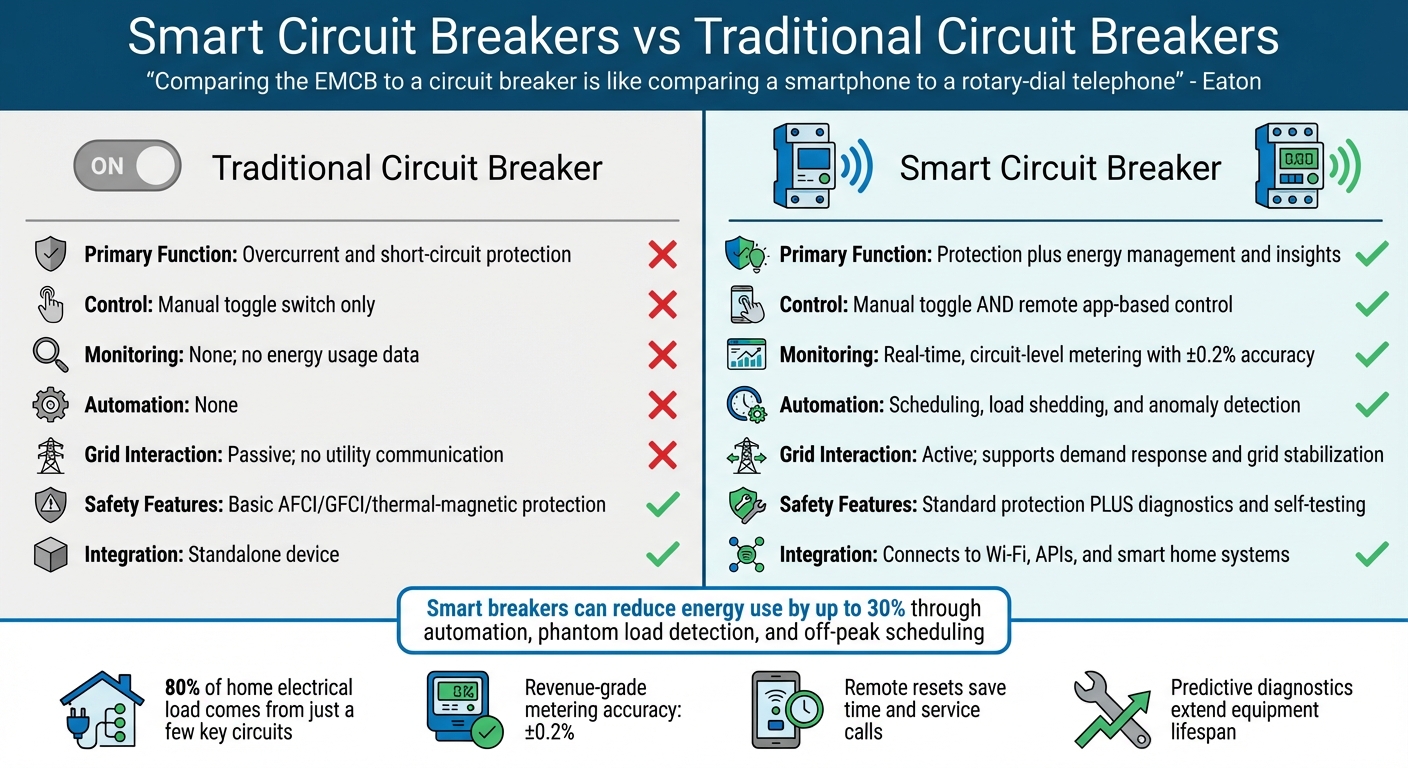
Traditional circuit breakers are pretty straightforward - they stay inactive until there’s an overload or short circuit that trips them. On the other hand, smart breakers are like the next generation of circuit breakers. They actively monitor and manage individual circuits, offering a level of control and insight that traditional breakers just can’t match. To put it simply, Eaton compares the difference like this: "Comparing the EMCB [Energy Management Circuit Breaker] to a circuit breaker is like comparing a smartphone to a rotary-dial telephone". This ability to monitor and control circuits in real time opens up opportunities for better energy efficiency and smarter maintenance.
The main distinction is in visibility and control. Traditional breakers don’t provide any data on energy usage. In contrast, smart breakers offer revenue-grade metering with ±0.2% accuracy, allowing you to track energy consumption at the circuit level. This is especially useful because about 80% of a home’s electrical load typically comes from a few key circuits, like HVAC systems, water heaters, and major appliances. By focusing on these high-demand circuits, smart breakers make energy monitoring much more effective.
But smart breakers go beyond just collecting data. They let you remotely turn circuits on or off, schedule operations during off-peak hours, and even automatically shed non-essential loads during outages or peak demand times. Traditional breakers, in comparison, are limited to manual toggling and don’t offer scheduling or load prioritization. The table below breaks down the key differences between the two.
Benefits of Smart Breakers
Smart breakers can help reduce energy use by up to 30% in homes equipped with the technology. How? They identify "phantom loads" - devices that quietly consume power even when not in use. They also allow for automated scheduling to shift energy-intensive tasks to times when electricity rates are lower and balance loads to prevent strain on your electrical system.
There’s also a big safety and maintenance advantage. Smart breakers provide predictive diagnostics, which can detect issues like an HVAC system running longer than usual or a freezer that isn’t operating properly. This means fewer unexpected breakdowns, fewer technician visits, and a longer lifespan for your appliances. And if something does go wrong, smart breakers allow remote resets, saving time and cutting down on unnecessary service calls - something traditional breakers simply can’t do.
| Feature | Traditional Circuit Breaker | Smart Circuit Breaker |
|---|---|---|
| Primary Function | Overcurrent and short-circuit protection | Protection plus energy management and insights |
| Control | Manual toggle switch only | Manual toggle and remote app-based control |
| Monitoring | None; no energy usage data | Real-time, circuit-level metering with high accuracy |
| Automation | None | Scheduling, load shedding, and anomaly detection |
| Grid Interaction | Passive; no utility communication | Active; supports demand response and grid stabilization |
| Safety Features | Basic AFCI/GFCI/thermal-magnetic protection | Standard protection plus diagnostics and self-testing |
| Integration | Standalone device | Connects to Wi-Fi, APIs, and smart home systems |
Finding Energy-Efficient Breakers on Electrical Trader
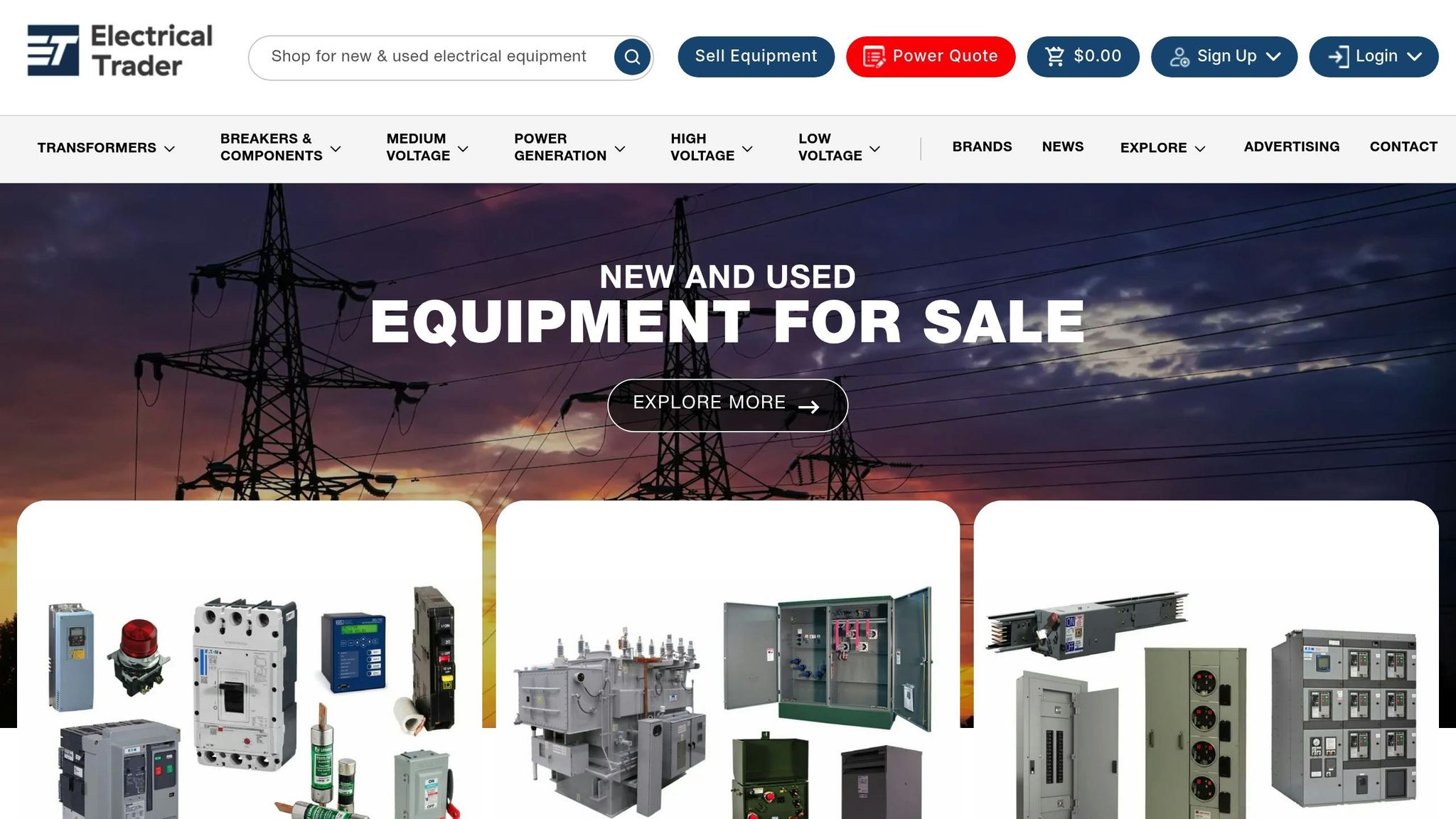
Electrical Trader's Product Range
Electrical Trader provides an extensive selection of smart circuit breakers designed to combine safety, energy efficiency, and modern connectivity. Among their offerings are EMCBs, which integrate cloud connectivity with revenue-grade metering for precise energy tracking. They also feature remote-control breakers that can be managed via apps like My Leviton or Tuya, as well as EV smart breaker chargers tailored to handle the high power demands of electric vehicles without requiring expensive infrastructure upgrades.
You’ll find breakers with various protection features, including overcurrent, AFCI, GFCI, and dual-function options, available in both 1-pole and 2-pole formats (up to 60A). These breakers support load shedding for critical appliances like refrigerators and help manage power during outages or peak pricing periods. Electrical Trader’s user-friendly listings allow you to filter products by breaker type, voltage, and brand, making it easier to identify the right option for your specific needs.
Steps for Selecting the Right Smart Breaker
Selecting the right smart breaker can significantly improve energy management while minimizing power waste. Start by focusing on circuits with high energy consumption, such as those powering HVAC systems, water heaters, or EV chargers. Since a majority of a home’s energy use - about 80% - is concentrated on just a few circuits, targeting these areas yields the greatest return on investment.
Ensure the breaker is compatible with your load center. For example, Eaton’s EMCBs are designed to retrofit seamlessly into both modern and older panels without requiring additional hardware. Next, choose a communication protocol that aligns with your existing infrastructure, whether it’s Wi-Fi, Bluetooth, 4G/5G, or industrial standards like Modbus or Ethernet/IP.
Pay attention to standards and certifications. Look for breakers that meet IEC 61557-12 Class 1 accuracy standards for power metering and prioritize safety features like AFCI for fire prevention and GFCI for shock protection. When comparing options on Electrical Trader, make sure to check key specifications such as working voltage (single-phase or three-phase), current rating, and breaking power to ensure the breaker is suitable for your system. For areas where water and electricity are both present, dual-function AFCI/GFCI breakers are a smart choice. These not only meet the latest safety codes but also help reduce panel clutter.
Conclusion
Smart circuit breakers are changing the way we approach electrical systems, transforming them from basic safety devices into advanced energy management tools. By focusing on key circuits, these systems help streamline energy use, offering practical benefits like real-time monitoring, remote control, and automated load management.
With features like real-time monitoring to detect phantom loads, remote control for scheduling energy use during off-peak hours, and load prioritization to extend backup power during outages, smart breakers provide a new level of control. When paired with solar panels, battery storage, or EV chargers, they also help manage the growing demand for electricity in homes - without requiring costly upgrades to your system.
Whether your goal is cutting down utility bills, participating in demand response programs, or simply gaining better insights into your energy consumption, smart breakers offer tangible benefits. The technology has advanced significantly, and retrofitting older systems is now easier, thanks to user-friendly, plug-and-play designs.
For those ready to make the switch, Electrical Trader provides a wide range of smart breakers designed for protection, connectivity, and efficient load management. You can filter options based on voltage, current ratings, and communication protocols to customize your panel into a smart energy hub.
Making the leap to smart electrical infrastructure empowers you to take charge of your energy usage while cutting costs and reducing your environmental footprint. Start by identifying your highest-energy-consuming circuits, checking compatibility with your existing panel, and choosing connectivity features that align with your energy goals.
FAQs
How do smart circuit breakers help save on energy bills?
Smart circuit breakers can help you cut down on energy costs by providing real-time monitoring, remote control, and load management features. These tools let you fine-tune your energy use, avoid overloads, and adjust or reduce power consumption during peak hours.
Equipped with advanced features like revenue-grade metering and demand-response capabilities, these breakers can lead to energy savings of up to 30% for homes and businesses. By reducing waste and improving efficiency, they help lower electricity bills without compromising the consistency of power distribution.
Can smart circuit breakers work with solar panels and battery storage systems?
Smart circuit breakers work well with solar panels and battery storage systems, creating a more efficient energy setup. Thanks to open-API interoperability, they can manage energy loads in real time, ensuring smarter energy use and maximizing the lifespan of backup power. This makes them a great option for improving renewable energy systems while also helping to reduce energy consumption.
What advanced safety features do smart circuit breakers offer compared to traditional ones?
Smart circuit breakers bring a whole new level of safety and functionality compared to traditional mechanical breakers. They can detect faults and voltage fluctuations in real time, monitor temperature and load levels continuously, and even perform remote shutdowns through mobile apps or connected systems.
What’s more, they offer predictive diagnostics - a feature that spots potential problems before they turn into serious failures. This proactive approach helps avoid downtime and reduces the need for expensive repairs. Beyond safety, these features also boost energy efficiency and ensure the system runs more reliably.