Indoor Dry-Type Transformer Maintenance Checklist
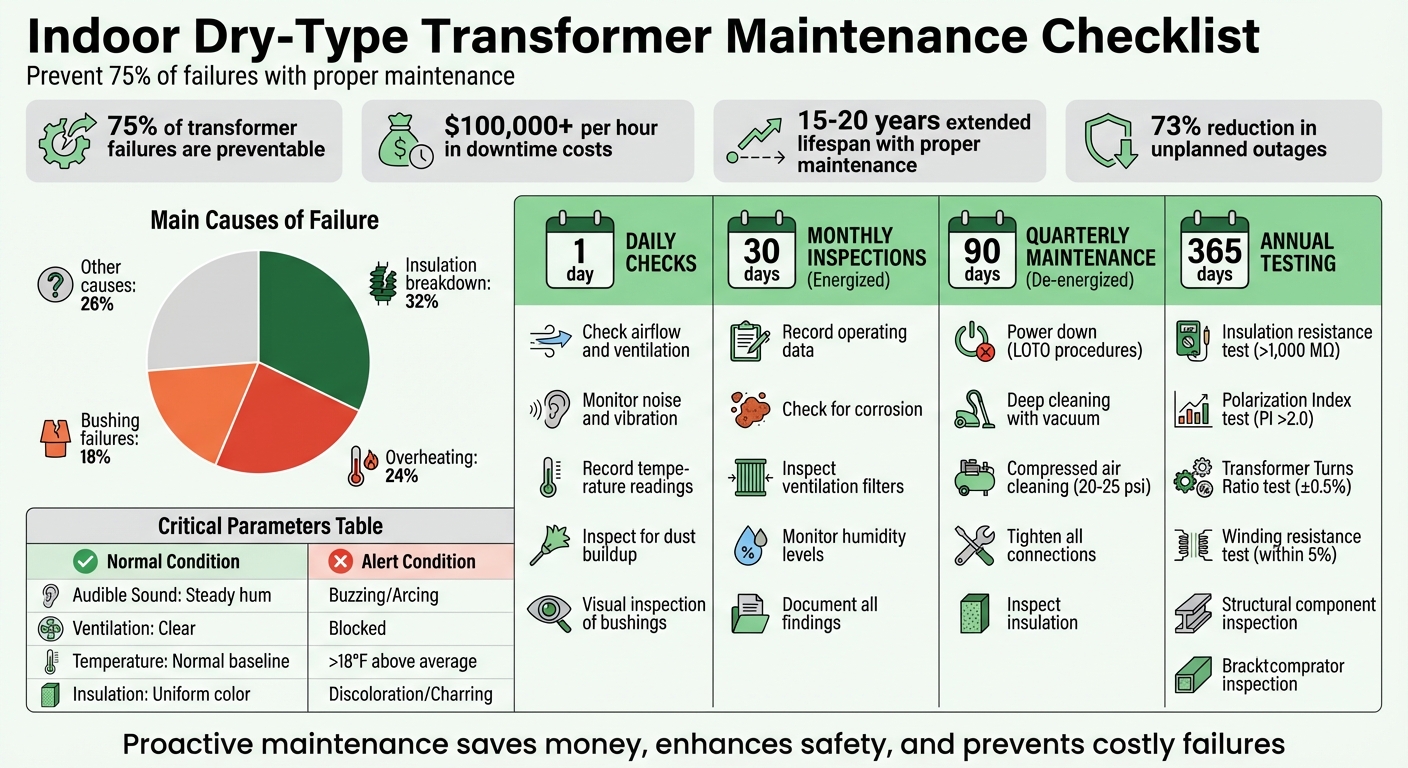
Indoor dry-type transformers are critical for powering facilities like data centers, hospitals, and manufacturing plants. Yet, 75% of transformer failures are preventable with proper maintenance. Neglecting this can lead to downtime costs exceeding $100,000 per hour and annual losses of over $3.5 billion in the U.S. alone. Regular maintenance not only extends transformer life by 15–20 years but also reduces unplanned outages by 73%.
Key causes of failure include insulation breakdown (32%), overheating (24%), and bushing failures (18%). Daily, monthly, quarterly, and annual checks can help identify these issues early. Inspections focus on airflow, noise, temperature, dust, and hardware condition to ensure reliability and compliance with safety standards like NFPA 70E and OSHA.
Quick Maintenance Highlights:
- Daily: Check airflow, noise, temperature, and dust.
- Monthly: Record operating data and inspect for corrosion or blockages.
- Quarterly: Power down for deep cleaning and tighten connections.
- Annual: Conduct electrical tests (e.g., insulation resistance, winding resistance) and structural inspections.
Proactive maintenance saves money, enhances safety, and keeps operations running smoothly. Prevent costly failures by following these steps consistently.
Indoor Dry-Type Transformer Maintenance Schedule and Checklist
DRY TYPE TRANSFORMER: INSTALLATION, OPERATION AND MAINTENANCE #transformer #drytypetransformer
sbb-itb-501186b
Daily Maintenance Checks
Daily inspections are essential for spotting issues early, preventing them from snowballing into expensive repairs. These quick checks, often performed during operation, help establish baseline readings, making it easier to detect gradual changes that could signal underlying problems. These daily routines also set the stage for more thorough monthly and annual maintenance.
Check Ventilation and Airflow
Proper air circulation is key to keeping dry-type transformers running efficiently. Take a close look at louvers, screens, and internal ducts to ensure they’re free of obstructions. Dust buildup can choke airflow, leading to higher operating temperatures. If you notice anything blocking the ventilation - like debris, stored items, or dirt - clear it immediately to avoid overheating.
"The presence of dust indicates that the transformer is in a dusty area that will require inspections every three to six months." - Todd Benadum, ELSCO Transformers
Make sure there’s enough clearance around the transformer. Items placed too close can restrict airflow and create hot spots. Also, check that the area is free of moisture sources, which could negatively impact the transformer’s performance.
Monitor Noise, Vibration, and Temperature
Pay attention to the sounds your transformer makes. A dry-type transformer typically emits a consistent, low-frequency hum. Any changes - such as excessive humming, buzzing, arcing, or crackling - can indicate issues like loose laminations or partial discharge inside the unit. Sudden shifts in sound patterns should be investigated immediately, as they often precede mechanical or electrical failures.
Keep track of winding temperature readings daily. This creates a historical record for comparison. Temperatures consistently exceeding 18°F (10°C) above your historical average may point to problems like cooling system failures or overloading. Also, ensure that monitoring gauges and temperature control circuits are working properly. While you’re at it, check for abnormal vibrations - components should remain stable during normal operation.
Look for Dust and Overheating
Dust is one of the biggest threats to a transformer’s health. Inspect all surfaces for dust, focusing on windings and ventilation areas where it tends to accumulate. If dust levels are high, consider shortening the maintenance schedule - transformers in dusty environments may need cleaning every three to six months instead of annually.
Keep an eye out for signs of overheating, such as discoloration of insulation materials, charring, carbon buildup on windings, or brown and black deposits. These changes might indicate loose electrical connections or overloading. Inspect bushings for cracks or contaminants and verify that grounding connections are secure and free of corrosion. If you notice any unusual smells - especially burning odors - document them immediately, as they’re often a sign of overheating.
| Parameter | Normal Condition | Abnormal Condition (Action Required) |
|---|---|---|
| Audible Sound | Steady, low-frequency hum | Humming, buzzing, arcing, or crackling |
| Ventilation | Clear louvers and screens | Dust buildup or physical obstructions |
| Insulation | Uniform color | Discoloration, charring, or carbonization |
| Temperature | Within historical baseline | >18°F (10°C) above historical average |
| Bushings | Clean and intact | Cracks, chips, or brown/black deposits |
| Hardware | Stationary | Visible vibration or movement |
Monthly and Quarterly Maintenance
In addition to daily monitoring, monthly and quarterly maintenance routines play a critical role in keeping your transformer in top condition. Monthly inspections focus on recording operating conditions while the equipment is energized, and quarterly maintenance involves shutting down the equipment for more hands-on tasks like cleaning and tightening connections. Here's a breakdown of what each involves.
Monthly Inspections While Energized
Monthly checks build on daily observations, helping you establish a more detailed performance baseline. During these inspections, record key data like temperatures, load levels, and any unusual sounds. These observations can help detect potential issues early since dry-type transformer maintenance often relies on subjective assessments.
Carefully inspect the enclosure for signs of corrosion, particularly on clamps or core steel. Ensure the surrounding environment is free from water drips, condensation, or high humidity, as moisture can compromise the transformer's integrity. If your transformer has ventilation filters, check them monthly for blockages, as restricted airflow is a leading cause of overheating. Even if everything appears normal, document your findings in a maintenance log for future reference.
Quarterly Cleaning and Connection Tightening
Quarterly maintenance steps go a step further, addressing tasks that require the equipment to be powered down. Begin by de-energizing the transformer following proper LOTO (Lockout/Tagout) procedures. Use a vacuum with a non-metallic hose to remove loose dust from windings and enclosures. For hard-to-reach areas, clean with dry, compressed air set at 20–25 psi.
Examine and tighten all accessible bolted electrical connections, as vibrations during operation can loosen them over time. Use torque specifications where applicable, but avoid over-tightening. While cleaning, inspect insulation for discoloration, charring, or tracking marks that could signal electrical stress. Use a soft brush or dry cloth for cleaning critical components, steering clear of any liquid cleaners.
| Inspection Category | Monthly (Energized) | Quarterly (De-energized) |
|---|---|---|
| Primary Method | Visual and auditory checks | Physical cleaning and mechanical testing |
| Key Focus | Ventilation, noise, temperature, load | Windings, fans, hardware, insulation |
| Cleaning | Surface inspection only | Deep cleaning of coils and internal ducts |
| Hardware | Visual wear inspection | Manual tightening of all accessible bolts |
Annual Testing and Full Inspections
Every year, plan a thorough inspection of your transformer while it's de-energized and locked out per safety protocols. This downtime is crucial for conducting electrical tests and structural checks that aren't possible when the unit is live. These annual evaluations work alongside daily and quarterly checks to keep your transformer running reliably over the long haul.
Conduct Electrical Testing
Annual electrical tests help assess the condition of your transformer's windings and insulation system. Key tests to include are:
- Insulation resistance (Megger) test: Ensure readings exceed 1,000 MΩ at 5kV, as outlined by IEEE 43-2013 standards.
- Polarization Index (PI) test: Measures the ratio of resistance at 10 minutes to that at 1 minute. A PI greater than 2.0 signals healthy insulation.
- Transformer Turns Ratio (TTR) test: Confirms the winding ratio and checks tap changer operation. Results should stay within ±0.5% of the nameplate rating.
- Winding resistance test: Identifies loose connections or broken conductors. Readings should remain within 5% of baseline measurements.
- Applied voltage (Hi-pot) test: For moisture-affected units, a Hi-pot test is essential. Readings below 20,000 ohms per volt suggest excessive moisture.
These tests provide insight into the transformer's internal health, particularly its insulation and winding performance.
Inspect Structural Components
With the transformer de-energized, carefully examine its structural parts. Check windings and insulators for signs of discoloration, charring, or tracking patterns that could indicate partial discharge. For cast resin transformers, inspect the resin surface for cracks or fissures, as these may point to mechanical stress. Look for rust or corrosion on the core steel and clamps, and verify that coil supports and bracing are secure and intact.
Inspect all bolted electrical connections and hardware for tightness, but only adjust them if the manufacturer's torque specifications are available. Over-tightening can cause more harm than loose connections. Examine the enclosure, cover louvers, and ventilation screens for damage, rust, or blockages that might hinder airflow. Lastly, check isolation dampeners for wear or loss of elasticity, as this can lead to excessive vibration.
Maintenance Best Practices and Record-Keeping
Record All Maintenance Activities
Regular inspections are just the beginning - keeping detailed records takes preventive maintenance to the next level. Accurate logs not only protect your equipment but also ensure compliance with standards like IEEE C57.12.01, IEC 60076-11, and NFPA 70B. These records should include essential details such as the transformer ID, location, nameplate data, and observations like dust buildup, rust on core steel, or carbonization on windings. Thermal data from infrared scans, especially when identifying hot spots or temperature differences over 18°F (10°C), should also be documented. Key electrical test results - primary and secondary voltage, load current, insulation resistance, winding resistance, and transformer turns ratio - are critical to include.
Another important metric is the Polarization Index (PI) ratio, which should always exceed 2.0. Don’t forget to note the ambient temperature and humidity during inspections, aiming for humidity levels below 60% RH. Record any corrective actions taken, such as part replacements, terminal torque adjustments, or cleaning processes used. To ensure accountability, both the inspector and supervisor should sign off on each maintenance record.
Comparing current measurements with baseline values is a proactive way to spot wear and tear before it leads to failure. Using digital platforms can simplify this process, offering real-time alerts and making records easily accessible for audits.
Train Staff on Maintenance Procedures
Good record-keeping is only effective when paired with a well-trained team. Transformer maintenance should always be conducted by qualified personnel. Training should cover essential safety procedures like Lockout/Tagout (LOTO), the proper use of arc flash-rated personal protective equipment, and adherence to NFPA 70E and OSHA standards. For dry-type transformers, staff must learn specific cleaning techniques, such as using vacuums or dry compressed air at 20–25 psi, while avoiding liquid cleaners that could damage insulation. Familiarity with industry standards like ANSI/NETA MTS and IEEE C57.94 ensures consistent and reliable maintenance practices.
"Only qualified electrical personnel should perform these inspections. Always follow lockout/tagout procedures and verify the absence of voltage before any inspection or maintenance tasks."
– Oxmaint
Staff should also document the "as found" and "as left" conditions during every service to monitor equipment degradation over time. Using calibrated tools like torque wrenches and infrared cameras is essential. Additionally, the frequency of inspections should be adjusted based on the operating environment. For example, transformers in dusty areas may need checks every 3–6 months, while those in cleaner settings might only require annual inspections.
Source Quality Replacement Parts
Using high-quality replacement parts is just as important as proper maintenance. Always choose parts that match your transformer model to maintain safety and performance. Pay special attention to components prone to failure, such as bushings (18% of failures), tap changers (14%), and cooling fans. For Vacuum Pressure Impregnated (VPI) transformers, replacement insulation should meet high-grade standards, like Class-H polyester resin for better moisture resistance. In high-moisture environments, consider cast resin components to prevent winding damage.
When tightening connections, always follow the manufacturer's torque specifications and use calibrated torque wrenches to avoid over-tightening. Clean all contact surfaces with lint-free rags or dry compressed air, steering clear of detergents or solvents that could harm insulation. For sourcing specialized components like bushings or fans, platforms like Electrical Trader offer industrial-grade equipment. By combining quality parts with diligent maintenance, you can extend a transformer's lifespan by 15–20 years and prevent up to 75% of potential failures.
Conclusion
Maintaining a structured checklist for indoor dry-type transformers is far more than just ticking off tasks - it's your first line of defense against costly failures and safety risks. This proactive strategy ensures long-term reliability and keeps operations running smoothly.
Facilities that prioritize thorough maintenance programs often see noticeable gains in both uptime and equipment lifespan. The financial stakes are high: unexpected transformer failures cost U.S. industries billions every year in lost productivity and emergency fixes. Scheduled maintenance, therefore, isn't just an operational task - it’s a smart investment in keeping things running without disruptions.
"A comprehensive transformer maintenance checklist isn't just paperwork - it's your insurance against catastrophic failure, unplanned downtime, and safety incidents."
– Delta Wye Electric
Beyond saving money, effective maintenance practices also enhance safety and ensure compliance with regulations. Regular inspections help prevent insulation failures that could lead to dangerous arc faults, catch loose connections before they spark fires, and keep your facility aligned with OSHA and NFPA standards. Keeping detailed records also protects your insurance terms and demonstrates responsible management.
Spending a few hours on preventive tasks - like clearing dust from cooling ducts, tightening connections, or conducting annual electrical tests - pays off significantly in reliability, safety, and cost-efficiency, ensuring your equipment serves you well for years to come.
FAQs
What daily maintenance steps are essential for indoor dry-type transformers?
Daily upkeep is essential to keep indoor dry-type transformers running smoothly and to avoid expensive breakdowns. Begin with a visual inspection to spot moisture, corrosion, dust accumulation, or any physical damage - these issues can affect performance. Make sure ventilation pathways are unobstructed and cooling fans are working properly to prevent overheating. Keep an eye on temperature readings for the windings and surrounding area; unexpected spikes could indicate cooling problems.
Check the breather and desiccant to ensure they aren’t saturated, as excessive humidity can harm the windings. Pay attention to unusual noises from motor bearings, confirm they are well-lubricated, and make sure motor contacts are secure. Inspect the pressure-relief diaphragm for any signs of damage, and verify that all operating mechanisms move freely. Always follow lock-out/tag-out procedures before conducting any hands-on tasks to prioritize safety.
Routine inspections like these can help extend the life of your transformer and minimize downtime. If you need replacement parts or new units, Electrical Trader offers a wide selection of dry-type transformers and related accessories to support your maintenance efforts.
Why is regular maintenance important for extending the lifespan of a dry-type transformer?
Regular maintenance plays a key role in spotting early signs of trouble like wear and tear, moisture accumulation, or overheating. Tackling these issues early not only helps you avoid expensive repairs but also minimizes downtime, keeping the transformer running smoothly throughout its 30–40-year lifespan.
When you keep your transformer in good condition, you ensure it performs at its best and stays dependable, avoiding unexpected breakdowns and extending its operational life.
What electrical tests should be performed annually on dry-type transformers?
To keep your dry-type transformer running smoothly and efficiently, it's essential to carry out a few critical electrical tests every year. These include:
- Insulation resistance testing (often referred to as megger testing)
- Winding resistance measurement
- Polarity checks
- Turns ratio testing
- Dielectric power factor testing
These tests are designed to catch problems like insulation breakdown, winding imbalances, or performance issues early - before they escalate into expensive repairs or unplanned downtime. By staying on top of these checks, you not only prolong the life of your transformer but also ensure it continues to meet safety and performance requirements.