Emergency Generator Sizing Checklist
When it comes to emergency generators, choosing the right size is critical. A generator that’s too small risks overheating, equipment damage, and failure during power outages. On the other hand, an oversized generator can lead to high upfront costs and operational inefficiencies like "wet stacking." To avoid these problems, you need to assess your power needs carefully and factor in both running and starting wattages, safety margins, and site-specific requirements.
Here’s a quick summary of what you need to know:
- Undersizing Risks: Overheating, damage to sensitive equipment, and inability to power critical systems.
- Oversizing Risks: High costs and issues like incomplete fuel combustion in diesel generators.
- Key Metrics: Generators are rated in kilowatts (kW) or kilovolt-amperes (kVA). Add a 20–25% safety margin to your calculated power needs.
- Load Assessment: Identify critical loads, calculate running and starting watts, and account for surges.
-
Generator Categories:
- Small Portable (1–7 kW): Ideal for individual appliances or camping.
- Residential Standby (8–28 kW): Covers essential home systems.
- Commercial (22–150 kW): Powers entire buildings, including HVAC.
- Industrial (50 kW–3,000+ kW): Supports large-scale operations like hospitals and factories.
- Installation Considerations: Ensure proper site access, ventilation, and compliance with codes like NEC and NFPA 110.
Proper sizing ensures reliable performance, prevents costly mistakes, and extends the lifespan of your generator. Keep reading for a detailed checklist and tips to calculate your power needs accurately.
How to select the right size residential standby generator - by Cummins Power Generation
sbb-itb-501186b
Generator Capacity Basics
Generator Capacity Ranges and Applications Guide
Understanding Kilowatts and Safety Margins
Generator capacity is measured in kilowatts (kW), where 1 kW equals 1,000 watts. This figure represents the actual working power the generator can produce. However, many generators are rated in kilovolt-amperes (kVA), which reflects the system's apparent power. To find the usable power, multiply the kVA rating by the power factor - typically around 0.8 for industrial generators. For example, a 100 kVA generator provides roughly 80 kW of usable power (kW = kVA × power factor).
When determining your power needs, avoid sizing the generator to match your load exactly. Instead, add a safety margin of 20% to 25% to handle unexpected power surges and to avoid overloading the generator. For generators that serve as the primary power source, it's a good idea to increase the margin further so the unit operates at only 70% to 80% of its capacity. This reduces the likelihood of overheating or other issues, like electrical fires. Once you've calculated your requirements and factored in safety margins, it's easier to decide on the appropriate generator capacity.
Common Capacity Ranges
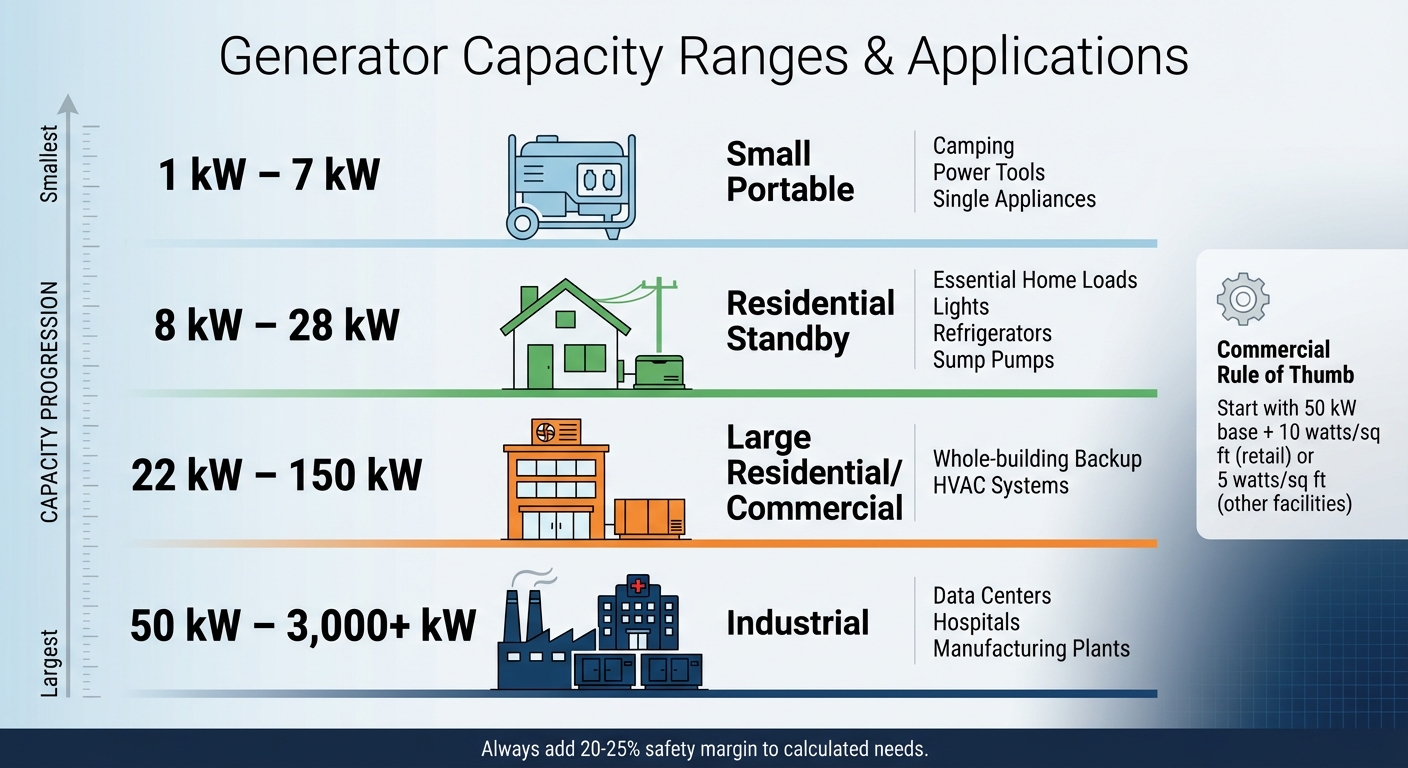
Generators come in various sizes to suit different needs. Here's a breakdown of common capacity categories and their typical uses:
| Generator Category | Capacity Range | Typical Applications |
|---|---|---|
| Small Portable | 1 kW – 7 kW | Camping, power tools, single appliances |
| Residential Standby | 8 kW – 28 kW | Essential home loads (lights, refrigerators, sump pumps) |
| Large Residential/Commercial | 22 kW – 150 kW | Whole-building backup, HVAC systems |
| Industrial | 50 kW – 3,000+ kW | Data centers, hospitals, manufacturing plants |
For smaller needs, portable units (1 kW to 7 kW) are perfect for activities like camping or powering individual appliances. Residential standby generators (8 kW to 28 kW) can handle critical home systems, such as refrigerators and lighting. Larger residential or commercial generators (22 kW to 150 kW) are designed for whole-building backup, including HVAC systems. Industrial generators, starting at 50 kW and exceeding 3,000 kW, are used in large-scale operations like hospitals, data centers, and factories.
For commercial spaces, a helpful rule of thumb is to start with a base of 50 kW and then add power based on square footage - 10 watts per square foot for retail spaces and 5 watts per square foot for other types of facilities.
Load Assessment Checklist
Identifying Critical Loads
Start by listing the systems that absolutely need power during an outage. For homes, this usually includes essentials like refrigerators, sump pumps, well pumps, furnace blowers, and basic lighting, which together typically require about 5–7 kW. In commercial buildings, maintaining fire alarms, fire pumps, security systems, and emergency lighting is crucial for safety. Healthcare facilities have even stricter requirements, needing backup power for life-saving equipment like ventilators, dialysis machines, medical gas pumps, and surgical suite systems. Industrial operations often focus on keeping servers, network equipment, programmable logic controllers (PLCs), elevators, and smoke control systems operational.
To streamline the process, organize equipment into categories such as Production, HVAC, Facility Systems (like lighting and elevators), IT/Control, and Emergency Equipment. For example, retailers should prioritize payment terminals and data servers, while restaurants need refrigeration and HVAC to avoid food spoilage. In hospital environments, critical patient care systems must receive backup power automatically within 10 seconds. Once you've identified these loads, the next step is to understand their power demands for both normal operation and startup.
Running vs. Starting Watts
After identifying the loads, it's important to distinguish between two key power ratings: running watts and starting watts. Running watts represent the continuous power a device needs during operation, while starting watts refer to the brief surge required to start up. These ratings are usually found on the equipment's nameplate or manual. If only volts and amps are listed, you can calculate watts using this formula: Watts = Volts × Amps.
The difference between running and starting power can be substantial. For example, a refrigerator may use 700 watts while running but require 2,200 watts to start. Similarly, a 3-ton central air conditioner might run on 3,500 watts but demand up to 10,500 watts during startup. Induction motors, in particular, can draw 3 to 7 times their running current for the first 2 to 10 seconds of operation. On the other hand, devices without motors - like microwaves, LED lights, and electric water heaters - generally have the same running and starting wattages.
Calculating Total Power Requirements
Once you know both running and starting wattages, calculating total power needs becomes straightforward. Add up the running watts of all the equipment you plan to use at the same time, then include the starting wattage of the largest motor among them. For example, if your total running load is 8,000 watts and the highest surge load is 7,000 watts, you'll need a generator with at least 15,000 watts of capacity.
For systems that operate continuously for extended periods (over 3 hours), such as HVAC units or EV chargers, apply a 125% multiplier to prevent overheating. For instance, a Level 2 EV charger drawing 7,200 watts should be calculated at 9,000 watts (7,200 × 1.25). Finally, add a 20–30% margin to account for potential future loads and to avoid running the generator at full capacity. This ensures reliable performance and reduces wear and tear on the system.
Accounting for Starting Surge
Calculating Surge Power Requirements
Starting surge is an essential factor to consider because motors and compressors need a significant burst of power to overcome inertia at startup. Typically, standard motors draw six to eight times their full-load ampere (FLA) rating during startup. For high-efficiency motors, this surge can exceed ten times their full-load current. This elevated current remains until the motor achieves about 80–90% of its rated speed.
To determine your total surge requirement, start by identifying the highest starting wattage in your system. Add this value to the combined running wattage of all other loads. For example, if your central air conditioner requires 10,500 watts to start and other loads consume 5,000 watts, your total surge requirement would be 15,500 watts. To ensure a safety margin, multiply this total by 1.25, accounting for a 25% buffer. This approach ensures your generator can handle peak demands effectively.
Motor nameplates provide useful data, such as starting kVA per horsepower. For instance, a motor with a code "F" may require 5.3 kVA/hp, while a high-efficiency motor with code "K" could demand 8.5 kVA/hp. To reduce starting kVA, consider sequencing large motors or using soft starters, which can cut the starting kVA by about 50% . Sequencing loads, as previously discussed, is another strategy to manage peak surge demand. Devices like soft starters or variable frequency drives (VFDs) can limit current to around 300% of FLA, compared to the typical 600–800%.
Using Measurement Tools
To confirm your calculations and ensure they reflect actual conditions, use measurement tools like a clamp-on ammeter. This device measures the peak current on each leg of your electrical service during startup. Unlike relying solely on motor nameplate ratings - which can sometimes be outdated or overly conservative - this method provides accurate, real-world data. Avoid traditional stopwatch methods, as they cannot capture the brief but intense surge events that occur in milliseconds.
Pay close attention to instantaneous voltage dips during startup. A 20% voltage dip is generally acceptable, but dips approaching 35% suggest insufficient capacity, which could cause other motors to drop offline. If your measurements reveal excessive dips or surges, you may need to increase generator capacity, implement load sequencing, or use soft-start technology to better manage the power demands during startup. These adjustments help maintain system reliability and prevent disruptions.
Application and Site-Specific Considerations
When selecting a generator, it’s not just about managing loads and surges. The specific application and site conditions play a critical role in determining the right choice.
Standby vs. Primary Use
The purpose of your generator - whether it’s for standby or primary use - directly affects the model you need. Standby generators are designed to kick in during utility outages, while primary (or prime) generators are meant to serve as the main power source for continuous or remote operations. These two types are built for different duty cycles and load demands.
Here’s a key point: neither type should run at full capacity for more than 30 minutes. For primary generators, operating at 70–80% of their rated capacity is essential for durability. For instance, if your load calculation comes to 40 kilowatts, you should choose a generator rated at least 50 kilowatts to maintain that 80% threshold and extend its lifespan.
Your generator’s application also determines which NEC code applies. Emergency loads (as per NEC Article 700) must be powered within 10 seconds of an outage, while legally required standby loads (NEC Article 701) have a 60-second window. Optional standby systems (covered under NEC Article 702) don’t have strict timing requirements, but proper sizing based on NEC Article 220 calculations is still critical.
Fuel Type and Availability
The choice of fuel is heavily influenced by your site conditions and how you plan to operate the generator. Larger, stationary systems often rely on diesel for high-capacity power needs, whether single-phase or three-phase. In contrast, standby generators for homes and businesses frequently use natural gas or propane, as these fuels provide the convenience of continuous operation without refueling.
Diesel generators, however, come with challenges. Running them at less than 30% load can lead to "wet stacking", where incomplete combustion occurs. Tom Divine, Senior Electrical Engineer at Smith Seckman Reid Inc., explains:
The purpose of these load requirements is to reduce the likelihood of 'wet stacking,' a condition caused by incomplete fuel combustion and other effects of running at light load.
To combat this, NFPA 110 mandates monthly operation at 30% of the generator’s nameplate power rating. If your building’s load doesn’t meet this threshold, you’ll need supplemental load banks for annual testing at 50% and 75% capacity.
Fuel storage logistics are another critical factor. Diesel fuel stored inside a building or on a roof is limited to 660 gallons. For larger volumes, you’ll need refueling systems, day tanks, and fire-protected fuel lines. Also, make sure your fuel port is accessible to delivery trucks - standard hoses typically reach only 25 feet.
Site Access and Installation Requirements
Physical site constraints, such as narrow roads, steep inclines, or limited space, can limit the size and delivery options for your generator. Standby generators require permanent concrete footings, while primary units at industrial sites are often mobile or skid-mounted.
Maintenance and safety standards are also critical. According to NFPA 110-2022, there must be at least 36 inches of working space around the generator, or enough room to fully open all hinged doors, whichever is greater. Indoor installations need a separate room with a two-hour fire rating, while outdoor units must be placed at least 5 feet from building openings or combustible walls unless the structure has a one-hour fire rating. Proper ventilation is also essential to keep enclosure temperatures within the manufacturer’s specifications.
Other installation considerations include the NEC height restriction for disconnecting means, which must not exceed 6 feet 7 inches. If the disconnect is higher, you’ll need a permanent platform or an emergency power-off switch in a convenient location. Additionally, NEC 700.3(F) requires provisions for connecting a temporary power source (like a docking station) when the permanent generator is offline for maintenance. To ensure compliance, consult your local Authority Having Jurisdiction (AHJ) during the design phase.
Verification and Sizing Tools
Once you've calculated your load requirements and site needs, it's crucial to double-check your figures using professional tools. This step ensures you avoid errors that could lead to selecting a generator that's too small or unnecessarily large.
Using Load Calculators and Sizing Charts
After assessing your load and factoring in safety margins, use tools like online wattage calculators to verify your numbers. These calculators, often provided by manufacturers and trusted retailers, help estimate the running and starting wattages for specific equipment. They're especially handy for residential or light commercial settings where individual loads can be listed out. These tools act as a practical checkpoint, bridging your initial calculations with real-world requirements.
For larger commercial and industrial projects, you'll need more advanced tools that calculate using kVA (apparent power) instead of just kW (real power). As Dustin Stelzer, Master Electrician at Electrician U, highlights:
Working in VA, we are 100% certain that this generator will work.
Professional-grade calculators convert real power to apparent power using a standard factor - typically 0.9 for modern systems and 0.8 for older ones. These tools often include built-in safety margins to account for motor startup surges and future power needs. Additionally, they adjust for altitude, as generators lose about 3% of their output for every 1,000 feet above sea level. For specialized setups like data centers or server rooms with an Uninterruptible Power Supply (UPS), a general rule of thumb is to use 1.5 times the UPS size at full load.
For even greater accuracy, supplement nameplate data with real-world measurements. A clamp meter can measure the actual amperage draw of circuits during peak usage. This often reveals that your actual load is lower than the nameplate rating, potentially saving you money by avoiding an oversized generator.
Finding Generators on Electrical Trader
Once you've verified your calculations, you're ready to explore generator options. Electrical Trader offers a robust marketplace with a wide selection of standby and primary generators. They cater to various needs, from smaller air-cooled units (8–28 kW) to larger liquid-cooled systems (22–150 kW) and heavy-duty diesel generators (15–200 kW).
The platform organizes equipment by type and application, simplifying the process of matching your verified load requirements to the right generator. Whether you're looking for a single-phase residential standby unit or a three-phase industrial system, you can filter options by capacity, fuel type, and brand. They also stock essential accessories like transfer switches and load banks to complete your installation.
Before making a final purchase, consult a qualified electrician. They can review your sizing calculations, ensure the generator meets local code requirements, and confirm proper neutral-ground bonding and compliance with the National Electrical Code (NEC).
Conclusion and Final Checklist
Sizing an emergency generator correctly means balancing your current and future power demands while steering clear of the pitfalls of over- or under-sizing. The process includes calculating total running watts, factoring in the largest starting surge, and adding a safety margin - typically 25% for commercial setups. As Primal Survivor puts it:
"Running a generator at full load can shorten its lifespan, so it's worth overestimating your power needs to avoid running at full capacity".
Key Points for Generator Sizing
Start by listing every appliance and system you’ll need to power at the same time. Separate essential loads, like refrigeration, medical devices, and security systems, from non-essential ones. For residential needs, sum up the total running watts and the highest starting surge. For commercial projects, use a clamp-on ammeter to measure peak amperage, calculate the full load with the formula (Total Amps × Supply Voltage) / 1,000, and then add a 25% reserve capacity.
Additionally, ensure your setup meets site-specific requirements like phase, fuel type, and clearances. Portable generators should be placed at least 20 feet from buildings, with the exhaust directed away from windows, doors, or vents. For permanent installations, it’s best to consult your local Authority Having Jurisdiction (AHJ) early to comply with NEC and NFPA codes.
Here’s a final checklist to help wrap up your planning process.
Final Sizing Checklist
- Calculate total running watts for all loads you plan to power simultaneously.
- Include the highest starting surge in your calculations.
- Add a 25% safety margin for commercial setups or future expansion needs.
- Match electrical specifications (voltage, phase, frequency) with your facility’s requirements.
- Verify fuel type availability and ensure proper storage at your location.
- Incorporate a transfer switch suited to your generator type.
- Account for site constraints, such as noise regulations, delivery access, and mounting needs.
- Consult a licensed electrician to review your calculations and ensure code compliance before making your purchase.
FAQs
How do I size a generator if multiple motors start at once?
When sizing a generator for multiple motors starting at the same time, you need to account for the high inrush current. This surge can be 2–3 times the motor's running wattage and, in the case of high-efficiency motors, it may even spike up to 10 times the full-load current. To ensure the generator can handle this startup load, base your calculations on the motor's horsepower, efficiency, and power factor. Proper planning here is key to avoid overloading the generator during startup.
When should I size in kVA instead of kW?
When evaluating a generator's apparent power capacity, it's important to size it in kVA. This measurement accounts for both active and reactive power, which is crucial for equipment like motors or transformers. These types of loads often have starting wattages that are much higher than their running wattages, making accurate sizing essential.
What site rules can force me to choose a different generator size?
Local building codes and safety standards often dictate the generator size needed to meet specific load demands, safety measures, and operational guidelines. These regulations take precedence over personal plans, ensuring your setup complies with legal and safety requirements.