Thermal Expansion vs. Fastener Performance
Thermal expansion can make or break the performance of fasteners in industrial systems. Here's why: when materials expand or contract due to temperature changes, the forces on fasteners can shift, leading to preload loss, loosening, or even structural failures. For example, steel bolts paired with aluminum components can loosen in summer and overstress in winter. This cycle weakens connections over time, risking equipment damage, safety hazards, and costly downtime.
Key points to know:
- Thermal expansion rates vary: Aluminum expands nearly twice as much as steel, creating stress in mixed-material assemblies.
- Fastener materials matter: Stainless steel, titanium, and nickel-based alloys like Inconel handle extreme conditions better than carbon steel.
- Design and installation are critical: Using compatible materials, proper preloading techniques, and protective coatings can reduce failures.
- Common risks include: Loosening, thread stripping, stress corrosion cracking, and hydrogen embrittlement.
Bottom line: Understanding thermal expansion and choosing the right fasteners for the job can prevent failures and keep systems running safely and reliably.
Bolted Joint Part 8 of 12 Thermal
sbb-itb-501186b
Fastener Materials for Thermal Expansion
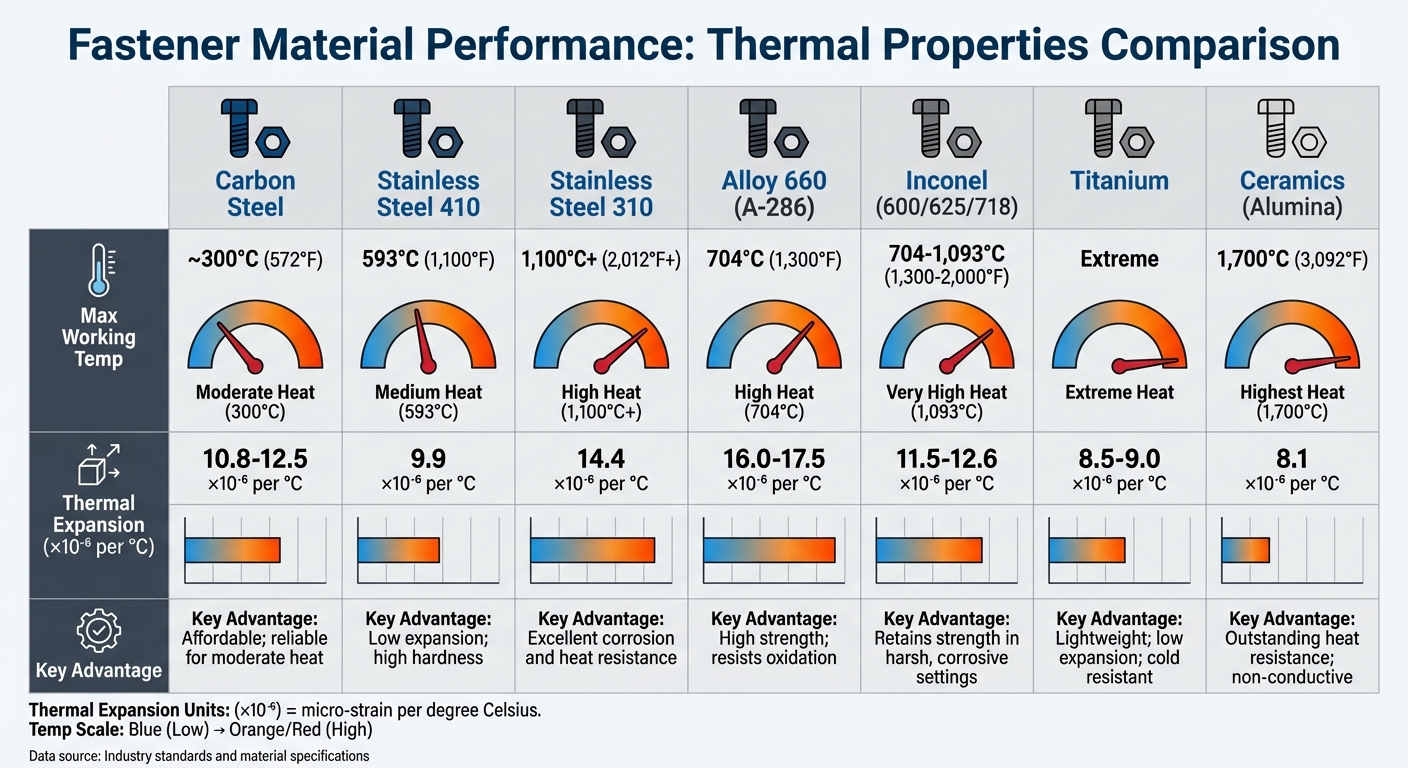
Fastener Material Thermal Performance Comparison Chart
Common Fastener Materials and Their Properties
Fastener materials respond differently to temperature changes, making it essential to choose the right one for specific conditions. Carbon steel is a staple in industrial applications due to its affordability and reliability at temperatures up to about 300°C (572°F). It’s a solid choice for moderate-temperature uses like indoor electrical panels or low-heat mechanical setups. However, carbon steel struggles in extremely cold environments, where it can become brittle, and under constant stress, where it’s prone to creep.
Stainless steel provides a wider temperature range, handling both high heat and cryogenic conditions (as low as -300°F) without losing toughness. For instance, Stainless Steel 310 can endure temperatures exceeding 1,100°C (2,012°F). But there’s a catch: austenitic stainless steels like Grade 304 expand more with heat, with a thermal expansion coefficient of 17.3 × 10⁻⁶ per °C. On the other hand, ferritic stainless steel, such as Grade 410, has a lower expansion rate (9.9 × 10⁻⁶ per °C), making it more stable during temperature swings.
For extreme conditions, nickel-based superalloys like Inconel are often the top choice. These materials retain strength and resist oxidation at temperatures where standard steels fail, operating between 704°C (1,300°F) and 1,093°C (2,000°F). Similarly, Alloy 660 (A-286) performs well up to 704°C (1,300°F) and offers excellent oxidation resistance.
Titanium stands out for its low thermal expansion (8.5 to 9.0 × 10⁻⁶ per °C) and impressive strength-to-weight ratio. It’s used in extreme environments, from aerospace engines to the cold vacuum of space, where its performance remains consistent.
Ceramics are unmatched when it comes to heat resistance, withstanding temperatures as high as 1,700°C (3,092°F). However, their brittleness in extremely cold conditions can limit their application in environments with drastic temperature fluctuations.
Another factor to consider is the durability of zinc coatings. These coatings degrade above 200°C (392°F), exposing the steel underneath to oxidation. For higher temperatures, alternatives like phosphate, black oxide, or ceramic coatings offer better protection.
Electrical Trader offers engineered fasteners designed to handle these thermal challenges effectively.
Material Performance Comparison Table
Here’s a quick reference for comparing material properties and performance:
| Material | Max Working Temp | Thermal Expansion Coeff. (×10⁻⁶ per °C) | Key Advantages |
|---|---|---|---|
| Carbon Steel | ~300°C (572°F) | 10.8 – 12.5 | Affordable; reliable for moderate heat |
| Stainless Steel 410 | 593°C (1,100°F) | 9.9 | Low expansion; high hardness |
| Stainless Steel 310 | 1,100°C+ (2,012°F+) | 14.4 | Excellent corrosion and heat resistance |
| Alloy 660 (A-286) | 704°C (1,300°F) | ~16.0 – 17.5 | High strength; resists oxidation |
| Inconel (600/625/718) | 704–1,093°C (1,300–2,000°F) | 11.5 – 12.6 | Retains strength in harsh, corrosive settings |
| Titanium | Extreme | 8.5 – 9.0 | Lightweight; low expansion; cold resistant |
| Ceramics (Alumina) | 1,700°C (3,092°F) | 8.1 | Outstanding heat resistance; non-conductive |
Failure Modes from Thermal Mismatch
Common Failure Modes
When fasteners aren't properly designed to handle thermal expansion, several issues can arise. Loosening is one of the most frequent problems. Thermal cycling can lead to preload loss in two ways: gradually through stress relaxation (non-rotational loosening) or by physically backing out due to vibration (rotational loosening). For example, at 600°C, some steels can lose over 50% of their initial stress within just 1,000 hours.
Another major concern is thread stripping, which becomes a critical risk at elevated temperatures. This sudden shear failure of bolt or nut threads can severely compromise structural integrity. High-strength bolt assemblies are especially vulnerable, as their stripping threshold decreases with rising temperatures. Unlike necking failure, which involves ductile plastic deformation and offers some warning before total failure, thread stripping happens abruptly.
Thermal stress also heightens risks tied to corrosion-related failures. Stress corrosion cracking (SCC) occurs when fasteners under constant tension are exposed to corrosive environments, with higher temperatures further reducing ductility. Similarly, hydrogen embrittlement (HE) develops when hydrogen infiltrates the metal's microstructure, often starting at stress concentration points like the fillet radius under bolt heads. Fasteners with hardness levels above Rockwell C36 are particularly at risk. Additionally, galvanic corrosion can occur when thermal expansion necessitates the use of dissimilar metals without adequate insulation, creating a galvanic cell that accelerates material degradation. Together, these failure modes pose serious hazards to industrial systems.
Impact on Industrial Systems
These failure modes highlight why choosing the right materials and design strategies is critical for managing thermal expansion. Real-world incidents demonstrate the consequences of neglecting these considerations. For example, in February 2007, a high-speed train derailed in Grayrigg, Cumbria, in the United Kingdom, resulting in one fatality and 88 injuries. The investigation revealed that nuts had detached from their bolts due to loosening, leading to a switch rail being struck by train wheels. Similarly, in 2014, General Motors issued a recall for nearly 500,000 vehicles - including models like the Chevrolet Impala and Cadillac SRX - due to fastener-related safety issues.
"Fasteners are typically low cost items; however, their failures may result in catastrophic and costly consequences." - Mersedeh Akhoondan, Ph.D., and Graham E.C. Bell, Ph.D., PE
The financial toll of such failures is immense. Corrosion alone, often exacerbated by thermal stress, costs the U.S. economy around $558 billion annually, roughly 3.1% of the nation’s GDP. A survey of U.S. automobile dealer service managers revealed that 23% of all service problems stem from fastener loosening, and approximately 12% of new cars have loose fasteners during their first service checks. These failures not only increase maintenance demands and unplanned downtime but can also jeopardize human safety. For instance, the San Francisco-Oakland Bay Bridge faced high-profile bolt failures shortly after its eastern span opened, with hydrogen embrittlement and stress-related corrosion identified as key causes.
How to Reduce Thermal Expansion Issues
Material and Design Considerations
To tackle thermal expansion challenges, start by selecting materials with compatible coefficients of thermal expansion (CTEs). This reduces tensile stress during thermal cycling, which can otherwise weaken joints. For temperatures up to 1,200°F, A-286 is a reliable choice. For harsher conditions reaching 1,600°F, superalloys like Inconel 718 or Waspaloy are better suited.
Designing with care is just as critical. Instead of relying on fewer high-strength fasteners (above 180 ksi), consider using more standard-strength ones. This approach minimizes brittleness and reduces the risk of stress corrosion. Thread designs also play a key role. For example, the Spiralock thread, featuring a 30° wedge ramp, helps prevent lateral movement caused by vibration and thermal stress. Together, these strategies improve joint durability under thermal cycling.
Proper Installation Techniques
Once you've chosen the right materials and design features, proper installation becomes essential for handling thermal challenges. One effective method is heating the bolt during installation. As the bolt cools, it contracts, creating the necessary clamping force. To account for heat loss during nut installation, heat the bolt slightly above the target temperature. Using a feeler gauge between the nut and bearing surface ensures the bolt has elongated sufficiently before final tightening.
Another method is nut-rotation preloading, which directly measures bolt tension and avoids the variability caused by friction. Moo-Zung Lee emphasizes its effectiveness:
"Nut-rotation preloading is more directly related to the bolt tension bypassing uncertainties in friction altogether"
For applications with significant thermal cycling, incorporating disk springs (Belleville washers) helps maintain consistent bolt loads despite temperature fluctuations. These techniques ensure reliable fastener performance in demanding thermal environments.
Protective Coatings and Treatments
Protective coatings provide an additional layer of defense against thermal degradation. Coatings like Sermatel W or SermaGard, which use aluminum particles in an inorganic binder, seal fasteners and protect against hydrogen embrittlement and stress corrosion up to 900°F. As NASA's Reference Publication 1228 notes:
"The bolt plating material is usually the limiting factor on maximum service temperature"
For temperatures as high as 1,600°F, silver plating offers lubrication and corrosion resistance, reducing "dry torque" by 50%. Nickel plating is effective up to 1,100°F. For stainless steel fasteners, passivation or preoxidation - achieved by exposing fasteners to 1,300°F in an air furnace - prevents thread galling or freezing post-installation. Additionally, for carbon steel fasteners, baking them at 375°F for 23 hours within two hours of plating prevents hydrogen embrittlement. These treatments significantly extend fastener lifespan and enhance system reliability in high-temperature conditions.
Conclusion
Grasping how thermal expansion impacts fastener performance is essential for ensuring the reliability of industrial systems. When fasteners and joint materials expand or contract at different rates, it can lead to issues like preload loss or unexpected tensile loads, which jeopardize safety. As Kenneth Korane, Editor of Machine Design, explains:
"Thermal effects may increase or decrease bolt load and clamping capability."
This highlights why it's so important to align fastener properties with the specific conditions they’ll face during operation. Overlooking thermal effects can lead to unsafe joints and reduced system reliability.
Material selection plays a critical role. Each fastener material has distinct properties, and matching their thermal behavior with the materials they secure can minimize strain caused by temperature changes. For instance, steel typically expands at around 6.5 ppm/°F (11.7 ppm/°C), while aluminum expands at about 12.8 ppm/°F (23.1 ppm/°C). By aligning the coefficient of thermal expansion (CTE) between fasteners and clamped materials, you can significantly reduce differential strain.
In addition to choosing the right materials, proper installation techniques and protective treatments can further enhance fastener performance. For high-temperature environments, mechanical locking solutions often outperform chemical adhesives, while zinc coatings may degrade at temperatures above 392°F (200°C). Disk springs are another effective option, helping maintain consistent bolt loads during temperature fluctuations. Thermal preloading techniques can also ensure sufficient clamping force as systems cool. Together with precise installation and treatment methods, these strategies are essential for maintaining robust and reliable joints.
FAQs
How do I calculate thermal expansion mismatch in a bolted joint?
To determine thermal expansion mismatch, you need to compare the coefficients of thermal expansion (CTE) of the materials involved and account for the temperature change. The formula is:
Thermal mismatch ≈ (α₁ - α₂) × ΔT × L
Here’s what each term means:
- α₁ and α₂: The CTEs of the two materials
- ΔT: The temperature difference
- L: The original length of the material
For situations with more intricate geometries or interactions, using finite element analysis (FEA) can offer more accurate and detailed insights.
What’s the best way to keep preload during thermal cycling?
To keep preload consistent during thermal cycling, choose materials with similar thermal expansion coefficients. This minimizes tension fluctuations caused by temperature changes. To combat stress relaxation, opt for materials and joint designs that can withstand creep under high temperatures. Using preloading methods, such as heating the fastener during installation, can further enhance stability. Additionally, make sure the joint design considers thermal effects and incorporates materials that remain stable at the expected operating temperatures.
When should I avoid zinc-plated fasteners because of heat?
Avoid using zinc-plated fasteners in situations where temperatures climb above 390°F (210°C). When exposed to such high heat, the zinc coating can melt or break down, losing its protective properties. This degradation may weaken the fastener's performance, making it less reliable in demanding conditions.