

Cable Routing for Transformers: Best Practices
Proper cable routing in transformer installations is critical for safety, performance, and longevity. Missteps can lead to overheating, voltage drops, and insulation damage. Two main methods - triangular and bundled configurations - offer distinct advantages and limitations.
-
Triangular Configuration (Trefoil):
- Reduces magnetic fields, lowers resistance, and improves cooling.
- Ideal for runs under 100 feet to minimize voltage drop.
- Supports better heat dissipation, extending cable lifespan.
-
Bundled Configuration:
- Simplifies installation but traps heat, reducing efficiency.
- Requires careful handling to avoid insulation damage.
- Suitable for tight spaces but demands derating for safety.
Key Takeaways:
- Use triangular setups for optimal heat management and current capacity.
- Avoid bundling in high-temperature environments or near transformer coils.
- Maintain proper spacing, support, and bending radii for safety and durability.
Quick Tip: Always re-tighten cable bolts after 30 days and ensure cables are routed to avoid mechanical stress. Proper planning ensures reliable, long-lasting transformer performance.
How to Connect Cable in Transformer | Transformer connection
1. Triangular Cable Configuration
The triangular configuration, also known as trefoil or A/B/C routing, arranges three-phase cables in a trefoil pattern. This setup helps cancel out the magnetic fields that naturally form around current-carrying conductors. The result? Lower resistance, cooler cables, and improved performance overall.
Thermal Performance
Triangular routing plays a major role in managing heat. By canceling out magnetic fields, this layout significantly reduces resistance, which in turn minimizes heat generation. For example, a 4/0 W cable rated at 405 amperes with a 90°C (194°F) rise over a 30°C (86°F) ambient temperature achieves better heat dissipation when arranged in a triangular layout. Without this configuration, cables grouped by phase (e.g., all A-phase cables together) trap heat, increase resistance, and risk damaging the 2-kV insulating jacket. In extreme cases, this can lead to short circuits or even electrical hazards.
Surface conditions also matter. Cables placed on asphalt in direct sunlight can reach temperatures of around 125°F, reducing their current-carrying capacity. In contrast, cables on cooler surfaces perform more efficiently.
"It's important to run cables in a triangular placement to ensure that the cables will operate at the highest carrying capacity, generate the least heat, and create the lowest risk."
– Sunbelt Rentals
Voltage Drop
While triangular placement minimizes resistance, the length of the cable run is the main factor affecting voltage drop. Ideal runs typically range between 50 and 100 feet. However, runs exceeding 200 feet with 4/0 type W cable can experience noticeable voltage loss. To address this, adding parallel cables can help maintain power levels, as long as the proper A/B/C phase sequence is followed.
Ease of Installation
Proper phase sequencing is crucial when using a triangular configuration to ensure cables of the same phase aren’t grouped together. Free air routing is also preferred, as it allows for better heat dissipation and maximizes the cable's capacity. On the other hand, running cables through conduit can trap heat, requiring a lower amperage rating for the same cable size. For high-voltage setups, maintaining a bending radius of at least 12 times the cable diameter is essential to protect both mechanical and thermal integrity.
Durability
This arrangement also boosts the lifespan of cables by protecting the insulating jacket from excessive wear and tear. Cooler-running cables are less likely to experience insulation damage, ensuring secure connections over time. This durability becomes especially important in challenging environments, where high ambient temperatures or hot surfaces demand superior heat management to prevent early cable failure.
2. Bundled Cable Configuration
Bundled cable configurations involve grouping multiple cables together using cable ties or woven sleeves. This method is popular for its ability to streamline cable management and create a neater installation. However, while it may simplify organization, it introduces serious thermal challenges that can negatively impact transformer performance and safety. Unlike the triangular configuration, which is designed to optimize heat dissipation, bundling prioritizes convenience, often at the cost of thermal efficiency.
Thermal Performance
Bundling cables significantly limits their ability to release heat. When cables are stacked or grouped by phase - for instance, placing all A-phase cables together - they generate excessive heat, which increases resistance at the cable ends. This setup traps heat that would otherwise dissipate into the surrounding air, often pushing cables to operate beyond their safe temperature limits. For example, the thermal performance of a 4/0 W cable can be severely compromised when bundled.
The risks are even greater when cables are running close to their rated capacity. The restricted airflow caused by bundling can lead to the melting of the 2-kV insulating jacket, creating the potential for short circuits or electrical shock hazards. Environmental factors make this issue worse - cables bundled in 100°F summer conditions can safely carry less current compared to the same setup in cooler, 40°F weather. These thermal challenges stand in stark contrast to the efficiency of triangular configurations, emphasizing the trade-offs of bundling.
"Cables should never be placed with all A phase, B phase, and C phase cables together or all cables piled on top of each other. This reduces the current carrying capacity of the cables and could damage the insulation, possibly resulting in electrical shock, as well as increase resistance at the cable ends, causing them to overheat."
– Sunbelt Rentals
Ease of Installation
Despite its thermal challenges, bundling does have practical advantages when it comes to installation. Grouping cables into manageable bundles reduces clutter and makes it easier to identify and trace individual cables during maintenance. However, proper handling is crucial. Avoid overtightening cable ties, as this can damage the insulation. For enclosed spaces like control cabinets, wiring ducts with slotted walls are a better option. They help keep cables organized while still allowing for some airflow.
Additionally, it's important to support cables to prevent undue stress on transformer bushings and connections. After installation, check and re-tighten all cable retaining bolts after the first 30 days of operation to ensure the connections remain secure over time.
Durability
Bundling does offer some protection against abrasion, but its thermal downsides can shorten cable lifespan. For aluminum conductors, applying a protective compound to terminals is essential to prevent surface oxidation, which helps maintain durable connections over time. To reduce thermal damage and prevent interference, it’s best to route bundled cables away from transformer coils and secure them with flexible connectors. This approach helps balance the convenience of bundling with the need for long-term cable health and safety.
sbb-itb-501186b
Comparison of Methods
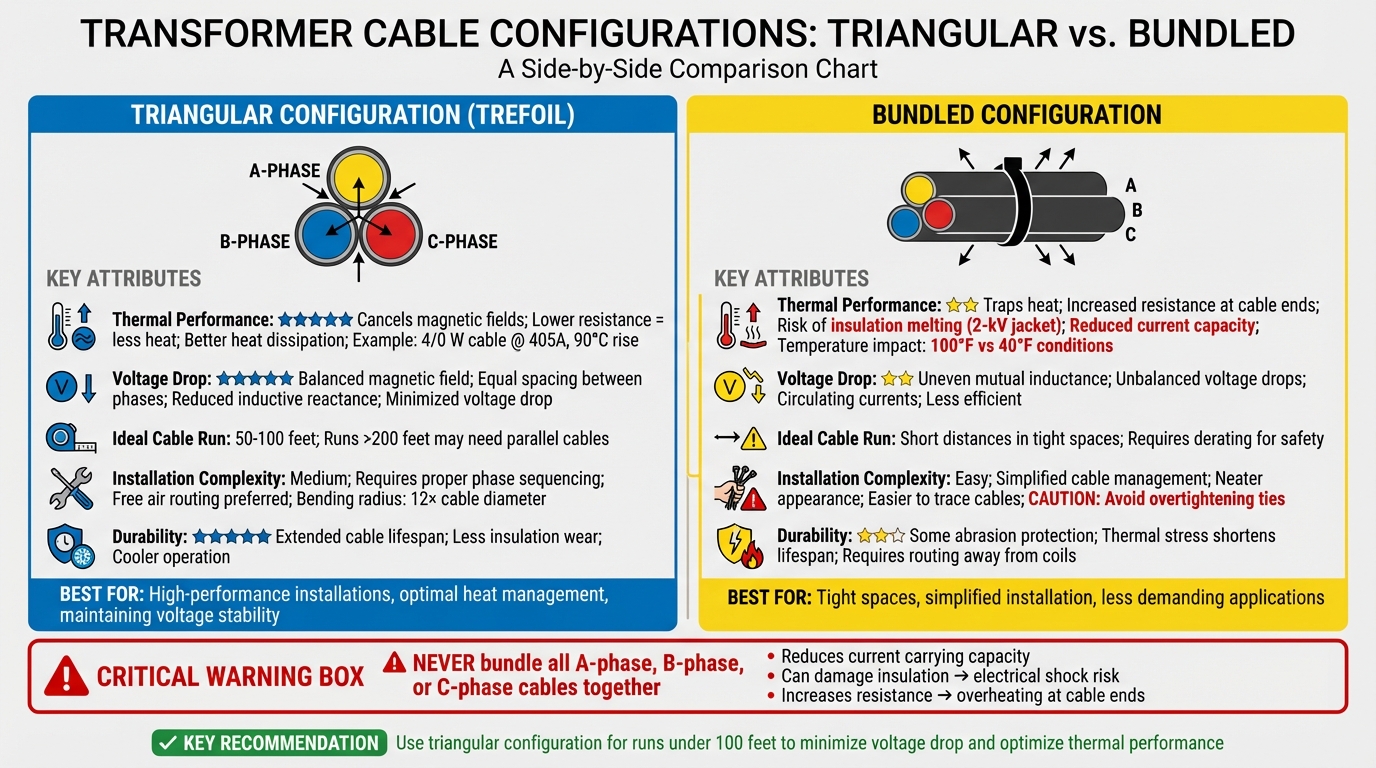
Triangular vs Bundled Cable Configuration Comparison for Transformers
Triangular and bundled cable setups primarily differ in how they affect voltage drop. A triangular configuration keeps the spacing between all three phases equal, resulting in a balanced magnetic field and circuit impedance. This balance helps reduce inductive reactance and minimizes voltage drop.
On the other hand, bundled configurations cause uneven mutual inductance between conductors. This imbalance can lead to unequal voltage drops and circulating currents.
For scenarios where maintaining voltage stability and phase balance is critical, triangular configurations are the better choice. While bundled configurations might work in less demanding situations, they don’t offer the same efficiency in reducing voltage drops as triangular setups. These differences play a key role in shaping implementation strategies.
Implementation Guidelines
When planning cable routing, consider the installation environment. For cable runs under 100 feet, triangular configurations are recommended to maintain voltage stability. For runs exceeding 200 feet, address voltage drop by adjusting the transformer's tap jumpers. These recommendations align with the earlier discussion on the advantages of triangular configurations, ensuring the transformer operates efficiently.
In areas with high ambient temperatures or significant heat generated by the transformer, side or bottom cable entry is ideal to help preserve insulation life. For dry-type transformers, cooling is critical - ensure airflow of approximately 100 cubic feet per minute for each kilowatt of transformer loss.
Always provide independent support for conduits and bus ducts, as transformer covers are not designed to bear their weight. Use UL-listed lugs without washers to minimize impedance, and adhere to NEC guidelines, ensuring no more than 360° of bending between pull points.
To meet both environmental and operational needs, size and protect cables appropriately. Use the transformer's nameplate rating as a guide, and where applicable, include a 125% safety margin. Match insulation ratings to the operating environment. For reliable supplies, including lugs and transformer accessories, Electrical Trader (https://electricaltrader.com) is a recommended source. Proper cable management is essential for both safety and optimal performance in transformer installations.
Maintain proper spacing when positioning transformers. Keep them 12–18 inches from walls and ensure at least 10 feet of clearance for safe access. To reduce vibration and noise, use flexible connectors. Apply power compound grease on all connections, and secure joints using galvanized bolts with flat and spring washers, leaving 2–3 threads exposed for a secure fit.
Conclusion
Deciding between triangular and bundled cable configurations comes down to the specific needs of your installation. Triangular routing stands out for its ability to enhance thermal performance by canceling magnetic fields around three-phase cables. This results in cooler operation and increased current capacity, making it ideal for installations where managing heat is a priority and where cable runs are between 50 and 100 feet. On the other hand, bundled configurations are easier to install in tight spaces, but they require careful consideration of derating factors and proper ventilation to avoid overheating.
Installing cables correctly is critical for ensuring transformer safety and longevity. Always support cables independently to prevent mechanical stress on bushings, as excessive strain can lead to cracks, connection failures, and costly downtime. Position cable entry points at the side or bottom of the enclosure to minimize the risk of insulation aging caused by rising heat when cables are routed above the unit.
Additionally, maintaining connection integrity is essential for reliable performance. As noted by don_resqcapt19, Retired Electrician:
"The secondary conductors are sized to the load, and protected at their ampacity as long as the OCPD does not exceed 125% of the secondary full load current."
This highlights the importance of correctly sizing and protecting conductors. Re-tighten cable bolts after 30 days to ensure solid connections, and use UL-listed lugs without washers to minimize impedance and reduce the risk of hazardous heating.
Effective thermal management is another key factor in creating dependable systems. Free-air cables allow for better heat dissipation, while improperly derated conduits can lead to insulation melting and short circuits. To avoid mechanical stress and insulation failure, maintain a bending radius of at least 12 times the cable diameter for high-voltage cables and 8 times for control cables. Clearly label cables at entry points, mid-spans, and terminations to simplify troubleshooting during maintenance or emergencies.
FAQs
What are the benefits of using a triangular cable configuration instead of a bundled one?
A triangular cable configuration comes with several perks, especially in transformer setups. One standout benefit is its ability to enhance heat dissipation. By allowing better airflow around the cables, this arrangement helps maintain proper operating temperatures and lowers the chances of overheating.
Another advantage lies in its ability to reduce electromagnetic interference (EMI). The triangular layout distributes the magnetic fields from the cables more evenly, which contributes to smoother and more stable performance.
This design can also save space in certain installations. Compared to bundled cables, it requires less room, creating a more compact setup. With proper spacing and alignment, this configuration ensures a safer and more efficient cable routing system, aligning with industry standards.
How does cable length impact voltage drop in transformer installations?
Cable length is a key factor in voltage drop during transformer installations because longer cables naturally have higher resistance. This resistance leads to energy loss as heat (known as I·R losses), which reduces the voltage available at the load. To address this, the National Electrical Code (NEC) advises keeping voltage drop below 3% of the nominal voltage to ensure efficient performance.
To limit voltage drop, designers aim for the shortest and most direct cable routes, avoiding unnecessary bends. When longer cable runs are unavoidable, engineers calculate the voltage drop using the formula V = I × R, where R = ρ × L / A. In this formula, ρ represents the conductor's resistivity, L is the cable length, and A is the cross-sectional area. If calculations show the voltage drop exceeds acceptable levels, solutions include using cables with larger cross-sectional areas or materials with better conductivity, such as copper.
For projects that demand specific cable sizes, resources like Electrical Trader provide a wide range of power distribution cables tailored to meet exact length and load requirements.
What steps can I take to ensure bundled cables last longer in transformer installations?
To keep bundled cables in transformer setups functioning effectively over time, prioritize mechanical protection, secure fastening, and routine inspections.
Start by using conduits or cable trays to guard cables against physical damage and exposure to moisture or impacts. Be mindful of the bend radius - never exceed the manufacturer's recommendations, as tight bends can harm both insulation and conductors. For fastening, opt for durable cable ties or clamps that are resistant to UV exposure and chemicals, and ensure they are suitable for the temperature and load conditions. Secure cables at regular intervals, typically every 4 to 6 feet for larger cables, to avoid sagging or unnecessary movement.
In harsher environments, use protective sleeves or additional supports to shield cables from corrosive substances and vibrations. Maintain at least one cable diameter of spacing between cables to promote proper heat dissipation. Finally, make regular inspections a priority to spot signs of wear, loose fasteners, or abrasion early, helping to ensure long-term performance and reliability.