

How Smart Switchgear Supports Renewable Grids
Smart switchgear is transforming how renewable energy integrates into the aging U.S. power grid. Unlike older systems, which rely on outdated methods to manage power, smart switchgear uses real-time monitoring, automation, and predictive maintenance to ensure grid reliability as solar and wind energy grow.
Key challenges addressed include:
- Intermittency: Solar and wind depend on weather, causing unpredictable energy flows.
- Power Quality: Renewable sources generate low fault currents that traditional systems can't handle.
- Legacy Infrastructure: Much of the grid, built in the 1950s, struggles with modern energy demands.
How smart switchgear solves these issues:
- Real-Time Monitoring: Tracks voltage and current changes instantly to stabilize the grid.
- Automation: Quickly isolates faults, preventing widespread outages.
- Predictive Maintenance: Uses AI to forecast equipment failures, reducing downtime and costs.
- Integration with Renewables: Manages bidirectional energy flows from solar, wind, and battery storage.
These advancements not only improve grid stability but also lower energy losses, extend equipment life, and reduce operational costs. As renewable energy expands, smart switchgear ensures the grid can meet future demands efficiently.
Switchgear by Noja Power
sbb-itb-501186b
Challenges in Renewable Energy Grid Integration
Adding solar and wind farms to the grid brings a host of technical issues that traditional systems weren't designed to handle.
Intermittency of Renewable Energy Sources
Solar and wind energy production is highly dependent on weather conditions. Wind turbines only generate electricity when there's enough wind, while solar panels produce varying amounts of power throughout the day. This unpredictability forces grid operators to constantly adjust supply and demand.
"One of the most widely acknowledged challenges with renewable integration is the variability and unpredictability of generation. Wind and solar do not always align with demand."
- Bryan Schurko, Strategic Growth Leader of Power Delivery, Stantec
A striking example of this occurred in California in 2024, when the state had to discard over 3.4 million MWh of wind and solar energy because the grid couldn't store or transfer the surplus power. These limitations highlight how sudden changes in renewable energy output can overwhelm the grid, causing issues like voltage drops, frequency instability, and harmonic distortion, all of which can damage sensitive equipment. This variability also puts pressure on the grid's ability to maintain consistent power quality.
Power Quality and Fault Risks
Renewable sources like solar and wind create different kinds of challenges compared to traditional power plants. Conventional coal or gas plants use large spinning turbines that help stabilize the grid during power surges. In contrast, solar and wind systems rely on electronic inverters, which don't provide the same physical inertia. These inverters also fail to generate the high fault currents needed to activate traditional grid protection systems.
"IBRs, such as wind and solar PV, do not inject high flows of current when a fault occurs so they do not trip the circuit breakers that disconnect the damaged area from the grid."
Another issue is the distance between renewable farms and urban centers. Transmitting power over long distances requires significant reactive power, and doubling the power on a transmission line increases the reactive power demand fourfold. If this isn't managed well, it can lead to overheating of transmission lines and unstable voltage levels. These challenges are even harder to address when combined with the aging infrastructure of today's grid.
Incompatibility with Legacy Systems
A large portion of the U.S. grid was built in the 1950s and is ill-equipped to handle the demands of modern renewable energy systems. Designed for one-way power flow and high-current faults, these older systems struggle with the bidirectional, low-current flow characteristics of renewable installations. The rise of distributed energy sources, like rooftop solar panels and small wind farms, has added complexity to grid management.
"The utility or system operator has gone from managing a handful of large, reliable generation sources to adjusting generation for a multitude of various size and variable output assets."
- Brett Benson, Director for Global Renewable Solutions, Emerson
Older protection systems, which were built to detect high fault currents from traditional generators, often fail to identify the low-current faults from inverter-based systems. Additionally, the grid's edge - where many small-scale solar systems feed power back - lacks real-time monitoring, making it difficult for operators to address issues before they escalate into larger problems.
Limitations of Traditional Switchgear in Renewable Grids
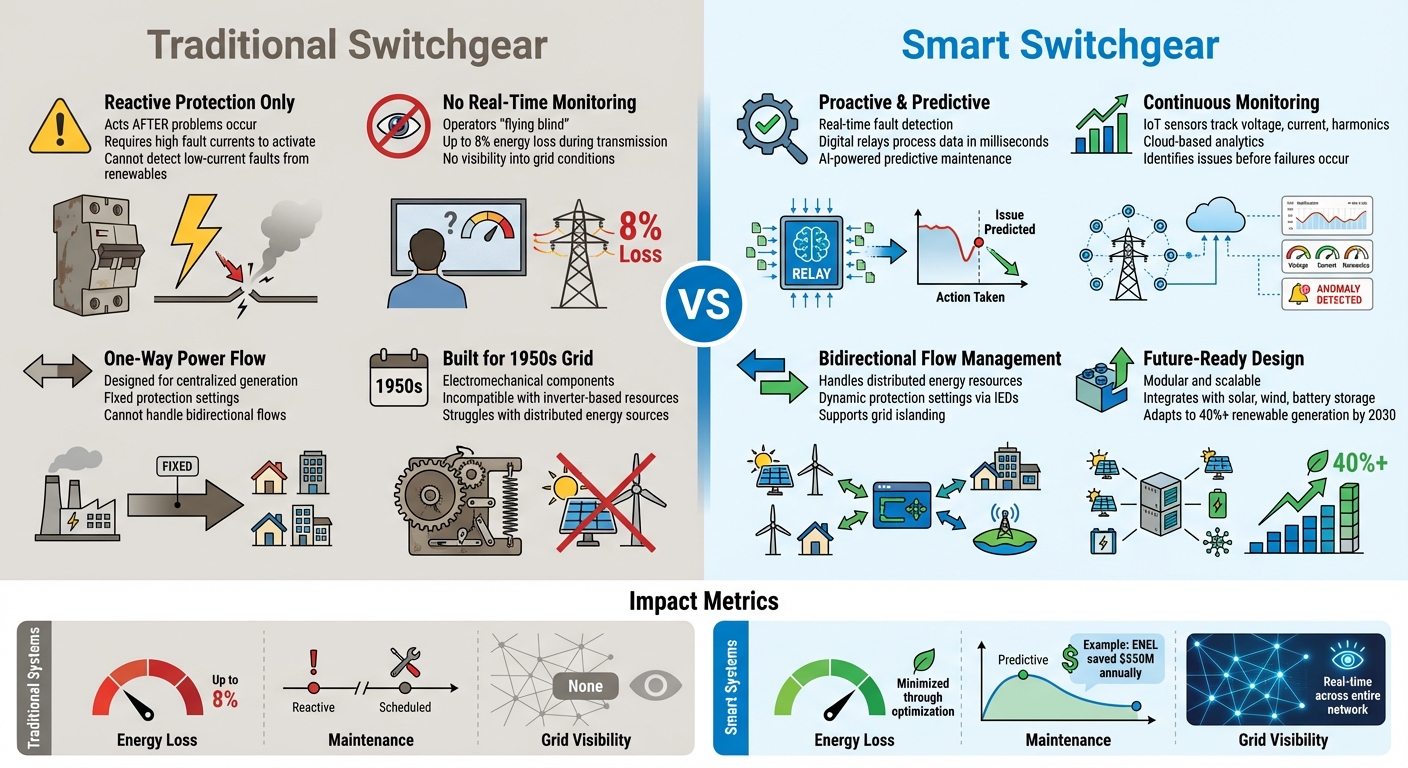
Traditional vs Smart Switchgear: Key Differences in Renewable Grid Management
Traditional switchgear was built for a time when electricity flowed in one direction - from large coal or gas plants to homes and businesses. Today’s renewable energy grids, with their bidirectional and variable power flows, expose the shortcomings of these legacy systems. At their core, traditional switchgear relies on electromechanical components that struggle to meet the demands of modern renewable energy systems.
Reactive Protection and Lack of Real-Time Data
One major limitation of conventional switchgear is its reliance on reactive protection. These systems only act after a problem occurs. Designed to detect faults by measuring high current surges from spinning synchronous generators, traditional switchgear disconnects damaged sections of the grid when a fault triggers a large current spike.
"The grid protection relays we have deployed in the past were designed to deliver stable frequency in systems run with fossil fuels that power spinning synchronous generators running at predictable cycles. These older, unmodernized systems are unable to understand or react to the behavior of solar PV or wind power."
- GE Vernova
Renewable energy sources, such as solar and wind, don’t produce the high fault currents needed to activate traditional circuit breakers. This means damaged sections may stay connected, increasing safety risks and the likelihood of cascading failures. As renewable energy becomes more prevalent, the effectiveness of traditional methods continues to decline. Inverter-based resources, which are central to renewable grids, result in lower overall fault levels, rendering conventional protection strategies less effective.
Another critical issue is the lack of real-time monitoring. Without sensors and data capabilities, operators are left "flying blind." This inefficiency contributes to significant energy losses - up to 8% of generated energy can be lost during transmission and distribution due to the inability to optimize power flow in real time.
"Traditional power grid systems do not have monitoring and automation capabilities. With the increasing demand for energy usage, there are hurdles in terms of the stability and efficiency of the electric grid."
In addition to their reactive nature, traditional systems struggle to keep up with the dynamic behavior of renewable energy sources.
Poor Adaptability to Distributed Energy Resources
The growing presence of distributed energy resources (DERs) like rooftop solar panels, small-scale wind farms, and battery storage is reshaping how electricity flows through the grid. These systems create bidirectional power flows, where electricity moves both to and from consumers. Traditional switchgear, with its fixed protection settings, wasn’t built to handle this complexity or the variability of renewable outputs.
This rigidity poses significant challenges for grid operators. Instead of managing a few large, predictable power plants, they must now coordinate hundreds - or even thousands - of smaller, fluctuating energy sources. Without real-time visibility into grid conditions, operators struggle to balance supply and demand when solar generation dips or wind speeds shift unexpectedly.
As global energy consumption is projected to increase by 60% between 2020 and 2050, the strain on outdated infrastructure will only intensify. Traditional switchgear, designed for a simpler era, is ill-equipped to manage this evolving landscape.
How Smart Switchgear Supports Renewable Grids
Smart switchgear is stepping up to address the challenges that traditional systems face in renewable energy grids. Unlike older systems that often react too slowly, these advanced solutions actively maintain grid stability in an energy landscape increasingly dominated by renewables. With renewables projected to contribute over 40% of global energy generation by 2030, the ability of smart switchgear to monitor, predict, and adapt to grid conditions is becoming indispensable.
Real-Time Monitoring and Reactive Power Compensation
Smart switchgear employs IoT sensors and Intelligent Electronic Devices (IEDs) to gather continuous data from across the grid. These sensors track key metrics like solar panel output and voltage fluctuations, with the data sent to cloud-based platforms for real-time analysis. For instance, IEEE-1547 standards allow Distributed Energy Resources to operate at 110% of their rated voltage, but during events like islanding, surges can exceed 200%.
By identifying harmonic currents that can lead to thermal or dielectric stress, smart switchgear activates reactive power compensation to stabilize voltage. When fluctuations occur, it quickly detects the issue and redirects power, ensuring the grid remains stable. This real-time monitoring also sets the stage for automated fault detection and proactive maintenance.
Automation and Predictive Maintenance
Automation is another game-changer with smart switchgear. Using microprocessor-based logic, it can detect and isolate faults almost instantly, preventing disturbances from spreading across the grid. This is particularly important for inverter-based resources, where fault levels are lower. Digital relays process data in milliseconds, isolating faults without depending on high surge currents.
The benefits go beyond fault management. Predictive maintenance, powered by AI and machine learning, analyzes performance trends to forecast potential equipment failures. This approach minimizes downtime and slashes maintenance costs while boosting grid reliability. A great example is the Telegestore project by Italian utility ENEL in 2005. By enhancing monitoring and automation, the project saved approximately $550 million annually, compared to its $2.3 billion build cost.
Integration with Distributed Energy Resources
Smart switchgear’s modular design adds another layer of flexibility, making it easier to integrate with renewable sources like rooftop solar, small wind farms, battery storage, and microgrids. IEDs process real-time data to dynamically adjust protection settings, effectively managing the bidirectional energy flows that come with renewable inputs. This adaptability also supports grid islanding, allowing parts of the grid to operate independently during outages, which strengthens overall resilience.
The move toward communication-assisted adaptive protection means smart switchgear can take preemptive action based on advanced measurements, rather than waiting for traditional short-circuit energy surges. With global energy consumption expected to rise by 60% from 2020 to 2050, this level of adaptability will be key to managing the small, variable energy sources that will power the grids of tomorrow.
Benefits of Smart Switchgear for Renewable Grid Integration
Improved Grid Stability and Efficiency
Smart switchgear changes the way utilities manage renewable grids by offering real-time monitoring and control. Unlike traditional systems, which lack continuous oversight, smart switchgear employs sensors and two-way communication to improve power distribution and reduce transmission losses across the network.
The advantage becomes especially clear during disruptions. Traditional switchgear is reactive, addressing problems only after they've occurred. In contrast, smart systems use advanced intelligence to detect voltage fluctuations or outages automatically and reroute power quickly. This automation significantly reduces both the frequency and duration of power outages, ensuring the grid remains stable even as renewable energy inputs vary throughout the day. The result? A more reliable and efficient grid that performs better under the dynamic conditions of renewable energy integration.
Cost Savings and Maintenance Benefits
Smart switchgear also delivers substantial financial and operational benefits. By combining IoT sensors with cloud-based analytics, these systems enable predictive maintenance, which identifies potential issues before they lead to failures. This is a major improvement over traditional systems that rely on scheduled maintenance or repairs after breakdowns.
Another key advantage is the ability to lower energy costs. When paired with energy storage systems, smart switchgear allows operators to use stored power during peak demand periods, avoiding high electricity charges. Additionally, it manages the higher harmonic currents caused by inverter-based renewable sources - currents that can cause wear and tear on conventional equipment. By monitoring and mitigating these effects, smart switchgear extends equipment lifespan and reduces the need for costly replacements, cutting long-term operational expenses.
Flexibility for Future Grid Expansion
Smart switchgear also addresses one of the biggest challenges of renewable energy adoption: integrating new systems with existing infrastructure. Thanks to its modular design, smart switchgear is built for scalability, making it ideal for expanding grids to accommodate renewable energy sources. Unlike older systems designed for one-way power flows from centralized plants, smart switchgear can handle the bidirectional flows required by distributed energy resources like rooftop solar panels and local battery storage.
This flexibility is crucial as renewable energy continues to grow. Modular systems save space and can be installed quickly, even in challenging environments like offshore wind farms. When new renewable assets are added to the grid, Intelligent Electronic Devices (IEDs) adjust protection settings and reroute power flows automatically, eliminating the need for expensive infrastructure upgrades. With integration into Advanced Distribution Management Systems, operators gain the ability to scale their grids seamlessly as renewable energy demands increase - all without the heavy capital investments that traditional systems would require.
Applications and Case Studies
Hybrid Grid Management
Smart switchgear plays a key role in balancing traditional and renewable energy sources by enabling bidirectional energy flow. This means electricity can move both to and from the grid, rather than just flowing from centralized generators.
A great example of this technology in action comes from the National Renewable Energy Laboratory (NREL). Between 2020 and December 2023, NREL collaborated with Florida State University and Ohio State University to develop a 10-kilovolt silicon-carbide–based power converter prototype. Operating in the 5-kilovolt range, this system automatically redirects power and handles the impacts of distributed solar energy. Impressively, its transformer weighs only 1/10 of traditional models.
"Much higher levels of distributed energy resources could be put onto a circuit if you had this extra device within the system."
– Barry Mather, Researcher, NREL
By enabling automated power management - what experts call "arbitrage of power" - smart switchgear ensures smooth electricity distribution without manual intervention. This is especially crucial as the United States continues expanding its renewable energy capacity. Since 2009, the U.S. Department of Energy's Smart Grid Program has invested over $9 billion to modernize the electrical grid. This ability to redirect power seamlessly also lays the groundwork for advanced microgrid systems, boosting the resilience of local communities.
Microgrid Implementation
Smart switchgear is the backbone of many microgrid projects, helping communities maintain power during emergencies while efficiently using renewable energy.
Take the Redwood Coast Airport Microgrid (RCAM) in Humboldt County, California, as an example. In December 2022, a 6.4-magnitude earthquake hit the area. Thanks to Schweitzer Engineering Labs (SEL) control hardware and a Tesla battery system (2.3 MW/8.9 MWh), the microgrid automatically disconnected from the main grid and provided 15 hours of uninterrupted power to the local airport and the U.S. Coast Guard Air Station. Led by Peter Lehman of the Schatz Energy Research Center, in partnership with PG&E and the Redwood Coast Energy Authority, this project has become a model for multi-customer microgrids.
| Project Name | Location | Key Technology/Vendor | Renewable Capacity | Notable Achievement |
|---|---|---|---|---|
| Redwood Coast Airport Microgrid | Humboldt County, CA | SEL Controls, Tesla Batteries | 2.2 MW Solar, 2.3 MW Battery | 15 hours backup during earthquake |
| Blue Lake Rancheria Microgrid | Humboldt Bay, CA | Siemens MGMS, Tesla Batteries | 420 kW Solar, 1.15 MW Battery | $150,000 annual electricity savings |
| Borrego Springs Microgrid | Borrego Springs, CA | SDG&E/NREL Controller | 100% Renewable IBRs | First renewable-led blackstart |
Another success story is the Blue Lake Rancheria (BLR) Microgrid in Humboldt Bay, California. This system uses a Siemens Microgrid Management System (MGMS) and a protective relay at the Point of Common Coupling (PCC) to manage a 420 kW solar array and a 1,150 kW/1,950 kWh battery. By optimizing battery use, the microgrid saves approximately $150,000 annually in electricity costs. During emergencies, it can operate indefinitely by prioritizing power loads across five levels. These examples highlight how smart switchgear overcomes the limitations of older grid infrastructure, as discussed earlier in its role for real-time monitoring and automation.
Predictive Analytics for Grid Management
Beyond these case studies, smart switchgear is revolutionizing grid operations through advanced data analytics. It can analyze hundreds of data points in milliseconds, detecting unusual changes in current or voltage and isolating faults immediately - no need for a short-circuit energy surge.
In September 2025, San Diego Gas & Electric (SDG&E) and NREL showcased the potential of predictive analytics with the Borrego Springs Microgrid. This project transitioned from diesel-based stabilization to 100% renewable, inverter-based resources (IBRs). Using a new microgrid controller and a Distributed Energy Resource Management System (DERMS), the system coordinated multiple energy storage units to achieve reliable performance.
Grid operators are also turning to digital twins, virtual replicas of physical assets, to simulate equipment behavior and predict maintenance needs. This approach is especially important since many U.S. transmission lines are 25 to 50 years old. By reducing outage risks and maintenance costs, digital twins are helping modernize the grid. Additionally, cloud-based platforms enable real-time benchmarking of performance, such as analyzing power factor variations, allowing businesses to measure the effectiveness of energy-saving strategies with greater precision.
Conclusion
Smart switchgear plays a critical role in integrating renewable energy into the U.S. power grid. By offering real-time monitoring, predictive maintenance, and bidirectional flow control, these systems tackle key challenges like intermittency, power quality concerns, and compatibility with distributed energy resources. They also enhance grid reliability by automatically detecting and isolating faults, preventing cascading failures, and ensuring the seamless operation of renewable energy sources and storage systems.
The benefits of this technology extend beyond technical improvements. On a global scale, smart grids could save over $290 billion by 2029. In the U.S., generating 35% of electricity from wind and solar could cut carbon emissions by as much as 45%. Additionally, advancements in IoT and AI help extend equipment lifespan, reduce downtime, and lower the need for expensive new infrastructure. Modern designs also emphasize sustainability, incorporating SF6-free gases and recyclable materials to minimize environmental impact.
"The integration of digital technology enables better monitoring and control, which reduces energy consumption and increases the longevity of the switchgear." – Nenad Uzelac, A3 chair G&W Electric
As the U.S. continues upgrading its aging grid infrastructure, smart switchgear offers the adaptability and scalability required for future growth. These systems are well-suited for managing hybrid grids, deploying microgrids, and utilizing predictive analytics to address challenges like intermittency and distributed energy resource integration.
For those looking to adopt smart switchgear solutions, Electrical Trader provides a wide selection of products tailored to renewable energy projects. From breakers and transformers to high-voltage components, the platform offers tools to support projects of all sizes.
FAQs
How does smart switchgear detect faults when solar and wind produce low fault currents?
Smart switchgear relies on traveling-wave-based detection methods to pinpoint faults, even in scenarios with low fault currents - common with energy sources like solar and wind. By analyzing traveling-wave signals and using advanced fault classification techniques, these systems can identify issues such as series faults and high-impedance problems that conventional devices often overlook.
What data does smart switchgear monitor in real time to stabilize renewable-heavy feeders?
Smart switchgear helps stabilize feeders with a high share of renewable energy by keeping an eye on real-time data like voltage, current, frequency, and power flows. By analyzing this information, it tackles fluctuations caused by renewable energy sources, ensuring the grid stays reliable.
Can smart switchgear be retrofitted into 1950s-era grid infrastructure without major rebuilds?
Yes, smart switchgear can be integrated into 1950s-era grid infrastructure without requiring a complete overhaul. By focusing on upgrading essential components - like breakers, relays, controls, and other critical internal parts - you can extend the system's lifespan while enhancing both safety and connectivity. This method allows for a modernized and more efficient grid without the need for costly or time-intensive reconstruction.