

Self-Healing Microgrids: How They Work
Self-healing microgrids are revolutionizing how power systems handle outages. They automatically detect faults, isolate damaged sections, and restore power in seconds - without human intervention. These systems combine renewable energy sources, storage, and advanced algorithms to ensure uninterrupted power for critical infrastructure, like hospitals and manufacturing plants, even during emergencies. Here's how they work:
- Fault Detection: Sensors and intelligent devices identify issues instantly.
- Fault Isolation: Circuit breakers isolate the problem area while keeping the rest operational.
- Load Management: Non-essential loads are disconnected to prioritize vital services.
- Power Restoration: Advanced algorithms and smart devices restore power efficiently.
With features like blackstart capabilities and decentralized control, self-healing microgrids improve reliability, reduce downtime, and lower operational costs. They are especially valuable for critical facilities and areas prone to natural disasters.
Self-Healing Power Grid Explained | TheElectricalGuy
sbb-itb-501186b
Key Components of Self-Healing Microgrids
Self-healing microgrids operate through the seamless interaction of three key elements: power generation and storage, intelligent switching and protection devices, and control systems that manage fault detection, isolation, and restoration. Together, these components create the foundation for a resilient and adaptive grid.
Distributed Energy Resources (DERs)
Distributed energy resources (DERs) include systems like rooftop solar panels, wind turbines, and traditional backup generators. To ensure a steady energy supply during islanded operations, these generation sources are paired with battery banks that balance supply and demand.
Power inverters play a crucial role by converting direct current (DC) from renewable sources and batteries into alternating current (AC) for powering buildings and equipment. Modern inverters are designed to stop regulating voltage when overloaded, triggering relays to disconnect non-essential loads. This automated safeguard prevents cascading failures, especially during emergencies.
While DERs provide the energy, advanced control systems are responsible for orchestrating the grid’s self-healing processes.
Control Systems and Algorithms
The control system serves as the brain of a self-healing microgrid. It uses Fast Fault Detection, Isolation, and Restoration (F-FDIR) algorithms to analyze data collected from sensors and protective devices across the network. These algorithms utilize peer-to-peer communication protocols, such as IEC 61850 GOOSE, which allow for low-latency data exchange, significantly speeding up restoration compared to older client-server models.
When faults occur, directional fault indicators identify the problem's location, even when power flows in multiple directions due to DERs. If an isolation switch fails to open, the algorithm extends the isolation zone to the nearest functional device, whether upstream or downstream. Some systems also feature miscoordination correction logic, which uses time-synced fault data to pinpoint the exact fault location.
These algorithms are complemented by real-time monitoring devices that ensure the grid can react swiftly to changing conditions.
Monitoring and Protection Devices
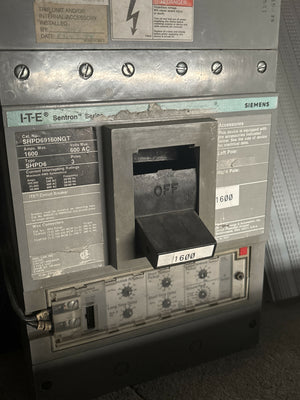
Intelligent electronic devices (IEDs) and smart circuit breakers act as the sensory and operational tools of self-healing microgrids. They continuously monitor voltage, current, and frequency while making autonomous decisions based on local measurements.
In February 2023, a research team led by Abhishek Banerjee of Siemens Technology and Gab-Su Seo from the National Renewable Energy Laboratory showcased autonomous restoration. Using a hardware testbed with 24 grid-forming inverter-based resources and 6 smart circuit breakers, they demonstrated how smart circuit breakers could detect active and faulted lines and recombine islanded microgrids without requiring a central communication system.
PulseCloser fault interrupters represent an advancement in protection technology. Unlike traditional reclosers that apply the full force of the electrical system to a fault, PulseClosers use low-energy pulses - less than 5% of the typical energy - to check if a line is clear before reclosing. This method reduces equipment stress and prevents unnecessary damage.
Additionally, sectionalizing switches (normally closed) and tie switches (normally open) reconfigure the network to bypass faulted areas, ensuring uninterrupted power delivery.
How Self-Healing Microgrids Work
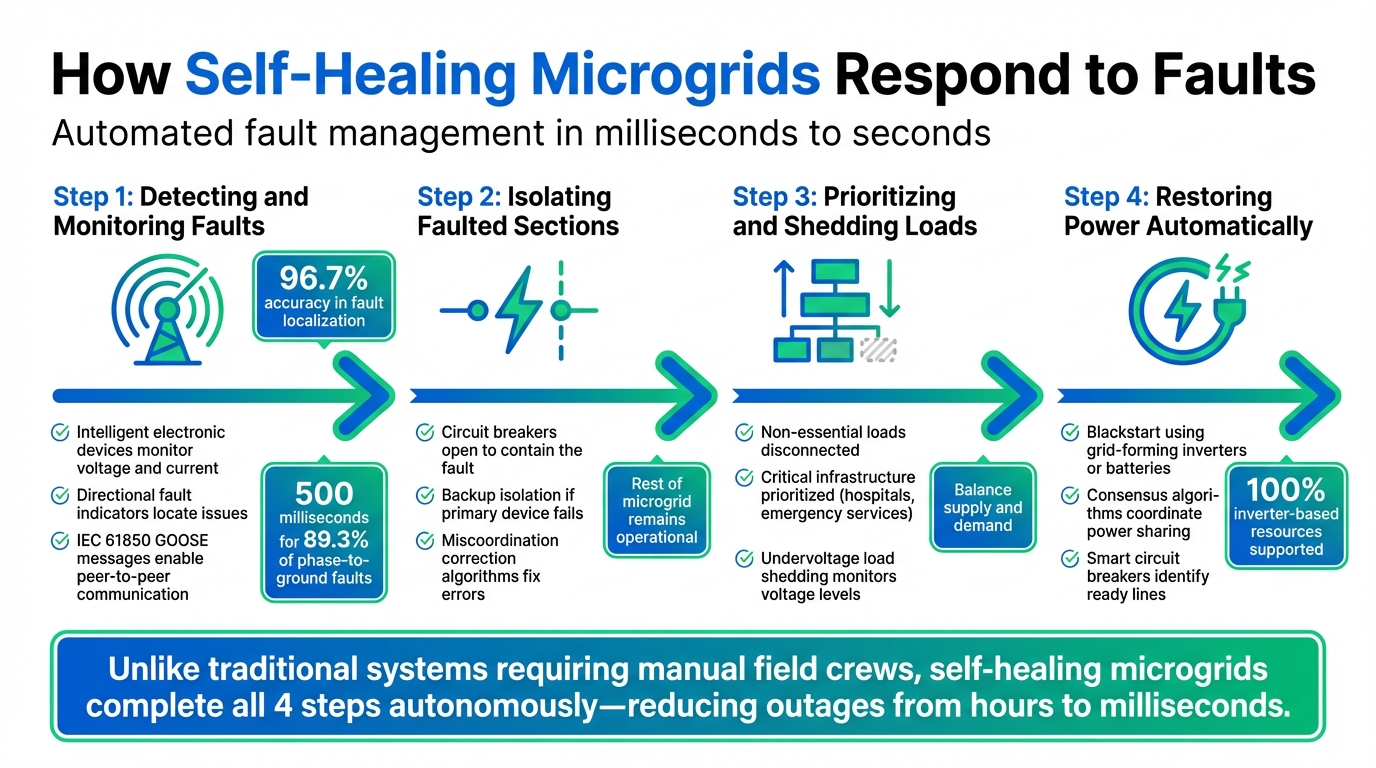
4-Step Self-Healing Microgrid Fault Response Process
Self-healing microgrids are designed to detect faults, isolate them, manage loads, and restore power - all within milliseconds to seconds. Let’s break down how these systems keep power flowing even when equipment fails.
Step 1: Detecting and Monitoring Faults
The first step is identifying when and where a fault has occurred. Intelligent electronic devices constantly monitor voltage and current across the network. If these readings deviate - like a sudden voltage drop or a current spike - the system flags it as a potential fault.
Directional fault indicators help locate the issue by analyzing the flow of fault currents. For example, when indicators on either side of a section point toward each other, the fault is isolated to that segment. This is especially useful in microgrids where power flows from multiple sources.
Some systems go further by using advanced methods like covariance estimation, Kalman filtering, and wavelet packet energy entropy to confirm faults quickly. AI-driven systems, using Transformer-based architectures, have achieved impressive results: 96.7% accuracy in fault localization and resolving 89.3% of phase-to-ground faults within just 500 milliseconds.
Communication is key here. Systems using the IEC 61850 standard rely on GOOSE (Generic Object Oriented Substation Event) messages for fast, peer-to-peer data exchange. Heartbeat signals also ensure devices are functioning. If a heartbeat stops, the system knows something has failed.
"GOOSE provides a mechanism for lightweight low latency peer-to-peer data exchange between devices, which reduces the restoration time compared to conventional client-server communication paradigm."
– Junho Hong, Department of Electrical and Computer Engineering, University of Michigan-Dearborn
Step 2: Isolating Faulted Sections
Once a fault is detected, the system quickly isolates the affected area. Circuit breakers or switches around the faulted section are commanded to "open", creating a boundary that contains the issue while keeping the rest of the microgrid operational.
If the primary isolation device doesn’t work, the system expands the isolation zone to the next switch upstream or downstream. This backup ensures the fault remains contained even if equipment malfunctions.
Miscoordination correction algorithms come into play here, fixing errors when the wrong device trips. By tracing the fault from the power source downstream, the system identifies the actual fault location. A 2021 demonstration at the University of California, Irvine Microgrid (UCIMG) showcased these capabilities on a 20MW-class system, integrating a diesel blackstart generator and battery storage to isolate faults and restore power using IEEE 2030.7-based control logic.
"Miscoordination correction will allow the self-healing system to properly isolate a faulted line segment when the wrong recloser clears a fault."
– Daniel P. Roth, Distribution Automation Technical Manager, Eaton
Step 3: Prioritizing and Shedding Loads
After isolating the fault, the microgrid balances supply and demand by shedding non-essential loads. If there isn’t enough power to go around, the system prioritizes critical infrastructure - like hospitals and emergency services - by disconnecting lower-priority equipment.
Each load is assigned a priority, ensuring essential services are powered first. Undervoltage load shedding monitors voltage levels and disconnects non-critical equipment when voltages drop below safe limits. Protective device settings may also be adjusted dynamically to avoid unnecessary tripping during the restoration process.
Step 4: Restoring Power Automatically
Once faults are isolated and loads are managed, the system begins restoration. If the microgrid is entirely de-energized, it starts with a blackstart, using resources like grid-forming inverters, batteries, or diesel generators.
Consensus algorithms coordinate power sharing among distributed energy resources. These algorithms distribute power across connected systems based on each resource’s capacity, ensuring efficient support.
Smart circuit breakers play a key role by identifying which lines are ready to reconnect and which are still faulted. This enables localized reconnection without relying on centralized communication.
In November 2021, researchers Phani Gadde and Sukumar Brahma tested a protection scheme on a modified IEEE 123-node distribution system. With 15 inverter-based resources, the system successfully reconfigured healthy sections automatically in both grid-connected and islanded modes, even with 100% inverter-based penetration.
"A consensus algorithm is used to distribute portions of the desired power support to each individual MG in a decentralized way."
– Zhaoyu Wang, Bokan Chen, Jianhui Wang, and Chen Chen
Benefits of Self-Healing Microgrids
Better Resilience and Less Downtime
Self-healing microgrids are designed to handle faults almost instantly, reducing outages to just milliseconds or seconds. Unlike traditional systems that rely on field crews to locate and fix issues manually, these advanced grids detect, isolate, and restore power automatically. For example, some systems can resolve 89.3% of phase-to-ground faults within 500 milliseconds.
One of the standout features is their ability to limit outages to the smallest possible section of the grid. When a fault occurs, the system isolates the problem area while keeping power flowing to unaffected sections. Additionally, microgrids can work together - if one grid has surplus capacity, it can support another that’s facing generation challenges.
Blackstart capabilities take resilience a step further. With tools like battery energy storage systems (BESS) or grid-forming inverters, self-healing microgrids can restart independently without external power. A real-world example of this is the University of California, Irvine, which demonstrated blackstart functionality in 2021 with its 20MW-class microgrid.
"A smart MG is distinguished from the traditional distribution systems in terms of reliability, self-adequacy, self-healing, and interactive characteristics."
– Zhaoyu Wang, IEEE Transactions on Smart Grid
Beyond improving resilience, these capabilities also lead to notable operational cost savings.
Efficiency and Cost Savings
Automating fault management doesn’t just improve reliability - it also saves money. Shortening the duration of interruptions reduces repair costs for utilities and minimizes disruptions for customers. Quick fault detection helps protect critical infrastructure, which translates into lower overall expenses.
Standards like IEC 61850 are another game-changer. They simplify engineering and installation by improving compatibility between devices from different vendors, cutting down on configuration complexity. Instead of replacing hardware, utilities can upgrade systems by updating communication protocols, which significantly reduces costs. Plus, limiting outages to smaller sections means fewer manual repairs and fewer field crew deployments.
"IEC 61850 based engineering can reduce the cost of configuration, installation and commissioning, enhance the multi-vendor interoperability, increase the long term stability, and reduce the impact on the existing utility automation systems."
– MDPI
Automated systems also optimize costs by scheduling generators and energy storage to ensure efficient operation. Systems that rely on local measurements for restoration avoid the high costs and cybersecurity risks associated with extensive communication-based protection systems. These features make self-healing microgrids not just resilient but also cost-effective.
Where Self-Healing Microgrids Are Used
Self-healing microgrids are a game-changer for both critical infrastructure and commercial operations, offering dependable power and cost savings in the face of grid challenges.
Critical Infrastructure and Emergency Services
Hospitals, data centers, and emergency facilities depend on self-healing microgrids to ensure uninterrupted power during outages. These systems intelligently segment the network into self-sufficient microgrids, prioritizing essential equipment and keeping critical operations running smoothly.
The increasing intensity of natural disasters has highlighted the importance of resilient microgrid systems. For example, a 2021 demonstration at the University of California, Irvine, showcased how blackstart capabilities can stabilize systems even during a complete generation failure.
"Increasing the resiliency and reliability of microgrid systems is becoming more important considering the recent surge in natural disasters such as wildfires and hurricanes. These natural disasters increase the probability of blackouts which can jeopardize critical loads and public safety."
– Breyah Evonna Matthews, University of California, Irvine
Networked microgrids enhance this resilience further. If one facility faces a power generation issue, nearby systems can step in, sharing their local energy resources. This mutual support is particularly vital for interconnected communities and remote locations.
Commercial and Industrial Facilities
Self-healing microgrids are also transforming commercial and industrial sectors by preventing costly downtime and boosting operational reliability.
Manufacturing plants and commercial buildings utilize these systems to avoid production halts. Fault detection and isolation technologies ensure that operations continue seamlessly, even during grid disturbances. For industrial sites, prioritized load shedding ensures that non-essential processes are paused during faults, while critical machinery stays operational.
Standardized IEC 61850 GOOSE communication plays a key role here, enabling devices to exchange data in real-time. This rapid communication reduces restoration time significantly, while advanced software allows multiple zones to be re-energized simultaneously.
"Fast and standardized information exchange is essential for stable, resilient, and reliable operations in microgrids."
– Junho Hong, Department of Electrical and Computer Engineering, University of Michigan-Dearborn
Modern self-healing microgrids also support 100% inverter-based resources, making it possible for facilities to rely entirely on renewable energy. This capability ensures stable power sharing and fault ride-through performance, offering a sustainable yet resilient solution for commercial and industrial applications.
Conclusion
Self-healing microgrids are transforming how power systems handle faults and restore service. These systems can automatically detect issues, isolate the affected areas, and restore power, significantly reducing downtime and ensuring critical operations continue without disruption.
With advanced control algorithms, real-time monitoring, and intelligent protection devices, self-healing microgrids create resilient power networks. Whether leveraging IEC 61850 GOOSE protocols or local measurements, these systems speed up fault recovery while reducing both infrastructure damage and operational costs.
In addition to improving reliability, they prevent further damage by isolating faults quickly and optimize energy costs through smart scheduling of distributed energy resources (DERs). Their blackstart capabilities also allow them to recover fully after complete system failures, ensuring power is restored even in the most challenging scenarios.
As natural disasters and grid challenges grow more frequent, self-healing microgrids provide a reliable solution for facilities like hospitals, data centers, manufacturing plants, and commercial buildings where extended outages are not an option. With ongoing advancements in algorithms and standardized engineering approaches, this technology is becoming more accessible and capable of delivering even greater autonomy in the future.
FAQs
What makes a microgrid “self-healing”?
A self-healing microgrid is one that can automatically:
- Identify faults,
- Isolate the affected section, and
- Restore power to as many areas as possible, all without needing human input.
It achieves this through local data monitoring and advanced control systems, allowing for fast and efficient recovery.
What equipment is required to enable self-healing?
Self-healing in microgrids relies on advanced technologies like smart circuit breakers and controllable assets, including inverter-based resources. These devices play a crucial role in fault detection, isolation, and automatic restoration. What’s impressive is that many of these processes can operate independently, often functioning without requiring any communication systems.
How does the microgrid decide which loads to shed?
Microgrids rely on control algorithms to decide which loads to reduce or disconnect, aiming to keep the system stable with minimal interruptions. Techniques such as direct load control and breaking the microgrid into smaller sections allow operators to focus on essential loads, ensuring that critical systems remain operational during faults or outages.
Related Blog Posts
- Community Energy Systems vs. Centralized Grids
- Smart Features in Circuit Breakers for Energy Savings
- Impact of Load Changes on Voltage Stability
- Black Start Capability: Why It Matters