How Hybrid Storage Reduces Load Management Costs
Hybrid Energy Storage Systems (HESS) can help lower energy costs by addressing both sudden power surges and sustained energy needs. By combining high-power components like supercapacitors with high-energy batteries, these systems efficiently manage energy loads, reduce equipment strain, and extend system lifespan. Key benefits include:
- Lowering peak demand charges: These charges often make up 30–50% of energy costs. HESS reduces reliance on expensive grid power during peak times.
- Energy price arbitrage: Store energy during low-cost periods and use it when prices spike, saving on electricity bills.
- Improved equipment lifespan: Dividing power demands between components reduces wear and maintenance costs.
- Enhanced grid stability: HESS supports renewable energy integration by balancing supply and demand fluctuations.
For example, studies show a 12% reduction in total costs when using hybrid systems compared to batteries alone. Facilities can save 10–35% on electricity bills with proper implementation and monitoring.
To succeed with HESS:
- Conduct an energy assessment to understand usage patterns.
- Select compatible equipment for your energy and power needs.
- Use advanced controls to optimize performance and reduce waste.
Hybrid storage systems offer a cost-effective way to improve energy management, particularly as renewable energy adoption grows.
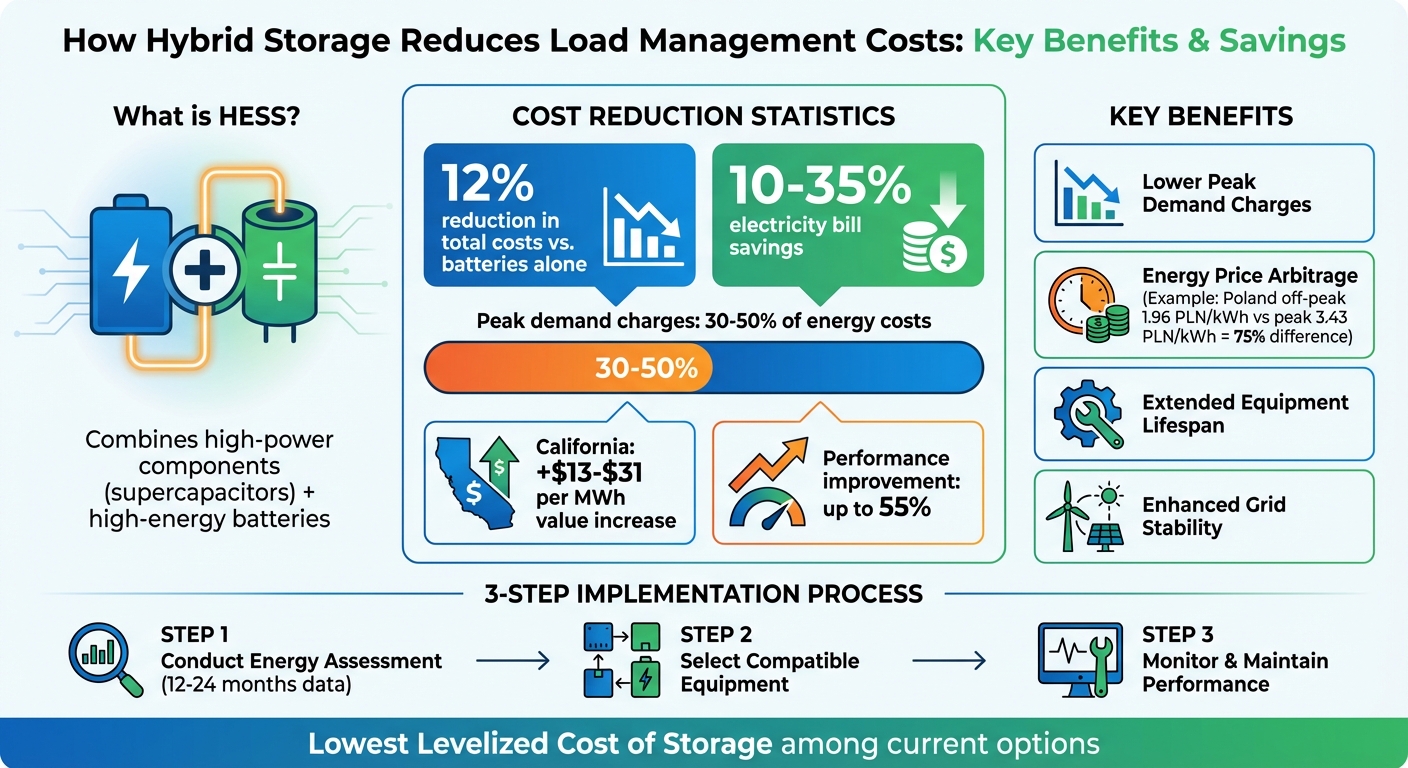
Hybrid Energy Storage Systems Cost Savings and Benefits Infographic
What is a Hybrid Energy Storage System (HESS)?
What Are Hybrid Energy Storage Systems?
A Hybrid Energy Storage System (HESS) combines multiple storage technologies to manage energy delivery and handle rapid power demands effectively. These systems bring together high-power density components and high-energy density batteries, addressing the shortcomings of using a single storage solution.
"The vulnerability of RES towards the unforeseeable variation of meteorological conditions demands additional resources to support. In such instance, energy storage systems (ESS) are inevitable."
The standout feature of hybrid systems is their ability to balance workloads. For instance, while a battery might excel at storing and delivering energy over time, it may fall short during sudden power surges. By integrating a component designed for quick discharge, a hybrid system can manage both steady energy demands and abrupt spikes. This balance is achieved through a coordinated setup of key components.
Main Components of Hybrid Systems
A HESS relies on three essential components:
- Multiple storage assets: These combine technologies with complementary strengths. For example, lithium-ion batteries provide sustained energy delivery, while supercapacitors handle immediate power needs.
- Power Conversion Systems (PCS): These systems regulate the flow of electricity between the storage units, the grid, and connected devices, ensuring smooth operation.
- Energy Management System (EMS): Using advanced algorithms, the EMS determines when and how each component charges or discharges energy.
"While integrating these different ESS, their power sharing control plays a crucial role to exploit the complementary characteristics of each other."
This coordinated control is key to maximizing efficiency and ensuring that each component operates within its ideal range, ultimately extending the system’s lifespan.
Hybrid Systems vs. Single-Source Storage
Hybrid systems offer a clear advantage over single-source storage by addressing their inherent limitations. Standalone battery systems have fixed charging and discharging rates, which can make them less responsive during sudden demand spikes. If demand surpasses these limits or renewable energy production dips unexpectedly, a single system may struggle to keep up.
Hybrid systems solve this by distributing the workload. High-power components handle sudden increases in demand, while high-capacity batteries manage consistent energy needs. This division reduces strain on individual components, enhancing reliability and potentially lowering maintenance costs. As renewable energy continues to expand, this reliability becomes increasingly important, offering a more efficient and cost-effective way to manage energy loads.
Load Management Costs Explained
Managing electrical loads comes with several cost challenges that hybrid storage systems can help address. Let’s break down the key cost categories and how hybrid storage plays a role in reducing them.
Peak Demand Charges
For commercial electricity users, peak demand charges can account for a significant portion of total energy costs - anywhere from 30% to 50%. These charges are based on the highest power usage during peak grid demand periods. For example, in California, using 4-hour battery hybrids sized to 50% of renewable nameplate capacity can increase combined energy and capacity value by $13 to $31 per MWh compared to standalone plants. In Texas, the same setup adds just $1 to $9 per MWh, showcasing how costs can vary widely by region.
Demand Response Fees
Demand response programs are designed to reduce energy use during times of grid stress. Participating facilities can earn between $20 and $50 per kW monthly, but failing to comply with these programs can lead to penalties. As renewable energy becomes a larger part of the grid, the ability to quickly adjust energy demand is becoming increasingly important.
Grid Dependency Costs
Relying on the grid can lead to variable costs and risks. Time-of-use pricing often results in significant price differences, with electricity during peak hours costing as much as three times more than during off-peak hours. Additionally, utilities may charge penalties for poor power quality, which can add 10% to 15% to monthly bills. For hybrid plants, restrictions on charging from the grid can reduce wholesale market value by 2% to 11%, limiting both flexibility and cost efficiency.
sbb-itb-501186b
How Hybrid Storage Cuts Load Management Costs
Hybrid storage systems help reduce energy expenses by storing electricity during low-cost periods, discharging it when prices peak, and using advanced controls to optimize performance. Let’s break down how these systems achieve cost savings.
Storing Energy During Off-Peak Hours
One of the most straightforward ways hybrid storage saves money is through price arbitrage - buying electricity when it’s cheapest and storing it for later use. Take Poland’s Tariff B23 as an example: off-peak electricity costs 1.96 PLN/kWh, while evening peak rates jump to 3.43 PLN/kWh - a 75% price difference. Hybrid systems capitalize on this by charging batteries during off-peak hours, either from the grid or from surplus renewable energy, which might otherwise be sold back at minimal rates (around 0.472 PLN/kWh).
Cost efficiency is further enhanced by combining components strategically. High-capacity batteries store energy reliably, while supercapacitors handle power fluctuations, reducing strain on the batteries and extending their lifespan.
Next, let’s see how discharging stored energy during peak periods contributes to savings.
Releasing Energy During Peak Periods
Hybrid systems discharge stored energy during peak demand, when electricity prices are highest. This reduces reliance on expensive grid power and helps avoid peak demand charges.
"HESS combines different energy storage technologies to provide short-term high power output and long-term energy storage solutions." - Sustainable Energy Research
A real-world example comes from Egypt’s Zafarana Wind Farm and Benban Solar Plant. Researchers tested a hybrid setup that paired plug-in electric vehicles for long-term energy balancing with superconducting magnetic energy storage for rapid response. The system improved performance by 55% compared to using superconducting storage alone and by 45% compared to relying solely on electric vehicles. Advanced controllers coordinated energy injection from both storage types, ensuring frequency stability and reducing grid dependency during high-demand periods.
Using Inverters and Controllers for Optimization
Bidirectional inverters play a key role by converting stored DC power into grid-ready AC power and vice versa during charging. These systems use real-time data, such as state-of-charge levels, temperature, and predictive algorithms based on historical usage and weather forecasts, to optimize operations.
Advanced controllers equipped with adaptive algorithms take optimization a step further. They prevent overcharging, avoid deep discharging, and adjust thermal management dynamically, extending the lifespan of storage components. This is especially important in standalone photovoltaic systems, where battery banks can account for up to 52% of total capital costs. By maximizing equipment longevity and minimizing energy waste, these intelligent systems directly reduce load management expenses.
Steps to Implement Hybrid Storage for Cost Savings
Once you understand how hybrid storage can cut load management costs, the next step is putting it into action. These steps will help you achieve optimal savings.
Conducting an Energy Assessment
Start by evaluating your facility's energy usage. This means separating energy requirements (kWh) from power demand (kW). Why? Because your system needs to handle both sustained energy use and sudden spikes in demand.
Gather 12–24 months of consumption data to pinpoint cost spikes and identify what’s driving those peaks. Also, consider the variability of renewable energy sources like solar and wind. This analysis helps you uncover supply-demand mismatches and determine the storage capacity your system will need.
Pay close attention to your utility's rate structure. Time-of-use pricing and peak demand charges can reveal where energy arbitrage - buying energy when it’s cheaper and using it during expensive periods - can save you the most.
Tools like RETScreen or iHOGA can simulate various system configurations, helping you design an efficient setup. These simulations can cut system costs by 12%–26%.
Selecting Compatible Equipment
A hybrid setup works best when you combine high-energy batteries (for long-duration storage) with high-power batteries (for rapid response). This multi-chemistry approach balances your system’s ability to handle both steady energy needs and quick demand spikes.
You can also incorporate second-life batteries into the mix. These repurposed units are cost-effective and can work well alongside newer, high-capacity batteries.
"Hybrid BESS solutions combine the strengths of batteries with renewables, conventional power plants, and advanced grid-forming assets. This synergy unlocks new levels of flexibility, resilience, and economic opportunity." - Siemens Energy
Make sure your chosen components are compatible with your facility’s existing infrastructure. Check integration with transformers, switchgear, and grid management systems. For sourcing equipment, platforms like Electrical Trader offer both new and used options that can fit hybrid storage systems.
To optimize your setup, use mathematical modeling techniques like mixed integer linear programming. This helps you determine the right equipment sizing based on your specific energy demands.
Monitoring and Maintenance
Keeping an eye on your system is key to maintaining efficiency. Monitor the state of charge (SoC) for each battery type to avoid degradation and ensure energy is dispatched when it’s most cost-effective.
Use control systems that can identify the best charging sources for each battery type. Since different battery chemistries have unique performance metrics, tracking each subsystem individually is essential.
When properly monitored, hybrid systems can lead to electricity bill reductions of 10% to 35%. But these savings only happen when your dispatch strategies align with real-time price structures and load patterns.
Conclusion
Hybrid energy storage systems offer a smart way to cut costs by handling both sudden demand spikes and consistent energy loads. Studies indicate that using a hybrid approach can boost system performance by up to 55% compared to relying on a single technology. Plus, they deliver the lowest Levelized Cost of Storage among current options, making them an economically attractive choice.
In energy-intensive regions like California, integrating 4-hour battery storage with renewable energy projects can add $13 to $31 per MWh in combined energy and capacity value. That’s a meaningful financial edge in competitive markets.
These systems also extend the lifespan of equipment. For example, combining supercapacitors with lithium-ion batteries reduces the strain on components, which helps prevent the wear and tear that shortens battery life.
To unlock these benefits, proper planning and execution are key. Start with a thorough energy assessment, select the right equipment for your specific energy needs, and keep a close eye on system performance. When done right, hybrid storage systems not only lower costs immediately but also deliver long-term efficiency that single-source solutions just can’t match. They’re a practical answer to today’s energy management challenges.
FAQs
How do hybrid energy storage systems help lower costs during peak energy demand?
Hybrid energy storage systems offer a smart way to cut costs during times of high energy demand through a technique called peak shaving. Here's how it works: energy is stored during off-peak hours - when electricity is cheaper - and then used during peak times, when demand (and prices) soar. This approach helps businesses avoid hefty peak demand charges by reducing their reliance on the grid during those high-cost periods.
Beyond saving money, these systems also boost energy efficiency and give users more control over how and when they use power. The result? Lower costs and a more dependable power distribution system.
How do supercapacitors enhance hybrid energy storage systems?
Supercapacitors play an important role in hybrid energy storage systems (HESS) thanks to their high power density and quick charge/discharge capabilities. These strengths work hand-in-hand with the high energy density of batteries, making the combination highly effective for tasks like managing peak loads, regulating frequency, and addressing rapid energy shifts in power systems.
When supercapacitors are integrated into HESS, they can enhance power delivery, extend the cycle life of the system, and improve efficiency. Research indicates that pairing batteries with supercapacitors can boost power performance by up to 60% while reducing battery wear, which translates to lower maintenance costs. This combination proves particularly valuable in renewable energy setups and electric vehicles, where fast energy responses and long-term reliability are essential. Together, these advantages help cut load management expenses and support more reliable energy systems.
What are the best practices for monitoring and maintaining hybrid storage systems to reduce costs?
To keep hybrid storage systems running smoothly and cut down on costs, facilities need to embrace advanced energy management strategies. Leveraging real-time data to monitor the state of charge (SoC), state of health (SoH), and the overall performance of storage components plays a crucial role. This approach helps fine-tune charge and discharge cycles, minimize unnecessary wear, and extend the lifespan of the system.
Adding predictive maintenance tools and adaptive controls can ensure the system consistently operates at its best. Comprehensive energy management systems (EMS) take it a step further by considering factors like battery wear costs, including depth of discharge and full equivalent cycles. This not only improves reliability but also helps trim operational costs. With regular monitoring and proactive maintenance, hybrid storage systems can unlock their full cost-saving potential.