Black Start Capability: Why It Matters
When the power grid fails, restarting it isn’t as easy as flipping a switch. Power plants rely on electricity to power internal systems, and during a blackout, they need an independent restart process - this is called black start capability. Here's why it's critical:
- Black start allows power plants to restart without external grid power by using on-site sources like diesel generators, batteries, or hydroelectric systems.
- It ensures faster recovery during outages, reducing downtime from days to hours.
- Parallel black start methods can cut recovery times by 64% and lower energy demands by 95% compared to traditional methods.
- Modern systems increasingly use renewable energy like wind, solar, and batteries, paired with grid-forming inverters, to handle black start operations.
The shift toward renewable energy presents challenges, but advances like inverter-based resources and decentralized restoration strategies are helping utilities improve grid recovery. Black start systems are essential for maintaining power reliability during extreme events.
How to Restart the Grid after total collapse
Why Black Start Capability Matters for Grid Reliability
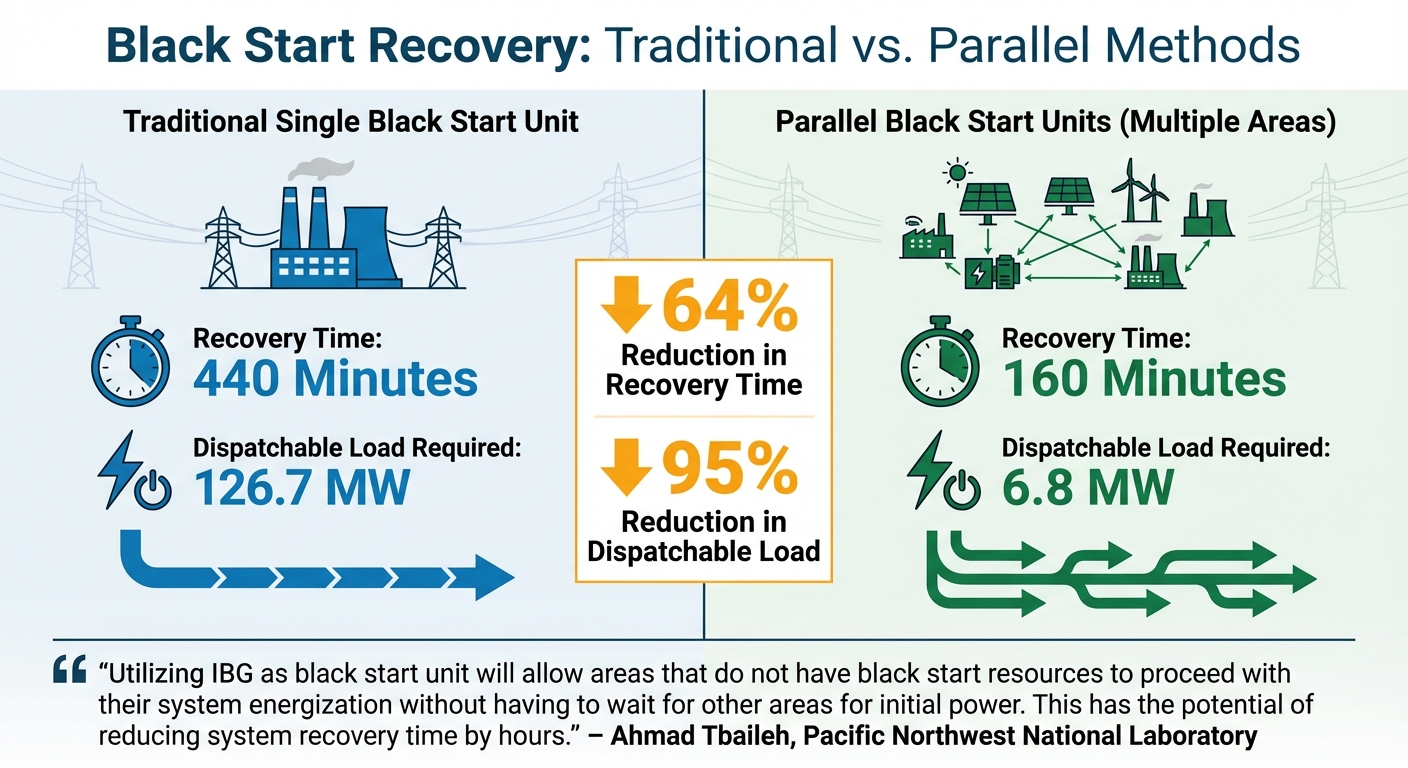
Black Start Recovery Times: Traditional vs Parallel Methods Comparison
Black start capability is a critical piece of the puzzle when it comes to restoring power after a total grid collapse. Without it, recovery times stretch out, leaving communities and businesses in the dark for longer periods. The Federal Energy Regulatory Commission (FERC) emphasizes that having adequate black start resources allows utilities to establish multiple restoration paths, speeding up recovery. On the other hand, depending on just one black start source can significantly delay efforts to restore power across large areas. This sets the stage for understanding how recovery times and overall system resilience are impacted.
How Black Start Affects Blackout Recovery Times
Research conducted by Pacific Northwest National Laboratory highlights the dramatic difference between traditional and modern black start strategies. In a simulation involving a 118-bus power system, a single conventional black start unit took 440 minutes to energize the transmission backbone. However, when parallel black start resources were deployed across different areas, the recovery time dropped to just 160 minutes - a 64% reduction.
The traditional approach also required operators to handle 126.7 MW of additional dispatchable load to maintain voltage stability while energizing transmission lines. By contrast, the parallel method slashed that load requirement to just 6.8 MW - a staggering 95% reduction. This simplified the restoration process and lowered the risk of secondary failures.
| Restoration Scenario | Recovery Time | Dispatchable Load Required |
|---|---|---|
| Single Conventional Black Start Unit | 440 Minutes | 126.7 MW |
| Parallel Units (Multiple Areas) | 160 Minutes | 6.8 MW |
| Improvement | 64% Reduction | 95% Reduction |
Ahmad Tbaileh and his team at Pacific Northwest National Laboratory explained the advantage of modern black start resources:
"Utilizing IBG as black start unit will allow areas that do not have black start resources to proceed with their system energization without having to wait for other areas for initial power. This has the potential of reducing system recovery time by hours."
In addition to cutting recovery times, having robust black start capabilities strengthens the grid against further disruptions during the restoration process.
How Black Start Maintains System Resilience
Black start capability plays a crucial role in keeping the grid resilient during extreme weather, cyberattacks, or equipment failures. During widespread blackouts, black start units provide the initial voltage reference needed for other generators to synchronize and come online. Without this function, the restoration process would grind to a halt before it even begins.
A 2018 study by FERC and the North American Electric Reliability Corporation examined nine major utilities and found that, despite some black start unit retirements over the past decade, utilities maintained restoration readiness through better planning and rigorous testing. These tests include energizing "next-start" generators, which rely on black start units for their initial power supply.
Microgrids equipped with black start capabilities add another layer of protection. These microgrids can isolate themselves during grid-wide outages, shielding critical facilities and customers from prolonged blackouts. Additionally, they provide multiple starting points for rebuilding the larger grid, working from the bottom up instead of relying solely on a top-down approach led by transmission systems.
Technologies Used in Black Start Systems
Black start systems rely on on-site power sources to restart the grid after a total blackout. These systems use a mix of well-established and newer technologies, each with its own method of operation, benefits, and challenges.
Established Technologies
Hydropower has been a cornerstone of black start operations for decades. These plants require minimal initial power - just enough to open intake gates and energize generator field coils. After that, gravity and water flow through turbines take over, producing significant amounts of power almost instantly. This makes hydropower ideal for jump-starting larger fossil fuel or nuclear plants. Their simplicity and efficiency are key to their reliability.
Diesel generators are another critical component in many black start setups. These compact, on-site units use pre-charged batteries to start and provide the initial energy needed to activate larger generators. While effective, diesel generators are limited by their fuel storage capacity and the amount of power they can produce.
Gas turbines also play a role in black start systems. Open-cycle gas turbines start electrically using on-site power sources. They deliver high power density but are more complex to start and operate compared to hydropower or diesel generators. Additionally, they tend to be more expensive to run.
Though these traditional systems are reliable, newer technologies are emerging that offer cleaner and potentially faster alternatives.
Newer Technologies
As the energy landscape shifts, grid-forming inverters are becoming a key player in black start systems. Unlike conventional grid-following inverters, which need an existing AC signal to function, grid-forming inverters can generate their own AC voltage waveform, even when the grid is completely offline. The National Renewable Energy Laboratory (NREL) highlights:
"These inverters need to operate in a grid-forming mode that enables them to provide a reference AC waveform".
This capability allows renewable energy sources like wind farms, solar installations, and battery storage systems to take on black start roles traditionally handled by fossil fuel generators.
Battery Energy Storage Systems (BESS) and wind farms have already proven their effectiveness in real-world black start operations. Examples from Southern California, Germany, and Scotland show how these systems can successfully restart grids while maintaining stability. They respond quickly and operate without emissions, but they face challenges such as managing high inrush currents from inductive loads like air conditioners and refrigerators, which can momentarily demand 8 to 10 times their usual power during restoration.
Solar and wind energy systems, while weather-dependent, can enhance their reliability by pairing with battery storage. This combination ensures a consistent power supply, even during periods of low sunlight or wind.
Together, these technologies - both established and emerging - are crucial for ensuring grid stability and reliability during the critical phases of power restoration.
sbb-itb-501186b
Black Start Restoration Methods
When black start systems are in place, grid operators rely on a detailed restoration plan. The specific methods used depend on the grid's infrastructure, the types of generators available, and the extent of the damage.
Bottom-Up, Top-Down, and Hybrid Methods
Top-down restoration follows a traditional model. It begins with large, centralized black start generators - such as hydropower plants or gas turbines - that energize a "skeleton" transmission system. This framework supplies power to auxiliary loads at larger power stations, helping them restart. Gradually, the grid is rebuilt by adding more load and synchronizing additional generators. While effective in grids with strong transmission networks and large centralized plants, this approach can fail if key transmission lines or central generators are compromised.
Bottom-up restoration flips the script. Instead of starting at a central point, it begins at the distribution level or within local microgrids. Resources like wind, solar, and battery storage form small, independent islands that power critical loads. Once stable, these islands reconnect to create an integrated grid. This method shines in grids with high renewable energy use or when the transmission system is severely damaged by natural disasters or cyberattacks. However, the challenge lies in aligning the frequency and voltage of these independent islands.
Hybrid restoration combines elements of both methods. It integrates distribution-level restarts with traditional, transmission-led strategies. This approach is particularly relevant as renewable energy sources grow more prominent. By blending centralized systems with modern distributed technologies, hybrid restoration boosts resilience and speeds up recovery efforts.
Next, we’ll look at how single-island and multiple-island restoration strategies differ in their operational details.
Single-Island vs. Multiple-Island Methods
The choice between single-island and multiple-island configurations plays a major role in the speed and complexity of grid recovery.
| Feature | Single-Island Method | Multiple-Island Method |
|---|---|---|
| Primary Approach | Top-down (Transmission to Distribution) | Bottom-up (Distribution to Transmission) |
| Primary Resource | Large synchronous generators (hydro, gas) | Distributed energy resources, microgrids, and inverter-based resources |
| Speed of Recovery | Slower; sequential restoration of the backbone | Faster; parallel restoration of multiple zones |
| Complexity | Lower; fewer synchronization points | Higher; requires precise synchronization across islands |
| Resilience | Vulnerable to single points of failure | High; localized failures remain contained |
| Best Use Case | Traditional centralized power systems | Modern grids with high renewable penetration and microgrids |
Single-island methods are easier to manage since they involve just one synchronization point. However, they can be slower because restoration occurs sequentially. Multiple-island methods, on the other hand, enable parallel restoration, which can significantly speed up recovery. Research indicates that smaller, independent power islands can restore electricity faster than a single large island. The trade-off? Synchronizing multiple islands requires advanced grid-forming inverters and precise coordination to align frequency and voltage levels effectively.
Challenges and Future Developments in Black Start Capability
Capacity and Testing Constraints
The transition to renewable energy introduces significant hurdles for black start systems. Inverter-based resources (IBRs) often face difficulties in delivering the high transient inrush currents needed to energize critical transformers and motors during grid restoration. Unlike traditional generators, IBRs are designed to follow the grid, which limits their ability to handle the heavy startup loads required.
Another challenge is resource availability. Solar panels, for instance, cannot provide black start capability at night, and battery energy storage systems may be fully depleted during a blackout. To ensure reliable restoration, electromagnetic transient (EMT) simulations have become essential for identifying potential conflicts between primary equipment and protective relays. These factors demand stricter and more detailed testing protocols.
Sam Salem, Principal Consultant at SR Salem & Associates, explains:
"Inverter-dominated systems will need to be able to provide sufficient starting current, or the loads must be segregated in such a manner as to enable controlled repowering of the grid."
To address these constraints, black start testing now requires grid-forming technology - which enables inverters to create their own AC voltage reference - to be built into new systems from the ground up, rather than being added as a retrofit. These testing challenges are reshaping how restoration strategies are approached during the energy transition.
How the Energy Transition Affects Black Start
The energy transition is redefining grid restoration practices, making it essential to tackle these technical and testing challenges. Research highlights the potential of inverter-based resources in improving black start efficiency. For example, a study using a simulated 118-bus system showed that employing parallel black start with IBRs reduced energization time from 440 minutes to 160 minutes, a 63% reduction. Additionally, IBRs with variable voltage setpoints lowered the dispatchable load required to manage high voltage conditions from 126.7 MW to just 6.8 MW.
Real-world examples reinforce these findings. ScottishPower's 69 MW Dersalloch wind farm, equipped with grid-forming inverters, and Southern California Edison's battery energy storage projects demonstrate that combining IBRs with traditional generation units can cut energization times and reduce the need for dispatchable loads. The Distributed ReStart project also emphasizes the importance of pairing renewables with storage to overcome self-starting limitations. However, renewables alone cannot yet meet all black start requirements on a large scale without backup generation or co-location.
"A rapid uptake of inverter-based resources (IBR) and consequent reduction in the number of online synchronous generators, would mean that it is no longer appropriate to discard such potential contributions [to black start]." - B. Badrzadeh, CIGRE
Moving forward, system operators must require grid-forming capabilities in new large-scale IBR connections and use real-time EMT simulations to identify and mitigate potential issues during restoration. As traditional generators are phased out, the industry is shifting toward establishing multiple power islands with smaller, distributed units, rather than relying on a single, centralized transmission system.
Conclusion
Black start capability plays a crucial role in maintaining grid reliability, especially as the energy landscape undergoes its most dramatic changes in decades. This ability to restart the grid without external power is key to how quickly communities can recover from widespread outages caused by extreme weather, equipment failures, or other disruptions.
The ongoing shift in energy generation is reshaping how utilities approach restoration. With fossil-fuel generators retiring, inverter-based resources (IBRs) like wind, solar, and battery storage are stepping in. Simulations show that using IBRs for parallel energization can reduce recovery time by 63.6% - from 440 minutes to just 160 minutes - and significantly lower the dispatchable load requirement by over 94%, dropping from 126.7 MW to 6.8 MW.
These advancements highlight the importance of incorporating grid-forming inverters into renewable projects right from the start. As CIGRE's B. Badrzadeh explains:
"A rapid uptake of inverter-based resources (IBR) and consequent reduction in the number of online synchronous generators, would mean that it is no longer appropriate to discard such potential contributions [from IBRs]".
Thorough testing of grid-forming technologies is essential to ensure they are ready to support restoration efforts.
Looking ahead, the move toward decentralized restoration strategies marks a significant shift. Instead of relying solely on a single transmission system, utilities are exploring the use of multiple power islands supported by microgrids and local generation. This approach allows sections of the grid to be restored simultaneously, leveraging advanced modeling and real-time optimization to adapt to the evolving generation mix.
To keep pace with these changes, utilities must prioritize annual readiness studies, robust testing programs, and updated system models. Updating black start strategies now will directly impact how quickly and effectively power can be restored in the future.
FAQs
What are the advantages of using parallel black start methods compared to traditional approaches?
Parallel black start methods bring a fresh approach to grid recovery, offering faster and more flexible solutions compared to traditional techniques. Instead of depending solely on large black start generators, these methods tap into distributed energy resources (DERs) like microgrids, energy storage systems, and inverter-based technologies. The result? Power can be restored simultaneously from multiple locations, cutting downtime and reducing the risk of widespread failures.
This decentralized strategy doesn't just speed up recovery - it also ensures voltage and frequency stability across the grid. As renewable energy sources and inverter-based systems become more common, this method aligns perfectly with the needs of modern power grids. It’s a forward-thinking way to enhance reliability and prepare for future disruptions, making grid restoration smarter and more resilient.
How do renewable energy sources support black start capability?
Renewable energy sources are becoming a key part of black start strategies, offering new ways to restore power after a blackout. Traditionally, black start operations depended on conventional generators like hydroelectric plants, diesel engines, or gas turbines. These systems have the ability to restart independently and gradually bring the grid back online. But now, renewable technologies such as solar panels, wind turbines, and battery storage are stepping into this role.
Take battery storage systems, for example. These, along with inverter-based technologies, can operate in isolated or "islanded" mode, responding quickly to the demands of grid restoration. Microgrids and distributed energy resources (DERs) are also proving to be effective localized solutions. They can restore power to smaller sections of the grid, creating a foundation for re-energizing the entire system.
This shift isn't just about improving grid resilience - it's also a step toward cleaner, low-carbon energy solutions. By integrating renewables into black start capabilities, we’re not only enhancing reliability but also advancing the transition to a more sustainable energy future.
What are the challenges of using inverter-based resources for black start operations?
Inverter-based resources (IBRs), such as solar panels and battery storage systems, encounter specific hurdles during black start operations. One major challenge is their limited capacity to supply high inrush currents, which are often necessary to energize grid components like motors during system restoration. This limitation arises from the inherent physical constraints of inverters.
To tackle this, engineers use specialized control techniques like soft-start methods. These methods help by gradually increasing voltage, which eases the stress on the inverters. Beyond this, IBRs must adapt to changing grid conditions and synchronize accurately, tasks that require advanced control algorithms and precise system modeling. While these technologies show promise for boosting grid resilience, ongoing research and hardware advancements are essential to enhance their reliability in black start scenarios.