

Voltage Regulation Challenges in Long-Distance Lines
Voltage regulation ensures stable power delivery across the grid, but long-distance transmission introduces unique challenges. High-voltage systems minimize energy loss, yet conductor resistance, reactive power demands, and renewable energy integration complicate stability. Here's what you need to know:
- Energy Losses: Resistance in long lines dissipates power as heat. For example, a 345 kV line can lose up to 4.2% of transmitted power over 100 miles.
- Voltage Stability: Reactive power management is critical to prevent overvoltages or drops, especially with fluctuating renewable sources.
- Modern Solutions: Technologies like HVDC systems, STATCOMs, and SVCs improve efficiency and stabilize voltage over vast distances.
Maintaining voltage stability requires advanced tools and precise equipment, particularly as grids shift to renewable energy and longer transmission distances.
The REAL Reason to Classify Transmission Lines as Short Medium or Long
How Voltage Regulation Works in Transmission Lines
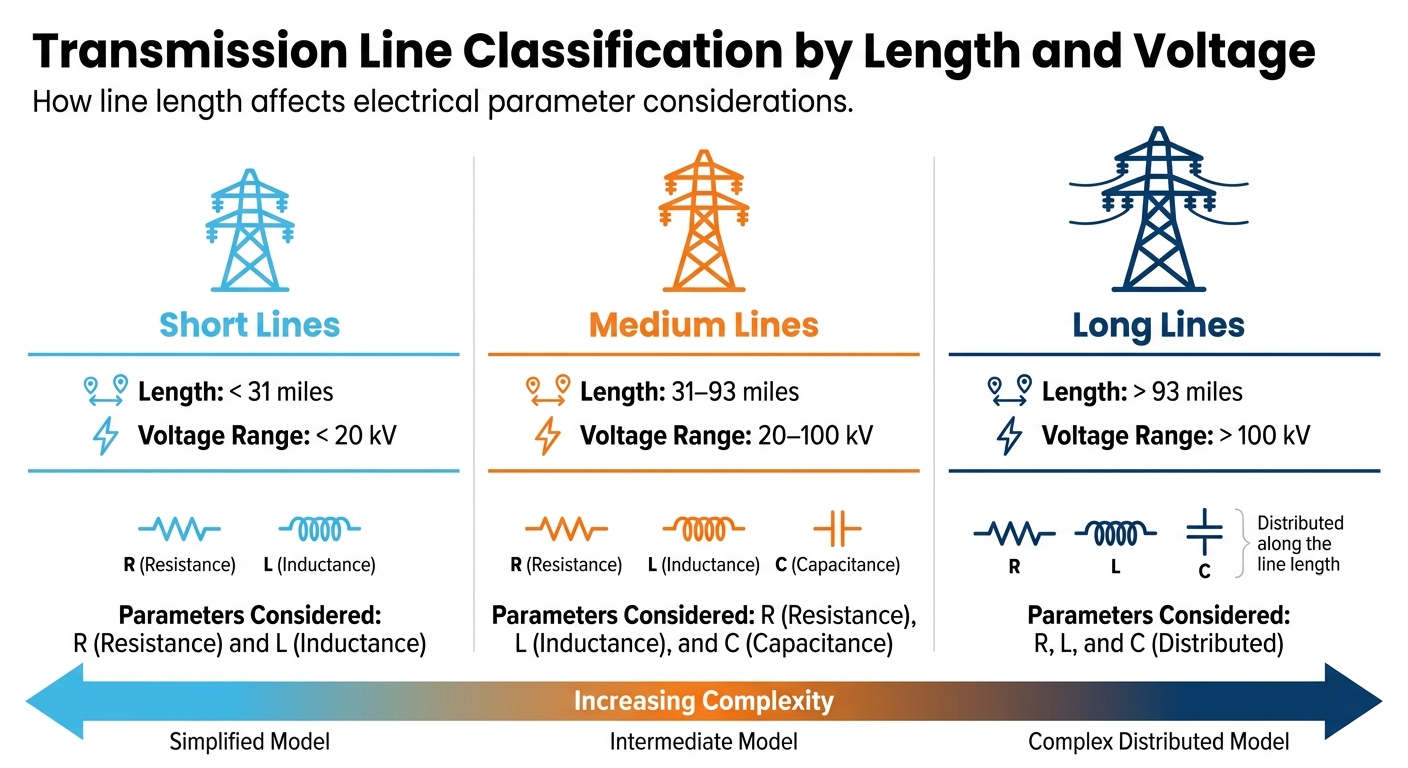
Transmission Line Types: Length, Voltage, and Parameters Comparison
Voltage regulation measures the percentage difference between the sending-end and receiving-end voltages. A lower percentage indicates better regulation, making this metric a cornerstone for analyzing the effects of reactive power and resistance.
Three electrical properties - resistance (R), inductance (L), and capacitance (C) - play a significant role in determining how voltage behaves along transmission lines. According to Cadence:
"The voltage regulation of a transmission line varies with the effect of the line parameters R, L, and C on the line length".
The length of the transmission line directly influences the impact of these parameters, as illustrated in the table below.
Reactive Power and Voltage Stability
Reactive power is essential for stabilizing voltage, as it compensates for fluctuations caused by interactions between inductance and capacitance. Without proper reactive power management, transmission systems are prone to steady-state failures and transient instabilities.
Modern grids increasingly rely on inverter-based technologies like STATCOMs and SVCs for managing reactive power. A notable advancement is the introduction of "night-mode" reactive power support. This feature enables solar PV inverters to help stabilize voltage even when they aren't generating active power. As renewable energy sources replace traditional power plants, this capability has become crucial, especially since reduced system inertia heightens the risk of voltage instability.
While reactive power management addresses voltage fluctuations, conductor resistance introduces additional challenges, particularly over long distances.
Distance and Conductor Resistance Effects
Conductor resistance contributes to voltage drops and power losses. The longer the distance, the greater the cumulative effect of resistance. Resistance causes power to dissipate as heat, reducing the ratio of receiving-end power to sending-end power.
At extremely high voltages - 345 kV and above - another issue emerges: corona losses. These occur when the surrounding air becomes ionized, potentially wasting several megawatts of power. Additionally, in 60Hz AC systems, the "skin effect" increases line resistance by about 2%, as current tends to concentrate near the conductor's surface rather than flowing evenly throughout. Environmental factors, such as ambient temperature and conductor configuration, also affect resistance, making it a variable property.
| Line Type | Length | Voltage Range | Parameters Considered |
|---|---|---|---|
| Short | < 31 miles | < 20 kV | R and L |
| Medium | 31–93 miles | 20–100 kV | R, L, and C |
| Long | > 93 miles | > 100 kV | R, L, and C (Distributed) |
Main Voltage Regulation Challenges in Long-Distance Lines
Maintaining voltage regulation in long-distance transmission lines is no small feat. As electricity travels farther from its generation point, grid operators face a host of technical and operational hurdles, including voltage drops, power losses, and the growing complexities tied to renewable energy sources.
Voltage Drop and Power Loss
One of the primary culprits behind power losses in transmission lines is conductor resistance, which causes energy to dissipate as heat, as described by the formula (P = I²R). The relationship is straightforward yet impactful: doubling the current results in quadrupled losses. To combat this, transmission systems operate at extremely high voltages, reducing the current and, in turn, minimizing waste. However, even with these measures, losses remain a challenge.
Take this example: a 765 kV transmission line carrying 1,000 MW over 100 miles experiences losses ranging from 0.5% to 1.1%. In comparison, a 345 kV line under the same conditions sees losses jump to 4.2%. Across the U.S. grid, transmission and distribution losses averaged about 5% between 2013 and 2019.
Other factors, like corona discharge (common above 200 kV) and the skin effect in 60 Hz AC systems, further complicate the picture by increasing both energy losses and effective resistance. Environmental conditions don’t make things easier, either. High ambient temperatures raise conductor resistance, while strong winds can cause "conductor gallop", potentially leading to flashovers if safety clearances are compromised.
Surge Impedance Loading (SIL) is another critical aspect. When the demand on a transmission line falls below its SIL, the line behaves capacitively, leading to overvoltages at the receiving end. On the flip side, operating above SIL makes the line more inductive, causing voltage drops. Dave Bryant, Director of Technology at CTC Global, explains:
"Long transmission lines typically operate near or beyond their Surge Impedance Loading (SIL), where the balance between capacitive and inductive reactive power becomes unstable".
While these losses and inefficiencies are inherent to transmission, the rise of renewable energy sources adds yet another layer of complexity.
Renewable Energy Integration Issues
Renewable energy, while essential for a greener future, introduces its own set of challenges. Wind and solar power, for instance, are highly variable. Changes in wind speed or cloud cover can cause output to fluctuate dramatically within minutes, making it harder for grid operators to predict and manage power flows.
High levels of renewable energy also replace traditional synchronous generators, which are critical for maintaining grid stability. Without these generators, the grid has lower inertia and reduced short-circuit ratios, making it more vulnerable to voltage fluctuations and oscillations that can range from tens to thousands of Hertz. Although modern power converters can supply up to 48% of their rated capacity as reactive power to stabilize the grid, this isn’t always enough during sudden disturbances.
Real-world events illustrate the risks. Blackouts in South Australia (2016) and the United Kingdom (2019) underscore how insufficient voltage support from wind and solar systems can destabilize the grid.
The challenge becomes even greater with the distances involved. Renewable energy installations, like solar farms and wind turbines, are often located far from urban centers. This necessitates ultra-long-distance transmission. For example, China’s Changji-Guquan UHVDC line spans 3,324 km and transmits up to 12 GW. Such distances not only increase energy losses but also demand intricate, multi-point voltage support systems to keep the grid stable.
The IEEE PES Voltage Optimization Working Group captures the situation well:
"Traditional Volt/Var control strategies - largely designed around synchronous generators and predictable load patterns - are increasingly inadequate".
sbb-itb-501186b
Technologies That Address Voltage Regulation Problems
Modern advancements tackle the challenges of voltage regulation in long-distance power transmission. From cutting-edge transmission systems to intelligent monitoring tools, these technologies address specific hurdles in delivering power over vast distances.
High-Voltage Direct Current (HVDC) Systems
HVDC technology has emerged as the preferred solution for ultra-long-distance power transmission, offering a significant reduction in energy losses - by as much as 30%–50% compared to traditional AC systems. To put it into perspective, HVDC systems typically experience losses around 5.6%, whereas comparable AC systems see losses closer to 8% over similar distances.
Using Voltage Source Converter (VSC) technology, HVDC systems can independently manage both active and reactive power. This capability is especially valuable for supporting weaker AC grids with low short-circuit levels. As Andre Pereira from the U.S. Department of Energy's Office of Electricity explains:
"HVDC technology... allows for control of energy flows. System operators can inject power onto the grid to minimize the impact of disturbances and recover from blackouts".
HVDC eliminates several challenges unique to AC systems, such as the skin effect and Ferranti effect, which complicate voltage regulation in traditional lines. Additionally, HVDC serves as a "firewall" between unsynchronized AC networks, preventing cascading blackouts from spreading through interconnected systems.
Real-world examples highlight the technology's effectiveness. The Pacific DC Intertie, completed in 1970, spans about 846 miles, delivering affordable hydropower from the Pacific Northwest to Southern California. Another milestone, the Transbay Cable Project in San Francisco, commissioned in 2010, marked the first commercial use of Modular Multilevel Converter (MMC) technology. This project provides a 400 MW link using Siemens' HVDC PLUS system.
While HVDC leads the way, compensation devices play a critical role in stabilizing voltage along transmission lines.
Shunt and Series Compensation Devices
Compensation devices are instrumental in maintaining voltage stability by providing targeted reactive power support. Shunt compensation addresses the Ferranti effect - where lightly loaded lines experience excessive voltage increases at the receiving end - by supplying reactive power, typically ranging from 10% to 50% of the active power being transferred. These devices also improve the power factor, enabling more power to flow without overburdening the line with reactive current.
Series compensation, on the other hand, uses capacitors to counteract a portion of the line's inductive reactance. This approach enhances the line's power transfer capability and improves system stability by reducing the power angle for a given power transfer. However, series compensation is generally capped at 80% of the line's reactance to avoid resonance issues at fundamental frequencies.
Modern Flexible AC Transmission Systems (FACTS) devices - such as Static Var Compensators (SVC), Static Synchronous Compensators (STATCOM), and Thyristor-Controlled Series Capacitors (TCSC) - take reactive power management to the next level. These devices can detect and respond to faults within milliseconds, delivering sub-cycle voltage support that far surpasses the capabilities of traditional capacitor or inductor banks.
In addition to these solutions, advanced monitoring and control systems ensure precise and dynamic grid management.
Monitoring and Control Systems
Real-time monitoring systems are essential for effective voltage management. Phasor Measurement Units (PMUs) provide dynamic, real-time data on large power systems, enabling operators to address stability issues as they arise. These systems work seamlessly with controllable components like HVDC lines, ensuring rapid and precise adjustments.
Control systems equipped with Modular Multilevel Converter (MMC) technology - widely adopted since its introduction in 2007 - allow for flexible and independent control of active and reactive power. These systems can even exhibit grid-forming behavior, acting as a "firewall" against disturbances and supporting black-start capabilities to help the grid recover from complete outages.
The evolution from simple point-to-point HVDC links to multi-terminal DC (MTDC) systems has introduced the need for more sophisticated control schemes. These coordinated systems manage interactions between multiple terminals effectively. As Marcelo A. Elizondo and colleagues noted in IEEE Transactions on Power Systems:
"The continued deployment of phasor measurement units makes dynamic information about a large power system readily available for highly controllable components, such as HVDC lines".
Buying Voltage Regulation Equipment
When it comes to addressing voltage regulation challenges and leveraging advanced technologies, selecting the right equipment is critical for ensuring efficiency in long-distance power transmission. This process demands a careful evaluation of technical specifications and supplier reliability. For instance, power transformers - a major component - can cost anywhere from $600,000 for smaller units (≤10 MVA) to about $4,000,000 for specialized phase-shifting transformers (100 MVA+). These high costs are coupled with lead times of approximately one year, regardless of the transformer’s MVA rating. Such factors significantly impact the selection of voltage regulation equipment.
Main Equipment Types
The backbone of voltage regulation includes several key components, each serving a specific role in maintaining transmission efficiency:
- Step-up and Step-down Transformers: These adjust voltage levels to minimize copper losses during transmission over long distances.
- Capacitor Banks and Shunt Reactors: Capacitor banks inject reactive power to boost voltage, while shunt reactors absorb excess reactive power, particularly on lightly loaded lines.
- SVCs and STATCOMs: For dynamic voltage support, these devices provide rapid adjustments to stabilize voltage levels.
- HVDC Converter Systems: Essential for ultra-long-distance transfers spanning hundreds of miles, these systems offer efficiency benefits that can outweigh their higher upfront costs.
Transformers must adhere to specific requirements, including Basic Insulation Level (BIL) ratings, MVA capacities, and guaranteed loss thresholds. Additionally, all equipment must be robust enough to handle transient overvoltages caused by lightning strikes or switching surges. Ahmed Sheikh, a Technical Author at EEPower, emphasizes the challenges associated with voltage regulation equipment:
"The cost of voltage conversion equipment, such as transformers and circuit breakers, is a significant concern due to the high voltages and fault currents involved".
Once the technical and financial aspects of the equipment are clear, the focus shifts to finding a dependable supplier.
Finding Reliable Equipment Suppliers
Selecting a trustworthy supplier is vital to ensuring both system reliability and long-term operational performance. Platforms like Electrical Trader offer a valuable resource for sourcing new and used electrical components, including breakers, transformers, and high-voltage equipment tailored for power distribution needs. Their organized listings make it easier to compare options based on voltage ratings, MVA capacities, and manufacturers.
Because costs can vary widely depending on factors like tank design, sound levels, and core configuration, it’s important to engage with vendors early and provide detailed specifications. Ensure that suppliers comply with international standards such as IEEE, IEC, and ASTM, and verify their track record in utility-scale projects. While advanced equipment may come with higher initial costs, it often delivers better long-term value through improved efficiency and reduced infrastructure demands over the project’s lifespan.
Conclusion
Transmitting power across long distances brings a host of voltage regulation challenges that can undermine both efficiency and reliability. Significant transmission losses are common, and integrating renewable energy sources adds another layer of complexity. Inverter-based generation is reshaping traditional grid dynamics, creating new hurdles for maintaining stability.
To address these issues, advanced technologies are paving the way. For example, HVDC systems have proven to be a game changer, cutting transmission losses to about 5.6%, compared to the 8% typically seen with conventional AC systems over similar distances. On top of that, tools like STATCOMs and SVCs offer real-time reactive power adjustments, which are critical for stabilizing voltage under fluctuating conditions.
Traditional control methods are no longer sufficient to handle the evolving complexities of today’s grids. Utilities now need advanced monitoring systems equipped with adaptive control logic, paired with well-coordinated reactive power resources, to ensure stability during extreme operating scenarios. As the grid continues to modernize, adopting state-of-the-art solutions and collaborating with reliable suppliers becomes essential.
Choosing high-quality voltage regulation equipment from dependable sources is a key step in maintaining grid stability while advancing the transition to cleaner energy. Platforms like Electrical Trader make it easier for utilities to find transformers, capacitor banks, and high-voltage components that comply with international standards, helping them tackle voltage regulation challenges effectively.
FAQs
How does reactive power management help maintain voltage stability in long-distance transmission lines?
Reactive power is essential for keeping voltage levels stable, especially across long-distance transmission lines. These lines tend to have a high inductive nature, and when real power flows through them, it can lead to a noticeable voltage drop. By either injecting or absorbing reactive power, operators can offset these drops and maintain voltage within safe operating limits.
Utilities rely on various tools to manage this, including shunt capacitors, series reactors, static VAR compensators (SVCs), and STATCOMs. Placing these devices strategically along transmission lines helps stabilize the system. Additionally, reactive power from generators and adjustable loads plays a key role in balancing the system's needs. This kind of management becomes even more crucial during times of heavy demand or unexpected disruptions, as a lack of reactive power can result in voltage instability or, in extreme cases, a system collapse.
For utilities looking to enhance their voltage regulation capabilities, platforms like Electrical Trader offer a comprehensive selection of reactive power compensation equipment. This includes capacitors, reactors, and advanced VAR devices designed to support the challenges of long-distance power transmission.
How do HVDC systems help reduce energy losses in long-distance power transmission?
High-voltage direct current (HVDC) systems offer a game-changing solution for minimizing energy losses during long-distance power transmission. By using direct current (DC) instead of alternating current (AC), HVDC systems avoid energy losses caused by reactive power and the skin effect - two inefficiencies that commonly plague AC systems.
What sets HVDC apart is its ability to keep transmission losses exceptionally low, around 3% per 1,000 kilometers. This translates to a boost in efficiency of about 30–40% compared to AC systems when covering long distances. Because of this, HVDC has become the go-to technology for efficiently moving electricity across expansive areas.
Why does integrating renewable energy make voltage regulation in power grids more challenging?
Integrating renewable energy sources such as wind and solar into power grids comes with its own set of challenges, particularly when it comes to voltage regulation. The output from these sources tends to be variable and unpredictable, leading to sudden voltage fluctuations that can occur at different locations within the grid.
Another hurdle is the reliance on inverter-based technologies in renewable systems. While these technologies are efficient, they reduce the grid's overall system inertia. This lower inertia makes it more difficult to stabilize voltage levels during abrupt shifts in supply or demand. To tackle these challenges, grid operators need to deploy fast, well-coordinated reactive power and volt-VAR control strategies to keep voltage levels within safe and stable ranges.