




Ultimate Guide to Voltage Regulator Selection
Voltage regulators provide stable output voltage for electronic devices, even with fluctuating input or changing loads. They are vital in applications ranging from microprocessors to industrial systems. Here's what you need to know:
-
Types of Regulators:
- Linear Regulators: Simple, low-noise, but inefficient for large voltage differences.
- Switching Regulators: Highly efficient, suitable for high-current or battery-powered systems, but more complex and noisier.
- AC Automatic Voltage Regulators (AVRs): Stabilize mains power for industrial and commercial equipment.
-
Key Selection Factors:
- Input/Output Voltage: Match your system's requirements.
- Load Current: Ensure the regulator handles maximum current.
- Efficiency: Linear regulators are less efficient than switching types.
- Thermal Management: Check heat dissipation to avoid overheating.
- Noise Sensitivity: Choose low-noise options for sensitive applications.
-
Applications:
- Linear regulators suit low-power, noise-sensitive devices like sensors.
- Switching regulators excel in high-power or battery-based setups.
- AVRs protect industrial systems from voltage fluctuations.
Quick Tip: Use switching regulators for efficiency and linear ones for low noise. For fluctuating input voltages, buck-boost regulators are ideal.
This guide explains how to choose the right voltage regulator for your needs, manage efficiency, and ensure stable performance.
Power For Your Electronics Projects - Voltage Regulators and Converters
Types of Voltage Regulators
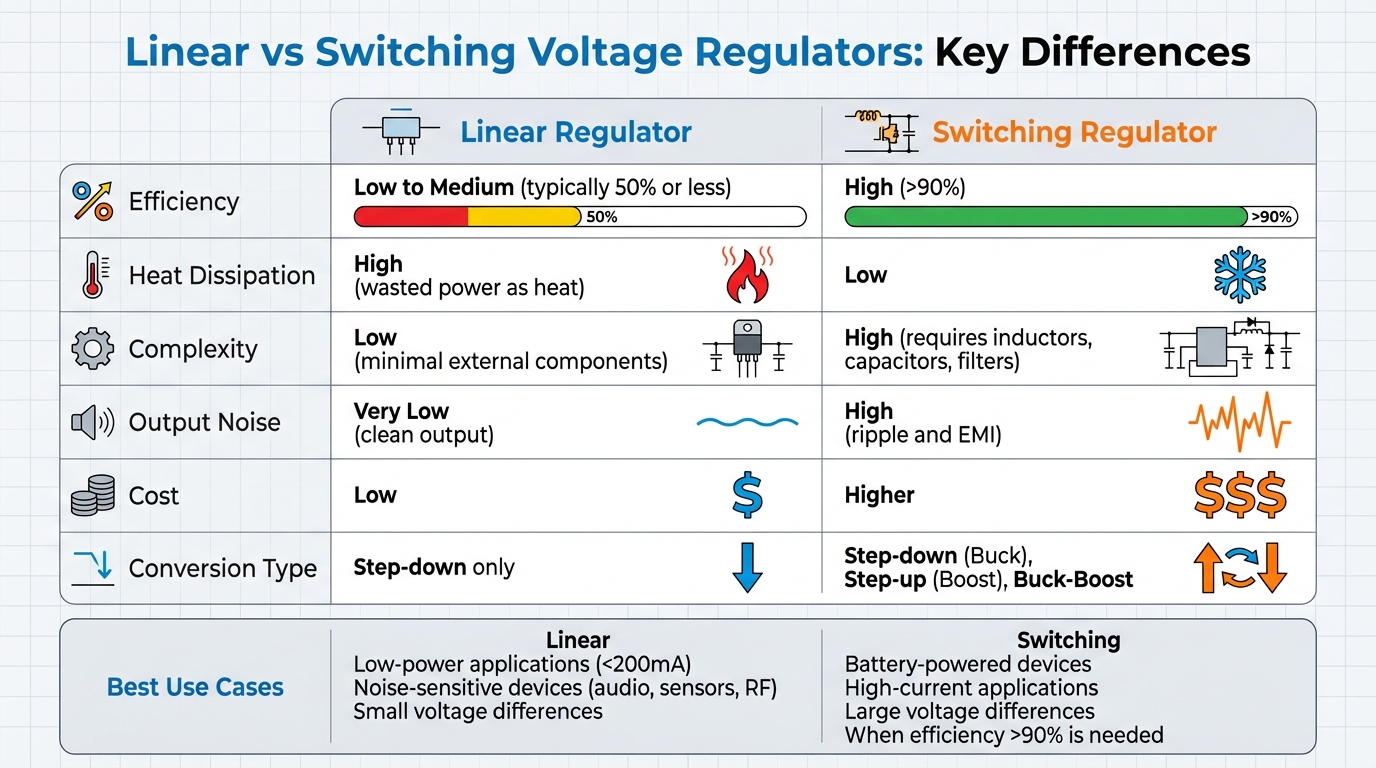
Linear vs Switching Voltage Regulators Comparison Chart
Voltage regulators come in three main categories, each designed to meet specific power and performance needs. Choosing the right type ensures your application runs efficiently and reliably.
Linear Regulators
Linear regulators work like a variable resistor, constantly adjusting to maintain a steady output voltage. Their simplicity makes them cost-effective and easy to design with, as they require minimal external components. A great example is the Analog Devices LT1761 family, which offers low-dropout (LDO) regulators. These are particularly useful in noise-sensitive devices like communication and radio equipment, where clean power is essential.
However, linear regulators have inherent efficiency limits, dictated by the input-to-output voltage ratio. The heat they generate follows this formula: Pₗₒₛₛ = (V₍ᵢₙ₎ – V₍ₒᵤₜ₎) × Iₗₒₐd. While this is manageable for low-power applications under 200 mA or when voltage differences are small, higher currents require heat sinks to keep temperatures within the standard 125°C component limit.
"The linear regulator's power dissipation is directly proportional to its output current for a given input and output voltage, so typical efficiencies can be 50% or even lower." – Analog Devices
Linear regulators can only lower voltage - they can’t increase it. Despite this limitation, they shine in applications like audio equipment, precision sensors, and other scenarios where reducing noise is more important than maximizing efficiency. For situations where efficiency and versatile voltage conversion are critical, switching regulators are a better fit.
Switching Regulators
Switching regulators operate by delivering power in quick bursts, using inductors and capacitors to store and transfer energy. They are highly efficient - often achieving over 90% - making them ideal for battery-powered devices, high-current applications, and systems where managing heat is critical.
These regulators can perform step-down (buck), step-up (boost), or both (buck-boost) voltage conversions. A standout example is the RECOM Power R-78E-1.0, a 1-A switching regulator with a 5 V output. It’s designed as a drop-in upgrade for the classic 7805 linear regulator, offering improved efficiency without requiring a new PCB layout.
"Switching topologies are overwhelmingly preferred for high-power applications due to their higher efficiency. They're also the only option if the application requires more than a simple step-down conversion." – Arrow Electronics
The trade-off? Switching regulators are more complex. They need carefully chosen components like inductors, diodes, and capacitors. Their high-frequency operation can introduce output ripple and electromagnetic interference (EMI), which may affect nearby circuits. For applications requiring both efficiency and low noise, combining a switching regulator with a linear regulator can offer the best of both worlds: efficient voltage conversion followed by noise reduction.
| Feature | Linear Regulator | Switching Regulator |
|---|---|---|
| Efficiency | Low to Medium | High (>90%) |
| Heat Dissipation | High (wasted power as heat) | Low |
| Complexity | Low | High (requires inductors/filters) |
| Output Noise | Very Low (clean) | High (ripple and EMI) |
| Cost | Low | Higher |
| Conversion Type | Step-down only | Step-down, Step-up, Buck-Boost |
AC Automatic Voltage Regulators (AVRs)
AC Automatic Voltage Regulators (AVRs) are designed to stabilize mains voltage, protecting industrial and commercial equipment from fluctuations and brief voltage drops that could damage components or disrupt operations.
Modern Electronic Voltage Regulators (EVRs) are highly efficient, maintaining up to 99% efficiency compared to older ferroresonant transformers, which often operate between 75% and 80% efficiency - and sometimes as low as 50%. High-quality AVRs typically achieve efficiency levels above 97%. For three-phase systems, independent phase regulation ensures better voltage balance, reducing the risk of overheating and mechanical vibrations in electrical devices.
"EVRs run silent and cool and can be installed indoors or out, while ferros are noisy and hot and must be installed in a protected indoor environment." – UST Power
AVRs come in various designs to suit different needs:
- Servo Electronic AVRs: Offer precise voltage control (up to ±0.5%) and are well-suited for general industrial and commercial use.
- Magnetic Induction AVRs: Require little maintenance, making them ideal for harsh environments like dusty or saline conditions.
- Static Tap Switching AVRs: Cost less but are less accurate, typically offering regulation in the ±5% to ±10% range.
- Ultra-Fast AVRs: Respond in 1.5 milliseconds or less, essential for equipment sensitive to brief voltage dips.
AVRs are often part of larger power conditioning systems that include surge suppression, short-circuit protection, line noise reduction, and harmonic filtering. When selecting an AVR, consider the maximum load and add a 10%–25% buffer for future expansion. For equipment with high inrush currents, like welders or X-ray machines, choose a unit rated 30%–50% higher than the full load.
How to Select the Right Voltage Regulator
Choosing the right voltage regulator involves matching your input and output needs, managing heat, and ensuring stability to prevent system failure.
Determining Electrical Requirements
Start by identifying three critical parameters: input voltage, output voltage, and maximum load current. These determine the type of regulator that fits your application.
"The first step in selecting the right voltage regulator is to determine your input voltage, output voltage, and maximum load current." – John Teel
For instance, a 7805 regulator with a 2V dropout requires at least 7V input to maintain a stable 5V output. If your input voltage can drop below this threshold - like when using two AA batteries (which range from 3.2V when full to 2.4V when empty) but you need a steady 3V output - you’ll need a buck-boost regulator to handle both higher and lower input voltages.
Dropout voltage is the minimum difference between input and output voltages required for the regulator to function properly. For battery-powered devices, quiescent current (Iₑ) - the current consumed by the regulator itself - becomes crucial, especially during idle periods when minimizing power draw is essential.
If you're using a linear regulator, calculate power dissipation with the formula:
P = (Vᵢₙ - Vₒᵤₜ) × Iₗₒₐd. Ensure the resulting heat stays within the regulator’s thermal limits. If the heat exceeds safe levels, consider switching to a buck (step-down) regulator instead.
Once you’ve addressed these electrical parameters, move on to efficiency and thermal management.
Efficiency and Heat Management
Efficiency affects both battery life and heat generation. Linear regulators typically operate at about 50% efficiency or less, while switching regulators often reach 90% or more. The efficiency of a linear regulator is roughly proportional to the ratio of output voltage to input voltage (Vₒᵤₜ / Vᵢₙ).
To estimate thermal rise, use the regulator’s datasheet value for Theta-JA (θJA), expressed in °C/W. Multiply the power dissipation by θJA to calculate the temperature increase above ambient. For example, if a regulator dissipates 2W and has a θJA of 50°C/W, the temperature rise would be 100°C. Add this to the worst-case ambient temperature - such as 50°C inside a car on a hot day - to ensure the total stays below 125°C, the typical maximum operating temperature for most components. Many regulators also include thermal shutdown features around 150°C for safety.
"Linear regulators are much cheaper and simpler to use than switching regulators, therefore they should typically be your first choice." – John Teel
Linear regulators are ideal for low voltage differences and light loads. However, if your thermal calculations exceed 125°C, switching to a buck regulator is a better option. To improve efficiency with low-dropout (LDO) regulators, keep the input voltage just above the dropout voltage. If significant heat is unavoidable, use heatsinks or larger PCB copper planes to stay within safe temperature limits.
Regulation and Dynamic Performance
Beyond electrical and thermal considerations, it’s important to evaluate how the regulator performs under system changes.
Line regulation measures how well the regulator maintains a steady output voltage despite changes in input voltage, while load regulation measures stability under varying load conditions. Both are expressed as ΔVₒᵤₜ relative to either ΔVᵢₙ or ΔIₒᵤₜ. For most digital ICs or op-amps, a ±5% voltage tolerance is acceptable.
Transient response is crucial in applications with rapid load changes. If your load-step slew rate exceeds the inductor’s current slew rate, you’ll need extra output capacitance to maintain stability. Ensure a phase margin of at least 45° at unity gain to avoid instability.
"The rule of thumb is to have at least 45 degrees of phase margin at unity gain." – Analog Devices
For noise-sensitive systems like RF circuits or A/D clocks, evaluate the Power Supply Rejection Ratio (PSRR) at the actual switching frequencies and harmonics present in your setup, not just the standard 120Hz specification. Poor stability can severely impact PSRR, so test it in your circuit. In complex RF systems, regulators with external synchronization capabilities can help align switching harmonics and prevent interference from "beat frequencies".
"Choosing the wrong voltage regulator can result in compromised reliability, higher power consumption, and even fried components." – Ashish Choudhary
sbb-itb-501186b
Voltage Regulators by Application
Selecting the right voltage regulator depends on what you're powering. Different devices and systems have unique needs - some prioritize low noise, others demand high efficiency, and some must handle unpredictable power sources effectively.
Low-Voltage Electronics and Embedded Systems
When working with low-voltage devices, the type of regulator you choose can significantly impact performance. Linear regulators are ideal for components that require minimal noise, such as sensors, analog-to-digital converters, and RF front-ends. Microcontrollers often rely on linear regulators like the 7805 because they offer low-noise performance at an affordable cost.
However, linear regulators dissipate extra energy as heat, which can be a problem in compact setups. For battery-powered systems or applications with high-current demands, switching regulators are a better choice. These regulators can reach efficiencies of around 90%, compared to the 50% or lower efficiency of linear types. In sensitive applications like high-performance RF systems, regulators with external clock synchronization help avoid "beat frequencies" that could disrupt signal integrity.
It’s also worth noting that the capacitance of ceramic capacitors can drop significantly - sometimes by over 80% - depending on the DC bias voltage applied. This is important when selecting capacitors for embedded systems.
Battery-Powered Devices
Batteries present unique challenges because their voltage fluctuates during use. A 12V automotive battery, for example, can range from about 12.5V when fully charged to under 10V as it discharges. This variability calls for regulators designed to handle the entire voltage range efficiently.
Low-dropout (LDO) regulators are a go-to solution when the input voltage is only slightly higher than the desired output. For instance, stepping down from a 3.6V battery to 3.3V with an LDO can achieve about 91.7% efficiency. However, when the battery voltage may cross the target output - such as when using two AA batteries that range from 3.2V to 2.4V while requiring a steady 3.0V output - a buck-boost regulator is the better option.
"In battery applications buck-boost regulators are often used to provide a constant stable voltage, overcoming the change of output voltage that is seen as batteries charge and discharge." – Vicor Power
Minimizing quiescent current is essential for extending battery life. To optimize both efficiency and noise levels, a common approach is to pair a switching regulator for the primary voltage conversion with an LDO for cleaning up the final output. This combination balances performance with battery longevity.
Industrial and Commercial Power Systems
In industrial settings, voltage regulators must handle demanding conditions, including harsh environments and variable loads. Switching regulators are often the top choice here because they maintain efficiencies above 90%, regardless of the input-to-output voltage difference. Additionally, they generate less heat compared to linear regulators, which is crucial for applications like powering motors, solenoids, or automation equipment that can create sudden power spikes.
For systems transmitting power over long distances, efficiency can be improved by using a boost regulator to increase the voltage before transmission. This reduces I²R losses, and the voltage can then be stepped down at the load.
"If DC power must be transmitted using a long cable, the I²R losses can be reduced by boosting the voltage before transmission and then stepping it down again at the load." – Vicor Power
In sensitive industrial applications, such as medical devices or RF equipment where noise is a concern, Zero Voltage Switching (ZVS) topologies offer a solution. These regulators provide high efficiency with inherently low noise. For systems with large capacitive loads, incorporating soft start capabilities can also help manage inrush currents effectively.
Finding Voltage Regulation Equipment on Electrical Trader
Benefits of Using Electrical Trader
When you're ready to source voltage regulation equipment, Electrical Trader simplifies the process. This U.S.-based marketplace is a one-stop shop for both new and reconditioned voltage regulators and power distribution equipment. For those working on tight budgets, reconditioned units offer a great balance of cost and reliability. For instance, you can find a reconditioned 1,000 kVA industrial power transformer (3-phase, 480V-208Y/120V) for about $12,999.00, while a new surplus 112.5 kVA dry-type transformer (3-phase, 480V-208Y/120V) is priced around $3,500.00.
The platform carries products from top manufacturers like ABB, Acme Electric, Cutler Hammer, Eaton, General Electric (GE), Hammond Power Solutions, SolaHD, and Square D. This range of options caters to diverse needs, from low-voltage systems and battery-powered setups to industrial three-phase installations. Each listing includes critical details - such as voltage ranges, phase configurations, and environmental ratings - so you can compare equipment against your project specs without needing to contact multiple vendors.
Once you're familiar with the available options, you can refine your search by focusing on the specific parameters for your project.
How to Search for Voltage Regulators
To streamline your search on Electrical Trader, use filters based on the selection criteria discussed earlier. Start by narrowing results using input voltage, output voltage, and maximum load current. For industrial setups, make sure to specify whether you need single-phase or three-phase regulation, along with your system configuration - Wye or Delta.
Choosing the right regulator topology is just as important. If you need to step down voltage, look for buck regulators. For stepping up voltage, boost regulators are the way to go. If the input voltage fluctuates both above and below the desired output, a buck-boost regulator is ideal. For linear regulators, check the "Dropout Voltage" specification, which indicates the smallest difference between input and output voltages. Low-Dropout (LDO) regulators are especially useful when the input voltage is close to the output.
Thermal performance is another key factor, especially for compact setups. Review the datasheet's Theta-JA (°C/W) value to estimate the temperature rise, keeping in mind that most regulators have a maximum operating temperature of 125°C. For industrial three-phase systems, prioritize regulators with independent phase regulation to avoid failures caused by phase-to-phase voltage imbalances.
Related Equipment and Components
In addition to voltage regulators, Electrical Trader also provides the complementary components your project might require. For example, transformers like buck-boost, potential, or autotransformers can help fine-tune voltages. Circuit protection tools, such as breakers, fuses, and switchgear, along with distribution equipment like bus plugs, panelboards, and switches, are essential for safe and reliable power management.
For monitoring and control, metering equipment and SCADA systems can help you track voltage accuracy and overall performance. If you're working on low-voltage or embedded applications, components like inductors, capacitors, and heatsinks are available to manage electrical noise and dissipate heat. For outdoor or harsh environments, make sure to select equipment with NEMA 3R ratings, which offer better protection than standard indoor enclosures (Type 1).
Conclusion
Selecting the right voltage regulator depends entirely on your specific application needs. Linear regulators are a solid choice for low-power, low-noise applications where simplicity is key, though they tend to lose efficiency under high voltage differences. On the other hand, switching regulators can achieve efficiencies above 90% and are versatile enough to step up, step down, or invert voltages - making them ideal for battery-powered devices and high-performance systems. For industrial and commercial setups, AC Automatic Voltage Regulators (AVRs) are excellent for maintaining stable voltage despite grid fluctuations.
Thermal management is another critical factor. Ensure power dissipation stays within safe limits by checking the Theta-JA value in the datasheet to confirm the chip won’t exceed 125°C. When the input voltage is close to the desired output, Low-Dropout (LDO) regulators are invaluable, with some modern ULDOs operating at voltage differentials as low as 35mV. For the best balance of efficiency and low noise, hybrid designs might be worth considering.
"The only times you don't want to use a linear regulator is if the power dissipation is too high, or you need to step-up a voltage." - John Teel, Predictable Designs
These technical factors are essential when sourcing the right equipment. Platforms like Electrical Trader simplify the process of finding reliable voltage regulation solutions. They offer a wide range of new and used voltage regulators, transformers, and related components from trusted manufacturers like ABB, Eaton, General Electric, and Square D. Whether you’re designing low-voltage embedded systems or managing industrial three-phase power, their detailed specifications and filtering options make it easy to find exactly what you need. Plus, with access to circuit protection, distribution equipment, and monitoring tools, you can create comprehensive, dependable power management systems all in one place.
FAQs
What’s the difference between linear and switching voltage regulators?
Linear voltage regulators operate by using a pass transistor paired with a high-gain amplifier to deliver a consistent output voltage. Their straightforward design makes them easy to use, and they generate very little electrical noise. This makes them a solid choice for low-power applications. That said, their efficiency drops when there's a big gap between the input and output voltage, often leading to significant heat generation.
Switching voltage regulators take a different approach. They rely on a high-frequency power switch alongside components like inductors and capacitors to manage voltage conversion. This design allows them to step voltage up or down with much greater efficiency, which is why they’re often preferred in power-sensitive setups. The trade-off? They’re more complex to implement and can introduce some switching noise into the system.
How can I choose the best voltage regulator for a battery-powered device?
To pick the right voltage regulator for a battery-powered device, start by figuring out the battery's voltage range. This includes its nominal voltage and the minimum voltage when it's fully discharged. Next, identify the output voltage your components need - like sensors or microcontrollers - and calculate the maximum load current. Be sure to include a safety margin of about 20% to account for unexpected fluctuations.
The type of regulator you choose depends on your battery's voltage and the output requirements:
- Use a buck (step-down) regulator if the battery voltage is always higher than the required output voltage.
- Opt for a boost (step-up) regulator if the battery voltage is consistently lower than the output.
- Go for a buck-boost regulator if the battery voltage can swing both above and below the desired output.
For designs where efficiency isn't the top priority, linear regulators are a straightforward option. However, if you're aiming to extend battery life, switching regulators are a better choice due to their high efficiency.
Lastly, don't overlook details like quiescent current, thermal performance, and the regulator's physical size to ensure it fits seamlessly into your design. Trusted marketplaces like Electrical Trader offer a variety of voltage regulators to match your technical needs and budget.
What should I consider for managing heat in voltage regulators?
Effective thermal management plays a key role in ensuring a voltage regulator operates safely and reliably. Start by estimating power dissipation - this is calculated by multiplying the load current by the regulator’s voltage drop, then adding any switching losses. This calculation gives you an idea of how much heat the regulator will produce. Next, look at the regulator’s thermal resistance (junction-to-ambient) to confirm that the temperature rise stays within safe limits, especially under typical ambient conditions measured in °F.
When dealing with switching regulators, keep an eye on heat sources like MOSFET resistance, gate capacitance, and switching frequency. While higher switching frequencies can shrink the size of external components, they tend to generate more heat. Using components with low on-state resistance or opting for efficient external MOSFETs can help reduce this heat buildup.
For effective heat dissipation, consider using a PCB layout with ample copper pour and thermal vias to disperse heat from the regulator. For higher power applications, adding heat sinks or forced-air cooling might be necessary. Make sure the regulator’s thermal pad is properly soldered to a copper area, and factor in any enclosure constraints, such as limited airflow. When it’s time to source high-quality regulators with detailed thermal specifications, check out Electrical Trader - they offer a broad selection of new and used components to suit your needs.





