




Copper-Clad vs. Solid Copper Ground Rods
Copper-clad and solid copper ground rods serve the same purpose: safely directing excess electricity into the ground. However, they differ in material, cost, durability, and performance. Here’s what you need to know:
- Copper-Clad Rods: Made of a steel core with a thin copper coating (5-10 mils). They are affordable, strong, and easier to install but may corrode if the copper layer is damaged. Lifespan: ~10-30 years.
- Solid Copper Rods: Fully copper, offering superior conductivity and corrosion resistance. They last over 50 years but cost significantly more and often require pre-drilling for installation.
Quick Comparison:
| Feature | Copper-Clad Rods | Solid Copper Rods |
|---|---|---|
| Material Cost | Lower | Higher |
| Installation | Easier (direct drive) | Harder (pre-drilling) |
| Lifespan | 10-30 years | 50+ years |
| Corrosion Risk | Higher if damaged | Very low |
| Conductivity | Moderate | High |
Choose copper-clad for cost-effective, standard installations. Opt for solid copper in corrosive soils or critical systems where long-term reliability is key.
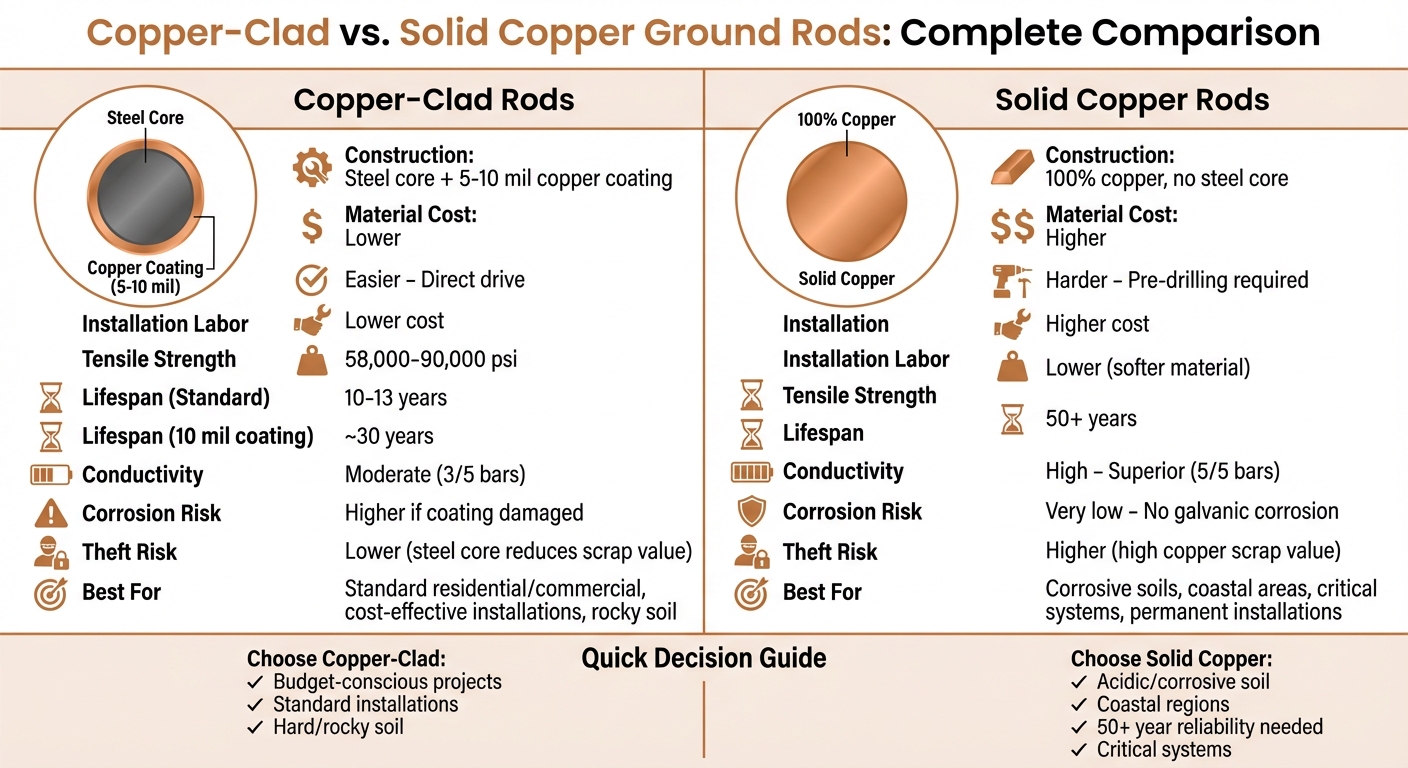
Copper-Clad vs Solid Copper Ground Rods Comparison Chart
Copper-Clad Ground Rods Explained
Construction and Composition
Copper-clad ground rods combine two materials to achieve durability and efficiency. At their core is high-strength steel, which allows the rod to be driven deep into the ground without bending or breaking. This steel core is coated with a thin layer of copper, typically between 5 and 10 mils thick.
"The standard driven rod or copper-clad rod consists of an 8 to 10 foot length of steel with a 5 to 10-mil coating of copper." – E&S Grounding Solutions
These rods are usually 8 to 10 feet long, with diameters ranging from 1/2 to 3/4 inch. To meet UL 467 standards, the copper coating must be at least 10 mils thick . This combination of materials ensures both strength and functionality, making copper-clad rods a practical choice for grounding applications.
Where They're Used and Their Benefits
Thanks to their sturdy design, copper-clad ground rods are widely used across a range of installations. Their construction offers both technical reliability and cost-efficiency, making them the most commonly used grounding device today. You’ll find them in residential, commercial, and industrial electrical setups. Contractors often prefer the 10-foot rods since they meet National Electrical Code requirements for 8 feet of soil contact without requiring extra digging, like an 18-inch starter hole.
These rods come with several advantages. Their steel core and copper coating combine to provide a dependable service life of about 40 years. The steel core also reduces their scrap value, making them less appealing to thieves compared to solid copper rods.
However, rocky terrain can make installation tricky. The rod’s tip may "mushroom" or deflect when hitting rocks, potentially turning back toward the surface. Despite these challenges, copper-clad rods remain a cost-effective and reliable option for grounding needs.
sbb-itb-501186b
Solid Copper Ground Rods Explained
Construction and Composition
Solid copper ground rods differ from copper-clad rods because they are made entirely of copper, from the core to the surface, without any steel center. These rods are driven into the ground to create a low-resistance path for electrical current.
Thanks to their all-copper design, these rods offer the highest conductivity among standard grounding electrodes. However, copper's softness makes these rods more likely to bend in hard or rocky soil. To avoid damage, such as mushrooming at the ends, it's best to use a driving sleeve or a pneumatic hammer drill during installation. To comply with UL 467 standards, these rods are typically at least 8 feet long.
Solid copper rods are also known for their durability, with an expected service life of about 40 years. Since they lack a steel core, there’s no risk of galvanic corrosion even if the surface gets scratched during installation.
Where They're Used and Their Benefits
Solid copper ground rods shine in environments where corrosion is a significant concern. Their superior conductivity and resistance to corrosion make them a reliable choice for demanding conditions. Without any steel core to rust, these rods eliminate the risk of galvanic corrosion, even if the surface is damaged.
These rods are particularly suited for critical installations where long-term reliability is essential, such as areas with acidic or highly corrosive soil. For deeper installations, some manufacturers offer sectional versions that can be connected to reach soil layers with lower resistance.
The downside, however, is the cost. As of 2026, a standard 5/8″ x 8′ solid copper rod costs about $225.00, while a 3/4″ x 10′ version is priced at approximately $355.00. Additionally, their high copper content makes them more appealing to thieves, which, along with their price, limits their use in typical residential and commercial settings.
Performance Differences
Conductivity and Efficiency
The material makeup of ground rods has a direct impact on both their conductivity and mechanical performance.
Solid copper rods excel in conductivity because they are made entirely of copper. This makes them the go-to choice for critical systems and sensitive electronics where maximum conductivity is essential. On the other hand, copper-clad rods, with their steel core and copper exterior, offer high conductivity at the surface but are less conductive overall due to the steel core.
For most applications, copper-clad rods provide enough conductivity to handle typical fault currents. The current capacity of a ground rod - usually between 100 and 200 amps for standard sizes - depends more on the rod's diameter than its material composition. Additionally, the copper coating on clad rods takes advantage of the skin effect. This phenomenon causes high-frequency currents, like those from lightning, to travel along the outer surface, making the copper layer especially effective.
The choice between the two becomes particularly important in specialized uses. Solid copper rods are better suited for applications demanding peak conductivity, such as grounding highly sensitive equipment or in soils with low resistivity. Meanwhile, copper-clad rods work well for standard residential or commercial installations and come at a lower cost.
These differences in performance naturally lead into considerations about installation and durability.
Strength and Durability
Beyond conductivity, the physical strength and durability of these rods play a key role, especially during installation.
Copper-clad rods stand out in terms of strength. Their high-carbon steel core gives them tensile strength ranging from 58,000 psi to over 90,000 psi. This toughness is crucial when driving rods into hard or rocky soil, as it prevents bending or damage during installation with a hammer or mechanical driver.
"Solid copper rods are often structurally too weak to be driven into the earth with a hammer system, thereby requiring pre-drilling." - E&S Grounding Solutions
Solid copper rods, while excellent in conductivity, are softer and more prone to bending or "mushrooming" when hammered into the ground. This often necessitates pre-drilling before installation. However, solid copper rods avoid some of the corrosion risks that can affect copper-clad rods if their copper coating becomes damaged.
Copper Bonded Steel Rod VS Pure Copper Ground Rod(Advantages)#earthrod #IEC62561 #grounding #UL467
Cost and Lifespan Comparison
When choosing a ground rod, cost and lifespan are just as important as performance. Let’s break down how these factors vary across different materials.
Material and Installation Costs
Copper-clad rods are much more affordable than solid copper rods. They can also be driven directly into the ground, which simplifies installation. On the other hand, solid copper rods require pre-drilling, which increases both material and labor costs. The direct drive installation of copper-clad rods - whether done manually or mechanically - further reduces labor expenses.
However, there’s a catch: hammering copper-clad rods can strip the copper coating, exposing the steel core to potential corrosion. While this makes copper-clad rods a budget-friendly choice upfront, it can impact the long-term durability of the grounding system.
Lifespan and Soil Conditions
The way a rod is installed doesn’t just affect costs - it also plays a role in how long it lasts, especially under varying soil conditions. Standard copper-clad rods with thinner coatings typically last about 10–13 years. Opting for a higher-quality copper-clad rod with a 10 mil (0.010 in) coating (the minimum required for UL listing) can extend the lifespan to roughly 30 years. Solid copper rods, however, stand out in terms of durability, with a lifespan that surpasses 50 years.
One major risk with copper-clad rods is that if the copper layer is damaged, the exposed steel core can corrode completely, leaving behind a hollow copper shell. Solid copper rods avoid this issue entirely, making them a more reliable option for long-term use.
Here’s a quick comparison of the key differences:
| Feature | Copper-Clad (Standard) | Copper-Clad (10 mil) | Solid Copper |
|---|---|---|---|
| Material Cost | Lower | Lower | Higher |
| Installation Labor | Lower (Direct drive) | Lower (Direct drive) | Higher (Pre-drilling required) |
| Expected Lifespan | 10–13 years | ~30 years | 50+ years |
| Corrosion Risk | High if coating scraped | Moderate | Very low |
This table highlights the trade-offs between upfront costs, installation requirements, and long-term reliability. While copper-clad rods offer savings initially, solid copper rods shine when durability and lifespan are the priority.
Choosing the Right Ground Rod
Selecting the right ground rod depends on your project's specific needs, budget, and environmental conditions. While both options meet electrical code standards when installed correctly, each has strengths suited to particular scenarios. Here’s a closer look at when to choose copper-clad or solid copper rods.
When Copper-Clad Is the Better Choice
Copper-clad ground rods are ideal for projects where cost-efficiency is a priority. Thanks to their high-tensile steel core, these rods can be driven directly into hard or rocky soil without pre-drilling. This feature not only simplifies installation but also cuts labor costs.
For standard residential setups or temporary grounding systems that don’t demand a 50-year lifespan, copper-clad rods offer dependable performance at a lower price point. Opting for a thicker 10-mil copper coating can extend the rod's lifespan to approximately 30 years.
When Solid Copper Is the Better Choice
Solid copper rods are the go-to option for installations where durability and corrosion resistance are critical. These rods shine in environments prone to corrosion, such as coastal regions with salty soil, areas with acidic ground, or locations with high moisture levels.
With a service life exceeding 50 years, solid copper rods are perfect for permanent installations where replacing the rod would be expensive and disruptive. Although their softer material often requires pre-drilling, the long-term reliability and minimal upkeep make them worth the higher upfront cost. For high-stakes applications where grounding failure could lead to severe consequences, solid copper ensures a stable and enduring connection.
FAQs
How do I choose between copper-clad and solid copper for my soil?
When deciding between copper-clad and solid copper ground rods, it's important to weigh factors like performance, cost, and durability.
Solid copper rods are known for their superior conductivity and strong resistance to corrosion. These qualities make them a top choice for long-term, high-performance grounding systems. On the other hand, copper-clad rods combine a steel core with a copper coating, offering a more cost-effective alternative. However, they might not last as long, especially in soils prone to corrosion.
If durability and performance are your priority, solid copper rods are the way to go. But if you're working within a tighter budget, copper-clad rods can get the job done.
What happens if a copper-clad rod’s copper coating gets scratched?
If the copper coating on a copper-clad rod gets scratched, the underlying steel core can become exposed. This exposure makes the rod vulnerable to corrosion, which can decrease its conductivity and affect its performance over time. To maintain durability and functionality, it's crucial to handle the rod carefully and avoid damaging the coating during installation or use.
Do I need to pre-drill, or can I drive the ground rod in directly?
Copper-clad ground rods are built to handle direct installation into the ground using a hammer or mechanical tools. This is possible because of their tough steel core covered with a copper layer. On the other hand, solid copper rods are less sturdy and usually need the ground to be pre-drilled. Attempting to hammer solid copper rods directly can harm the rod, stripping away its protective copper layer and making it more prone to corrosion. It's crucial to choose the right installation method based on the type of rod you're using.





