




Copper vs. Aluminum Cables for Wind Turbines
Choosing between copper and aluminum cables for wind turbines boils down to performance, cost, and durability. Copper offers superior conductivity, flexibility, and resistance to stress, making it ideal for high-stress areas like nacelle drip loops. Aluminum, on the other hand, is lighter, cheaper, and easier to handle, making it a better fit for long, stationary applications like down-tower segments or feeder lines.
Key Takeaways:
- Copper: Best for dynamic, high-stress environments (e.g., nacelle cables), thanks to its flexibility, tensile strength, and corrosion resistance.
- Aluminum: A cost-effective, lightweight option for long-distance, static applications, though it requires special installation steps to prevent oxidation.
- Cost Comparison (2021): Copper costs ~$4,417/ton, while aluminum is ~$1,138/ton.
- Performance: Copper is 40% stronger and has 100% conductivity, while aluminum is 70% lighter but requires larger cables to match copper's ampacity.
Quick Comparison:
| Factor | Copper | Aluminum |
|---|---|---|
| Conductivity (IACS) | 100% | ~61% |
| Weight | 8.96 g/cm³ (heavier) | 2.7 g/cm³ (lighter) |
| Tensile Strength | 40% higher | Lower (may need steel reinforcement) |
| Corrosion Resistance | Naturally resistant | Requires treatment to prevent oxidation |
| Cost (2021) | ~$4,417/ton | ~$1,138/ton |
| Applications | High-stress, dynamic | Long-distance, static |
Using both materials strategically - copper for high-stress areas and aluminum for static, long-distance runs - can optimize performance and cost for wind turbine systems.
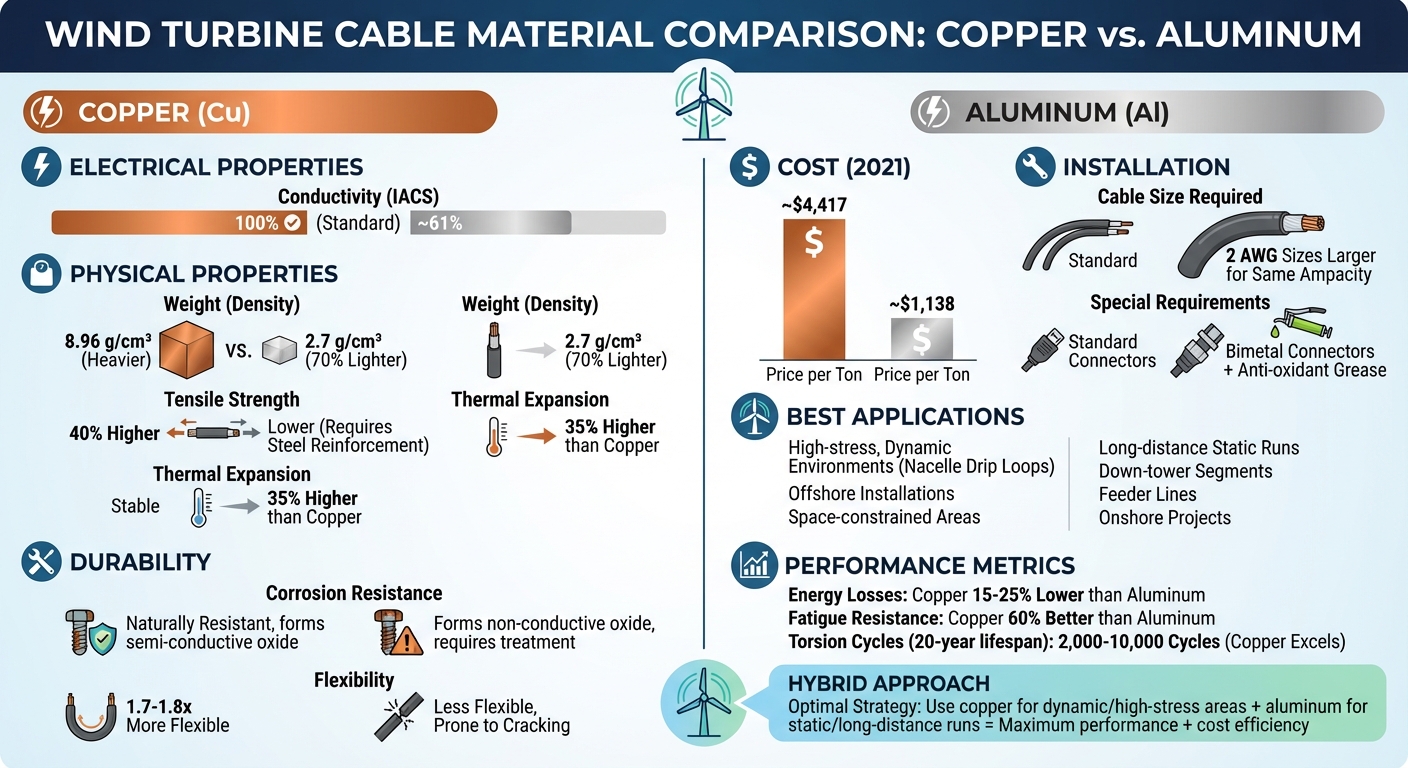
Copper vs Aluminum Cables for Wind Turbines: Complete Comparison Chart
Cable solutions for the Wind turbines industry
sbb-itb-501186b
Material Properties and Characteristics
To understand why copper and aluminum perform differently in wind turbine environments, it's essential to look at their physical and electrical traits. Each material brings unique strengths and challenges to the table, which influence their use in cabling.
Copper Cable Properties
Copper is the gold standard for electrical conductivity, rated at 100% IACS (International Annealed Copper Standard). With a density of 8.96 g/cm³, copper is considerably heavier than aluminum, but this added weight comes with advantages. Its tensile strength is about 40% higher than aluminum's, making it more resistant to damage from pulling forces during installation and to mechanical stress over time. This durability is especially valuable in wind turbines, where nacelle cables endure between 2,000 and 10,000 torsion cycles over a 20-year lifespan.
Aluminum Cable Properties
Aluminum, on the other hand, has a very different profile. With a density of just 2.7 g/cm³, aluminum cables are roughly one-third the weight of equivalent copper cables. This lighter weight reduces the structural load on turbine towers and simplifies installation. However, aluminum's electrical conductivity is only 61% IACS, meaning its cross-sectional area must be 50% to 60% larger than copper to carry the same current.
One of aluminum's key drawbacks is its oxidation behavior. When exposed to air, aluminum forms a hard, non-conductive oxide layer almost immediately. As Mingda Wire and Cable Group explains:
"Oxidized copper is still a pretty good conductor, but oxidized aluminum is a very poor conductor".
To address this issue, the oxide layer must be physically removed - typically by brushing - and treated with anti-oxidant grease containing abrasive particles like corundum before connections are made. Another challenge is aluminum's higher thermal expansion coefficient, which is 35% greater than copper's. This can lead to "creep", where thermal cycling loosens connections over time. In applications requiring long spans or high tension, aluminum cables often incorporate steel reinforcement, known as ACSR (Aluminum Conductor Steel Reinforced), to compensate for their lower tensile strength.
These contrasting characteristics highlight the trade-offs between copper and aluminum in wind turbine cabling, setting the stage for a deeper comparison of their performance in such demanding environments.
Copper vs. Aluminum Cables: Direct Comparison
Comparison Table: Key Factors
Choosing the right material for wind turbine cabling involves more than just comparing prices. Copper and aluminum have distinct properties that impact performance, durability, and overall cost. Here's a side-by-side comparison of the most important factors:
| Feature | Copper Cable | Aluminum Cable |
|---|---|---|
| Conductivity (IACS) | 100% | ~61% |
| Weight (Raw Material) | 8.96 g/cm³ (denser) | 2.7 g/cm³ (~70% lighter) |
| Tensile Strength | 40% higher than aluminum | Lower; may require steel reinforcement (ACSR) |
| Thermal Expansion | Stable | 35% higher than copper |
| Corrosion Resistance | Naturally resistant; forms a semi-conductive oxide | Forms a non-conductive oxide layer needing treatment |
| Required Size for Same Ampacity | Standard | About 2 AWG sizes larger for equivalent ampacity |
| Typical Cost (August 2021) | ~$4,417 per ton | ~$1,138 per ton |
| Energy Losses | Lower for the same size | Higher unless oversized |
| Installation Requirements | Standard lugs and connectors | Requires Al/Cu bimetal connectors and oxide-inhibiting grease |
Even when aluminum cables are upsized to match copper's ampacity, they remain 50%–60% lighter. This weight advantage simplifies handling, especially when installing cables in tall turbine towers, and reduces the overall load on the structure. These distinctions set the stage for a deeper dive into the cost factors - spanning purchase, installation, and operation - that influence material choice.
Cost Analysis: Purchase, Installation, and Operating Costs
While the table highlights material costs, the broader cost picture includes installation and long-term operational expenses. Aluminum may have a lower upfront price, but that's only part of the story.
Aluminum's lighter weight can reduce labor costs and make handling easier, particularly for long cable runs. However, its installation process is more involved. Installers need to remove the oxide layer, apply antioxidant grease, and use specialized Al/Cu connectors, which adds time and effort.
Copper, on the other hand, offers better conductivity, which translates into lower energy losses over time. As Frédéric Lesur, Senior Engineer at Nexans, points out:
"A bigger conductor, although more expensive on initial purchase, may generate lower losses than the thermally designed conductor. Therefore, it can become significantly more cost-effective after a few decades".
For example, specifying a larger aluminum conductor - such as 1,600 mm² instead of 630 mm² - can deliver better returns over a 50-year lifespan than a smaller copper cable, even if the aluminum option costs more initially. Energy losses, estimated at around 30 W/m at steady-state current ratings, add up significantly over time. Matching conductor size to operating loads is crucial, especially since transmission grid cables typically operate at less than 60% of their maximum capacity over 95% of the time. These cost dynamics are essential for making informed decisions about cabling materials in wind turbine applications.
Performance in Wind Turbine Applications
Nacelle and Tower Cabling Requirements
Drip loop cables, which connect the nacelle to the tower, face constant twisting, bending, and vibration as the nacelle rotates. This makes the durability and flexibility of these cables absolutely critical in wind turbine systems.
Copper plays a key role here due to its exceptional flexibility and tensile strength, outperforming aluminum in these high-stress scenarios. In fact, copper is 1.7 to 1.8 times more flexible and has 40% greater tensile strength compared to aluminum. To simulate a 20-year service life, torsion cables undergo rigorous testing for 15,000 to 18,000 cycles. These tests reveal aluminum’s limitations - it tends to crack under repeated high-frequency movements because of its brittleness.
Nacelle cables also operate under harsh conditions, including exposure to gear oils and greases at temperatures up to 158°F (70°C). Given these challenges, copper's mechanical strength and thermal stability make it the go-to material for Class 5 torsion cabling in such demanding environments.
These differences in material performance become even more pronounced when comparing offshore and onshore installations.
Offshore vs. Onshore Installations
In addition to mechanical stress, environmental factors heavily influence material performance in wind turbine installations. Offshore wind farms, in particular, introduce unique challenges like salt fog, high humidity, and direct exposure to seawater, all of which accelerate corrosion.
Copper stands out in these conditions because it resists corrosion without requiring extra protective measures, even in salty environments, as noted by Leonardo Energy. Aluminum, on the other hand, forms a protective oxide layer when exposed to air. While this layer prevents further oxidation in dry conditions, it becomes vulnerable in moist, saline environments. If water seeps into the insulation of aluminum cables, it reacts with the metal to produce hydrogen gas, potentially causing partial discharge or even complete cable failure. Copper, by contrast, does not react with water, making it a safer and more reliable choice for submarine applications.
Another consideration is copper’s higher specific weight - three times that of aluminum. This added weight enhances stability on the seabed, reducing the risk of movement from underwater currents and tides. Onshore installations, where corrosion risks are lower, benefit from aluminum’s lighter weight, which is about 70% less than copper. This makes aluminum easier to handle and reduces the structural load on towers. However, to address aluminum’s tendency to oxidize, installers must take extra steps like brushing conductor ends and applying oxide-inhibiting grease containing abrasive particles like corundum.
These environmental and mechanical factors highlight the importance of balancing upfront costs with long-term durability and reliability, as previously discussed.
Environmental and Sustainability Factors
When considering cables for wind turbines, it's crucial to look beyond the initial purchase price and factor in their environmental footprint. A 2025 study by researchers Sirui Yang and Yanchi Zhang from Shanghai DianJi University revealed that aluminum-core cables have a higher manufacturing carbon footprint than copper due to the energy-intensive processes involved in aluminum extraction and production. This upfront environmental cost needs to be balanced against the long-term benefits during operation.
Copper has a clear edge in operational emissions. Its lower electrical resistance (0.0172 Ω·mm²/m compared to aluminum's 0.0282 Ω·mm²/m) significantly reduces heat loss over the 20- to 30-year lifespan of wind turbine cables. As Frédéric Lesur, Senior Engineer for High Voltage Cable Systems, points out:
"The lower losses also play a favourable role in terms of environmental impact... lower losses help in limiting global warming".
Since power losses during operation usually account for the majority of a cable's environmental impact, copper's efficiency becomes a critical factor in reducing overall emissions.
On the other hand, aluminum's recyclability shifts the sustainability balance in its favor. Yang and Zhang highlight that aluminum's excellent recycling potential can significantly reduce its carbon footprint. While both materials are recyclable, aluminum's abundance - it's the 3rd most common element in Earth's crust compared to copper, which ranks 25th - gives it an advantage in terms of resource sustainability. In fact, when comparing cables with equivalent current-carrying capacity, aluminum alloy cables outperform copper in six key environmental metrics, including Global Warming Potential, acidification potential, and energy depletion potential. Additionally, aluminum's lighter weight reduces emissions during transportation and installation.
Being 70% lighter than copper, aluminum offers a substantial reduction in transportation and structural support emissions. This advantage becomes particularly important in large-scale wind farm projects where extensive amounts of cable need to be moved and installed.
Ultimately, the most environmentally sound choice depends on the specific priorities of your project. If long-term operational efficiency and lower lifetime emissions are the focus, copper's superior conductivity makes it the greener option despite its higher manufacturing emissions. However, for projects where resource sustainability, recycling potential, and reduced transportation impacts are critical, aluminum with a high recycled content presents a strong case for sustainability.
When to Use Copper, Aluminum, or Both
Choosing between copper and aluminum doesn't always have to be a one-or-the-other decision. Many wind farms strategically use both materials to strike a balance between performance and cost.
When to Choose Aluminum
Aluminum shines in stationary, long-distance applications where weight and budget are key factors. It’s particularly well-suited for down-tower segments, underground feeders, and overhead collection lines connecting turbines. Its lightweight nature makes installation easier, especially at high elevations, and reduces the structural strain on masts.
From a cost perspective, aluminum is a budget-friendly option. With prices at $1,138 per ton compared to copper’s $4,417 per ton, aluminum delivers significant savings for large-scale onshore projects that require miles of cable. Additionally, aluminum’s price tends to be more stable, making it easier to plan material costs without worrying about market fluctuations.
These qualities make aluminum the go-to choice for expansive network segments where cost and weight are critical.
When to Choose Copper
Copper, on the other hand, excels in dynamic, high-stress environments. For example, the nacelle drip loop - where cables are constantly twisted and bent - benefits from copper's superior malleability and fatigue resistance. In fact, copper outperforms aluminum in fatigue resistance by about 60%, offering greater reliability in such demanding conditions.
Offshore installations are another area where copper stands out. Its natural resistance to corrosion makes it ideal for environments exposed to salt fog and saltwater. Copper's compact size is also a significant advantage in space-restricted areas, as aluminum cables need to be about two AWG sizes larger to achieve the same ampacity.
When energy efficiency is a priority, copper takes the lead. Its lower resistance can reduce annual energy losses by 15% to 25% compared to aluminum, which helps offset its higher upfront cost over the 25- to 30-year lifespan of a turbine.
Using Both Materials in Wind Farms
Combining copper and aluminum allows wind farms to optimize both cost and performance. Aluminum is often used for main power collection lines and underground feeders, while copper is reserved for flexible connections inside turbines. As James Moorman, VP of Sales at Helukabel USA, explains:
"Aluminum cables can be a successful alternative to copper cables - in terms of performance and pricing - when the proper engineering techniques are used at both the manufacturing and end-user levels of the supply chain".
When using both materials, it’s essential to take precautions to avoid problems like moisture ingress and galvanic corrosion. Friction-welded bimetal connectors should be used, and anti-oxidant grease containing abrasive particles should be applied to all aluminum terminations. Without these measures, condensation can trigger electrochemical reactions between the metals, leading to aluminum degradation, increased resistance, and even fire risks.
Conclusion
Choosing the right cable comes down to aligning material properties with the specific needs of the application. Copper, with its 100% IACS conductivity and 40% higher tensile strength, stands out for dynamic, high-stress environments like the nacelle drip loop. Its flexibility and resistance to fatigue make it well worth the investment in such demanding conditions.
On the other hand, aluminum shines in static applications. Its 70% lighter weight makes installation easier and reduces structural stress on towers. Plus, its lower cost is a big advantage for large-scale onshore projects that require extensive cabling.
A smart approach often combines the two materials. Aluminum works well for main feeders and transmission lines, while copper is better suited for flexible connections or areas with tight space constraints. When using both, always rely on bimetal connectors and apply anti-oxidant grease to avoid issues like oxidation and corrosion-induced failures.
Whether you're designing an onshore wind farm or an offshore installation, it's crucial to tailor your cable choices to the specific requirements of each part of the system. Consider factors like conductivity, space, environmental conditions, and long-term costs. By leveraging the strengths of both copper and aluminum - whether for dynamic nacelle loops or extensive feeder lines - engineers can ensure reliable performance and cost efficiency over the turbine's 25- to 30-year lifespan.
FAQs
How do I size aluminum cable to match copper ampacity?
To ensure aluminum cables match the ampacity of copper, their cross-sectional area must be larger due to aluminum's lower conductivity. Generally, aluminum cables need to be 25% to 50% larger. For instance, if you're using a 10 AWG copper wire, you might need an 8 AWG or even 6 AWG aluminum wire to handle the same current. Always consult local electrical codes and consider installation conditions to determine the correct size.
What connectors do I need when mixing copper and aluminum?
When joining copper and aluminum cables, it’s essential to use connectors specifically designed for this purpose. Al-Cu transition terminal connectors are a popular option for securely connecting copper busbars or equipment to aluminum conductors. These connectors come in various forms, such as bolt or compression clamps, and are tailored to fit specific conductor sizes. Using the right connectors is critical to avoid galvanic corrosion and to maintain both a dependable electrical connection and mechanical stability.
Which cable is best for offshore wind turbines?
Aluminum cables are often a preferred choice for offshore wind turbines because they weigh less and cost less than copper. Aluminum is approximately 70% lighter than copper, which helps ease installation and reduces the structural load on turbine systems. Additionally, aluminum is significantly cheaper - its price is about one-third that of copper. While copper does offer better conductivity, aluminum's weight and cost benefits make it an excellent option for offshore setups, where balancing efficiency and budget is essential.





