Copper vs. Aluminum: Grounding High-Fault Systems
Choosing between copper and aluminum for grounding high-fault systems comes down to performance, cost, and durability. Copper offers superior conductivity, heat resistance, and long-term reliability, while aluminum provides significant cost savings and lightweight advantages. Here's a quick breakdown:
- Copper: 100% conductivity, higher melting point (1,980°F), corrosion-resistant, but expensive and heavier.
- Aluminum: 61% conductivity, lower melting point (1,220°F), lightweight, and cheaper, but requires larger sizes and more maintenance.
Quick Tip: Use copper for high-fault, harsh environments or critical systems. Opt for aluminum when budget constraints or weight considerations are priorities.
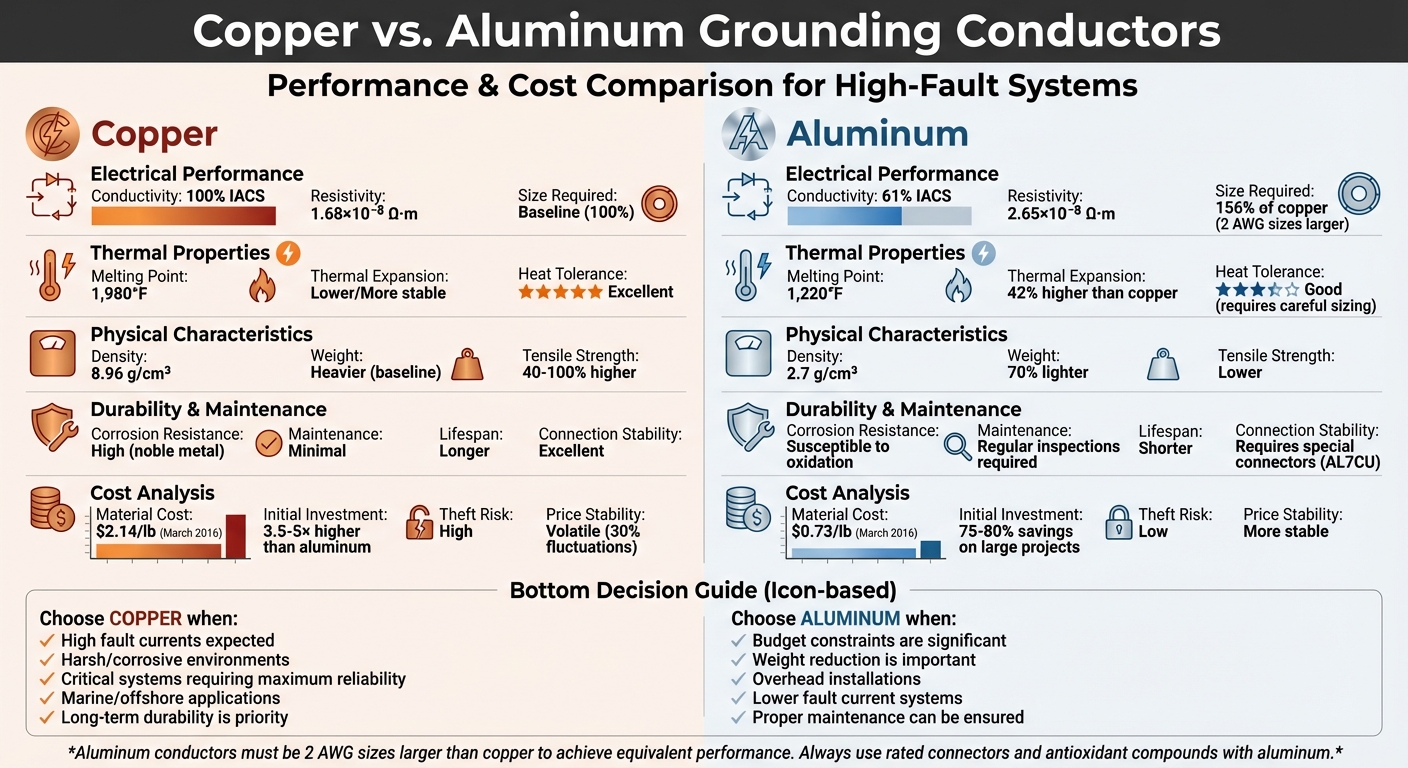
Copper vs Aluminum Grounding Conductors: Performance and Cost Comparison
NEC Equipment Grounding Conductors Aluminum vs Copper
sbb-itb-501186b
Quick Comparison
| Feature | Copper | Aluminum |
|---|---|---|
| Conductivity | 100% IACS | ~61% IACS |
| Melting Point | 1,980°F | 1,220°F |
| Weight | Heavier | ~70% lighter |
| Corrosion Resistance | High | Requires treatment |
| Cost | 3.5–5x higher | Lower |
| Maintenance | Minimal | More frequent |
Key Insight: Copper excels in high-stress, fault-prone systems, while aluminum is ideal for cost-effective, low-maintenance installations with proper precautions.
Copper Grounding Conductors: Properties and Performance
Copper stands out as the global standard for grounding conductors. Commercial annealed copper achieves 100% IACS (International Annealed Copper Standard) conductivity, which directly translates into lower ground impedance, minimized ground potential rise (GPR), and safer touch and step voltages during electrical faults.
Its natural properties make it ideal for high-fault environments. When exposed to air, copper forms a dense layer of copper oxide, which serves as a protective barrier against further corrosion. Additionally, its high tensile strength and 42% lower thermal expansion compared to aluminum help maintain secure connections over time, even under extreme conditions.
Benefits of Copper in High-Fault Systems
One of copper's standout features is its melting point of 1,980°F, which gives it a clear edge in handling intense heat during electrical faults or lightning strikes. Stephen Oaks, B.S., MBA, highlights this advantage:
Aluminum's melting point is 1,220 degrees Fahrenheit, while copper's is 1,980 and steel's is 2,500. In most power-conducting circuits, aluminum is electrically sufficient, but it does not handle the heat typically created by fault currents or lightning.
This high heat tolerance ensures copper maintains its structural integrity under extreme conditions. Copper also excels in providing reliable connections. Mechanical connectors using copper consistently pass thermal cycling tests (IEC 61238-1), a benchmark that aluminum connections often fail.
Copper's resistance to corrosion is another major benefit. As a noble metal, copper is highly resistant to corrosion in most soil environments. The Copper Development Association underscores this point:
Copper is the preferred metal for grounding conductors and electrodes. This is not only due to its high degree of connectivity, but also its corrosion resistance.
However, in environments where soil pH exceeds 8 or where organic acids are present, tinned copper or bentonite backfill is recommended to extend its lifespan. For marine and offshore applications, copper’s natural resistance to harsh conditions makes it the go-to choice.
Drawbacks of Copper
Despite its many advantages, copper does have its downsides. The most notable challenge is cost. As a commodity traded on global markets, copper prices can fluctuate significantly, sometimes spiking up to 30% above industrial rates. For instance, in October 2021, copper reached a high of $4.73 per pound, making it a far more expensive option compared to aluminum. This price volatility can complicate long-term project budgets.
Copper's high market value also makes it a target for theft. In utility installations that are easily accessible, copper grounding conductors are often stolen, prompting the use of copper-clad steel as a theft-resistant alternative that still delivers strong performance. Additionally, copper's 50% greater weight compared to aluminum adds to labor and support requirements during installation.
There’s also an environmental aspect to consider: bare copper runoff can corrode galvanized steel structures. According to IEC 61024-1-2, installing bare copper above galvanized steel towers should be avoided. Using tinned copper conductors can help mitigate this risk.
Aluminum Grounding Conductors: Properties and Performance
Aluminum offers a lightweight and cost-effective alternative to copper, particularly in modern electrical systems. Today’s systems often rely on AA-8000 series aluminum alloys, which are designed to deliver better creep resistance, strength, and workability compared to earlier options. These advancements have made aluminum a practical choice for many high-fault installations.
In terms of conductivity, aluminum provides about 61% of what copper offers. To achieve comparable resistance, an aluminum conductor must be two AWG sizes larger than its copper counterpart. For instance, where an 8 AWG copper conductor suffices for a 60-amp circuit at 75°C, a 6 AWG aluminum conductor would be needed for similar performance. Despite this size difference, aluminum is significantly lighter - only about 30% to 50% of the weight of an equivalent copper conductor. This makes it easier to handle, bend, and install, especially in tight spaces.
The lighter weight of aluminum translates into reduced labor costs and less demanding structural requirements. These benefits are especially valuable in overhead utility installations and large-scale commercial projects. Additionally, aluminum’s lower market value reduces the risk of theft. As the third most abundant material on Earth - compared to copper, which ranks 26th - aluminum also offers more stable pricing and greater availability. Below, we’ll explore aluminum’s advantages and limitations in high-fault environments.
Benefits of Aluminum in High-Fault Systems
One of aluminum’s biggest advantages is its ability to significantly cut costs. Brent Kooiman, Senior Project Engineer at Interstates, highlights this point:
One can expect to spend approximately 3.5 to 5 times more on copper wire than aluminum wire. It's no wonder that more engineers are examining the possibilities and functionality of aluminum wiring.
In fact, aluminum can reduce material costs by as much as 80%. These savings are most noticeable in larger cable sizes - 1/0 AWG or larger - used for applications like service entrance conductors, transformer-to-switchboard feeders, or runs between switchboards and motor control centers.
Aluminum’s low weight also simplifies installation, requiring less labor and support infrastructure. It performs especially well in utility overhead power distribution, high-voltage transmission lines, and weight-sensitive projects like high-rise buildings and industrial facilities.
Drawbacks of Aluminum
Despite its advantages, aluminum does come with some challenges. In high-fault current systems, where extreme temperatures are a concern, aluminum’s lower melting point (1,220°F) can pose risks. Copper, by comparison, has a melting point of 1,980°F. During electrical faults, which can cause rapid temperature spikes within milliseconds, aluminum conductors must be carefully sized to prevent fusing. This is particularly important in systems prone to lightning strikes or severe fault currents.
Connection reliability is another critical factor. Aluminum forms a non-conductive oxide layer on exposed surfaces, which can lead to high-resistance connections and localized overheating if not properly addressed. To mitigate this issue, AL7CU-rated connectors and antioxidant compounds are essential to maintain connection integrity. The National Electrical Code also requires the use of AA-8000 series electrical-grade alloy for aluminum conductors to ensure safety and reliability.
Additionally, aluminum has about half the tensile strength of copper. This makes it more vulnerable to damage when subjected to heavy pulling forces or repeated mechanical stress. Combined with the need for larger conductor sizes, these factors can create space constraints in conduits and enclosures. Furthermore, aluminum connections often demand more rigorous maintenance, as bolted connections are more prone to oxidation and loosening over time.
Copper vs. Aluminum: Side-by-Side Comparison
Let’s break down how copper and aluminum stack up against each other in key performance areas. Both materials have their strengths, but a direct comparison highlights where each shines - and where trade-offs come into play.
Conductivity
Copper sets the benchmark with a conductivity rating of 100% IACS (International Annealed Copper Standard) and a resistivity of about 1.68×10⁻⁸ Ω·m at 20°C. Aluminum, on the other hand, achieves roughly 61% of copper’s conductivity, with a higher resistivity of 2.65×10⁻⁸ Ω·m. To match copper’s ampacity, aluminum conductors need about 56% more cross-sectional area.
Thermal Performance
Thermal performance becomes critical during fault conditions. Copper boasts a melting point of 1,980°F, significantly higher than aluminum's 1,220°F. According to Stephen Oaks, a Subject Matter Expert at Pacific Management Partners Ltd.:
Aluminum's melting point is 1,220 degrees Fahrenheit, while copper's is 1,980... aluminum is electrically adequate under normal conditions, but it does not handle the heat typically created by fault currents or lightning.
This 760°F difference is crucial because fault events can cause extreme temperature surges in milliseconds. Moreover, aluminum’s higher thermal expansion can lead to loose connections during rapid temperature changes, a factor to keep in mind for installations.
Weight and Mechanical Strength
Aluminum’s density is 2.7 g/cm³ compared to copper's 8.96 g/cm³, making it about 70% lighter. This weight advantage is particularly useful for overhead installations or projects with strict weight limits. However, copper’s tensile strength is 40–100% higher than aluminum’s, giving it an edge in withstanding mechanical stress during installation and operation.
Performance and Cost Comparison Table
| Property | Copper | Aluminum |
|---|---|---|
| Electrical Conductivity (IACS) | 100% | ~61% |
| Resistivity | 1.68×10⁻⁸ Ω·m | 2.65×10⁻⁸ Ω·m |
| Melting Point | 1,980°F | 1,220°F |
| Density (Weight) | 8.96 g/cm³ | 2.7 g/cm³ |
| Tensile Strength | 40–100% higher | Lower |
| Size for Equal Ampacity | Baseline (100%) | ~156% of copper |
| Thermal Expansion | Lower, more stable | ~42% higher |
| Corrosion Resistance | High (noble metal) | Susceptible to oxidation |
| Maintenance Requirements | Minimal | Requires regular inspections |
| Material Cost (March 2016) | ~$2.14/lb | ~$0.73/lb |
This comparison table lays out the critical differences, helping to guide material selection for high-performance or fault-prone applications.
Cost Considerations
Price is a major factor, but it’s not just about the sticker cost. As of March 2016, copper was around $2.14 per pound, while aluminum came in at $0.73 per pound. However, aluminum’s larger size requirements mean bigger conduits and raceways, which can drive up secondary costs. In large-scale industrial projects, the cost difference between copper and aluminum feeders has been reported to range from $120,000 to $150,000. While aluminum offers lower upfront costs, copper’s durability and reduced maintenance needs may justify its higher initial price over the long term.
Cost and Availability
Price Comparison
Copper and aluminum differ significantly in cost, with copper typically priced 3.5 to 5 times higher than aluminum wire. For example, in Q1 2021, copper was priced at $8,477 per ton, while aluminum was far lower at $2,091 per ton. Over the course of the year, electric copper wire prices soared by more than 120% between January 2021 and January 2022, whereas aluminum prices saw a more modest increase of 24% during the same period.
When looking at specific installations, the cost savings become even more apparent. For a 200A service entrance, using 250 MCM aluminum in a 2″ conduit is significantly cheaper than opting for 3/0 copper with a 1-1/2″ conduit. In large-scale projects, especially for conductors sized 1/0 AWG or larger, switching to aluminum can reduce material costs by 75% to 80%.
These price disparities not only influence budget decisions but also shape market trends and material preferences.
Supply and Market Factors
Price isn't the only factor to consider - market dynamics also heavily influence material selection. Copper's status as a globally traded commodity subjects it to frequent price swings. Stephen Oaks, a Subject Matter Expert at Pacific Management Partners Ltd., explains:
Starting in 2004, the price of copper began to increase, making it a precious, street-tradeable commodity.
This trading activity can inflate copper's price by as much as 30% beyond its industrial value. Copper's high value has also made it a frequent target for theft, particularly from utility structures and construction sites.
On the other hand, aluminum offers greater stability. As the third most abundant material on Earth (compared to copper, which ranks 26th), aluminum experiences relatively steady pricing with minimal fluctuations. This abundance ensures better availability for large-scale projects and allows for more predictable procurement planning. Additionally, aluminum's lighter weight - just 30% that of copper - reduces shipping costs and simplifies logistics. However, contractors must account for the added expense of using larger conduits to match the ampacity of copper.
Long-Term Performance and Maintenance
Performance in Different Environments
Copper stands out for its ability to resist corrosion. As Leonardo Energy notes, "Corrosion is not an issue for copper. It is resistant to most organic chemicals and can operate indefinitely in most industrial environments". A stable patina forms on its surface due to oxidation, and because copper doesn’t react with water, it handles exposure to moisture without any trouble.
Aluminum, however, faces more environmental challenges. When exposed to oxygen, it develops a thin aluminum oxide layer (Al₂O₃). While this layer offers some protection, it can create insulating issues at connection points. This becomes especially problematic in high-fault systems where increased resistance at connections leads to higher temperatures and further degradation. Aluminum also reacts with water, producing hydrogen gas, which can damage insulation and potentially cause system failures.
Copper generally performs well in most soil types, though environments with a pH above 8 can cause corrosion. Aluminum, on the other hand, is not suitable for environments with a pH greater than 9 - such as alkaline soils or direct contact with concrete - since these conditions can dissolve its protective oxide layer. In marine or offshore settings, copper is the better choice because it resists the salty atmospheres that can lead to localized pitting on bare aluminum surfaces.
Another drawback of aluminum is its higher thermal expansion. It expands about 42% more than copper under similar conditions, which can loosen joints over time and increase oxidation. Additionally, when aluminum and copper are connected in conductive environments, galvanic corrosion can occur. To prevent this, bimetal cable lugs are recommended as a transition device.
These environmental factors significantly influence the long-term performance and maintenance requirements of both materials.
Expected Lifespan and Maintenance Needs
Long-term performance is another area where copper and aluminum differ significantly, beyond their initial cost.
Copper’s resistance to corrosion means maintenance is limited to occasional visual inspections and resistance testing. If the resistance between the conductor and the ground plane exceeds 10 ohms, the conductor should be replaced. Nexans highlights this advantage: "Because the semi precious copper is much more resistant to oxidation and corrosion, this material has a longer lifespan than aluminium". Copper also has a fatigue limit that’s about 1.6 times greater than aluminum's, making it more durable in systems exposed to mechanical stress or vibration.
Aluminum, in contrast, requires more frequent monitoring, especially at connection points. Its higher thermal expansion can cause "creep", where connections gradually loosen and resistance increases. This sensitivity to temperature makes aluminum particularly vulnerable during fault events. To mitigate oxidation, antioxidant coatings should be applied to aluminum connections during installation. After high-fault or lightning events, aluminum conductors must be carefully inspected, as their lower melting point (1,220°F compared to copper’s 1,980°F) makes them more prone to internal damage or fusing.
When considering life cycle costs, copper often offsets its higher upfront price with reduced maintenance needs and a longer lifespan. Aluminum’s lower initial cost can be deceptive, as maintenance expenses and shorter service life often even out the overall costs between the two materials. For aluminum installations, it’s critical to remove the oxide layer and apply an oxide-inhibiting compound to maintain contact integrity over time. Additionally, avoiding direct contact between aluminum and concrete or highly alkaline soils is essential to prevent rapid corrosion.
These maintenance considerations are essential for ensuring reliable performance, particularly in extreme fault conditions.
Choosing the Right Material for Your System
Selection Guidelines
Deciding between copper and aluminum for your system hinges on three key factors: fault current characteristics, environmental conditions, and budget limitations.
Before burying conductors directly in the ground, conduct a soil analysis to check pH levels and chemical composition. If the soil's pH exceeds 8 or contains high levels of organic acids, protect copper conductors with appropriate backfill materials like bentonite. This step ensures the longevity and performance of the system.
Thermal management is another critical consideration, particularly in systems with high fault currents. Aluminum, with its lower melting point, requires extra care in such scenarios. Stephen Oaks from Pacific Management Partners highlights this difference:
Aluminum's melting point is 1,220 degrees Fahrenheit, while copper's is 1,980... in most power-conducting circuits, aluminum is electrically sufficient, but it does not handle the heat typically created by fault currents or lightning.
To ensure aluminum conductors can handle faults effectively, size them to clear faults within 500 milliseconds without melting. Keep in mind, aluminum conductors need to be two AWG sizes larger than copper to achieve the same electrical resistance.
Compatibility with connectors is equally important when working with aluminum. Always use connectors rated AL7CU or AL9CU for aluminum-to-copper transitions and confirm they are suitable for your system’s operating temperature, typically around 75°C. For outdoor installations, especially those involving galvanized steel structures in salty or moist environments, opt for tinned copper to avoid corrosive runoff that could damage the steel.
In regions where metal theft is a concern, copper systems may pose a higher risk. For example, when copper prices reached $4.73 per pound in October 2021, theft incidents surged. This risk makes alternatives like copper-clad steel worth considering. Also, avoid using carbon-based backfills with copper, as sulfur and other contaminants can degrade the metal.
Where to Source Grounding Materials
Once you've identified the best material for your system, the next step is finding reliable suppliers. Electrical Trader (https://electricaltrader.com) serves as a one-stop marketplace for both new and used electrical components, including copper and aluminum grounding conductors. The platform offers a range of conductor sizes and configurations, making it easy to compare options based on your budget and technical needs. Whether you're looking for standard copper conductors for high-fault systems or larger aluminum alternatives for cost-sensitive projects, this centralized resource simplifies procurement and ensures you get materials that meet both performance and financial requirements.
Conclusion
Choosing the right grounding material for high-fault systems is all about finding the balance between performance and practical considerations. Copper stands out for its 100% IACS conductivity, a high melting point of 1,980°F, and excellent resistance to corrosion. On the other hand, aluminum offers 61% conductivity, is 70% lighter, and provides a more cost-effective alternative. As discussed, effective grounding depends on safely handling fault currents while keeping an eye on both cost and durability.
The differences between these materials also show up in how they perform under real-world conditions and their maintenance needs. Aluminum conductors typically need to be larger to match copper's resistance, and fault conditions must clear within roughly 500 milliseconds to prevent damage.
Environmental factors like soil pH and exposure to corrosive elements play a big role in material selection. Copper is better suited for harsher conditions, while aluminum requires specialized connectors and treatments. For example, in soils with a pH higher than 8 or high organic acid levels, copper may need protective backfill materials like bentonite. In coastal or industrial areas where galvanized steel is common, tinned copper can help reduce corrosive runoff.
Economic factors also weigh heavily in this decision. Copper prices can fluctuate, while aluminum tends to offer more stable costs. Aluminum’s lighter weight can save on shipping, but its larger conductor sizes may increase conduit and labor expenses during installation.
Ultimately, the best grounding material depends on your specific system needs - fault current levels, soil conditions, thermal requirements, and budget constraints. Instead of looking for a one-size-fits-all solution, focus on selecting the material that aligns with your installation’s unique demands and operating environment.
FAQs
What should I consider when deciding between copper and aluminum for grounding high-fault current systems?
When deciding between copper and aluminum for grounding in high-fault current systems, it's essential to weigh electrical performance, durability, and cost to determine the right material for your needs.
Copper stands out for its exceptional conductivity, which ensures rapid fault clearing and efficient heat management during high-energy surges. Its durability is another major advantage - copper resists corrosion and handles mechanical stress well, making it a reliable choice even in challenging environments. On the other hand, aluminum, while less conductive and more susceptible to expansion and contraction, offers a lightweight and more budget-friendly alternative. This makes it appealing for projects where cost and ease of installation are key considerations.
In summary, copper is the go-to choice for critical systems demanding top-tier performance and reliability, whereas aluminum can work for budget-sensitive projects, provided its limitations are addressed through proper installation and upkeep.
What are the differences in conductivity and heat performance between copper and aluminum for electrical grounding?
Copper is often the go-to material for electrical grounding, and for good reason. Its exceptional conductivity and heat management capabilities set it apart from aluminum. To put it in perspective, copper boasts a conductivity rating of 100% IACS (International Annealed Copper Standard), while aluminum lags behind at about 61%. This means aluminum has roughly 1.6 times the resistance of copper, which can lead to greater heat buildup during fault conditions.
On top of that, copper’s superior thermal conductivity enables it to disperse heat more effectively. This helps keep temperature increases in check, safeguarding the integrity of the grounding system. These attributes make copper a more dependable choice for systems that handle high fault currents, offering better performance, reduced energy loss, and enhanced longevity.
What are the maintenance differences between copper and aluminum grounding conductors?
Copper grounding conductors are known for their durability and strong resistance to corrosion, even in challenging soil conditions. They usually require little maintenance beyond the occasional visual inspection. For soils that are especially corrosive, applying a tin coating can help extend their lifespan. Even without treatment, copper can endure for decades with minimal degradation.
On the other hand, aluminum grounding conductors are lighter and more budget-friendly but come with some trade-offs. They are more prone to corrosion and oxidation, which means they often need additional care, like applying anti-oxidant compounds, performing torque checks, or adding protective coatings. Aluminum also has a lower conductivity, requiring larger diameters to perform effectively. Its lower melting point makes it less resilient under high-fault currents, demanding more frequent inspections to maintain reliability.