How BMS Design Varies by Battery Chemistry
Battery Management Systems (BMS) are tailored to the specific needs of different battery chemistries. Here's the key takeaway: choosing the right BMS is crucial for safety, performance, and battery lifespan. Different battery types - lithium-ion, lead-acid, and NiMH - require unique designs due to their distinct characteristics.
Key Points:
- Lithium-Ion Batteries: Require precise monitoring to avoid thermal runaway. Advanced BMS features include high-resolution sensors, cell balancing, and thermal management.
- Lead-Acid Batteries: Focus on preventive care, such as avoiding sulfation and managing temperature. Often, a BMS is optional.
- NiMH Batteries: Use simpler monitoring systems that rely on temperature and voltage changes to manage charging and discharging.
Quick Comparison:
| Battery Type | Complexity of BMS | Key Focus Areas | Common Applications |
|---|---|---|---|
| Lithium-Ion (NMC/LFP) | High | Safety, balancing, thermal | EVs, portable electronics |
| Lead-Acid | Low | Prevent sulfation, temperature | Backup power, automotive |
| NiMH | Moderate | Temperature, overcharging | Consumer electronics, hybrids |
Each chemistry has unique demands, and the right BMS ensures optimal performance and safety. Let’s dive into the details.
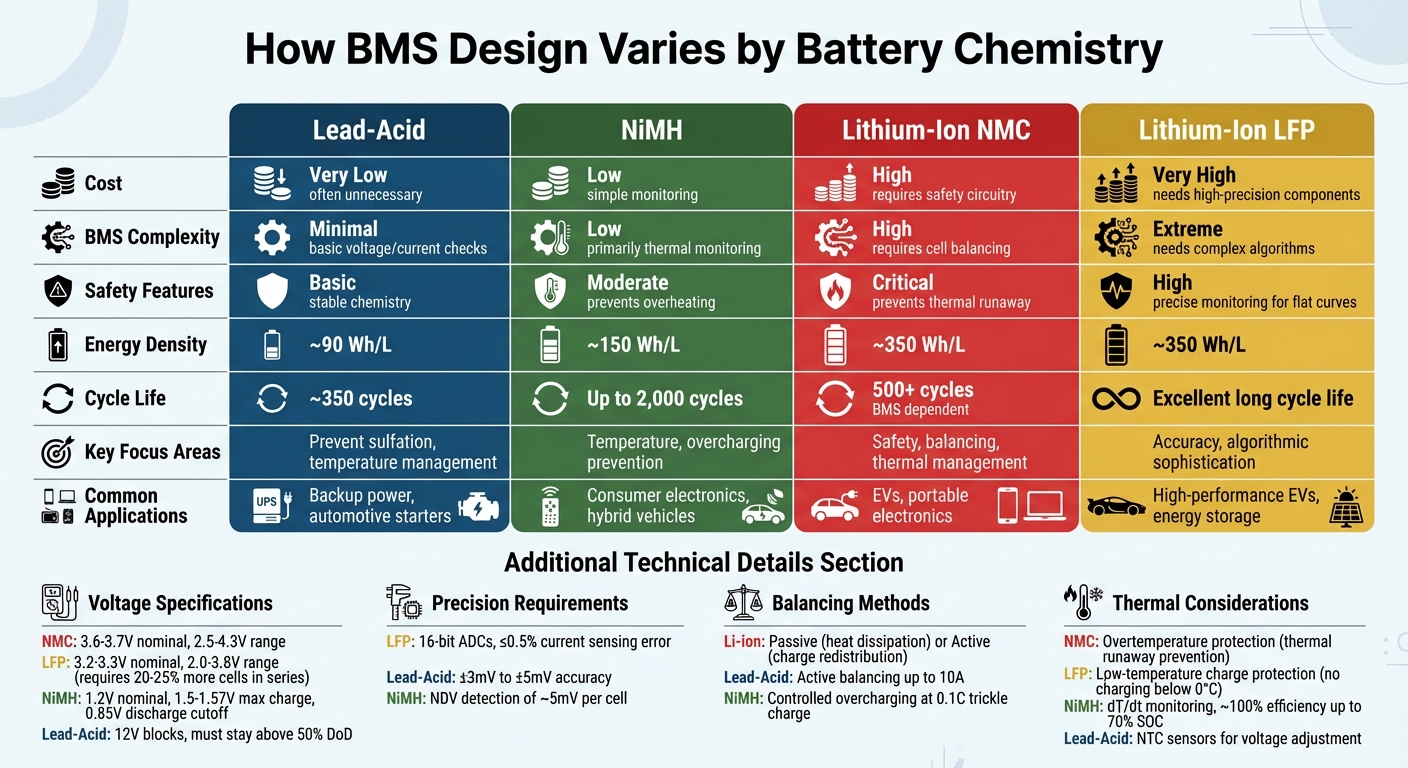
BMS Design Requirements Comparison Across Battery Chemistries
What Battery (Cell) Do I Need? | BMS Design Series Part 02 | Battery Managment System
sbb-itb-501186b
1. Lithium-Ion Batteries
Designing a Battery Management System (BMS) for lithium-ion batteries requires a specialized approach due to the unique demands of different lithium-ion chemistries. Among these, Nickel-Manganese-Cobalt (NMC) and Lithium Iron Phosphate (LFP) cells stand out for their distinct characteristics. NMC cells typically operate at a nominal voltage of 3.6V to 3.7V, while LFP cells function at a lower range of 3.2V to 3.3V. This voltage difference means that LFP systems need 20% to 25% more cells in series to match the pack voltage of NMC systems, which introduces additional complexity in wiring and monitoring.
Voltage Thresholds
Voltage monitoring requirements for lithium-ion batteries vary significantly depending on the chemistry. NMC batteries have a steeper voltage curve, simplifying state-of-charge (SOC) estimation. In contrast, LFP batteries maintain a nearly flat voltage between 20% and 80% SOC, making voltage-based estimation more challenging. For instance, a 5-mV error that might be manageable for NMC could obscure critical balancing in LFP systems. To address this, BMS designs for LFP often rely on high-precision sensing, such as 16-bit ADCs, within a narrower 2.0–3.8V range, compared to the broader 2.5V to 4.3V range used for general lithium-ion systems. Additionally, current sensing must achieve a full-scale error of ≤0.5% to enable accurate coulomb counting.
Balancing Methods
Lithium-ion batteries utilize either passive balancing, which dissipates excess charge as heat, or active balancing, which redistributes charge between cells. Modern BMS chips like the Qorvo PAC22140 incorporate advanced balancing technologies for packs with 10 to 20 cells in series. For LFP batteries, traditional voltage-based balancing at the top of the charge cycle is less effective due to their flat voltage profile. Instead, balancing should be based on SOC or capacity and performed during mid-SOC rest periods. The extended cycle life of LFP batteries has also made active balancing methods, such as capacitive or inductive systems, more appealing from an economic standpoint.
Thermal Management
Temperature management is another area where lithium-ion chemistries diverge. NMC cells require stringent overtemperature protection to avoid thermal runaway, while LFP cells prioritize low-temperature charge protection. Charging lithium-ion batteries at temperatures below 0°C (32°F) can lead to lithium plating, which increases impedance and causes permanent damage to the cells. As Sophia Du, Sales Manager at Batterea, explains:
"Lithium-ion batteries are particularly susceptible to temperature fluctuations. Engineers must implement robust thermal management systems to prevent issues such as thermal runaway, which can lead to catastrophic failures".
For LFP batteries, BMS designs must include pre-heating mechanisms and temperature-dependent charge acceptance curves to safeguard against cold-weather charging damage. These strategies are essential to ensure the longevity and safety of lithium-ion systems.
State-of-Charge Estimation
The flat voltage profile of LFP batteries makes traditional voltage-based SOC estimation unreliable. As Alan Earls, Contributing Editor at Electronic Design, points out:
"LFP batteries reward engineers who design for accuracy, long-term observability, and algorithmic sophistication rather than brute-force voltage thresholds".
Modern BMS systems address this challenge by integrating coulomb counting with impedance-based methods to adjust for load changes. This shift moves away from basic hardware sensing to more advanced system-level algorithms, such as Kalman filters and observers, which are better suited to managing chemistries with flat voltage profiles.
Next, let’s explore how lead-acid battery characteristics shape BMS design.
2. Lead-Acid Batteries
Battery Management Systems (BMS) for lead-acid batteries operate quite differently compared to those designed for lithium-ion batteries. While lithium systems prioritize immediate safety to prevent catastrophic failures, lead-acid systems focus on preventive care. KuRui BMS captures this distinction perfectly:
"While a Lithium BMS acts as a 'guard dog' stopping dangerous conditions instantly, a lead-acid management system acts more like a 'doctor,' constantly maintaining equilibrium to prevent the silent killer: sulfation."
This difference in approach highlights the unique requirements of lead-acid batteries compared to higher-risk chemistries like lithium-ion.
Voltage Thresholds
For lead-acid batteries, the Low Voltage Disconnect (LVD) is the most critical parameter. These batteries need to stay above a 50% Depth of Discharge (DoD) to avoid sulfation and premature wear. In setups like 24V or 48V battery banks, individual 12V blocks can show variations (e.g., one block might read 14.4V while another is at 13.0V). To address this, high-precision circuits with accuracies of ±3mV to ±5mV are used to minimize false LVD triggers and optimize capacity.
Balancing Methods
Unlike lithium systems that often use passive balancing, lead-acid batteries rely on active balancing. This involves physically transferring energy from higher-voltage blocks to lower-voltage ones, with currents reaching up to 10A. Such balancing helps manage the voltage differences typical in lead-acid strings and can extend the lifespan of a battery bank by 2 to 3 years. When retrofitting a BMS, always connect the main negative (B-) first, followed by the balance wires, and finally the P- wire.
Thermal Management
Temperature management for lead-acid batteries focuses on adjusting charging voltages using NTC sensors to prevent overcharging. High temperatures can lead to issues like electrolyte evaporation and plate corrosion, especially during constant charging. While lead-acid batteries are generally chemically stable and unlikely to catch fire, thermal runaway can occur in sealed enclosures if heat isn’t properly dissipated. Active balancing, which generates less heat compared to passive methods, also helps keep thermal conditions under control.
State-of-Charge Estimation
Estimating the State-of-Charge (SOC) in lead-acid batteries is tricky due to their relatively flat voltage profile. The Open Circuit Voltage (OCV) method requires a resting period of 2–8+ hours, making it impractical for regular use. Coulomb counting is more feasible but needs periodic resets to 100% SOC for accuracy. As Anastasia Ponomareva from Integra Sources explains:
"Lead-acid batteries must be stored at full charge, otherwise, they would become sulfated and lose their capacity."
BMS systems monitor SOC primarily to prevent discharges below the critical 50% DoD threshold, which helps avoid irreversible sulfation damage.
3. NiMH Batteries
NiMH batteries use a Negative Delta V (NDV) signal - a slight voltage drop of about 5mV per cell - to indicate when they're fully charged. Detecting this small signal is challenging because it can easily get lost in the noise and fluctuations of the charger, requiring precise components and effective filtering to pick it out clearly. Below, we'll dive into the key aspects of NiMH batteries, including their voltage thresholds, balancing strategies, thermal considerations, and methods for estimating state of charge (SOC).
Voltage Thresholds
Charging NiMH batteries requires a multi-layered approach to termination logic. This includes NDV detection, monitoring of voltage plateaus, tracking temperature changes over time (dT/dt), setting absolute temperature limits, and using safety timers. The charging process stops as soon as any of these conditions are met. This is especially important for slower charge rates (below 0.5C), where NDV signals are even harder to detect.
- Nominal Voltage: 1.2V per cell
- Maximum Charge Voltage (MCV): 1.5V to 1.57V per cell
- Discharge Protection: Activates at 0.85V per cell to avoid permanent damage
Balancing Methods
Unlike lithium-ion systems, which use electronic circuits to balance cells, NiMH batteries rely on controlled overcharging at low currents. This involves applying a 0.1C trickle charge for about 30 minutes, which allows weaker cells to catch up while stronger cells dissipate excess energy as heat. To ensure optimal performance, high-quality NiMH packs are manufactured with cells matched to within ±2.5% capacity tolerance. Interestingly, NiMH cells can "adjust" to each other naturally after several charge/discharge cycles, gradually reducing performance differences over time.
Thermal Management
Temperature plays a critical role in NiMH battery performance. These batteries are highly efficient - close to 100% - up to about 70% SOC, but efficiency drops off as charging continues, leading to heat buildup. To manage this, the battery management system (BMS) must monitor temperature changes (dT/dt) to detect rapid spikes that signal a full charge. After charging, a trickle charge rate of about 0.05C is used to prevent overheating.
State-of-Charge Estimation
For NiMH batteries, SOC estimation relies more on temperature changes than voltage signals. At lower charge rates (0.1C–0.3C), the voltage and temperature profiles are less distinct, making safety timers a critical tool for charge termination. A great example of this in action is the Toyota Prius (Models II and III), which uses a NiMH battery pack comprising 28 modules with 6 cells each, for a total nominal voltage of 201.6V. The system is designed to carefully monitor charging and discharging to extend the battery's lifespan. By using only a portion of the pack's capacity, it supports the vehicle's demanding recharge cycle needs.
Advantages and Disadvantages
Each type of battery chemistry comes with its own set of strengths and weaknesses, which directly influence the level of sophistication required for its Battery Management System (BMS). Understanding these trade-offs is crucial for selecting the right system for your specific needs. Here's a closer look at how the characteristics of different battery types impact their BMS design and requirements.
Lithium-ion batteries deliver an impressive energy density of about 350 Wh/L. However, this high performance comes at a cost - both financially and in terms of design complexity. A BMS is absolutely essential for lithium-ion systems to manage risks like thermal runaway, combustion, or even explosions. These systems demand advanced hardware, such as high-resolution ADCs (16-bit preferred), precise current sensing with an error margin of ≤0.5%, and sophisticated algorithms to estimate the state of charge.
Lead-acid batteries, on the other hand, are much simpler. With an energy density of roughly 90 Wh/L, they are heavier and bulkier, but they require minimal BMS involvement - often none at all in standard applications. This simplicity makes them highly cost-effective and ideal for uses like stationary backup power or automotive starting systems, where weight isn't a critical factor.
NiMH batteries strike a middle ground with an energy density of about 150 Wh/L. While they can often be charged and discharged without a dedicated BMS, thermal monitoring is advisable to avoid issues like plate corrosion at high temperatures. This keeps their overall system complexity relatively low.
Lithium Iron Phosphate (LFP) batteries stand out as a unique case. Although they fall under the lithium-ion umbrella, their flat voltage curve and the need for 20% to 25% more cells in series to match the voltage of NMC batteries add significant complexity to their BMS design. Alan Earls, a Contributing Editor at Electronic Design, highlights this challenge:
"LFP batteries reward engineers who design for accuracy, long-term observability, and algorithmic sophistication rather than brute-force voltage thresholds."
Below is a table summarizing the key differences in cost, complexity, safety features, energy density, and cycle life across these battery chemistries:
| Feature | Lead-Acid BMS | NiMH BMS | Lithium-Ion (NMC) BMS | Lithium-Ion (LFP) BMS |
|---|---|---|---|---|
| Cost | Very Low; often unnecessary | Low; simple monitoring | High; requires safety circuitry | Very High; needs high-precision components |
| Complexity | Minimal; basic voltage/current checks | Low; primarily thermal monitoring | High; requires cell balancing | Extreme; needs complex algorithms |
| Safety Features | Basic; stable chemistry | Moderate; helps prevent overheating | Critical; prevents thermal runaway | High; precise monitoring needed for flat curves |
| Energy Density | ~90 Wh/L | ~150 Wh/L | ~350 Wh/L | ~350 Wh/L |
| Cycle Life | ~350 cycles | Up to 2,000 cycles (NiCad) | 500+ cycles (BMS dependent) | Excellent; long cycle life |
These comparisons highlight the importance of selecting a BMS that aligns with both the performance requirements and safety considerations of your application.
Conclusion
Lithium-ion, lead-acid, and NiMH batteries each come with their own management needs, making it crucial to match the right Battery Management System (BMS) to the specific battery chemistry and application. For lithium-ion batteries, an advanced BMS is essential to prevent issues like thermal runaway and to maximize their cycle life. Without proper management, the lifespan of lithium-ion batteries can be drastically shortened. Lead-acid batteries, on the other hand, often function without a BMS unless fast charging is involved, while NiMH batteries typically require minimal monitoring, especially in consumer electronics.
Cost considerations also play a major role in choosing the right system. Lead-acid and NiMH batteries are great options for projects where budget constraints are key, such as backup power systems or automotive starters, where weight isn’t a primary concern. However, for high-performance applications like electric vehicles or portable devices, lithium-ion batteries are the preferred choice. Keep in mind, though, that they demand significant investment in BMS development, safety measures, and testing.
When designing custom battery packs, using reliable components is critical. Platforms like Electrical Trader provide a wide selection of BMS components, sensors, and other parts to ensure safe battery system integration. Whether you need basic monitoring for lead-acid systems or advanced features like cell balancing for lithium-ion packs, sourcing both new and used components can help you meet safety requirements without breaking the bank. Check out Electrical Trader for dependable options.
Ultimately, your decision should align with your specific needs. If high energy density and advanced monitoring capabilities are priorities, lithium-ion with a robust BMS is the way to go. For applications where simplicity and cost are more important, lead-acid batteries are a solid choice. And for moderate performance requirements in consumer electronics, NiMH strikes a practical balance.
FAQs
How do I choose the right BMS for my battery chemistry?
Choosing the right Battery Management System (BMS) hinges on your battery's chemistry - whether it's lithium-ion, lead-acid, or NiMH - because each type comes with specific needs. For example, lithium-ion batteries often demand advanced features like cell balancing and thermal protection. On the other hand, lead-acid batteries prioritize voltage regulation, while NiMH batteries benefit from over-discharge prevention and temperature monitoring. To ensure your battery performs well and lasts longer, consider its capacity, cycle life, and safety requirements when selecting a compatible BMS.
Why does LFP need a more precise BMS than NMC?
LFP (lithium iron phosphate) batteries need a highly accurate battery management system (BMS) because of their lower full charge voltage - about 3.7V - and their tighter voltage range. This precision is essential for monitoring and balancing the cells, ensuring safety, and maintaining peak performance. Without proper management, overcharging or undercharging could harm the battery's efficiency and shorten its lifespan.
When is a BMS optional for lead-acid or NiMH packs?
A Battery Management System (BMS) is usually considered optional for lead-acid and NiMH battery packs in low-risk, small-scale, or stationary setups where safety and monitoring aren't as crucial. That said, incorporating a BMS is generally a smart choice, as it can improve safety, boost performance, and help prolong the battery's life.