How BMS Improves Energy Storage Efficiency
Battery Management Systems (BMS) are the backbone of modern energy storage, ensuring safety, efficiency, and longevity in battery systems. They monitor critical metrics like voltage, current, and temperature to prevent risks like overcharging, overdischarging, and thermal runaway. By actively managing battery performance, BMS technology extends lifespan by up to 60% and improves energy efficiency through precise cell balancing and predictive algorithms. Here's why BMS matters:
- Prevents Damage: Avoids overcharging, overdischarging, and overheating, reducing risks of fires or explosions.
- Extends Battery Life: Balances cell performance and maintains optimal operating conditions, ensuring consistent energy output.
- Improves Accuracy: Reduces errors in energy level (SoC) estimates by over 15% using advanced algorithms.
- Lowers Costs: Minimizes maintenance and replacement expenses with remote diagnostics and proactive management.
Whether for renewable energy systems, EVs, or microgrids, a well-implemented BMS is key to reliable and cost-effective energy storage.
Common Energy Storage System Challenges
Intermittency and Energy Waste
Renewable energy sources like solar and wind come with a major hurdle: their output is inconsistent. Solar panels only generate electricity when the sun is shining, and wind turbines rely on ever-changing wind speeds. This unpredictability makes efficient energy storage a tough nut to crack.
These fluctuations can wreak havoc on storage systems. Overcharging from voltage surges and overdischarging during low output periods both take a toll on battery cells. Not only does this speed up aging, but it also disrupts load shifting during peak demand. Addressing these risks is critical to ensuring reliable energy storage.
Overcharging, Overdischarging, and Thermal Runaway
Overcharging batteries can lead to serious consequences. When a battery is exposed to excessive voltage, it swells, experiences internal stress, and suffers irreversible damage. This process often triggers thermal runaway - a dangerous, self-sustaining reaction where heat and pressure rapidly escalate.
On the other hand, overdischarging - dropping below 2 volts - can also cause major damage. It dissolves the copper in the anode, creating internal shorts, while the cathode releases oxygen, leading to permanent capacity loss.
Thermal runaway is especially alarming because, once it begins, it’s unstoppable. Anton Beck of Epec Tec highlights the danger:
"Once one battery in the pack experiences a thermal runaway, the next battery will start to experience thermal runaway as nothing can stop this effect until the battery ignites or explodes."
During thermal runaway, the electrolyte and metal oxide cathode degrade, releasing gases faster than safety vents can handle. Plastic battery casings, which soften around 200°F and melt above 300°F, only add to the risk of fires or explosions. Beyond the immediate safety hazards, these failures come with steep financial costs for energy systems.
Economic Challenges in Microgrid Operations
Inefficient battery management hits microgrid operators hard financially. Poorly managed systems often see battery lifespans shrink to just 3–5 years, compared to the 10–15 years that optimized systems can achieve. This premature wear forces operators to replace costly battery packs far more frequently.
For remote microgrids, these replacement costs - combined with power losses - drive up the Levelized Cost of Energy (LCOE). This undermines the financial appeal of renewable energy storage and makes it tougher to justify investments. When maintenance becomes reactive instead of proactive, operating expenses skyrocket, and system reliability takes a hit. Better battery oversight is essential to keeping these economic risks in check.
sbb-itb-501186b
How BMS Improves Energy Storage Efficiency
State-of-Charge (SoC) Monitoring and Cell Balancing
A Battery Management System (BMS) tackles the complex challenges of energy storage by carefully tracking the energy levels in each battery cell. Using methods like Coulomb counting and impedance measurements, it ensures accurate monitoring of remaining energy, which helps prevent overcharging and overdischarging - common problems in unmanaged systems.
As BSLBATT explains:
A battery management system acts as the brain of an energy storage setup. It constantly monitors voltage, current, and temperature to protect batteries from risks like overheating or capacity loss.
To address cell imbalances, the BMS employs cell balancing. This process ensures that all cells maintain equal charge levels, which maximizes the battery's usable capacity. There are two main approaches: passive balancing, which dissipates excess charge as heat, and active balancing, which redistributes energy between cells to improve efficiency and prolong battery life. Additionally, advanced techniques like LSTM-based deep learning can reduce errors in SoC estimation by over 15% compared to traditional methods.
Maintaining proper temperature and voltage is equally essential to achieving these performance benefits.
Temperature and Voltage Management
Alongside optimizing SoC, controlling temperature and voltage is crucial for preventing battery degradation. A BMS keeps batteries within a safe operating range of 15°C–35°C (59°F–95°F), minimizing wear and avoiding dangerous conditions like thermal runaway. When temperatures rise, the BMS works with cooling systems, which may use air circulation, liquid coolants, or even immersion cooling for larger setups.
Voltage management complements thermal regulation. The BMS halts charging if voltage exceeds safe limits and stops discharging if cells fall below critical thresholds. By ensuring voltage is evenly distributed across all cells, it prevents weaker cells from limiting the performance of the entire battery pack. This careful coordination allows the system to operate efficiently while avoiding capacity loss and safety risks associated with extreme conditions.
Predictive Algorithms for Charge and Discharge Optimization
Beyond monitoring and control, predictive algorithms bring an extra layer of efficiency to battery management. Advanced BMS units use these algorithms to anticipate issues before they occur. Machine learning models predict temperature fluctuations and load demands, enabling the system to adjust cooling mechanisms and charging cycles proactively. This capability is particularly helpful in managing the variability of renewable energy sources, which often leads to energy waste in systems without such intelligent oversight.
Technologies like neural networks and Kalman filters excel at managing the nonlinear behavior of batteries and adapting to changing environments. They are especially effective for lithium-iron-phosphate (LFP) batteries, which have flat voltage profiles that traditional monitoring struggles to handle. Modern BMS setups even integrate digital twins and deep learning to simulate battery performance in real-time, allowing for precise adjustments to charging profiles. Over-the-air (OTA) updates further enhance these systems, enabling ongoing improvements to predictive algorithms as the batteries age - without the need for hardware upgrades.
Why Is A BMS Crucial For Renewable Energy Batteries? | Electrical Engineering Essentials News
BMS vs. Non-BMS Systems: Performance Comparison
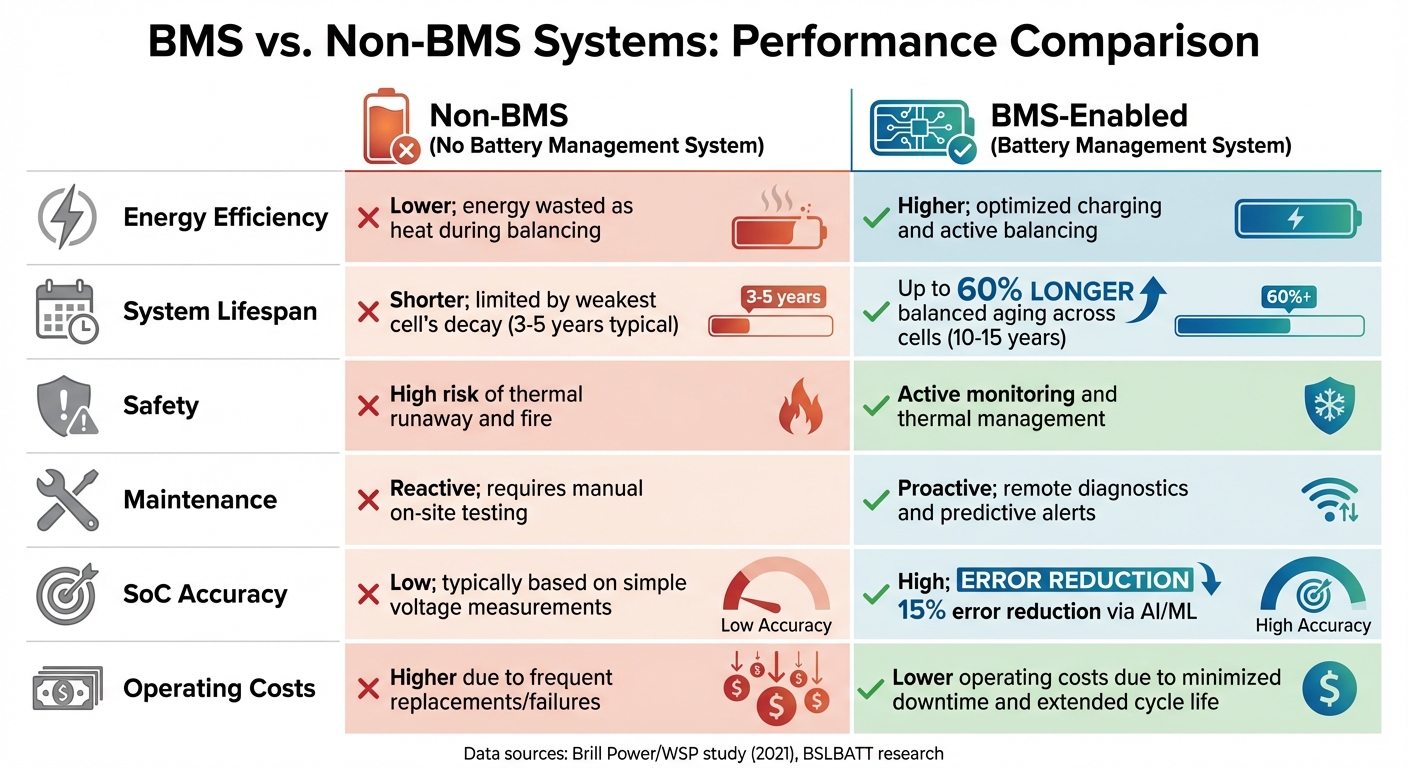
BMS vs Non-BMS Battery Systems Performance Comparison
Efficiency and Cost Savings
Systems equipped with a Battery Management System (BMS) are designed to run more efficiently and at lower costs compared to traditional, non-BMS setups. Non-BMS systems often waste energy by converting surplus charge into heat, leading to inefficiencies that add up over time. This not only increases electricity expenses but also impacts the overall return on investment.
A study conducted in December 2021 by Brill Power, a spin-out from Oxford University, along with engineering firm WSP, highlighted the benefits of their proprietary "complete current control" BMS technology. Their findings showed that this technology could extend battery lifespans by up to 60% by adjusting current based on the health of individual cells. This innovation reduces the total cost of ownership by enabling smaller battery sizes without sacrificing performance and eliminating the need for certain external components like DC/DC converters. Additionally, advanced BMS platforms optimize charging schedules and solar energy usage, directly improving the return on investment for both residential and commercial projects.
Another key advantage is the shift from reactive maintenance to proactive management. With remote diagnostics, BMS systems significantly lower operational costs by reducing the need for costly on-site service visits.
These cost-saving measures go hand-in-hand with improved system durability.
Reliability and System Lifespan
While cost savings are important, the longevity of a system is equally critical, and this is where BMS technology truly stands out. In non-BMS systems, the weakest cell in a battery series determines the overall energy output, power, and lifespan. As this weak cell degrades, it impacts the performance of the entire system, often leading to premature failure.
BMS-enabled systems address this issue by balancing cells to ensure they age evenly and by maintaining optimal operating temperatures between 15°C and 35°C (59°F to 95°F). By distributing loads based on cell health, BMS technology prevents early cell failures, ultimately extending battery performance. Moreover, modular BMS architectures allow for the replacement of individual units without shutting down the entire system, reducing downtime and ensuring reliable operation.
Comparison Table
| Performance Metric | Non-BMS / Traditional System | BMS-Enabled (Advanced) |
|---|---|---|
| Energy Efficiency | Lower; energy wasted as heat during balancing | Higher; optimized charging and active balancing |
| System Lifespan | Shorter; limited by the weakest cell's decay | Up to 60% longer; balanced aging across cells |
| Safety | High risk of thermal runaway and fire | Active monitoring and thermal management |
| Maintenance | Reactive; requires manual on-site testing | Proactive; remote diagnostics and predictive alerts |
| SoC Accuracy | Low; typically based on simple voltage measurements | High; over 15% error reduction via AI/ML |
| Operating Costs | Higher due to frequent replacements/failures | Lower operating costs due to minimized downtime and extended cycle life |
Implementing BMS in Energy Storage Projects
Steps for Selecting the Right BMS
Start by defining your system's requirements, beginning with the battery chemistry - whether you're working with LFP (Lithium Iron Phosphate) or NMC (Nickel Manganese Cobalt). This is critical because BMS algorithms are tailored to each chemistry's voltage profile. For instance, LFP cells typically operate with minimum voltages around 2.5V, while NMC cells can reach up to 4.3V at maximum. Your choice of balancing strategy should also align with the chemistry:
- Passive balancing uses resistors to dissipate excess charge as heat, making it a cost-effective option.
- Active balancing redistributes charge between cells with capacitors or inductors, improving efficiency and extending battery life.
In high-demand applications, using complete current control technology can significantly extend battery life - by as much as 60%.
Next, decide between a centralized BMS or a distributed BMS. Centralized systems are ideal for smaller setups due to their lower cost. On the other hand, distributed systems offer better scalability and fault tolerance, making them a smart choice if you plan to expand in the future. A distributed architecture allows you to add modules without complex rewiring.
Make sure the BMS you select supports standard communication protocols, such as CAN bus, RS485, or MODBUS, to ensure smooth integration with inverters, chargers, and energy management systems. Many modern BMS units are compatible with over 40 inverter communication protocols, including popular brands like Victron, Growatt, Studer, and Deye. Always check that your BMS is compatible with your specific inverter before purchasing.
Once your requirements are clear, you can proceed to source the necessary components.
Sourcing BMS Components from Electrical Trader

Electrical Trader offers a centralized marketplace for sourcing both new and used BMS components. You'll find everything you need for integration, including controllers, fuses, current sense resistors, temperature sensors, and communication modules.
Here’s a quick breakdown of key components:
- Controllers: Monitor cell performance and balance loads.
- Primary fuses: Protect the entire battery pack from overcurrent.
- Cell-level fuses: Isolate individual cells if an issue arises.
- Current sense resistors: Provide precise current measurements.
- Temperature sensors: Help prevent overheating.
- Communication modules: Enable data exchange via CAN, RS485, or MODBUS.
The platform's categorized listings make it easy to filter components by voltage and current ratings. For example, if you're working with a 4S lithium-ion pack rated for 16.8V and a maximum current of 40A, you can search specifically for products that meet these specifications.
Ensuring Compatibility with Existing Systems
Once you've selected a BMS, confirm that it integrates seamlessly with your existing setup. Check that the module includes clearly marked wiring points (e.g., 0V, 4.2V, 8.4V, 12.6V, 16.8V for a 4S configuration) and matches your battery pack's series (S) and parallel (P) setup. For example, a "4S" BMS is required for a four-cell series configuration.
Ensure the BMS provides essential protections, including overvoltage, undervoltage, short-circuit, and over-temperature safeguards. For advanced performance, opt for a microprocessor-based BMS. Unlike hardwired ICs, microprocessor-based systems can adapt to changes in cell characteristics over time using programmable models.
Finally, verify that your BMS complies with industry standards such as IEEE 2686-2024 (stationary storage best practices), UL 1973 (safety standards), IEC 62619 (industrial lithium batteries), and NFPA 855 (fire safety). These certifications are not just about safety - they're often required for system approval and insurance coverage. Make sure your thermal management system keeps the battery within the recommended range of 59°F to 95°F (15°C to 35°C).
Following these steps will help you maximize the efficiency and reliability of your energy storage project.
Conclusion
Main Takeaways
The steps outlined above demonstrate how Battery Management Systems (BMS) tackle key challenges in energy storage. By monitoring voltage, current, and temperature in real time, a BMS helps prevent dangerous situations like thermal runaway, overcharging, and premature capacity loss. This not only reduces the risk of fires but also improves overall safety and efficiency.
With advanced algorithms, BMS technology reduces State of Charge (SoC) estimation errors by over 15% and can extend battery life by up to 60%. It also lowers operational costs by minimizing downtime, optimizing charging cycles, and extending battery longevity. Features like cell balancing ensure that weaker cells don’t drag down the performance of the entire battery pack, while thermal management keeps temperatures in the ideal range of 15°C to 35°C (59°F to 95°F). Additionally, predictive algorithms can identify early warning signs, such as internal short circuits or self-discharge, allowing for proactive intervention.
Final Thoughts on BMS Adoption
Running energy storage systems without a BMS is a gamble that can lead to inefficiencies and safety risks. A well-implemented BMS provides centralized control, ensuring safety, reliability, and long-term performance - key benefits highlighted throughout this discussion.
If you’re considering implementing or upgrading your BMS, Electrical Trader offers a wide range of components, from controllers and fuses to temperature sensors and communication modules. Their organized listings make it easy to find the parts you need to meet your system’s specifications. By integrating proven BMS technology from Electrical Trader, you can achieve better performance and cost efficiency for years to come.
FAQs
What’s the difference between passive and active cell balancing?
The main distinction between passive and active cell balancing lies in how they handle the charge distribution among battery cells.
Passive balancing works by releasing excess energy from overcharged cells as heat through resistors. This method is straightforward and less expensive but comes with lower efficiency.
On the other hand, active balancing redistributes energy from higher-charged cells to those with lower charge using power circuits. This approach provides better accuracy, quicker balancing, and helps extend the battery's lifespan, though it involves higher complexity and cost.
How do I choose the right BMS for LFP vs NMC batteries?
Choosing the right Battery Management System (BMS) starts with understanding your battery's voltage and chemistry. For LFP (LiFePO4) batteries, the nominal voltage is typically 3.25V per cell, so you'll need a BMS designed for that specification. On the other hand, NMC batteries have a higher nominal voltage of 3.7V per cell, requiring a BMS tailored to handle that difference.
Make sure the BMS aligns with your battery’s voltage, current, and thermal requirements. This ensures both optimal performance and safety, protecting your battery system effectively.
Which BMS communication protocol do I need (CAN, RS485, MODBUS)?
The best BMS communication protocol depends on what your system needs. If you're handling real-time, safety-critical tasks and need low latency, CAN Bus is a solid option. For applications like data collection or building management, Modbus is a better fit. Meanwhile, RS-485 serves as a physical layer that supports protocols like Modbus and CAN. However, keep in mind that CAN support might be limited on Windows systems. Make your choice based on the specific demands of your application.