How to Choose a BMS for Renewable Systems
A Battery Management System (BMS) is essential for managing energy storage in renewable setups like solar and wind. It ensures safety, optimizes performance, and extends battery life by monitoring voltage, current, and temperature. Selecting the right BMS is critical to avoid risks like overcharging, thermal runaway, and compatibility issues with components like inverters.
Key Takeaways:
- Functions: Monitors cell voltage, manages thermal conditions, and balances cells for long-term performance.
- Compatibility: Must match your battery chemistry (e.g., LiFePO4, NMC) and system voltage (e.g., 12V, 48V).
- Safety Features: Includes overvoltage, undervoltage, and thermal protections, plus cold-charge prevention in freezing conditions.
- Architecture: Options include centralized (for small systems), modular (for scalability), and distributed (for large-scale setups).
- Integration: Supports communication protocols like CAN Bus and RS-485 for seamless connection with inverters and charge controllers.
- Cost vs. Longevity: High-quality BMS units reduce failures and extend battery life, saving money in the long run.
Choosing a BMS tailored to your system ensures reliable, efficient, and safe energy storage over time.
BMS (Battery Management System) Basics for LiFePO4 Batteries | Battery Basics Ep: 2/7
sbb-itb-501186b
Key Functions of a BMS
A Battery Management System (BMS) plays a vital role in monitoring and safeguarding battery packs. It keeps track of individual cell voltage, overall pack voltage, charging and discharging currents, and cell temperatures in real time. Using this data, it calculates the battery's State of Charge (SOC) and State of Health (SOH). In renewable energy setups, where power conditions can fluctuate, this precise monitoring ensures both reliability and safety.
"A Battery Management System (BMS) is an electronic controller found in nearly every advanced battery pack... it acts as the brain behind the battery." - Rahul Jalthar, CEO, SunLith
Protection is another critical function of a BMS. It prevents catastrophic failures through features like Overvoltage Protection (OVP), which stops charging when the maximum voltage is reached, and Undervoltage Protection (UVP), which disconnects loads to avoid deep discharge. Other safeguards include Short Circuit Protection (SCP), which cuts power almost instantly to prevent fires, and Overtemperature Protection (OTP), which halts operations if temperatures exceed safe limits. For lithium-ion batteries, cold-charge protection is especially crucial.
Monitoring and Protection Features
Modern BMS units constantly monitor each cell's voltage, identifying potential issues before a single weak cell can compromise the entire pack. Temperature sensors placed on the hottest cells provide critical thermal data, allowing the system to adjust charge and discharge currents as needed. To ensure uninterrupted operation, it's recommended to choose a BMS with 20–30% headroom above the continuous and peak current requirements, reducing the likelihood of nuisance trips.
Tailoring protection thresholds to the specific battery chemistry is equally important. For example, LiFePO₄ (LFP) batteries require different settings compared to NCM/NCA systems. When configured correctly, a BMS can extend the lifespan of LiFePO₄ batteries to over 5,000 cycles and more than 10 years of use. Beyond monitoring and protection, the system’s ability to manage cell balancing and thermal control is essential for long-term performance.
Cell Balancing and Thermal Management
To maintain uniform performance and extend battery life, a BMS also manages cell balancing and thermal regulation. Battery packs are only as reliable as their weakest cell, making cell balancing a key feature. Over time, even cells from the same batch can develop slight variations. Passive balancing, which uses resistors to dissipate excess energy, is a cost-effective solution for smaller packs. For larger, high-capacity systems, active balancing transfers energy between cells using capacitors or inductors. While more complex and expensive, active balancing delivers greater efficiency.
Thermal management works in tandem with cell balancing to ensure optimal operating conditions. Advanced BMS units integrate with cooling systems - such as forced air, liquid cooling, or passive heat pipes - to maintain temperatures between 59°F and 95°F. Straying outside this range can reduce performance in cold conditions or accelerate wear and safety risks in heat. For the most accurate thermal control, temperature sensors should be attached directly to the hottest cells, rather than relying solely on ambient readings.
"Pack longevity is limited by the weakest cell. The right BMS battery slows divergence through balancing and temperature control, protecting your investment over thousands of cycles." - EV Battery School
These combined features are essential for ensuring consistent and reliable performance, especially in renewable energy systems where efficiency and safety are paramount.
Checking Compatibility with Your Renewable Energy System
Ensuring your Battery Management System (BMS) aligns with your battery chemistry, voltage, and renewable energy components is crucial. A mismatch can lead to problems - nearly 40% of battery failures stem from compatibility issues. On the other hand, a well-matched BMS can extend battery life by up to 30%.
Matching Battery Type and Voltage Range
Your BMS must be tailored to your battery's chemistry. For example, Lithium Iron Phosphate (LFP) batteries demand specific voltage thresholds and charging profiles, which differ from those required by Nickel Manganese Cobalt (NMC) or NCA chemistries. Using the wrong BMS for your battery type can result in inaccurate State of Charge readings and even safety risks.
Another factor to consider is the series configuration your BMS supports. For instance, a 4S-24S BMS can handle systems ranging from 12V to 84V, making it suitable for a variety of residential setups. A 12V system typically uses a 4S configuration, while a 48V system requires a 16S configuration. Additionally, check if the BMS supports your system's specific series/parallel arrangement - some models can manage up to 20 batteries.
The continuous current rating is just as important as voltage compatibility. To avoid unnecessary shutdowns, select a BMS with a continuous current rating at least 20% higher than the peak output of your solar array.
| BMS Model Type | Voltage Compatibility | Typical Application | Key Features |
|---|---|---|---|
| SmallBMS | 12V, 24V, 48V | Small residential systems | On/off signals, pre-alarm |
| VE.Bus BMS V2 | 12V, 24V, 48V | Systems with inverter/chargers | VE.Bus communication, GX device support |
| Lynx Smart BMS | 12V, 24V, 48V | Large installations (homes, RVs) | Built-in 500A/1000A contactor, Bluetooth |
| Smart Active Balance BMS | 12V to 84V (4S-24S) | Versatile lithium-ion systems | 3A active balancing, RS485/CAN |
Once you've confirmed battery compatibility, the next step is ensuring the BMS can seamlessly integrate with your renewable energy components.
Integration with Solar and Wind Systems
A good BMS should communicate effectively with inverters, charge controllers, and other renewable components. This is typically achieved through protocols like CANbus, Modbus RTU/TCP, RS485, or Ethernet/IP, which enable "closed-loop" communication. Without these protocols, the BMS won't be able to share critical data - such as the State of Charge - with your solar inverter, leading to inefficient charging cycles.
If you're using Victron equipment, ensure your BMS supports VE.Bus or DVCC (Distributed Voltage and Current Control) for centralized system management. For setups involving wind turbines or vehicle alternators, look for a BMS with a dedicated alternator port and current limiting features.
Keep in mind that many basic BMS models lack built-in State of Charge monitoring. To maintain accurate energy management, you might need an external battery monitor like a SmartShunt, which can deliver up to 99% efficiency when calibrated properly. Another helpful feature is the pre-alarm function, which provides a warning at least 30 seconds before the BMS shuts down due to low voltage. This gives you valuable time to activate a backup generator or reduce the system's load.
Safety and Reliability Features to Look For
Once you've considered monitoring and compatibility, it's time to focus on safety and reliability - key elements to secure your renewable energy system. A Battery Management System (BMS) plays a crucial role here, protecting your battery pack from potential failures.
"A high-performance BMS can transform a battery pack into a reliable energy asset; a weak or underspecified BMS can turn the same batteries into a liability." - Power Dream
Essential Safety Protections
A reliable BMS includes several built-in protections to ensure safe operation:
- Overcharge Protection (OVP) and Over-discharge Protection (UVP): These features monitor cell voltages to prevent overcharging or deep discharging, which can lead to fire risks or chemical degradation. For LiFePO4 cells, OVP activates if voltage surpasses 14.6 volts.
- Thermal Runaway Prevention: Lithium-based systems are particularly vulnerable to thermal issues. A robust BMS uses multiple temperature sensors across the battery stack to detect hot spots rather than relying on average readings. It should implement a tiered response - reducing current as temperatures rise and initiating emergency shutdowns when necessary. For LiFePO4 batteries, shutdowns occur if temperatures exceed 140°F or drop below 14°F.
- Overcurrent and Short-Circuit Protection: This feature isolates the battery immediately if excessive current is detected. Class T fuses are recommended for their high interrupt rating. Advanced systems use time-domain logic to differentiate between transient and sustained faults, minimizing unnecessary shutdowns.
- Isolation Monitoring and Ground Fault Detection: These are critical for large systems to ensure electrical safety and prevent leakage currents.
- Cold-Charge Protection: In cold climates, this feature prevents charging lithium-ion batteries below freezing temperatures, which can lead to irreversible damage.
With these safety measures in place, your system is better equipped to handle both internal and external risks.
Built to Withstand Outdoor Conditions
In renewable energy setups, durability is just as important as internal safety. Outdoor systems often face harsh environmental conditions, so your BMS must be designed to endure.
- Ingress Protection (IP) Rating: Ensure your BMS is certified under standards like IEC 60529 to guard against dust and water. Even with this protection, it's best to install the BMS in a cool, dry location, away from direct sunlight and moisture, to extend its lifespan.
- Corrosion-Resistant Materials: For environments exposed to saltwater or chemicals, opt for aluminum enclosures or stainless steel fasteners to prevent corrosion. For high-capacity setups, metal enclosures are preferable to plastic for their durability and fire resistance.
- Temperature Tolerance: A well-designed BMS should operate reliably within a range of -4°F to +149°F.
Certifications also provide an added layer of assurance. Look for systems that meet UL 9540 standards for fire safety and energy storage, and IEC 62660-1 for lithium-ion cell safety during manufacturing and long-term use.
"All these designations provide peace of mind that the BMS meets specific requirements for safety and longevity - something that should not be taken lightly!" - Harvey Power
These features and certifications ensure your BMS is up to the challenge, whether it's protecting against internal failures or withstanding tough environmental conditions. Up next, we'll dive into how BMS architecture can enhance scalability and overall system performance.
BMS Architectures and Scalability Options
BMS Architecture Comparison for Renewable Energy Systems
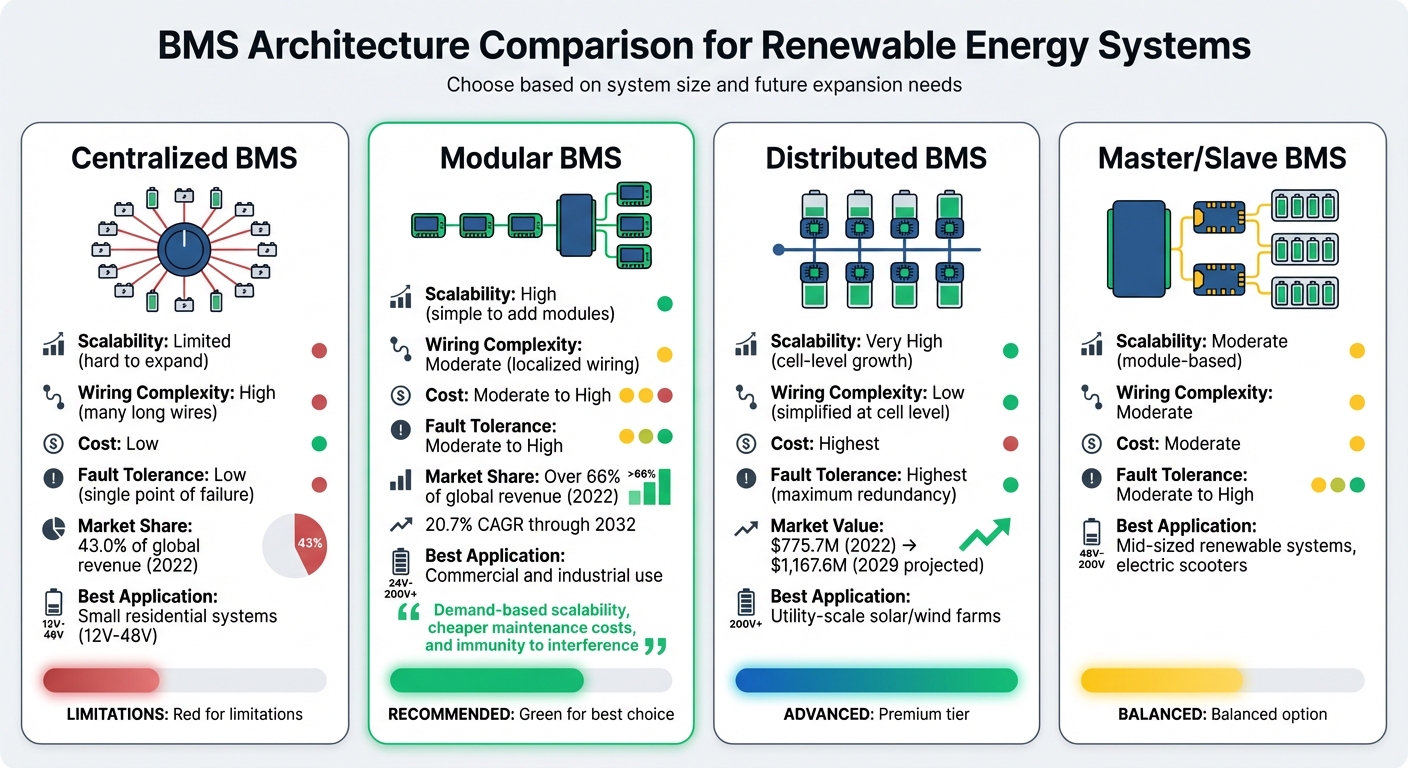
Choosing the right Battery Management System (BMS) architecture is a key decision for building renewable energy systems that can grow and handle faults effectively. The architecture you select impacts how easily the system can scale and how efficiently it operates, whether it's a small home setup or a massive utility-scale solar installation.
Centralized vs. Modular BMS
Centralized BMS relies on a single control unit to manage the entire battery pack. It's a practical choice for smaller systems like 12V to 48V residential setups, where keeping initial costs low is a priority. In fact, centralized architectures accounted for over 43.0% of global revenue in 2022 due to their affordability. However, as the battery pack grows, the wiring becomes more complex. Every cell connects to a single hub, creating a maze of wires that's hard to troubleshoot. Plus, if the central unit fails, the entire system comes to a halt.
Modular BMS, on the other hand, divides the battery pack into sections, each with its own monitoring module that communicates with a master controller. This design led the market in 2022, capturing over two-thirds of global revenue, and is expected to grow at a CAGR of 20.7% through 2032. Why? Because it's easy to scale - modules can be added without redesigning the entire system. If one module fails, it can be replaced without shutting everything down, making it ideal for commercial and industrial applications.
"Modular BMS is expected to rise rapidly... due to advantages such as demand-based scalability, cheaper maintenance costs, and immunity to interference."
– Jessica Liu, Engineer, MokoEnergy
| Feature | Centralized BMS | Modular BMS |
|---|---|---|
| Scalability | Limited; hard to expand | High; simple to add modules |
| Wiring Complexity | High; many long wires | Moderate; localized wiring |
| Cost | Low | Moderate to High |
| Fault Tolerance | Low; single point of failure | Moderate to High |
| Best Application | Small residential systems | Commercial and industrial use |
Distributed and Master/Slave BMS
For systems requiring even more precision and flexibility, Distributed and Master/Slave BMS architectures provide advanced options.
Distributed BMS assigns a dedicated board to each cell, offering unmatched precision and redundancy. While this comes at a higher cost, it's an excellent choice for large-scale renewable installations where safety and fault tolerance are critical. With electronics at the cell level, wiring is simplified - a big advantage when managing thousands of cells in a solar farm or wind installation. The distributed BMS market was valued at approximately $775.7 million in 2022 and is projected to reach $1,167.6 million by 2029.
Master/Slave BMS is somewhat similar to modular setups, with slave boards monitoring individual cells and a master board processing the data and making decisions. This design is well-suited for mid-sized renewable systems, offering a balance between scalability and cost without the full redundancy of a distributed system.
| Feature | Distributed BMS | Master/Slave BMS |
|---|---|---|
| Scalability | Very High; cell-level growth | Moderate; module-based |
| Fault Tolerance | Highest; maximum redundancy | Moderate to High |
| Adaptability to Renewables | Excellent for grid-scale systems | Good for mid-sized setups |
| Cost | Highest | Moderate |
| Typical Application | Utility-scale solar/wind | Electric scooters, compact mobility |
If your system might need a voltage boost - say, expanding from 24V to 200V - both modular and distributed designs allow you to add cells without major hardware changes. By aligning your choice of architecture with your system's specific needs, you can ensure smooth operations and leave room for future growth.
Communication and Integration Capabilities
After selecting a scalable BMS architecture, the next step is to ensure smooth communication between all components in your renewable energy system. Effective communication protocols are essential for coordinating data exchange between the BMS, inverters, grid connections, and monitoring platforms. Misconfigured protocols can lead to issues like overcharging or unexpected shutdowns.
Communication Protocols for Grid Integration
Several communication protocols play key roles in integrating renewable systems:
- CAN Bus (Controller Area Network): Widely regarded as the gold standard for battery-to-inverter communication, CAN Bus offers speed, stability, and real-time battery protection commands. Most solar storage systems use CAN Bus at 500 kbps. However, even with its speed, inverters may take 3–5 seconds to respond to BMS limit changes, potentially causing brief overcharging.
- RS-485 (Modbus RTU): Known for reliability over long distances, RS-485 is often used to link multiple battery modules. For network-based applications, Modbus TCP/Ethernet provides dependable data transmission and supports grid integration.
- Wi-Fi and Cloud Protocols: These enable remote monitoring, firmware updates, and participation in Virtual Power Plants (VPPs) or energy trading.
Interestingly, most communication issues stem from physical layer problems rather than protocol malfunctions. For example, CAN Bus termination should measure exactly 60Ω, achieved with two parallel 120Ω resistors. Use shielded cables for runs longer than 2–3 meters or when cables are near high-current DC lines to avoid interference.
To prevent State of Charge (SoC) drift, set the inverter's Charge Voltage Limit slightly above the BMS balancing threshold (e.g., 3.48V for LFP batteries). Even with ±1% accuracy in BMS current sensors, SoC drift of up to 10% can occur over time in a 10 kWh battery.
| Protocol | Speed & Distance | Primary Use Case |
|---|---|---|
| CAN Bus | High speed, short-medium | Real-time inverter-to-battery control |
| RS-485 | Lower speed, long distance | Linking battery modules; industrial inverters |
| Modbus TCP | Network-based | Grid integration and industrial monitoring |
| Wi-Fi/Cloud | Internet-dependent | VPP participation, apps, remote updates |
Once you’ve established stable communication, you can focus on planning for future system growth.
Planning for Future System Expansions
Expanding your system - whether by adding solar panels or increasing battery capacity - requires thoughtful planning. A BMS that supports unique CAN IDs for multiple battery strings ensures the inverter can monitor the entire bank as a single unit. Standardized protocols like CAN Bus and RS-485 simplify integration across components from different manufacturers.
For systems aiming to participate in VPPs or energy trading, future-proofing is key. Wi-Fi or Ethernet connectivity allows for remote monitoring, firmware updates, and integration with smart grid programs. Additionally, compatibility between your BMS and inverter is critical. Even if both claim "Pylontech compatibility", minor differences in timing or byte order can lead to intermittent failures.
When scaling, ensure the inverter can manage low current requests (e.g., 0.5A) from the BMS for cell balancing. If not, cells may drift apart over time, reducing the system's usable capacity. Proper planning and protocol alignment now can save significant headaches down the road.
Cost, Efficiency, and Vendor Considerations
Once you’ve ensured reliable communication and planned for system expansion, the next step is balancing your budget with the long-term value of your battery management system (BMS). These systems typically cost between $100 and $500 per unit, depending on their features and the number of cells they manage. However, opting for budget-friendly options often compromises performance, especially in renewable energy applications.
Weighing Cost vs. Longevity
The real value of a BMS lies in its Total Cost of Ownership (TCO). A high-quality BMS can extend the lifespan of your battery pack by up to 30%, which translates to significant savings by reducing premature replacements and minimizing system failures. On the flip side, poor BMS selection is a leading cause of battery system failures - responsible for 25–30% of issues. Of these failures, nearly 40% are due to thermal runaway conditions that a robust BMS is specifically designed to prevent.
Take this example from early 2023: A solar installer in northern Maine deployed a 16s 280Ah LiFePO4 battery bank with a low-cost BMS. Within six months, the system experienced a hard shutdown, causing cell degradation and requiring an expensive replacement. After switching to a validated BMS with active balancing, the system maintained a cell voltage spread under 12 mV for over 14 months, even in extreme temperatures as low as –13°F.
"Voltage accuracy isn't theoretical - it's the difference between detecting a failing cell at 3.15 V versus waiting until it hits 2.9 V and triggers irreversible copper dissolution."
- Dr. Lena Torres, Lead Battery Systems Engineer, GridTec Energy Solutions
High-quality BMS units offer precise voltage measurements (≤±2 mV), which prevent "stacking errors" that lead to premature cutoffs and wasted capacity. For larger renewable systems using LiFePO4 batteries, active balancing is generally preferred over passive balancing. Active balancing speeds up equalization, improves efficiency, and ensures consistent performance. It’s also crucial to select a BMS that’s specifically calibrated for your battery chemistry. Generic profiles may seem convenient but can accelerate battery aging.
When evaluating safety and reliability, look for independent certifications like UL 1973 or IEC 62619 instead of relying on self-declared CE markings. These certifications verify performance and ensure long-term safety. A well-designed BMS doesn’t just extend battery life - it also safeguards the operation and efficiency of your renewable energy system.
Sourcing Components from Trusted Vendors
After optimizing your BMS for performance and cost, sourcing high-quality components becomes the next priority. Platforms like Electrical Trader (https://electricaltrader.com) act as centralized marketplaces for buying new and used electrical components. They offer a range of battery management systems and power distribution equipment tailored for solar and wind applications. Verified sellers on the platform provide components that meet international standards, including ISO 9001, UL, and IEC certifications.
When choosing a vendor, focus on those with in-depth expertise in battery chemistries like LFP and NMC. Look for comprehensive warranties, robust technical support, and components that support standardized communication protocols such as CAN (J1939) or Modbus RTU.
As the global BMS market is expected to grow to $11.6 billion by 2026, the demand for reliable energy storage solutions continues to rise. To make the most of your investment, conduct a lifecycle cost analysis that considers not just upfront costs but also long-term expenses like maintenance and energy losses. A well-optimized BMS can boost annual revenue from energy storage projects by 15–30% compared to basic systems, making vendor selection a critical factor in ensuring both safety and profitability over a system’s 15–20 year lifespan.
Conclusion
Selecting the right Battery Management System (BMS) for renewable energy systems requires a careful balance of factors like battery compatibility, safety, scalability, and cost-effectiveness. A BMS designed for your specific battery chemistry - whether it's lithium iron phosphate (LFP), NMC, or lead-acid - ensures precise management of voltage thresholds and state-of-charge estimation, which are critical for efficient operation.
Safety is at the heart of any BMS. Features like overvoltage, undervoltage, overcurrent, and thermal runaway protection act as a safeguard against battery failures, reinforcing the importance of these measures discussed earlier. For systems that may grow over time, opting for a modular or distributed architecture is a smart move. It allows for seamless capacity additions without overhauling the entire system, an advantage that becomes even more relevant as the global BMS market is projected to hit $11.6 billion by 2026.
Beyond safety and compatibility, integration plays a pivotal role. A BMS that supports communication protocols like CAN bus, Modbus, or RS-485 connects effortlessly with inverters, chargers, and energy management systems. While active cell balancing might involve a higher initial investment, it significantly prolongs battery life compared to passive balancing methods.
"Selecting the right BMS is crucial for ensuring the longevity and optimal performance of battery systems." - Enerlution
This insight underscores the importance of system protection and performance highlighted throughout this discussion. Your choice of BMS today lays the groundwork for performance and reliability over the next decade or more. By focusing on compliance with standards like UL 1973 or IEC 62619, ensuring precise monitoring, and working with reputable vendors, you can secure a BMS that delivers both safety and long-term value. A thoughtful selection now ensures reliable energy performance and maximum return on investment.
FAQs
How do I size a BMS current rating for my solar system?
To determine the appropriate current rating for a BMS, you need to calculate the maximum load, factoring in inverter surge power and any DC loads. Here's how it works:
- For a 2,000W surge at 12V, divide 2,000 by 12, which gives you 166A. Add a 25% safety margin by multiplying by 1.25, resulting in 208A.
- For a 4,500W surge at 24V, divide 4,500 by 24 to get 188A. After applying the same safety factor, the current rises to 235A.
Including this safety margin ensures the BMS can handle peak currents without issues.
Do I need active balancing or passive balancing?
Whether you go for active or passive balancing depends on what your system needs. Passive balancing is straightforward and budget-friendly, making it a good choice for smaller systems. However, it has its downsides - it dissipates excess energy as heat and works at a slower pace. On the other hand, active balancing moves energy between cells, which boosts efficiency, speeds up the balancing process, and optimizes capacity usage. This makes it a better fit for high-performance or large-scale systems where efficiency and durability are key factors.
Which communication protocol should my BMS support for my inverter?
To ensure compatibility with your inverter, your Battery Management System (BMS) should support the CAN bus protocol. This protocol allows for dependable communication between the BMS and the inverter, which is crucial for maintaining control and safety in renewable energy systems. However, it's worth noting that occasional response delays or signal interruptions can sometimes cause capacity loss, even if the protocol itself is working as intended. Including CAN bus support is typically a smart choice for smooth and efficient system performance.