Battery Sizing for Renewable Energy: Key Factors
Getting the right battery size is critical for renewable energy systems to work effectively. It impacts efficiency, lifespan, and your ability to power essential devices during outages. Here’s what you need to know:
- Capacity Needs: Calculate based on daily energy use, critical loads, and desired backup duration.
- Battery Chemistry: Lithium Iron Phosphate (LiFePO4) batteries offer longer lifespans and higher efficiency compared to lead-acid.
- Usage Patterns: Tailor battery size to your goals - backup power, off-grid living, or peak rate savings.
- Efficiency Losses: Factor in oversizing (1.1–1.25x) to account for energy losses and temperature effects.
- Scalability: Modular systems allow for future expansion as energy needs grow.
For grid-tied systems, focus on backing up critical loads during outages. Off-grid setups require larger batteries to ensure energy independence, especially during cloudy days. Proper planning helps balance cost and reliability while leaving room for future upgrades.
1. Grid-Tied Systems with Backup
Capacity Requirements
When planning a grid-tied backup system, getting the capacity right is critical. These systems need to strike a balance between meeting power demands during outages and staying cost-efficient. Start by pinpointing your essential loads - things like refrigerators, medical devices, Wi-Fi, and lighting. On average, these critical items consume about 10 kWh per day.
Focus on usable capacity instead of just nameplate capacity. This means factoring in efficiency losses, temperature effects, and depth-of-discharge limits. To account for these, apply a multiplier of 1.1–1.25x and include a temperature adjustment factor of 0.7–0.85 for colder climates.
Finally, choose a battery chemistry that aligns with your energy needs and system performance goals.
Battery Chemistry
When it comes to grid-tied backup systems, Lithium Iron Phosphate (LiFePO4) batteries are the top choice. They deliver 3,000–8,000 cycles at an 80% depth of discharge, far outlasting VRLA lead-acid batteries, which manage only 800–2,000 cycles at 50% depth of discharge. The longer lifespan and better efficiency of LiFePO4 batteries often make them more cost-effective over time.
Here’s a quick comparison:
| Battery Technology | Typical Design DoD | Cycle Life Range | Efficiency |
|---|---|---|---|
| VRLA Lead-Acid | ≈50% | 800–2,000 | 70–85% |
| LiFePO4 (LFP) | 70–90% | 3,000–8,000 | 80–90% |
| Lithium-Ion (NMC) | 70–90% | 2,000–5,000 | 80–90% |
Load Profiles
Understanding your power usage patterns is key to avoiding system failures or overspending. It’s important to separate continuous power needs from short-term surge demands. For example, a refrigerator might use 625 watts continuously but could need up to 2,000 watts momentarily when the compressor starts. To handle these surges, make sure your inverter’s peak rating is 1.1–1.25 times the continuous load.
To estimate daily energy consumption, divide your peak monthly usage by 30. This method accounts for seasonal changes, like higher energy use for air conditioning in summer or heating in winter, ensuring the system is sized appropriately for all conditions.
Once you’ve nailed down your energy needs, think about how the system can grow with you.
Scalability
Flexibility is a major advantage of modular systems. Take the SimpliPHI Home Battery System by Briggs & Stratton as an example. Each unit provides 6.65 kWh, and you can stack multiple units to expand capacity up to 119.7 kWh and 84 kW of power. This modular approach is perfect for adapting to future needs, whether it’s charging an electric vehicle or powering a home addition.
What's the RIGHT Home Solar Battery Size for You?
2. Off-Grid Systems
Unlike grid-tied systems that depend on utility support during power outages, off-grid setups need to handle all energy demands independently.
Capacity Requirements
Sizing an off-grid system is a unique challenge since there’s no utility backup to fall back on. Your battery bank needs to store enough energy to keep your home running for several days without sunlight. Start by figuring out your daily energy consumption in kilowatt-hours (kWh) - this serves as your baseline. Multiply that by your desired days of autonomy, which is typically 2 to 3 days in most areas.
You’ll also need to consider factors like depth of discharge (DoD) limits, system efficiency losses from inverters and wiring, and the impact of temperature. For instance, if you use 10 kWh per day and want 2 days of backup with lead-acid batteries (50% DoD), you’d require about 24 kWh of total capacity after accounting for a 1.2 inefficiency multiplier. On the other hand, with lithium batteries at 80% DoD, the requirement drops to about 12.6 kWh.
"A large solar battery bank size will be best utilized in areas with more cloudy days, while a smaller solar battery bank should be sufficient in areas with prevalent sunlight. However, it's always recommended to size up rather than down." - Unbound Solar
Round up your calculations to account for efficiency losses and varying temperatures, ensuring your system is reliable throughout the year.
Battery Chemistry
When it comes to off-grid systems, LiFePO4 (Lithium Iron Phosphate) batteries are the go-to choice. While they come with a higher upfront cost (around $1,200 per kWh installed), their longer lifespan (3,000–8,000 cycles compared to 800–2,000 for VRLA lead-acid batteries) and better efficiency (80–90% round-trip) make them a more compact and durable option. For example, a typical 10 kWh LiFePO4 system in 2024 costs about $12,000 installed, which includes $7,000 for the battery, $2,000 for the inverter, and $3,000 for installation.
However, there’s a trade-off: lead-acid batteries can handle surge loads better. If your system needs to power equipment with high startup demands, you might need additional lithium batteries to compensate.
Load Profiles
To build a successful off-grid system, you need a clear understanding of how and when you use electricity. Create a list of each appliance’s continuous power draw and surge requirements. For example, a refrigerator might surge from 625 watts to 2,000 watts, while air conditioners and pumps could require 2–7 times their running wattage during startup.
"Sizing a system without reducing demand is like heating a home in the winter while leaving the front door open." - John Connell, VP of Crown Battery's SLI Products Group
Before determining your battery bank size, look for ways to cut energy use. Switch to LED lighting and ENERGY STAR appliances to reduce consumption. Also, design your system based on the month with the least sunlight to ensure it can handle year-round demands. Many experts suggest sizing battery banks at twice the calculated daily amp-hour needs to maintain healthy discharge levels and provide a safety buffer. This careful planning highlights the value of modular systems that can grow with your energy needs.
Scalability
One of the key advantages of off-grid systems is their modular design, which allows you to expand capacity as your energy requirements change. Batteries can be connected in series to increase voltage (e.g., from 12V to 48V) or in parallel to boost total amp-hour capacity. This adaptability is crucial for accommodating future needs, whether it’s adding more equipment or expanding your living space.
Modern lithium systems come equipped with a Battery Management System (BMS), which monitors voltage, temperature, and charge levels. This eliminates the need for special venting, a requirement for flooded lead-acid batteries.
These strategies emphasize the importance of selecting the right battery setup to match your current and future energy demands effectively.
sbb-itb-501186b
Advantages and Disadvantages
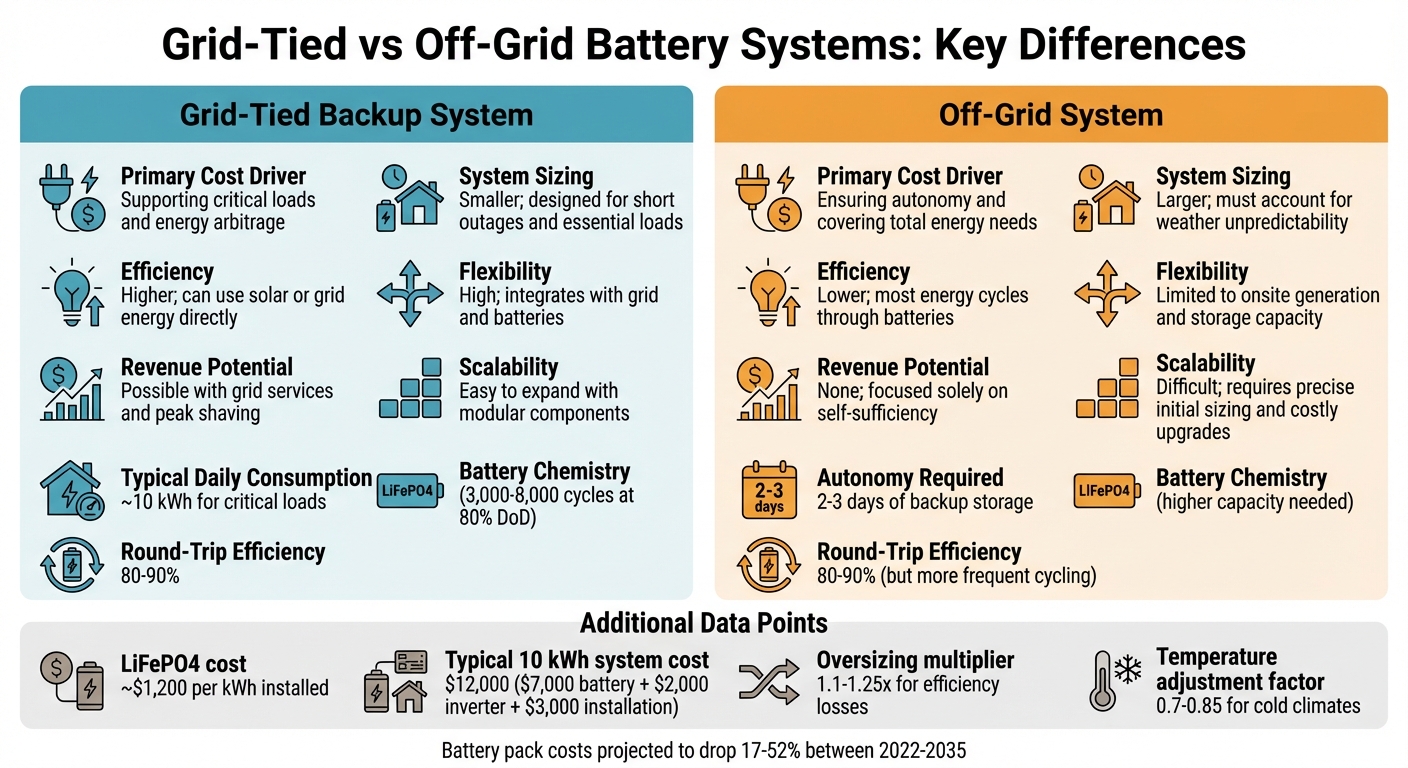
Grid-Tied vs Off-Grid Battery Systems Comparison Chart
Let’s dive into the pros and cons of grid-tied and off-grid systems, focusing on their costs, efficiency, and adaptability.
Cost Differences
Grid-tied systems tend to be more budget-friendly because they don’t require oversized battery banks to handle long periods without sunlight. On the other hand, off-grid setups need larger batteries to ensure enough stored energy for extended autonomy, which drives up the cost.
Efficiency Considerations
When it comes to efficiency, grid-tied systems have the upper hand. They can power your home directly from the solar panels or the grid, bypassing the battery whenever possible. Off-grid systems, however, must cycle nearly all their energy through batteries, which adds to energy losses. While both lithium battery types offer 80–90% round-trip efficiency, off-grid systems experience more frequent cycling, which compounds those losses over time.
Flexibility and Scalability
Grid-tied systems offer more flexibility because they integrate with the grid. This allows them to draw power during high demand and even take advantage of energy arbitrage opportunities. Off-grid systems, in contrast, are entirely reliant on onsite energy generation and storage. If the system isn’t sized correctly, prolonged periods of low sunlight can lead to complete power loss.
Grid-tied setups are also easier to scale. You can expand the system incrementally by adding more batteries or components without overhauling the entire design. Expanding an off-grid system, however, often requires significant upgrades or even replacing hardware to ensure compatibility, making it a more challenging and expensive process.
Quick Comparison Table
| Feature | Grid-Tied Backup System | Off-Grid System |
|---|---|---|
| Primary Cost Driver | Supporting critical loads and energy arbitrage | Ensuring autonomy and covering total energy needs |
| System Sizing | Smaller; designed for short outages and essential loads | Larger; must account for weather unpredictability |
| Efficiency | Higher; can use solar or grid energy directly | Lower; most energy cycles through batteries |
| Flexibility | High; integrates with grid and batteries | Limited to onsite generation and storage capacity |
| Revenue Potential | Possible with grid services and peak shaving | None; focused solely on self-sufficiency |
| Scalability | Easy to expand with modular components | Difficult; requires precise initial sizing and costly upgrades |
Key Takeaways
Choosing between grid-tied and off-grid systems often comes down to your specific energy needs. Grid-tied systems are great for those seeking efficiency, flexibility, and the ability to tap into grid services. Off-grid systems, while more self-reliant, demand careful planning and come with higher costs for autonomy. Each approach has its strengths, so understanding your energy priorities will help guide the decision.
Conclusion
Sizing a battery system starts with understanding your specific energy needs. If you're connected to the grid, a system designed for backup power during outages can be a cost-effective choice. On the other hand, off-grid setups demand careful planning to handle extended periods of low sunlight and typically come with higher upfront costs.
Several factors play a role in determining the right battery size: your daily energy usage in watt-hours, the depth of discharge allowed by the battery type, and efficiency losses from inverters and charging cycles. A well-thought-out sizing strategy not only ensures reliable performance today but also leaves room for future upgrades.
Before diving into calculations, it’s a good idea to cut down on energy consumption. Simple changes like switching to LED lights or using ENERGY STAR-rated appliances can significantly reduce the battery capacity you’ll need.
With battery pack costs projected to drop by 17% to 52% between 2022 and 2035, this approach becomes even more appealing. Rather than oversizing your system now, you can scale it up more affordably over time. Be sure to include a safety buffer - multiplying your calculated capacity by 1.25 to 2.0 helps account for efficiency losses and prevents over-discharging, which can shorten battery lifespan.
FAQs
How can I determine the right battery size for my renewable energy system?
To determine the right battery size for your renewable energy setup, begin by figuring out your total daily energy use. Start by listing all the devices you plan to power, noting their wattage and estimating how many hours each will run per day. For each device, multiply its wattage by the number of hours it’s used to calculate its watt-hours (Wh). Add up all these values to find your total daily energy demand.
Once you have that number, choose a battery voltage - common options are 12V or 24V. Divide your total daily watt-hours by the chosen voltage to calculate the amp-hours (Ah) your system requires. To account for real-world conditions, like depth of discharge (e.g., 50% for lead-acid batteries or 80-90% for lithium batteries) and efficiency losses, add an extra 10-15% capacity. If you want your system to provide power for several days without recharging, multiply the adjusted capacity by the desired number of backup days.
When selecting a battery bank, opt for one that meets or exceeds your calculated capacity. Pay attention to factors like battery type, warranty, and whether it can scale with your system. Platforms such as Electrical Trader offer a variety of batteries and components to help you build a dependable energy storage solution.
What are the advantages of Lithium Iron Phosphate (LiFePO₄) batteries?
Lithium Iron Phosphate (LiFePO₄) batteries stand out for several reasons, especially when it comes to renewable energy systems. One of their biggest strengths is their safety and thermal stability, which helps minimize risks like overheating or fire. This makes them a reliable choice for various applications.
These batteries also last a long time, offering thousands of charge-discharge cycles, which means they can handle heavy use while maintaining performance. Another advantage is their flat discharge voltage, ensuring steady power output throughout their usage cycle. Plus, they use non-toxic materials, making them a more eco-conscious choice compared to other battery types. All of these qualities make LiFePO₄ batteries a solid and dependable option for energy storage.
How can I make sure my battery system can handle future energy demands?
To make sure your battery system can handle future energy demands, start by opting for a modular design. Choose a system that lets you add battery modules in parallel or series without the hassle of major rewiring. This setup makes it much easier to expand capacity as your energy needs grow - like adding EV chargers or extra solar panels. Also, when installing your system, think about oversizing your inverter and wiring. Doing this upfront helps accommodate future power requirements more efficiently.
When it comes to battery chemistry, go for one that offers the most usable capacity. For instance, lithium-ion batteries typically deliver 90–95% of their rated capacity, while lead-acid batteries only provide about 50%. This means you’ll need fewer upgrades in the long run. Don’t forget to factor in efficiency losses, which are usually around 10–15%, and plan for a 20% capacity drop over a 10-year lifespan to ensure your system stays dependable as it ages.
Lastly, work with a trusted supplier that provides a variety of battery modules, charge controllers, and related gear. This ensures you can scale your system safely and affordably as your energy needs increase.