

How Hybrid Energy Storage Improves Load Management
Hybrid Energy Storage Systems (HESS) combine different energy storage technologies - like batteries and supercapacitors - into a single system to manage power demand and energy supply more effectively. This setup is particularly useful for balancing grid stability, reducing energy costs, and supporting renewable energy integration. Here's what you need to know:
- How It Works: Batteries handle long-term energy needs, while supercapacitors manage short bursts of power, reducing stress on the batteries and improving system efficiency.
- Grid Stability: HESS improves frequency stability by up to 55% compared to single-technology systems, making it ideal for handling fluctuations from renewable energy sources.
- Cost Savings: Facilities using HESS can cut electricity bills by 10%–35% and reduce system costs by 12%–26% through peak shaving and optimized energy use.
- Renewable Integration: HESS stores excess energy from solar and wind, ensuring consistent power availability and maximizing renewable energy usage.
While the upfront costs can be high, the long-term benefits - like extended battery life, reduced maintenance, and lower energy costs - make HESS a smart choice for modern energy management. This article explores how HESS works, its benefits, and challenges to consider.
How HESS Improves Load Balancing
How Batteries and Supercapacitors Work Together
HESS (Hybrid Energy Storage Systems) combines the strengths of batteries and supercapacitors to handle power demands more effectively. When there's a sudden surge in demand - like multiple machines starting at once or fluctuations in renewable energy output - supercapacitors step in immediately. They provide a quick burst of power to stabilize the DC bus voltage, preventing transient errors. Meanwhile, batteries take over for sustained, long-term energy supply.
Supercapacitors act like shock absorbers, managing high-frequency fluctuations and shielding batteries from excessive wear and tear. For instance, research using wind data from Jabal al-Zeit and solar data from Benban in Egypt found that a well-designed HESS improved frequency stability by 55% compared to systems relying on a single type of storage.
"The combination of battery-SC can utilize the complementary properties of each other... [it] minimizes the dynamic stress of the secondary storage system and optimizes the operation." - IEEE Access
This collaboration between batteries and supercapacitors creates a foundation for precise, real-time load balancing managed by advanced control systems.
Real-Time Load Balancing with Control Systems
HESS takes this synergy further with sophisticated control systems that fine-tune load distribution. It uses a two-layer control approach: a low-level controller handles real-time regulation of DC bus voltage and current, while a high-level Energy Management System (EMS) oversees power allocation, monitors state-of-charge, and directs high-frequency demands to supercapacitors and low-frequency demands to batteries.
This level of control allows advanced EMS platforms to keep the DC bus voltage within ±1.7% of its nominal value, even during unpredictable disturbances caused by renewable energy sources. After supercapacitors deliver power during a spike, the control algorithm quickly recharges them during steady-state conditions, ensuring they're ready for the next demand surge. Such coordinated operation reduces stress on critical components by about 20%.
sbb-itb-501186b
Cost-Saving Strategies with HESS
Peak Shaving and Demand Charge Reduction
HESS helps cut costs by storing energy during low-rate periods and discharging it during high-demand times. This process, known as peak shaving, sets a limit for your facility's power usage. When your power demand nears that limit, the system automatically releases stored energy to keep you below the costly peak threshold.
The savings can be impressive. Industrial facilities using HESS for peak shaving often reduce their electricity bills by 10% to 35%. Compared to traditional single-battery setups, hybrid systems designed for optimal performance can lower total system costs by 12% to 26%. Mariya Koleva from the National Renewable Energy Laboratory explains:
"Compared to traditionally designed battery storage with a homogeneous battery, optimally designed hybrid systems can save 12%–26% of system costs, depending on the nature of the dispatch profile".
Supercapacitors in these systems handle short bursts of high power, while batteries take care of longer, sustained energy needs. This division of labor prevents rapid wear and tear on the batteries, extending their lifespan and saving on replacement costs. Additionally, optimized dispatch can reduce peak loads by as much as 56.7 kVA. Considering that peak demand charges can reach $110 per kVA annually in some areas, these savings stack up fast. With this approach, facilities can also fine-tune their energy usage schedules for even more efficiency.
Energy Usage Predictability and Scheduling
HESS doesn’t stop at peak shaving - it also excels at enhancing energy scheduling. Using advanced tools like mixed integer linear programming, HESS platforms create highly efficient charge-discharge schedules. These schedules work hand-in-hand with the system’s real-time load balancing, which evaluates your facility’s past consumption trends, utility rates, and grid conditions to generate optimized 15-minute interval plans.
To protect battery health, the software applies safeguards, such as a modest $0.001 per kWh throughput penalty, to avoid unnecessary discharges. The system ensures charging happens during off-peak hours when electricity rates are lowest and discharges energy precisely when it delivers the highest value. Given that lithium-ion storage systems cost around $350 per kWh, efficient scheduling is crucial to offset upfront costs and achieve long-term savings.
Integrating Renewable Energy Sources with HESS
Pairing HESS with Solar and Wind Energy
Solar and wind energy work well together: wind generation often increases when solar output is lower. Hybrid energy storage systems (HESS) play a crucial role in storing energy from these sources, ensuring power availability during times of low generation. Typically, batteries handle long-term energy storage, while supercapacitors manage short-term fluctuations.
Take the Wheatridge Renewable Energy Facility in Oregon as an example. It's the first large-scale project in North America to combine 50 MW of solar PV, 300 MW of wind, and 30 MW of four-hour battery storage. This setup has boosted capacity factors from 60% to over 80% and, depending on battery size, can achieve capacity credits nearing 100%.
"These PV-wind-battery hybrids can help integrate more VRE by providing smoother, more predictable generation and greater flexibility",
explains Anna Schleifer from the National Renewable Energy Laboratory.
By balancing intermittent renewable generation with stored energy, this hybrid approach improves load management. It not only supports the integration of renewable energy but also optimizes demand management, ensuring grid stability during fluctuating generation periods.
Improving Grid Stability with Renewables
Integrating renewables with HESS strengthens grid stability by addressing the unpredictable nature of variable energy sources. As traditional power plants, which provided rotational inertia, are replaced by renewables, HESS steps in to manage frequency and voltage challenges. Advanced control systems, like PD-PI cascaded controllers, enable HESS to stabilize grids with high renewable penetration. For instance, real-world testing using data from Egypt's Zafarana wind farm and Benban solar plant showed that this strategy improved frequency stability by 55% compared to systems using only Superconducting Magnetic Energy Storage, and by 45% compared to those relying solely on Plug-in Electric Vehicles.
Additionally, facilities can oversize renewable capacity relative to their grid connection and use HESS to manage surplus energy, maximizing infrastructure without expensive upgrades. Hybrid systems have reached renewable energy usage rates as high as 98.37%, ensuring nearly full utilization of generated power. This approach reduces reliance on the grid while maintaining a steady and reliable energy supply, even during periods of high renewable output. It ties directly to the goal of optimizing load management through strategic energy storage solutions.
What is a Hybrid Energy Storage System (HESS)?
Benefits and Challenges of HESS
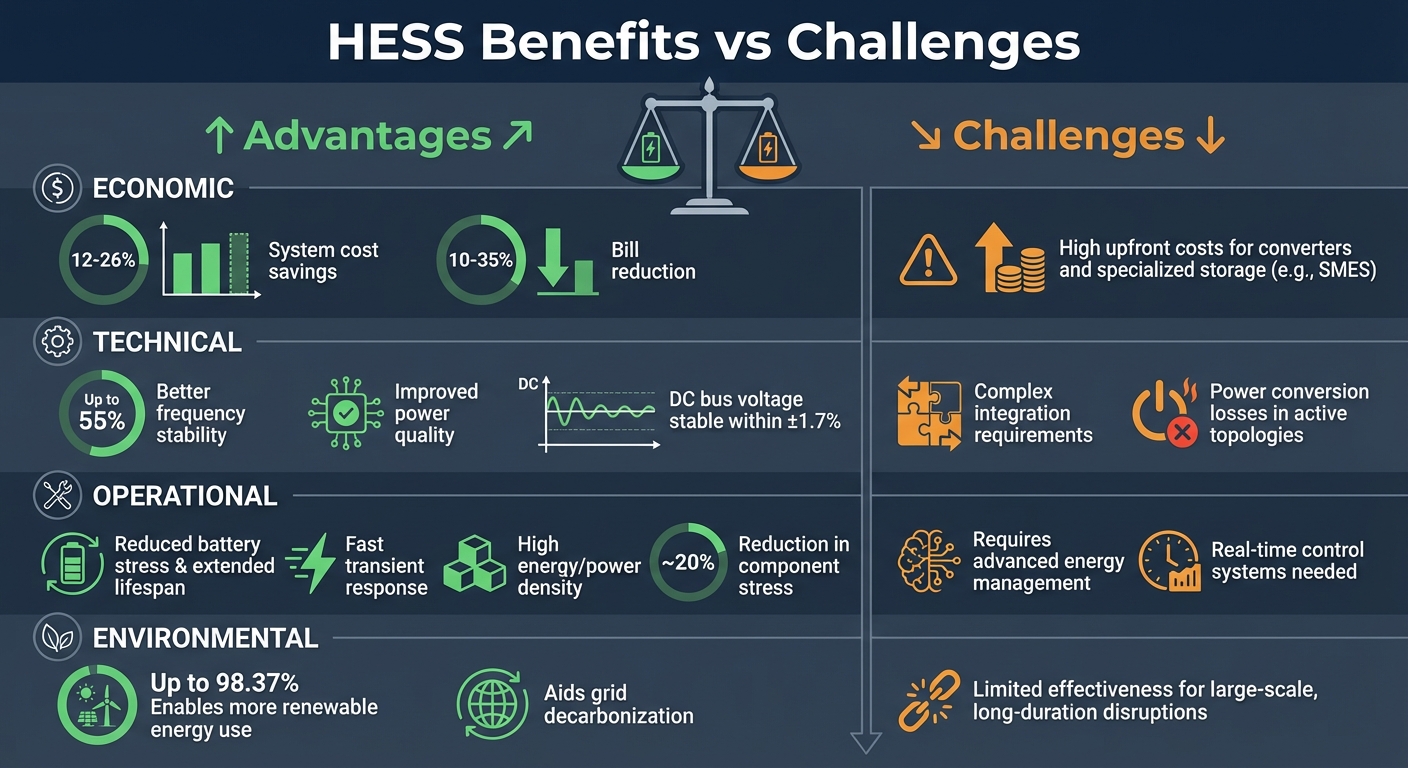
HESS Benefits vs Challenges: Cost Savings, Technical Performance and Implementation Considerations
Comparing Benefits and Drawbacks
Hybrid energy storage systems (HESS) bring a mix of advantages and hurdles that are worth exploring.
On the cost front, HESS can deliver savings of up to 26%, as highlighted earlier. This efficiency comes from splitting power and energy responsibilities between components. For instance, supercapacitors handle quick power surges, while batteries manage long-term energy storage. This division allows for more economical sizing of system components.
From a technical perspective, HESS offers significant perks. These systems can lower the wear and tear on battery components, which extends their lifespan. Additionally, advanced energy management systems keep DC bus voltage steady within ±1.7% of nominal levels, even during unexpected disturbances. However, achieving these benefits requires sophisticated control techniques like Model Predictive Control or Fuzzy Logic.
| Category | Advantages | Challenges |
|---|---|---|
| Economic | 12–26% system cost savings; 10–35% bill reduction | High upfront costs for converters and specialized storage (e.g., SMES) |
| Technical | Better frequency stability (up to 55%); improved power quality | Complex integration; power conversion losses in active topologies |
| Operational | Reduced battery stress; fast transient response; high energy/power density | Requires advanced energy management and real-time control |
| Environmental | Enables more renewable energy use; aids grid decarbonization | Limited effectiveness for large-scale, long-duration disruptions |
While these benefits are impressive, the challenges tied to HESS cannot be ignored, especially when it comes to system integration and infrastructure.
One key issue lies in the infrastructure demands. Active HESS designs, known for their superior control and fault tolerance, require individual bidirectional DC-DC converters for each storage element. This setup significantly increases initial investment costs. Additionally, the success of certain HESS configurations depends on the availability of complementary infrastructure, such as networks for plug-in electric vehicles or specialized units like Superconducting Magnetic Energy Storage. For facilities considering upgrades to their power distribution systems, these trade-offs are critical to evaluate, ensuring that HESS aligns with both operational needs and financial limitations.
Striking the right balance between these benefits and challenges is essential for effective load management and creating a robust power distribution network. These trade-offs will ultimately determine how well HESS performs in balancing demand and maintaining grid stability.
Conclusion
Key Takeaways
Hybrid energy storage systems (HESS) offer a practical way to tackle modern load management challenges. By combining high-power devices like supercapacitors with high-energy batteries, these systems manage both quick power fluctuations and sustained energy needs. This pairing reduces battery strain, extends their lifespan, and ensures stable voltage during shifts in power demand.
The financial benefits of HESS are hard to ignore. According to the National Renewable Energy Laboratory, well-designed hybrid systems can lower total system costs by 12% to 26% and cut energy bills by 10% to 35%, especially when paired with optimized electricity pricing structures.
HESS also boosts grid stability, delivering up to 55% better frequency performance compared to systems relying on a single technology. This is especially valuable for facilities incorporating renewable energy sources or handling intricate power distribution networks. When integrated thoughtfully, these systems enhance resilience alongside their performance benefits.
Although implementing HESS requires careful planning and comes with higher upfront costs, tailoring each component to its specific role - whether for power or energy - creates a system that is both more robust and cost-effective in the long run. These advantages position HESS as a key player in modern power distribution and load management strategies.
For those considering upgrades to their electrical systems, platforms like Electrical Trader offer access to the equipment and components necessary to adopt these advanced energy solutions.
FAQs
When does a HESS make more sense than a battery-only system?
A hybrid energy storage system (HESS) outshines a battery-only setup when the goal is to boost performance, cut costs, and optimize energy management. By integrating different storage technologies, HESS takes advantage of their combined strengths, making it a smart choice for applications that demand high energy and power capabilities, stronger resilience, or improved load balancing.
How are supercapacitors sized for my facility’s load spikes?
Supercapacitors are designed to handle quick bursts of high power, especially during sudden load spikes. Their capacity is determined by two key factors: the amount of current needed and the duration of the load transient. These parameters are typically influenced by the system's power requirements and the smoothing time constant.
What control system is needed to run HESS safely and efficiently?
To run hybrid energy storage systems (HESS) effectively and safely, a control system plays a key role in managing the interaction between batteries and supercapacitors. Popular methods include hysteresis control and model-free strategies, both of which help maintain proper load distribution and ensure the system remains stable.