How to Choose the Right RV Generator
Most RV generator mistakes come down to one thing: buying the wrong size. I’d start with your RV’s service, your A/C startup load, your fuel choice, campground noise limits, and your total budget.
Here’s the short version:
- A 30-amp RV tops out at 3,600 watts
- A 50-amp RV can supply up to 12,000 watts
- A roof A/C often needs the largest startup surge
- Generator output can drop about 3% per 1,000 feet of elevation
- Many quiet campgrounds want low noise, and the National Park Service limits motorized equipment to 60 dB at 50 feet
- Propane usually gives about 10% to 15% less power than gasoline in the same unit
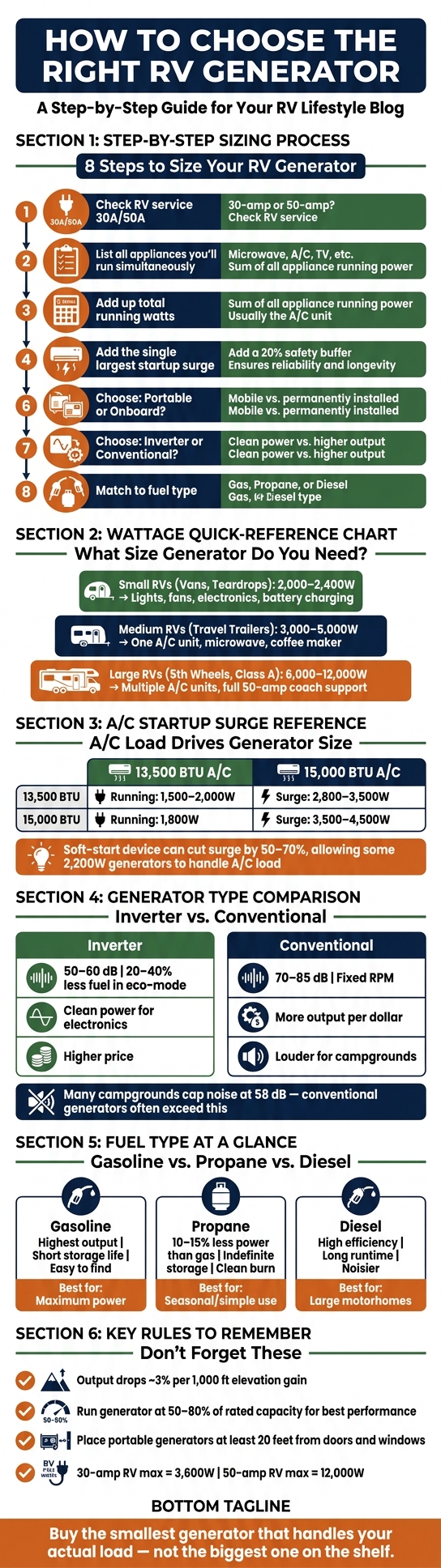
If I were choosing one, I’d use this order:
- Check if the RV is 30A or 50A
- Add the appliances I want to run at the same time
- Add the largest startup surge
- Add a 20% buffer
- Pick between portable or onboard
- Pick inverter or conventional
- Match the unit to gas, propane, or diesel
- Confirm the outlet, weight, noise, and starting method
A simple sizing shortcut:
- 2,000 to 2,400 watts: small RVs, battery charging, lights, fans
- 3,000 to 5,000 watts: many travel trailers, one A/C, microwave
- 6,000 to 12,000 watts: large fifth wheels and Class A coaches, often with more than one A/C
How to Size & Choose the Right RV Generator: Step-by-Step Guide
How to Shop for the Best RV Generator (What to Look For Before You Buy)
sbb-itb-501186b
Quick Comparison
| Option | Best for | Main tradeoff |
|---|---|---|
| Portable | Lower upfront cost, flexible use | Setup, storage, theft risk |
| Onboard | Push-button power in motorhomes | Higher cost, harder service access |
| Inverter | Quiet use, electronics, lower fuel burn at part load | Higher purchase price |
| Conventional | More output for less money | More noise, rougher fit for campgrounds |
| Gasoline | Highest output, easy to find | Short storage life |
| Propane | Clean storage, simple seasonal use | Lower wattage |
| Diesel | Large motorhomes, long runtime | Higher cost, more noise |
Bottom line: I’d buy the smallest generator that can handle my actual load without strain, not the biggest one on the shelf.
1. Calculate the Generator Size Your RV Needs
Identify Your RV Electrical Service and Main Appliances
Start by checking your RV’s electrical service rating on the shore cord or breaker panel. A 3-prong plug usually means 30-amp service, while a 4-prong plug usually means 50-amp service.
Next, write down the 120-volt appliances you plan to run at the same time. That often includes:
- Roof A/C
- Microwave
- Converter/charger
- Water heater
- Coffee maker
- Electronics
Check the nameplate on each appliance for wattage. Don’t wing it or go by memory, because a bad estimate can leave you with a generator that comes up short.
Add Running Watts, Starting Watts, and a 20% Safety Margin
Running watts are the power an appliance uses once it’s up and running. Starting watts, also called surge watts, are the short burst needed to start a motor. For motor-driven gear, that surge can be 2 to 3 times the running load.
To size your generator, add up the running watts for everything you expect to use at once. Then add the single largest starting load on your list, which is usually the air conditioner. After that, add a 20% safety buffer.
That buffer matters. If a generator is pushed to its limit all the time, you’ve got almost no room for surprise loads. A better target is 50% to 80% of rated load during normal use.
Altitude matters too. Generator output drops by about 3% for every 1,000 feet above sea level. If you camp in the Rockies or other high-elevation spots, build that into your math.
Use A/C Demand to Narrow Your Wattage Range
In most RV setups, the air conditioner is the load that drives generator size.
A 13,500 BTU roof A/C usually runs at 1,500 to 2,000 watts and surges to 2,800 to 3,500 watts when it starts. A 15,000 BTU unit usually runs at about 1,800 watts and can surge to 3,500 to 4,500 watts at startup.
| A/C Unit | Running Watts | Starting (Surge) Watts |
|---|---|---|
| 13,500 BTU | 1,500–2,000W | 2,800–3,500W |
| 15,000 BTU | 1,800W | 3,500–4,500W |
For a 30-amp RV with one A/C unit, a generator in the 3,000 to 4,500-watt range is usually the right fit. For larger 50-amp coaches running more than one A/C plus heavier kitchen loads, you may need something in the 5,500 to 12,500-watt range.
There’s one wrinkle here worth noting: a soft-start device can cut A/C startup surge by 50% to 70%, which can let some 2,200-watt generators handle the load.
Once you know your wattage range, it gets much easier to sort through inverter, conventional, portable, and onboard models. Then you can weigh fuel type, runtime, and noise without guessing.
2. Compare Generator Types, Fuel Options, and Noise Levels
Onboard vs. Portable Generators for Different RV Setups
Once you know your wattage range, the next step is picking the setup that fits your RV and the way you camp.
Onboard generators are common in Class A and Class C motorhomes. They start with the push of a button from inside the coach and pull fuel from the RV’s main tank. That means no setup once you get to camp, and the unit stays locked inside the chassis for added security. The catch is cost and service access. Built-in units usually cost more, and they’re harder to reach if repairs are needed without a service bay.
Choose onboard if you want a permanent motorhome setup. Choose portable if you want a lower-cost option with more flexibility.
Portable generators cost less up front and make sense if you don’t want a permanent install. You can place them at least 20 feet away from doors, windows, and vents to help prevent carbon monoxide buildup. That said, they do come with extra work. You have to carry them, connect them, store them, secure them against theft, and keep up with a separate fuel supply at every stop.
| Feature | Onboard | Portable |
|---|---|---|
| Installation | Factory-installed or professionally installed | No modifications required |
| Fuel source | RV’s main fuel tank | Separate gas cans or propane tanks |
| Convenience | Push-button start from inside | Manual setup at each stop |
| Security | Locked in chassis | Needs a chain or lock to deter theft |
| Maintenance access | More difficult to access | Easy to service or take to a shop |
Inverter vs. Conventional Generators: Output, Efficiency, and Electronics Protection
When it comes to power quality, the choice is pretty simple: inverter generators are the better pick for quiet camping and sensitive gear, while conventional generators are often chosen for more output at a lower price.
Inverter generators produce clean, stable AC power, so they’re a safer match for electronics like laptops, phones, and CPAP machines. They also adjust engine speed to match the load instead of running flat-out all the time. In practice, that usually means 50–60 dB operation and 20–40% lower fuel use in eco-mode compared with fixed-speed operation. They do cost more, but you get quieter performance and better protection for electronics.
Conventional generators run at a fixed RPM no matter how much power you’re using. That makes them louder, usually in the 70–85 dB range. And that can be a problem in campgrounds. Many private RV parks set their noise cap at 58 dB, which makes conventional models a rough fit for quiet camping.
Gasoline, Diesel, and Propane: Trade-Offs for Runtime and Storage
Fuel choice shapes how long you can run, how easy refills will be, and how much hassle storage brings.
Gasoline gives you the highest power output and is easy to find at gas stations across the U.S. The downside is storage. Gas doesn’t last long, and stale fuel can gum up carburetors. If the generator sits between trips, you’ll usually need to run it dry or add fuel stabilizer.
Propane burns cleaner and keeps indefinitely in a sealed tank. If your RV already uses propane for the stove or water heater, a dual-fuel or propane generator can draw from that same supply. The trade-off is output: propane usually gives 10–15% less power than gasoline in the same unit. So if propane will be your main fuel, size the generator by its propane-rated wattage, not the higher gasoline peak.
Diesel is a strong match for large diesel motorhomes, since the generator can share the vehicle’s fuel tank. It’s efficient and works well for long runtime. On the other hand, diesel units are often noisier, have a stronger exhaust smell, and cost more up front.
| Fuel Type | Availability | Storage Life | Power Output | Best Fit |
|---|---|---|---|---|
| Gasoline | Excellent | Short | Highest | Maximum power |
| Propane | Good | Indefinite | Lower | Simple seasonal use |
| Diesel | Good | Long | High/efficient | Large motorhomes, heavy-duty use |
After you narrow down the type, fuel, and noise level, the next step is comparing runtime and total cost.
3. Balance Runtime, Fuel Cost, and Purchase Budget
How to Read Runtime and Fuel Consumption Specs
Runtime numbers change with load. Most spec sheets show hours per tank at 25% load and 100% load, and those numbers can be far apart. So don't compare one generator at 25% load with another at full load. Match the same load percentage across models, then use the load that best fits how you camp.
Once you have a good estimate of runtime at your usual load, you can line that up with the generator size that fits your RV.
Match Wattage Ranges to RV Size and Appliance Use
A good rule of thumb is to run your generator at 50% to 80% of rated capacity during normal use. That gives you some breathing room without running too light or too close to the limit. After you've worked out your load, use this table as a practical shortcut:
| RV Category | Recommended Wattage | Typical Use |
|---|---|---|
| Small (Vans, Teardrops) | 2,000W – 2,400W | Lights, fans, electronics, battery charging |
| Medium (Travel Trailers) | 3,000W – 5,000W | One A/C unit, microwave, coffee maker |
| Large (5th Wheels, Class A) | 6,000W – 12,000W | Multiple A/C units, full 50A coach support |
After that, it's time to look past sticker price. A lower-cost unit can end up costing more on a long trip if it burns more fuel.
Estimate Upfront Cost and Long-Term Fuel Expense
Fuel burn is what turns runtime into dollars-and-cents operating cost. Inverter models often cost more than conventional units at the same wattage, but they can adjust engine speed to match demand and usually use less fuel at partial loads.
A portable RV inverter generator usually burns about 0.12 to 0.36 gallons per hour depending on load. That's a pretty wide range, which is why load matters so much.
Fuel type matters too:
- Propane stores cleanly but burns faster
- Gasoline usually gives you more output and is easy to find
Both points are backed by the same general tradeoffs in RV generator use.
To estimate trip cost, multiply your expected fuel burn by your local fuel price and the number of hours you'll run the generator each day. It's a simple check, but it helps a lot. In most cases, higher-wattage units and inverter models cost more up front, while lighter day-to-day loads help cut fuel expense.
4. Check RV-Specific Features and Find Equipment Through Electrical Trader
Verify Outlets, Starting Method, Portability, and Installation Fit
Once you’ve nailed down size, fuel, runtime, and budget, it’s time for the last round of fit checks. This is where you weed out models that look good on paper but don’t match your RV.
Start with the outlet. The generator needs to match your RV plug: TT-30R for 30-amp rigs and a four-prong connector for 50-amp rigs. If the plug setup is wrong, everything gets harder than it needs to be.
Then look at how the unit starts. Some generators use a pull-start. Others come with electric start, remote start through a key fob or app, or an interior switch on built-in units. That might sound like a small detail, but it makes a big difference when you’re setting up in the rain or heading out early.
Portability matters too. Smaller inverter generators can weigh about 46 lbs, while larger models can top 260 lbs. That’s a huge gap. If you plan to move the generator often, check for:
- Integrated wheels
- Telescoping handles
- Lifting handles
For built-in units, get out the tape measure. Measure the compartment opening and make sure the exhaust routes away from windows and awnings. Also check oil and filter access. A cramped compartment can turn basic upkeep into a headache.
Once the generator fits your RV both physically and electrically, you can move on to side-by-side model checks and the parts that support it.
Compare Generator Listings and Related Components on Electrical Trader
Use Electrical Trader to compare RV generator listings, specs, and matching components in one spot. When you’re looking at models, focus on the numbers that matter most: rated watts, voltage rating, fuel type, and noise ratings.
Don’t stop at the generator itself. The support gear matters just as much.
A transfer switch lets you switch safely between shore power and generator power. A surge protector or Electrical Management System (EMS) helps guard sensitive electronics from voltage spikes. Skip those parts, and you could end up with a much bigger problem than a bad campsite hookup.
If you’re shopping used, ask for run hours and maintenance records. Then test voltage stability under load. That tells you a lot more than a clean exterior ever will. Used units with fewer than 500 hours often sell for 65% to 80% of the new price.
Conclusion: Choose a Generator That Fits Your RV's Load and Use Case
Once you’ve narrowed down the type and fuel, compare models based on your target load. Start with your RV’s service rating, add up the appliances and systems you plan to run, factor in startup surge, and shop for a generator that meets that wattage.
Your use case should guide the pick. Short battery-charging sessions usually need less output. Full-time A/C use needs more.
The goal is simple: pick the smallest generator that can cover your actual load without trouble, while still staying within your limits for noise, fuel, and weight.
Before you buy, check the details that affect fit and safety:
- The right outlet type
- Your preferred start method
- A noise level that stays within campground rules
- Automatic CO shutdown
For built-in units, make sure the exhaust route is safe and the generator works with your transfer switch. For portable units, make sure it can sit at least 20 feet from doors, windows, and other openings while still working with your campsite layout.
FAQs
Can I run my RV air conditioner on a 2,200-watt generator?
Usually, no. A 2,200-watt generator often doesn’t have enough startup power to kick on an RV air conditioner.
It can work in a few limited cases, like with a smaller 8,000–11,000 BTU unit, a low AC setting, or a soft-start device. Even then, you’ll likely have little to no room to run other appliances at the same time.
For steadier performance, most experts suggest 3,000 to 4,000 watts.
Do I need an inverter generator for RV electronics?
Yes, an inverter generator is a smart pick for RV electronics. It delivers clean, steady power with a clean sine wave output - usually less than 3% total harmonic distortion - which helps protect sensitive circuit boards in devices like laptops, smartphones, and TVs.
It’s also quieter and more fuel-efficient than standard generators, which is why many RV owners use one at campgrounds and while boondocking.
How much generator power do I lose at high elevation?
Generator combustion engines lose about 3% of their power output for every 1,000 feet above sea level.
The reason is simple: the higher you go, the thinner the air gets. With less dense air, the engine gets less oxygen for combustion, which means less power.
If you're camping at higher elevations, build that derating into your load calculations. Otherwise, a generator that works fine at lower altitude may come up short when your RV needs it most.