How to Choose an Inverter Generator for RV Trips
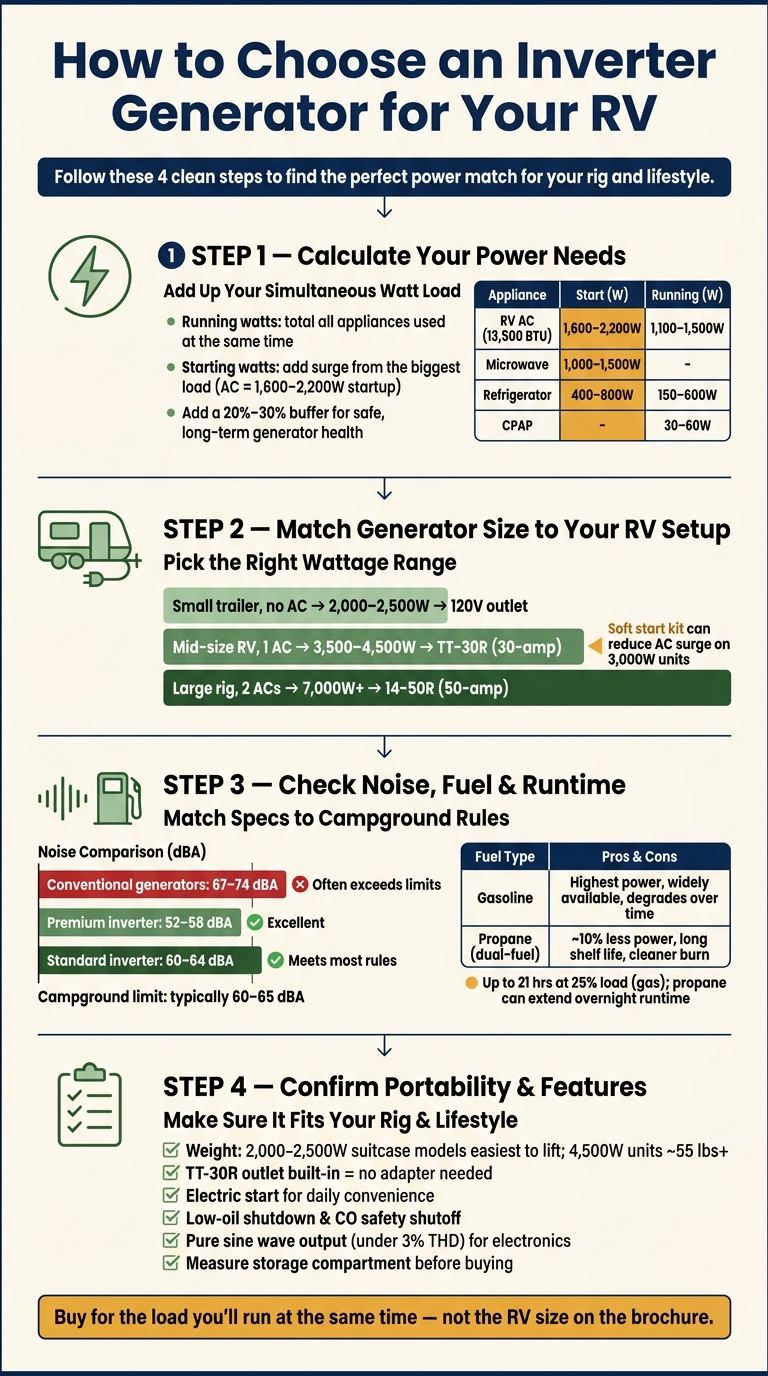
Most RV generator mistakes come down to four things: too few watts, the wrong outlet, too much noise, or too much weight. If I were picking one, I’d start with my actual power load, then check for a TT-30R or 14-50R outlet, a noise rating around 52–64 dBA, and enough headroom to stay about 20%–30% above my expected use.
Here’s the short version:
- I’d total the running watts for the items I plan to use at the same time.
- Then I’d add the startup surge from the single biggest load, which is often the 13,500 BTU AC.
- For a small RV with no AC, I’d look at 2,000–2,500 watts.
- For one AC plus basics, I’d look at 3,500–4,500 watts.
- For a large 50-amp rig with two AC units, I’d expect to need 7,000 watts or more.
- I’d also check fuel type, runtime, and whether I can actually lift and store the unit.
A few numbers matter more than the rest:
- Campground noise limits: often 60–65 dBA
- Inverter generator noise: often 52–61 dBA
- Safe electronics target: under 3% THD
- Big AC startup demand: about 1,600–2,200 watts
- Common generator weight range: many larger units can feel heavy fast, often 55 lbs. and up
| RV use | Watt range to look at | Main thing to check |
|---|---|---|
| Small trailer, no AC | 2,000–2,500W | Can it cover lights, fans, and charging? |
| Mid-size RV, 1 AC | 3,500–4,500W | Startup surge and TT-30R outlet |
| Large rig, 2 ACs | 7,000W+ | 50-amp hookup and storage space |
| Boondocking | 4,000W+ | Runtime, fuel type, and noise |
If I had to boil the whole choice down to one line, it would be this: buy for the load you’ll run at the same time, not the RV size printed on the brochure.
How to Size an Inverter Generator for Your RV: 4-Step Guide
Step 1: Calculate Your RV Power Needs
Before you compare generator models, get one number nailed down: how many watts your RV will use at the same time. That number tells you what generator size makes sense.
List the Appliances You Plan to Run at the Same Time
What matters is simultaneous load, not every appliance in the RV. If your AC, microwave, and refrigerator are running together, power use jumps fast. Then add smaller items like a TV, laptop, or CPAP machine, and you’ll get a more realistic view of peak demand.
Start with the biggest power users. In most RVs, those are the appliances that shape generator size.
| Appliance | Starting Watts | Running Watts |
|---|---|---|
| RV AC (13,500 BTU) | 1,600–2,200 | 1,100–1,500 |
| Microwave | 1,000–1,500 | 1,000–1,500 |
| Refrigerator | 400–800 | 150–600 |
| Coffee Maker | 800–1,000 | 600–900 |
| TV | 0 | 80–150 |
| Laptop / Electronics | 0 | 50–200 |
| CPAP Machine | 0 | 30–60 |
Understand the Difference Between Running Watts and Starting Watts
Running watts are the power an appliance uses once it’s operating normally. Starting watts - also called surge watts - are the short burst of extra power some appliances need when they first turn on. If your generator is too small, that startup burst can trip it.
The AC unit is usually the main issue. A standard 13,500 BTU RV air conditioner may need 1,600–2,200 starting watts, even though it only uses 1,100–1,500 running watts after it gets going. That’s why you don’t want to size a generator by steady use alone.
A simple way to think about it:
- Add up the running watts of everything you expect to use at once.
- Then add the starting watts of the single largest load, which is usually the AC.
Once you know that number, the next step is to check how it fits with your RV’s service.
Account for 30-Amp and 50-Amp RV Service and Add a Buffer
Your RV’s service type limits how much power you can use at one time. Most travel trailers have 30-amp service, while larger fifth wheels and Class A motorhomes often have 50-amp service.
If you own a 50-amp RV, you can still run it with a 30A generator. You just have to be selective. In plain English, that means you may need to skip running several high-draw appliances together, and using multiple AC units at once may not be practical.
After you total your load, add a 20%–30% buffer. That extra headroom matters. A generator tends to last longer and hold voltage better when it runs at about 70%–80% of rated load. That gives you a safer target for day-to-day RV use.
Next, match that wattage to your RV’s service and outlet type.
sbb-itb-501186b
Step 2: Match Generator Output to Your RV Setup
Once you have your wattage number from Step 1, sizing the generator gets a lot simpler.
Pick a Wattage Range Based on How You Camp
The way you camp has a huge effect on the size you need. A 2,000–2,500W inverter works well for pop-ups and small trailers that only need lights, fans, and electronics. No air conditioner.
If you want to run one 13,500 BTU AC with a fridge and microwave, step up to a 3,500–4,500W generator. And if you have a larger rig with two AC units, a residential fridge, or a washer, plan on 7,000W or more.
A soft start can cut AC startup surge on a 3,000W generator.
After wattage, look at the outlet your RV uses.
Check Outlets, Adapters, and RV Connection Fit
Wattage by itself doesn't mean the generator will plug right in. The outlet on the generator has to match your RV power cord, or you'll need an adapter.
Most travel trailers use a TT-30R (30-amp) receptacle, so it's smart to look for a generator that already has that outlet built in. Some generators come with locking outlets like L5-30R instead of a TT-30R. In that case, you'll need the proper adapter to connect a standard RV cord. A direct TT-30R connection means less hassle and fewer extra parts.
Then check power quality too. That part matters more than many people think, especially if you're running laptops, TVs, chargers, or other RV electronics.
Aim for under 3% THD to help protect RV electronics.
RV Load Level vs. Recommended Generator Size: Comparison Table
| RV Setup | Typical Load | Generator Size | Outlet Needed |
|---|---|---|---|
| Small trailer / pop-up | Lights, fans, electronics | 2,000W – 2,500W | 120V outlet or parallel kit |
| Mid-size trailer (1 AC) | 13.5k BTU AC, fridge, microwave | 3,500W – 4,500W | TT-30R (30-amp) |
| Large rig (2 ACs) | Dual ACs, residential fridge, washer | 7,000W – 9,500W | 14-50R (50-amp) |
| Off-grid camping | AC + propane appliances | 4,000W+ (dual-fuel or tri-fuel) | TT-30R or L5-30R with adapter |
Step 3: Review Noise, Fuel Use, and Runtime
Now it’s time to look at the specs that shape day-to-day campground use: noise, runtime, and fuel type.
Use Decibel Ratings to Find a Generator That Meets Campground Noise Limits
Start with the dBA rating and compare it with campground rules. Conventional generators often sit around 67 to 74 dBA, which can push them past the limit. Inverter generators are usually quieter, often landing between 52 and 64 dBA depending on load.
Check the noise rating at both 25% load and full load. That part matters more than it seems. A generator gets louder as demand goes up, so the quiet number on the spec sheet may not match what you hear once the air conditioner kicks on.
| Generator Type | Typical Noise Level | Campground Compatibility |
|---|---|---|
| Premium Inverter | 52–58 dBA | Excellent – well under most limits |
| Standard Inverter | 60–64 dBA | Good – meets most campground rules |
Compare Fuel Tank Size and Expected Runtime
Runtime matters most if you plan to use the generator overnight or run bigger loads for long stretches. Add air conditioning, and fuel burn goes up fast.
Some RV-focused inverter generators can run up to 21 hours at 25% load on one tank of gasoline. That’s plenty for overnight use or lighter power needs. But at heavier loads, runtime drops fast. So don’t get pulled in by the biggest number on the box.
Focus on the runtime that matches how you’ll use the generator most of the time.
Gasoline vs. Dual-Fuel: Which Works Better for RV Trips
Once runtime looks good, the next choice is fuel.
For most weekend RV trips, gasoline-only models are the simplest option. Gasoline is easy to find at gas stations and gives you the highest power output, which helps when you need full wattage to start a large AC unit. The downside is storage. Gasoline breaks down over time, so if the generator sits for a while, you may need a fuel stabilizer.
Dual-fuel models give you a second option: propane. Propane has a nearly indefinite shelf life, burns cleaner, and is easier to store. That can make life a lot easier if you don’t use your generator every week. Some compact dual-fuel units can stretch runtime from about 7 hours on gasoline to 12 hours on propane at 50% load.
There is a tradeoff, though. You usually lose a bit of output on propane. For example, a generator rated at 6,600W on gas may drop to about 5,940W on propane.
| Feature | Gasoline | Propane (Dual-Fuel) |
|---|---|---|
| Power Output | Highest; best for starting large AC units | Approx. 10% lower than gasoline |
| Fuel Availability | Widely available at all gas stations | Hardware stores, exchange centers |
| Storage | Degrades over time; needs stabilizer | Long shelf life; no degradation |
| Runtime Impact | Standard; varies by tank size | Can extend overnight runtime |
| Campsite Emissions | Standard exhaust | Cleaner burning; less odor |
Match the fuel type to your trip length, storage setup, and how easy it is to refuel on the road.
Step 4: Check Portability, Features, and Make Your Final Choice
Check Weight, Dimensions, and Storage Fit
After wattage, noise, and fuel, make sure the generator fits both your RV and the way you camp.
Start with weight. A 4,500W gas inverter generator can weigh around 55 lb, which is still a lot to move. So be honest about what you can lift. If you'll be moving it on your own, a 2,000W–2,500W suitcase model is usually easier to manage. A simple way to narrow your options is to set your wattage target first, then cut any model that you can't lift or store. You can also use two smaller parallel units to get the output of a larger setup.
Before you buy, measure your RV's cargo tray or storage compartment and compare those numbers with the generator's footprint. That step matters more than people think. Generators in the 3,500W–4,500W range often include integrated wheel kits and ergonomic handles, which can make moving them much less of a chore.
Look for RV-Specific Features That Improve Daily Use
Once you've confirmed the fit, focus on the features that make day-to-day camping easier.
A TT-30R outlet is usually the most practical RV-ready option. It lets you plug in directly without dealing with adapters.
Electric start also makes a big difference in daily use. Recoil cords are fine as a backup, but push-button start is simply easier. Some models also include Bluetooth monitoring, so you can check load and runtime from inside the RV.
A few other features are worth paying close attention to:
- Low-oil shutdown helps prevent engine damage.
- CO safety shutoff can turn the generator off if carbon monoxide reaches dangerous levels.
- Pure sine wave output with low THD helps protect sensitive electronics from resets and damage.
Conclusion: Choose Based on Load, Fit, Noise, and Trip Style
Pick based on load, fit, noise, and trip style. Start with your appliance load. Match that to your RV's 30A or 50A service. Then check noise and runtime against how you camp, and make sure the unit will physically fit in your storage space.
Skip one of those checks, and you can end up with a generator that's underpowered, too loud, or a pain to store.
If you're sourcing power generation equipment for your RV setup, Electrical Trader lists electrical components and power generation tools for RV power planning.
FAQs
Do I need a soft start for my RV AC?
It comes down to two things: your generator’s power capacity and your RV AC’s startup surge.
Most RV air conditioners pull a big burst of power when they first kick on. That startup surge is usually around 2,800 to 3,500 watts, based on the unit’s BTU size.
If your generator is right on the edge of that starting wattage, a soft start can lower the initial load and help prevent tripping or stalling.
If your generator has plenty of room to handle that surge, you may not need one.
Can I run a 50-amp RV on a 30-amp generator?
No. A 30-amp generator usually provides about 3,600 watts, which is enough for many 30-amp RVs, but not a 50-amp RV.
A 50-amp RV can draw up to 12,000 watts across both legs, especially if you’re running multiple air conditioners. With a 30-amp generator, you can run into overload or insufficient power fast.
Is a dual-fuel generator worth it for RV trips?
Yes, a dual-fuel generator can be worth it for RV trips because it gives you more than one way to keep the power on. You can run it on gasoline or propane, which makes life easier when one fuel is easier to find or cheaper during your trip.
Propane has a few clear upsides too. It burns cleaner, stores longer without going bad, and is often easier to keep on hand safely. For RV travel, that extra fuel choice can make a big difference, especially if you want less hassle and more control over runtime.