Ultimate Guide to Economic Trends in Electrical Equipment Markets
The electrical equipment market is shifting fast, with rising prices, longer lead times, and growing demand driven by data centers, electrification, and grid modernization. Here's what you need to know:
- Prices are skyrocketing: Power transformer costs are up 77% since 2019, with copper prices jumping over 70% since 2020.
- Lead times are extensive: Large power transformers now take 128–144 weeks to deliver, while generator step-up transformers exceed 210 weeks.
- Demand is surging: U.S. electricity consumption is expected to grow 20–25% by 2030, with data centers projected to dominate 40% of the market by 2030.
- Federal policies are influencing costs: A 15% tariff on imported grid equipment will increase to 25% in 2028, impacting budgets.
Key takeaway: Plan ahead, secure equipment early, and consider alternative suppliers to manage costs and avoid delays. The market's rapid evolution demands proactive procurement strategies.
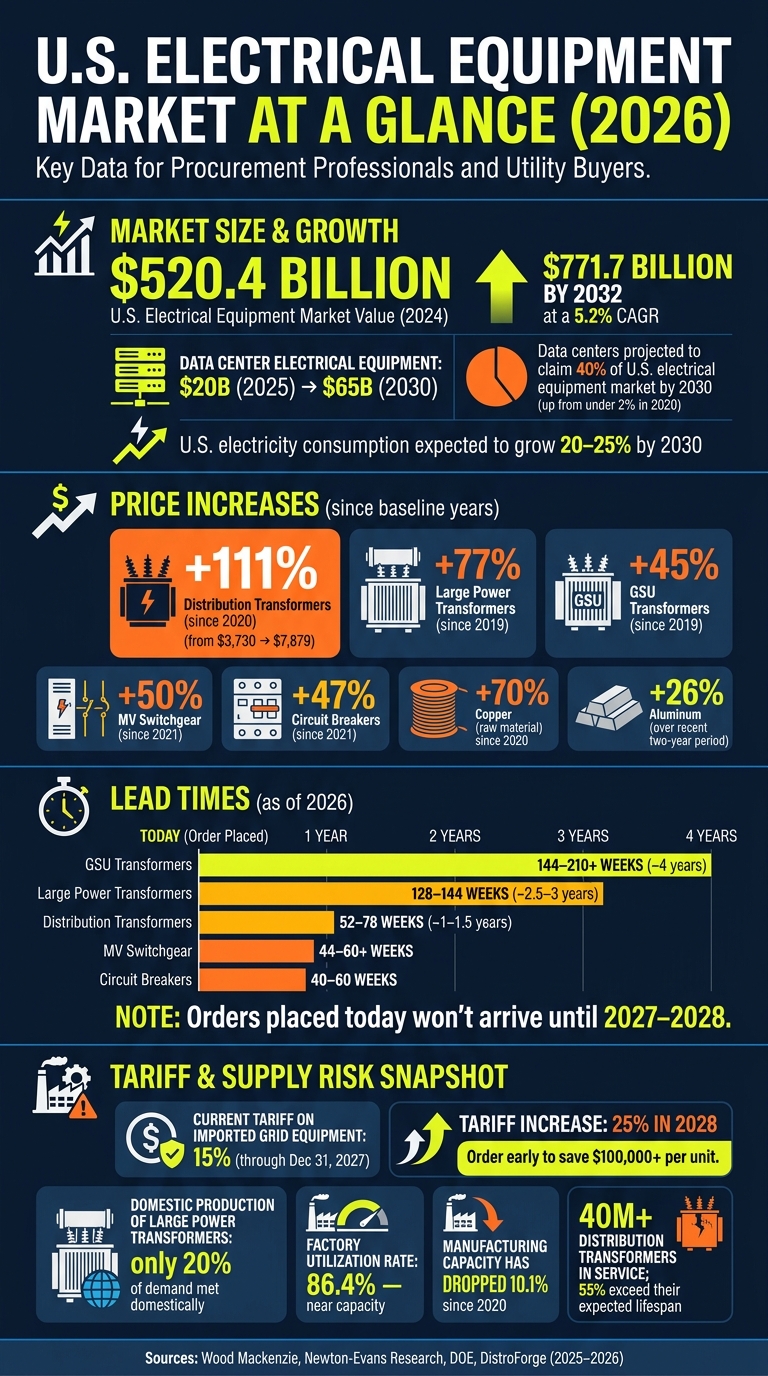
U.S. Electrical Equipment Market: Key Stats, Lead Times & Price Surges (2026)
Why Electricity Demand Is Reshaping the Power Industry
sbb-itb-501186b
Key Economic Growth Drivers
These economic forces explain the rapid changes noted earlier and highlight the shifts shaping the U.S. electrical equipment market. By understanding these trends, you can better anticipate how prices, lead times, and procurement challenges might evolve.
GDP Growth and Industrial Expansion
The U.S. electrical equipment market, valued at $520.4 billion in 2024, is expected to grow to $771.7 billion by 2032, with a CAGR of 5.2%. This growth aligns with broader economic shifts driven by manufacturing reshoring, AI infrastructure development, and the electrification of transportation - all of which are increasing demand for power-intensive industries.
Electricity demand in the U.S. is forecasted to rise by 20% to 25% by 2030, with peak-load growth projections surging from 24 GW in 2022 to 166 GW in 2025. This rapid acceleration underscores the growing influence of industrial and digital loads. Utilities remain the largest end-use sector, accounting for 60% of market revenue in 2024.
"Data centers are fundamentally different from any load the electrical equipment industry has supported before. This is a structural shift that will define the next decade of the electrical equipment market." - Ben Boucher, Senior Analyst, Wood Mackenzie
These trends are already reshaping pricing and lead times across the industry.
Construction Activity and Electrification
Construction activity shows a mixed picture: while traditional office and residential projects remain sluggish, data center and institutional developments are booming. Electrical work typically represents 10% of a construction project's cost, but for data centers, that figure jumps to 33%–40% due to their immense power needs.
In March 2025, Siemens AG invested $285 million to open factories in California and Texas, aimed at producing electrical equipment for AI-driven data centers. Similarly, Cooper University Health Care announced plans in February 2025 for a $3 billion hospital expansion in Camden, NJ, demonstrating how institutional projects are maintaining steady demand.
The nationwide push toward electrification is also creating additional demand. Projects like EV charging infrastructure, energy-efficient motors, and smart building systems are all contributing to this surge.
Grid Modernization and Renewable Energy Integration
An aging grid and the integration of renewable energy are further driving demand for electrical equipment. Over 40 million distribution transformers - more than half of the current fleet - are already past their expected service life. Replacing these transformers is essential, ensuring a steady, long-term need for equipment regardless of economic fluctuations.
Federal initiatives are accelerating these efforts. In April 2026, the Defense Production Act was invoked to boost domestic manufacturing of transformers, substations, and high-voltage components. Additionally, the U.S. Department of Energy allocated $375 million in January 2026 to strengthen the transformer supply chain. Manufacturers have committed nearly $2 billion to increase North American transformer capacity since 2023. Notable projects include Hitachi Energy’s $457 million facility in South Boston, Virginia - set to become the largest power transformer plant in the U.S. by 2028 - and Siemens Energy’s $150 million plant in Charlotte, North Carolina, which is expected to begin production in early 2027.
Meanwhile, renewable energy projects are surging. Solar and battery installations now account for two-thirds of all capacity in the interconnection development queue. Additionally, 41,000 miles of new transmission projects above 100 kV are either under construction or in planning. These large-scale efforts require vast amounts of specialized equipment like generator step-up (GSU) units and advanced switchgear, ensuring supply chain pressures will persist for years to come.
Market Size and Growth Outlook
Current Market Size
The U.S. electrical equipment market ranks as one of the largest industrial sectors in the country. With a valuation of $520.4 billion in 2024, it spans essential products like electric motors, switchgear, transformers, and tools for power generation. Electric motors dominate the market, making up 70% of its value, driven by demand from industries such as manufacturing, automotive, and HVAC. Breaking it down further, power transmission and distribution (T&D) equipment was valued at $31.5 billion in 2024, while the U.S. switchgear market reached $17.31 billion in 2025.
| Market Segment | 2024/2025 Value | Projected Value | CAGR |
|---|---|---|---|
| Total U.S. Electrical Equipment | $520.4B | $771.7B (2032) | 5.2% |
| Power T&D Equipment | $31.5B | $71.5B (2035) | 7.74% |
| Data Center Electrical Equipment | $20B | $65B (2030) | - |
| U.S. Switchgear Market | $17.31B | $22.79B (2031) | 4.69% |
Regionally, the South accounts for 40% of the market share, while the West emerges as the fastest-growing area, fueled by investments in renewable energy and the expansion of technology infrastructure. These strong foundations are paving the way for growth across various segments.
Future Growth Projections
Looking ahead, the market is expected to hit $771.7 billion by 2032, with a steady growth rate of 5.2% CAGR. The data center electrical equipment market, in particular, is forecast to skyrocket from $20 billion in 2025 to $65 billion by 2030, potentially capturing 40% of the U.S. electrical equipment market - a significant leap from under 2% in 2020.
"Manufacturers face a stark choice: invest significant capital to expand capacity, or cede market share in what could be a $65 billion market by 2030." - Ben Boucher, Senior Analyst, Wood Mackenzie
Among product categories, medium-voltage equipment (1–69 kV) is experiencing a 6.5% CAGR, while high-voltage switchgear is growing at a 6.54% CAGR through 2031. The hyperscale data center segment is also driving demand for padmount transformers, with projected growth from 1,573 units in 2025 to 9,395 units by 2030.
Federal programs are playing a critical role in this expansion. Initiatives like the $10.5 billion Grid Resilience and Innovation Partnerships (GRIP) and incentives from the Inflation Reduction Act are channeling funds into grid modernization and boosting domestic manufacturing.
Pricing and Cost Trends
Material Costs and Supply Chain Challenges
The cost of electrical equipment has been climbing steadily, driven by sharp increases in raw material prices. For example, copper prices have surged over 70% since 2020, with spot prices hitting $12,835 per metric ton by March 2026. Aluminum has also seen a significant rise, up 26% over a recent two-year period. These increases, combined with structural shifts in the industry, have caused transformer prices to double over the past five years.
To put this into perspective, a standard distribution transformer that cost $3,730 in 2020 now costs $7,879 - a staggering 111% increase by March 2026. Other equipment has experienced similar trends: large power transformers are up 77% since 2019, circuit breakers have increased by 47% since 2021, and medium-voltage (MV) switchgear prices have risen 50%.
Supply chain issues only add to these challenges. The U.S. heavily depends on imports for critical components, with domestic production meeting just 20% of the demand for large power transformers. Compounding this, 95% of U.S. transformer cores rely on Grain-Oriented Electrical Steel (GOES), but Cleveland-Cliffs, the sole domestic supplier, covers only 12–20% of the market needs. This dependency creates a fragile supply chain, leading to extended lead times for essential equipment.
Here’s a snapshot of lead times and price changes for key equipment as of 2026:
| Equipment Type | Lead Time (2026) | Price Change |
|---|---|---|
| Large Power Transformers | 128–144 weeks | +77% since 2019 |
| GSU Transformers | 144–210+ weeks | +45% since 2019 |
| Distribution Transformers | 52–78 weeks | +95% (certain classes) |
| MV Switchgear | 44–60+ weeks | +50% since 2021 |
| Circuit Breakers | 40–60 weeks | +47% since 2021 |
Adding to the complexity, a tariff restructuring in April 2026 replaced the flat 50% Section 232 duty on metal content with a four-tier system. Finished grid equipment, like transformers and switchgear, now carries a 15% tariff on the full customs value through the end of 2027. For example, a $1.4 million imported large power transformer now incurs a $210,000 tariff - down from $350,000 under the previous system. However, this relief is temporary, as the tariff rate will rise to 25% in 2028.
"Growth in real market demand is significantly lower than total year-over-year market value increases would suggest. This is largely due to inflationary pressures, caused by rising prices for key commodities." - Charles Newton, President, Newton-Evans Research Company
These rising costs and extended lead times are squeezing contractors, forcing them to operate on tighter margins.
Labor Costs and Contractor Pricing
While material costs rise, labor expenses and contractor margins are feeling the pinch. Electrical contractors typically work with net profit margins of just 6–7%, leaving little room to absorb unexpected cost surges. Meanwhile, manufacturers have managed to expand their margins significantly. For instance, Eaton’s margins grew by more than 500 basis points, largely due to constrained supply boosting pricing power.
An added challenge is that only 34% of construction contracts include material escalation clauses. This means most contractors lack protection against the 50–85% price hikes seen across various electrical equipment categories. The time between bidding and purchasing also creates risks. For smaller commercial projects, this window averages four months, but for larger projects like data centers, it can stretch up to 28 months.
To mitigate these challenges, contractors should prioritize negotiating escalation clauses, especially for large or long-term projects. Additionally, for equipment with lead times under 18 months, placing orders before mid-2026 can lock in the current 15% tariff rate before it increases to 25% in 2028.
Demand by Equipment Segment
Breakers and Transformers
The U.S. transformer market is grappling with a significant supply-demand imbalance. Since 2019, demand for power transformers has surged by 119%, while distribution transformers have seen a 34% increase. However, supply hasn't kept pace, with power transformers experiencing a 30% shortfall and distribution transformers a 10% shortfall.
Aging infrastructure is adding to the problem. Over half of the 40 million in-service distribution transformers - about 55% - are more than 33 years old, exceeding their expected lifespan. This aging fleet is driving a wave of replacement needs, competing with new construction projects for limited manufacturing capacity.
"On average, it takes three years to acquire high-voltage transformers and one year for distribution transformers." - Adrienne Lotto, Senior Vice President, American Public Power Association
Circuit breakers and switchgear are also in tight supply. Medium-voltage circuit breakers and high-voltage switchgear are particularly affected. As a result, utilities are prioritizing early procurement strategies to secure the equipment they need in a competitive market.
These challenges are reshaping demand trends across both low- and high-voltage equipment.
Low-Voltage and High-Voltage Equipment
By 2030, data centers are expected to drive 68% of U.S. electricity load growth, accounting for 40% of equipment purchases - far outpacing the impact of electric vehicle adoption. Major players like Microsoft, Google, and AWS are securing long-term factory capacity agreements, leaving smaller buyers and municipal utilities scrambling for the remaining slots. The demand for medium-voltage switchgear is projected to grow by 498% between 2025 and 2030.
"Hyperscale data center buyers are absorbing the dominant share of OEM allocation; non-data-center utilities are de facto deprioritized." - DistroForge
At the higher voltage end, utilities are filing for ambitious 765-kV transmission projects in states like Texas to accommodate new energy loads. For example, in March 2026, Entergy Louisiana expanded the Meta Hyperion campus to a 5 GW target, requiring HV/MV step-down transformers at eight substations and 500-kV autotransformers to support 240 miles of new transmission.
Power Generation Tools
The demand for power generation tools has skyrocketed, fueled by the growth of both renewable and traditional energy projects. Generator step-up (GSU) transformers, for instance, have seen a 274% increase in demand since 2019, driven by renewable energy, gas, and battery storage projects. However, lead times for these GSUs now exceed 210 weeks, creating additional challenges for project planning.
In February 2026, Southern Company secured a $26.5 billion DOE loan to fund 16 GW of new nuclear, gas, battery energy storage, and hydropower projects. This investment has created sustained demand for GSUs and high-voltage circuit breakers. Similarly, Michigan regulators approved a 1,332 MW battery storage portfolio for DTE Electric in March 2026, including the 450 MW "Big Mitten" project, which requires several transformers in the 100+ MVA class.
"The grid supply chain crunch is already impacting utility bills, threatening reliability, and stalling critical projects, from power plants and data centers to new housing construction." - Ellie Garland and Ben Feshbach, RMI
With 2.6 TW of generation and storage capacity currently in U.S. interconnection queues, utilities planning for projects in 2027–2028 must act quickly to secure equipment orders.
Regional and Industry-Specific Forecasts
U.S. Market vs. Global Trends
The U.S. electrical equipment market is expanding quickly but relies heavily on imports to meet its needs. Right now, domestic manufacturers supply only 20% of the demand for large power transformers (LPTs), while imports from countries like Mexico, Southeast Asia, and Europe fill the remaining gap. Overall, about 75% of the U.S. demand for power conversion equipment is met through imports. This reliance is driving significant investment in North American manufacturing, which, in turn, is adding to pricing and lead-time challenges across the industry.
Recent efforts to shift production back to the U.S. are evident in projects like Hitachi Energy's new North American facility and Siemens Energy's planned plant in Charlotte. These developments are part of a broader reshoring trend, even though domestic units often cost 10%–25% more due to higher labor costs and the complexity of producing over 80,000 custom transformer designs, which limits economies of scale. Federal policies are also playing a big role here. Programs like the Defense Production Act, the CHIPS Act, and the Inflation Reduction Act are funneling billions into domestic manufacturing, shaping both procurement strategies and long-term pricing for buyers and suppliers.
"The products that NEMA members make are integral to a secure, reliable and affordable grid, and we need to use every tool in the toolbox to help make more of those here at home." - Spencer Pederson, Senior Vice President of Public Affairs, National Electrical Manufacturers Association
Industry-Specific Opportunities
Shifts in manufacturing locations and supportive regulations are creating varied growth patterns across industries, with data centers and utilities standing out. The U.S. market is showing a clear divide: while data center and industrial sectors are thriving, residential construction and parts of nonresidential construction are under recessionary pressure. Broader nonresidential construction is projected to shrink by 1.9% in 2026, but electric power construction is expected to grow by 6.5% in the same year.
Data centers are leading the charge. Spending on electrical equipment for U.S. data centers is forecasted to jump from $20 billion in 2025 to $65 billion by 2030. During this period, their capacity is expected to grow from 24 GW to 110 GW. Analysts see this as a fundamental shift in market demand, with data centers shaping the future of the electrical equipment industry. Facilities driven by AI alone could account for 40%–50% of total U.S. electricity demand growth through 2030.
Utilities and grid modernization projects are another area of strong demand. U.S. electricity consumption is expected to grow by 1.3% in 2026 and 3.1% in 2027. To handle this growth, the country will need to construct around 5,000 miles of high-voltage transmission lines annually - far above the 888 miles built in 2024.
What Buyers and Sellers Should Know
Inventory Planning and Procurement
Right now, buyers need to treat procurement as a strategic priority. Utilities and engineering firms that secure equipment early are the ones keeping projects on track. Why? Because current OEM lead times are staggering - over 2.5 years for LPTs and up to 4 years for GSUs. If you're not planning well in advance, you're already falling behind.
The urgency is amplified by tariffs. A 15% tariff is in place until December 31, 2027, but it will jump to 25% in 2028. Ordering by early 2026 or 2027 could save you over $100,000 per unit, avoiding the higher rates after the deadline.
Supplier diversification is another must. The "Big Four" manufacturers often prioritize hyperscale data center contracts through long-term agreements, leaving smaller utilities and contractors scrambling for limited production slots. To avoid getting squeezed out, team up with both a primary OEM and an independent supplier. Many mid-tier and independent suppliers can deliver substation transformers in 12–14 months, provided engineering drawings are approved quickly - a much faster option compared to OEM timelines.
Another smart move? Add material escalation clauses to your contracts. Right now, only 34% of construction contracts include these clauses, despite the fact that transformer prices have surged by 77%–85% since 2019. Without this protection, you could end up paying far more than the price locked in at the purchase order.
"The price you locked at PO is no longer the price you pay at delivery. Most municipal and cooperative procurement processes assume PO price equals delivered price." - DistroForge Research
When traditional procurement methods can't keep up, alternative sourcing strategies become essential.
Using Online Marketplaces Like Electrical Trader
OEM backlogs and rigid vendor lists often create bottlenecks, but online marketplaces offer a practical workaround. Platforms like Electrical Trader expand your supplier options, connecting you with independent distributors and sellers who have inventory ready to go - inventory that traditional procurement channels might overlook.
This flexibility is critical during emergencies. Utilities with pre-staged inventory have restored service in 4–5 days after recent storms, compared to 9–10 days for those without it. When a transformer fails unexpectedly, waiting years for an OEM order simply isn't feasible. Online marketplaces link buyers to distributors with strategic stock of breakers, transformers, switchgear, and power generation equipment - all available without the multi-year delays.
"There is not a shortage... It's all exaggerated to drive pricing. I'm telling you that we can get the supplies they need, but they don't ask." - Patrick Tarver, Owner, Bolt Electrical LLC
For sellers, these platforms provide a way to move surplus or used inventory quickly. Whether you're an electrician clearing out extra stock or a distributor dealing with overstock from canceled projects, listing on a marketplace like Electrical Trader puts your equipment in front of buyers actively searching for alternatives to long OEM lead times. From low-voltage breakers to high-voltage substation gear, these platforms cater to both routine procurement and urgent sourcing needs.
Key Takeaways
The electrical equipment market is undergoing dramatic shifts that challenge traditional norms. Since 2020, manufacturing capacity has dropped by 10.1%, even as demand continues to climb. Factories are currently operating at 86.4% capacity, leaving little room to handle new orders quickly. At the same time, power transformer prices have surged by 77% since 2019, and generator step-up transformer lead times now average a staggering 144 weeks - nearly three years. These supply constraints are expected to persist at least until 2030, creating a fundamentally different market landscape.
The market is splitting into two distinct segments. Hyperscale operators like Google, Microsoft, and AWS are locking in long-term OEM production agreements, effectively monopolizing capacity and leaving smaller buyers struggling to secure equipment. Data centers are projected to claim 40% of the U.S. market by 2030, and failing to account for this shift in procurement strategies could leave some buyers at a disadvantage.
Adding to these challenges, trade policy is amplifying financial risks. The current 15% Section 232 tariff on grid equipment, including transformers and switchgear, will remain in place until December 31, 2027, before rising to 25% in 2028. This makes auditing open purchase orders for tariff exposure an essential step in protecting budgets.
Here’s a snapshot of the most pressing risks and opportunities:
| Factor | Current Status | Key Consideration |
|---|---|---|
| Power transformer lead times | 128–144 weeks | Orders placed now won’t arrive until 2027–2028 |
| Tariff rate (grid equipment) | 15% through Dec 2027 | Increases to 25% in 2028 |
| Factory utilization | 86.4% | No immediate capacity relief |
| Distribution transformer cost | Up ~111% since 2020 | Escalation clauses in contracts are critical |
| Data center demand share | 40% of U.S. market by 2030 | Further limits options for mid-market buyers |
Staying ahead of these trends is crucial for managing project budgets and timelines effectively. Monitoring lead times, tariff schedules, and commodity prices allows buyers and sellers to make informed decisions, avoiding costly surprises and positioning themselves for success in this evolving market.
FAQs
How early should I order transformers and switchgear to avoid delays?
To avoid project delays, it's crucial to order transformers and switchgear far ahead of time. High-voltage transformers often take 2–3 years to produce, and specialized units might require as long as 4 years. Distribution transformers generally have a lead time of about 75 weeks. These timelines can fluctuate, so experts advise securing orders with manufacturers several years in advance and staying in regular contact to monitor progress. Platforms like Electrical Trader offer valuable insights and access to equipment, helping navigate these extended wait periods effectively.
What contract terms protect me from equipment price hikes?
Contracts that include material escalation clauses or price adjustment provisions can help protect you from rising equipment costs. Despite this, only around 34% of construction contracts have such clauses, meaning the majority of contractors are left exposed to major price fluctuations.
How can I source gear faster if OEM lead times are years long?
To get equipment quicker during long OEM lead times, you might want to explore buying production slots at a premium or refurbishing equipment you already have to meet urgent demands. Platforms like Electrical Trader offer a convenient marketplace for both new and used electrical components, making it easier to sidestep lengthy manufacturer wait times. Another effective approach is programmatic planning, which involves reserving production capacity early and standardizing parts to reduce supply chain bottlenecks.