Energy Policy Impact on Power Equipment Pricing
The U.S. power equipment market is facing steep cost increases due to recent policy changes and supply chain challenges. Here's what you need to know:
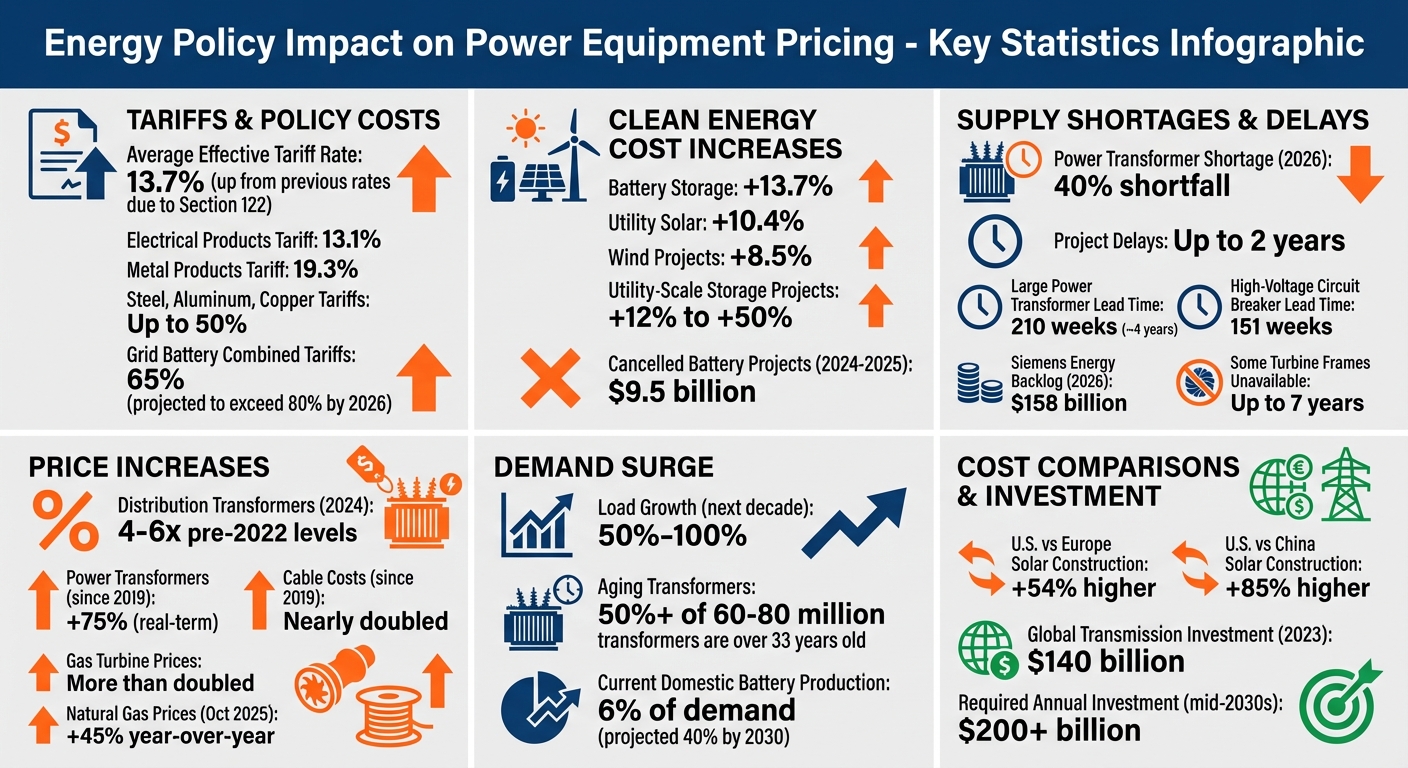
- Tariffs: A new 15% flat import tariff under Section 122 has raised the average effective tariff rate to 13.7%, with electrical and metal products seeing rates of 13.1% and 19.3%, respectively.
- Clean Energy Costs: Costs for battery storage have risen by 13.7%, utility solar by 10.4%, and wind projects by 8.5%, partly due to the repeal of clean energy tax credits.
- Transformer Shortages: The supply of power transformers is expected to fall short by 40% in 2026, causing project delays of up to two years.
- Material Tariffs: Steel, aluminum, and copper tariffs (up to 50%) have driven up manufacturing costs, especially for transformer components.
- Demand Surge: Load growth of 50%-100% over the next decade, driven by new data centers and electrification, is straining the grid and equipment supply.
Businesses are responding by leveraging online marketplaces, locking in long-term agreements, and advocating for regulatory reform to manage costs and delays. However, systemic challenges like aging infrastructure and material shortages remain critical obstacles.
Energy Policy Impact on Power Equipment Costs: Key Statistics and Market Trends
How Energy Policies Affect Equipment Costs
Recent regulatory changes have significantly influenced the cost of power equipment, reshaping procurement strategies and adding layers of complexity to pricing and market trends. Factors like tax policy changes, material tariffs, and state-specific regulations are playing a key role in driving up costs.
Removal of Clean Energy Tax Credits
The Section 45X Advanced Manufacturing Production Credit was introduced to encourage domestic production by offering incentives of $35 per kilowatt-hour for battery cells and $10 per kilowatt-hour for battery modules. However, strict sourcing requirements and Foreign Entity of Concern (FEOC) rules have excluded many projects from these benefits. This has left developers with tough choices: either switch to more expensive suppliers or bear the full cost of equipment without federal assistance.
Between 2024 and 2025, uncertainty surrounding eligibility for these credits led to the cancellation of $9.5 billion worth of battery projects. By 2025, domestic production was only meeting 6% of demand, with projections suggesting it could reach 40% by 2030. These challenges have driven up utility-scale storage project costs by 12% to over 50%.
"The federal government is simultaneously subsidizing the clean energy industry while taxing its most critical and cost-effective inputs." – ARC Advisory Group
Material Tariffs and Their Impact
The 50% tariffs on steel, aluminum, and copper introduced during the Trump administration in 2025 have heavily impacted the economics of manufacturing power equipment. These tariffs don’t just apply to raw materials but also to the steel content in finished products, making imported transformers particularly costly due to their steel cores.
Materials typically account for 20% to 30% of the total cost of transmission projects, so these tariffs have had a significant effect. For example, gas turbine prices have more than doubled in recent years as manufacturers struggle to meet rising demand.
A particularly acute issue lies with electrical steel - a critical material for transformers that remains scarce domestically. In August 2025, Dominion Energy reported price increases for its 2.6-GW offshore wind farm project, attributing the rise to the impact of these tariffs.
State-level mandates further add to these cost challenges by creating regional variations in equipment needs.
State-Level Policy Differences
State mandates have led to diverse equipment demands across regions. States with ambitious renewable energy goals are heavily investing in solar-plus-storage systems, while others focus on gas turbines to ensure reliable power for data centers. This regional variation drives localized pricing differences as suppliers respond to concentrated demand.
The cost of solar construction in the U.S. is 54% higher than in Europe and 85% higher than in China, largely due to inefficient transmission policies and inconsistent interconnection requirements. Additionally, projects that rely on non-domestic components risk losing access to federal tax credits.
"In a business with 5-to-10-year planning cycles, not knowing what a project will cost next year or the year after is disruptive and causes massive uncertainty for US power industry participants." – Chris Seiple, Vice Chairman of Power and Renewables, Wood Mackenzie
Surging demand from data centers and the rapid adoption of electric vehicles have also created supply-demand imbalances for critical equipment like 3-phase transformers. Combined tariff rates on grid batteries have reached 65% and are projected to exceed 80% by 2026.
Market Trends Driving Price Increases
The power equipment market is grappling with significant challenges as supply chains feel the pressure of rising electricity demand and an outdated grid. These factors are creating a tough environment for pricing stability.
Data Center Growth and Grid Modernization
The explosive growth of AI-powered data centers is pushing manufacturers to their limits, leading to multiyear delays in fulfilling orders. Siemens Energy, for example, reported a staggering $158 billion backlog in 2026, with some turbine frames unavailable for up to seven years. In early 2026, two data centers in Silicon Valley faced delays due to a lack of electrical equipment, highlighting the severity of supply shortages.
Adding to the strain is the aging U.S. power grid. More than half of the country's 60–80 million high-voltage transformers are over 33 years old. Utilities are now tasked with replacing outdated equipment while simultaneously increasing capacity to support renewable energy and electrification efforts. This has effectively doubled the demand for transformers. By 2024, lead times for large power transformers stretched to 210 weeks (roughly four years), and high-voltage circuit breakers required about 151 weeks for delivery - double the wait times seen before the pandemic.
Compounding the issue is the fact that the U.S. has just one domestic producer of grain-oriented electrical steel, a critical material for transformers. Transporting these massive transformers poses another challenge, as only 10 super-heavy-load railcars in the U.S. are capable of handling the 100–400 ton weight.
"Until the underlying supply-chain choke points – steel, copper, insulation materials and heavy transport – expand meaningfully, utilities are managing reliability not through construction, but through choreography." – Morgan Bazilian, Professor of Public Policy and Director, Payne Institute, Colorado School of Mines
Inflation and Energy Price Volatility
Inflation is magnifying the impact of supply shortages on equipment prices. By 2024, the cost of distribution transformers had risen to 4–6 times their pre-2022 levels. Power transformer prices saw a real-term increase of about 75% since 2019, while cable costs nearly doubled over the same period. Tariffs have also contributed, adding approximately 0.7 percentage points to the overall Consumer Price Index by September 2025.
Manufacturers, anticipating higher import costs, have adjusted prices proactively. Between March and September 2025, prices for imported goods climbed 5.4%, while domestically produced goods saw a 3% increase as companies passed along rising input costs. Meanwhile, global investment in power transmission hit $140 billion in 2023, but experts estimate that annual spending will need to exceed $200 billion by the mid-2030s to keep up with demand.
sbb-itb-501186b
Cost Management Strategies
With equipment prices climbing and lead times stretching into years, managing costs effectively has become essential. By combining smart procurement methods, strategic timing, and pushing for systemic regulatory changes, professionals can keep spending under control without delaying projects.
Using Online Marketplaces for Equipment
Online marketplaces are transforming how professionals source equipment, offering a practical way to cut costs. The global B2B e-commerce market for power tools and accessories was valued at $56.84 billion in 2024, with projections showing a growth rate of 23.7% annually from 2025 to 2030. These platforms bring transparency to pricing and provide access to surplus inventory, which can lead to noticeable savings.
Platforms like Electrical Trader make it easy to compare prices for new and used equipment, such as breakers, transformers, and power generation tools, all in one place. Opting for pre-owned or surplus equipment through these marketplaces not only reduces costs but can also bypass the long wait times often associated with ordering new equipment.
Digital tools also streamline the purchasing process. Automated B2B platforms minimize errors from manual data entry and free up employee time. Interestingly, online order values have shown an average increase of up to 20%, thanks to the ease of finding suitable products through digital catalogs. For hefty equipment like transformers or switchgear, features such as "Buy Online, Pick Up In-Store" (BOPIS) help avoid expensive shipping fees.
Optimizing Purchase Timing
When it comes to major equipment, timing is everything. Reserving production slots years in advance and leveraging regional price differences can help secure better deals before supply tightens further. Locking in prices through multi-year agreements with multiple vendors also helps mitigate the impact of market volatility and rising material costs.
Fuel-dependent equipment is particularly vulnerable to price fluctuations. For example, natural gas prices rose 45% year-over-year in October 2025 and are expected to increase another 16% by October 2026. This makes timing purchases even more critical. For projects taking advantage of federal tax credits, aligning purchases with "construction start" and "safe-harbor" deadlines can ensure compliance while maximizing financial benefits. Early 2025 saw $30 billion in clean-energy tax credits traded through transferability provisions, with the figure expected to hit $50 billion by year-end. Selling unused credits through these provisions can generate liquidity to offset higher equipment costs.
While strategic timing can yield immediate savings, addressing larger policy issues is essential for achieving long-term cost stability.
Supporting Regulatory Reform
Outdated utility regulations often prioritize capital spending over cost efficiency, leading to unnecessarily high bills for customers. Advocating for regulatory changes that reward cost-effective solutions rather than excessive capital deployment is a vital step forward.
"The traditional electric utility regulatory framework... creates incentives that run counter to cost control. Without thoughtful reforms, these perverse incentives will likely result in customer bills that are higher than necessary." – RMI
Key areas for reform include promoting proactive distribution planning instead of relying on reactive, request-based upgrades. This approach helps avoid the compounded costs that come with piecemeal improvements. Additionally, standardized cost-sharing frameworks can ensure that expenses for grid upgrades are distributed more fairly among developers and large loads. For example, Minnesota uses standardized cost-sharing fees, while Massachusetts is experimenting with a Proactive Hosting Capacity Fee that includes strong rate-impact caps.
Encouraging competitive procurement processes is another important step. These processes help uncover cost-effective equipment solutions and push utilities to consider non-wires alternatives before approving expensive upgrades. When combined with smart procurement and well-timed purchases, these regulatory reforms create a more comprehensive strategy for managing costs in an unpredictable market.
Conclusion
Regional energy policies are reshaping the power equipment industry in profound ways. With average effective tariffs climbing to 23.5% and a projected 40% shortfall in power transformer supply by 2025, businesses are under immense financial strain. These challenges are causing delays in project timelines, stretching budgets, and complicating operations across the board.
"The uncertainty shock that hit the U.S. economy in the first quarter of 2025 was historically large, even surpassing the shock associated with the COVID-19 pandemic." – Federal Reserve Bank of St. Louis
In response to these pressures, businesses are adopting a mix of strategies. Platforms like Electrical Trader are proving invaluable for smart sourcing, helping companies navigate equipment shortages and avoid traditional delays. Securing long-lead items early and locking in multi-year pricing agreements are also key tactics to buffer against market volatility. However, addressing these issues on a systemic level will require more than just individual efforts. Pushing for regulatory changes that emphasize cost efficiency and standardized cost-sharing frameworks is critical for long-term stability.
The combination of tariff increases, supply chain bottlenecks, and shifting trade policies demands immediate action. Businesses that diversify their supply chains and use digital tools to maintain visibility in procurement will be better equipped to manage ongoing disruptions. With transformer supplies unlikely to stabilize until 2030 and gas turbine prices more than doubling, the need for proactive measures has never been more urgent.
FAQs
Which power equipment prices are most likely to rise next?
Prices for power distribution transformers are likely to rise as extended lead times and supply chain disruptions continue to affect the market. These challenges are tied to recent energy policies and surging demand. Over the past three years, shortages have already pushed prices up by 4 to 9 times, highlighting just how sensitive transformers are to further price increases.
How can I reduce transformer lead times for my project?
To shorten transformer lead times, it’s critical to plan early and get your orders in as soon as possible. Current supply chain issues have stretched timelines, so acting ahead is key. You might also consider working with overseas manufacturers, though it’s worth noting that this could lead to higher costs. Collaborating closely with your suppliers can help prioritize your order, and looking into alternative designs that are easier to source might be another way to speed things up. Staying updated on energy policies and supply chain news can also give you the insight needed to fine-tune your procurement strategy.
When should I lock in pricing to avoid tariff spikes?
To keep costs under control and avoid unexpected tariff increases, it's important to lock in pricing as soon as possible. Tariffs can drive up costs by as much as 25% and cause delays in lead times. By planning ahead and acting early, you can reduce these risks and maintain better control over your expenses.
Related Blog Posts
- Supply Chain Delays from Energy Policy Changes
- Regional Supply Chain Delays for Transformers
- Power Equipment Supply Chains: Regional Challenges
- Transformer Shortages: Supply Chain Impact on Pricing