Regional Supply Chain Delays for Transformers
The U.S. is facing severe delays in transformer supply chains, impacting power distribution, renewable energy projects, and grid modernization. Key issues include:
- Skyrocketing Demand: Since 2019, demand for power transformers rose 119%, with generator step-up (GSU) units up 274%.
- Import Reliance: 80% of power transformers and 50% of distribution transformers are imported, leaving the U.S. vulnerable to global disruptions.
- Material Shortages: Critical materials like grain-oriented electrical steel (GOES) and copper are in short supply, driving up costs.
- Extended Lead Times: Delivery times for large power transformers now average 128 weeks, with some delays reaching up to 210 weeks.
- Rising Costs: Transformer prices have increased 60%–80% since 2020, with tariffs on copper and steel worsening the situation.
Domestic production is struggling to keep up due to underinvestment, labor shortages, and material constraints. Investments of $2 billion since 2023 aim to expand capacity, but relief isn’t expected until 2027–2028. For now, utilities must plan years ahead to secure equipment, with delays likely to persist into the 2030s.
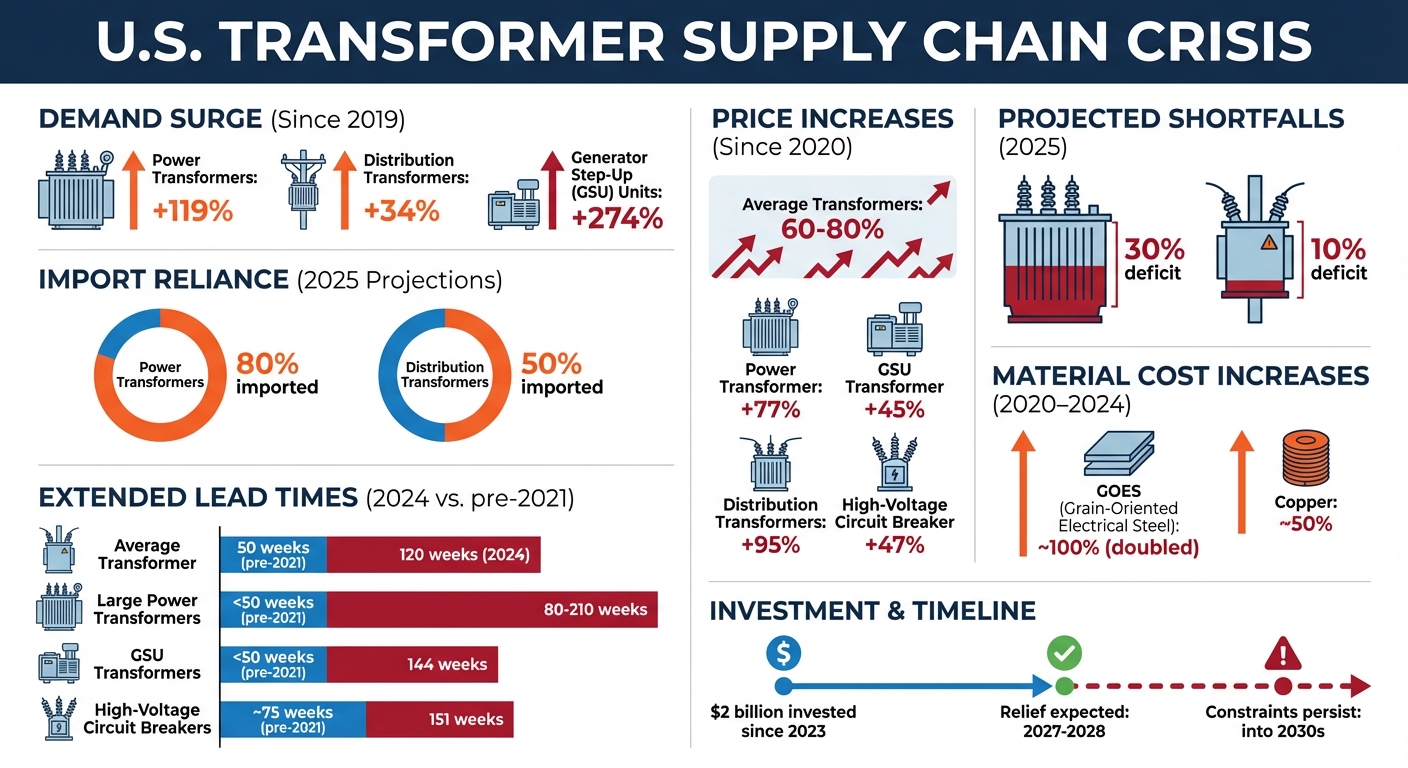
U.S. Transformer Supply Chain Crisis: Key Statistics and Lead Times 2024-2025
Supply Chain Problems in North America
Import Reliance and Extended Lead Times
By 2025, the U.S. is projected to import about 80% of power transformers and 50% of distribution transformers. This heavy dependence on foreign suppliers exposes the power grid to risks from global supply chain disruptions and shifts in trade policies. When overseas production slows or shipping delays occur, domestic options are limited, leaving utilities and project developers with few alternatives.
Lead times for large power transformers have stretched to an average of 128 weeks, while generator step-up units require around 144 weeks as of Q2 2025. These lengthy timelines compel utilities to place equipment orders three to four years before construction begins - often before engineering designs are even finalized. This early procurement has become a critical competitive advantage. Utilities that secure transformers early can move forward with data center and renewable energy projects, while others face significant delays. Such extended lead times are creating ripple effects that complicate efforts to boost domestic production.
"Extended lead times and elevated costs will become the new normal, potentially derailing grid modernization efforts."
Workforce Shortages and Material Constraints
In addition to delays caused by import reliance, domestic production faces its own set of challenges, particularly workforce and material shortages. The growing demand for transformers has highlighted a lack of skilled labor, which slows down manufacturing and limits the ability to scale up production - even as companies invest billions in new facilities.
Material shortages add another layer of complexity. The U.S. produces almost no grain-oriented electrical steel (GOES), a critical material for transformers, forcing manufacturers to depend on unpredictable foreign markets. On top of that, recent tariff increases have driven up costs for both imported and domestically made transformers.
"The U.S. produces almost no grain-oriented electrical steel (GOES), a key transformer material."
- Erin McLaughlin, Senior Economist, The Conference Board
Manufacturing Pressures and Regional Differences
Renewable Energy Growth and Production Delays
The rapid growth of renewable energy projects and data center construction is pushing manufacturing capacity to its limits. Since 2019, demand for power transformers in the U.S. has skyrocketed by 116%. Generator step-up (GSU) transformers, essential for connecting renewable energy sources to the grid, have seen an even sharper demand increase of 274%. This surge has put roughly 25% of global renewable energy projects at risk of major delays because developers can’t secure the transformers they need within their project timelines.
Data centers are adding to the strain. These facilities rely on specialized three-phase, dry-type transformers, and their rapid expansion is overwhelming an already stretched supply chain. Manufacturers are working at full capacity, often prioritizing higher-margin orders, which limits their ability to scale up production.
"The convergence of accelerating electricity demand, aging infrastructure and supply chain vulnerabilities has created constraints that will persist well into the 2030s."
- Ben Boucher, Senior Analyst, Wood Mackenzie
These manufacturing pressures are driving up costs and increasing lead times across different regions.
Lead Times and Cost Changes by Region
Production bottlenecks are leading to longer wait times and higher prices. In the U.S., lead times for transformers have more than doubled since 2021, jumping from an average of 50 weeks to 120 weeks by 2024. Large power transformers now take between 80 and 210 weeks to produce - nearly four years in the worst cases. High-voltage circuit breakers are also delayed, with lead times reaching up to 151 weeks by late 2023.
The cost of transformers has surged as well. Since January 2020, prices have climbed by 60% to 80% on average, with some utilities reporting costs that are four to six times higher than pre-2022 levels. Rising raw material prices are a significant factor. Grain-oriented electrical steel (GOES) prices have nearly doubled, and copper costs have increased by about 50% since early 2020. Compounding the issue, new U.S. tariffs, including a 50% duty on copper, are driving costs even higher.
| Equipment Type | 2024/2025 Lead Time | Pre-2021 Lead Time | Price Increase Since 2020 |
|---|---|---|---|
| Average Transformer | 120 weeks | 50 weeks | 60% – 80% |
| Large Power Transformer | 80 – 210 weeks | <50 weeks | 77% |
| High-Voltage Circuit Breakers | 151 weeks | ~75 weeks | 47% |
| GSU Transformers | 144 weeks | <50 weeks | 45% |
The electric transformer shortage
sbb-itb-501186b
Main Causes of Transformer Supply Delays
Continuing the discussion on supply chain challenges, let's dive into the two main reasons behind the delays in transformer availability.
Raw Material Shortages
Transformers depend heavily on two critical materials: grain-oriented electrical steel (GOES) and copper. GOES is used for the magnetic cores, while copper is essential for the windings. Right now, both of these materials are in short supply.
In the U.S., the situation is particularly tight. Cleveland-Cliffs is the only domestic producer of GOES, operating facilities in Pennsylvania and Ohio. During the COVID-19 pandemic, manufacturers scaled back production, only to face a sharp rise in demand driven by electrification efforts, data center growth, and renewable energy projects.
This imbalance has caused prices to skyrocket. Between January 2020 and 2024, GOES prices doubled, while copper prices jumped about 50%. The demand for power transformers has increased 119% since 2019, and generator step-up (GSU) transformers have seen a staggering 274% surge in demand. Despite this, manufacturers are struggling to scale production fast enough, leading to projections of a 30% shortfall in power transformers and a 10% shortfall in distribution transformers by 2025.
These supply challenges are further complicated by recent policy changes in the U.S.
Policy Effects and Tariffs
Recent U.S. policies and tariffs have added another layer of difficulty. The "One Big Beautiful Bill" (OBBBA) introduced stricter rules around foreign entities of concern (FEOC), significantly restricting the use of Chinese-linked transformer components in federally funded projects. This is a big deal, considering that 80% of large power transformers and 50% of distribution transformers in the U.S. are imported.
On top of that, new tariffs - some as high as 50% on copper - along with expanded duties on steel, aluminum, and imports from countries like Brazil, India, and China, have further driven up costs. As Ben Boucher, a Senior Analyst at Wood Mackenzie, put it:
"Transformer costs are expected to increase due to new tariffs, as both imported and domestically produced units will be subject to higher unit costs due to the wide array of new tariffs." - Ben Boucher, Senior Analyst, Wood Mackenzie
The numbers tell the story: since 2019, unit prices for power transformers have risen 77%, GSU transformers are up 45%, and distribution transformers have seen a 95% increase. Adding to the strain, a $500 million grant intended to help Cleveland-Cliffs expand its electrical-steel production capacity was reportedly canceled by the Trump administration, further limiting domestic production.
Market Data and Future Projections
The transformer market is on track for substantial growth, with projections estimating its value to reach around $61.3 billion by 2025. This expansion is fueled by increasing electrification, renewable energy projects, and the rising demand for data centers, all of which are driving infrastructure development. However, supply shortages are expected to persist well into the 2030s, creating a long-term imbalance that will keep prices high and delivery timelines extended.
Market Growth and Continuing Shortages
The growing demand for transformers paints a picture of both opportunity and challenge. Since 2019, U.S. demand for power transformers has skyrocketed by 119%, while the need for distribution transformers has grown by 34%. Generator step-up (GSU) units, essential for connecting renewable energy sources to the grid, have seen an astonishing 274% increase in demand during the same period. This surge is largely driven by the rapid growth of data centers, the replacement of aging infrastructure, and the expansion of solar and wind energy projects.
Unfortunately, manufacturing capacity has struggled to keep up. By 2025, supply deficits are expected to reach 30% for power transformers and 10% for distribution transformers. Lead times have become a major issue, with averages stretching to 144 weeks for GSU transformers and 128 weeks for power transformers. Simply put, orders placed today could face delays of several years.
"The convergence of accelerating electricity demand, aging infrastructure and supply chain vulnerabilities has created constraints that will persist well into the 2030s." - Ben Boucher, Senior Analyst, Wood Mackenzie
To address these challenges, manufacturers are making significant investments to expand production capacity.
Production Capacity Investments
Since 2023, manufacturers have poured nearly $2 billion into expanding transformer production capacity in North America. This shift toward reshoring production aims to reduce reliance on imports, which are projected to account for 80% of the U.S. power transformer supply and 50% of the distribution transformer supply by 2025.
Leading the charge is Hitachi Energy, which announced a $6 billion investment plan in 2024, allocating $1.5 billion specifically for scaling global transformer production. In March 2025, the company committed an additional $250 million to boost the production of critical transformer components, such as bushings and insulation, by 2027.
"The demand for transformers and grid infrastructure is rising at an unprecedented scale and pace. As the world's largest transformer manufacturer, we have a responsibility to expand our capacity and accelerate the delivery of transformers and essential components." - Andreas Schierenbeck, CEO, Hitachi Energy
Hitachi's North American expansion is particularly noteworthy. In September 2024, the company unveiled a $155 million investment plan that includes a $70 million distribution transformer factory in Reynosa, Mexico, and a $25 million expansion in South Boston, Virginia. By 2028, Hitachi aims to complete a $457 million facility in South Boston, which is set to become the largest power transformer plant in the U.S..
Other manufacturers are also stepping up. Siemens Energy is investing $150 million to establish its first large power transformer plant in Charlotte, North Carolina, with production expected to begin in early 2027. Eaton plans to launch operations in 2027 at a new $340 million three-phase transformer facility in South Carolina to meet growing industrial demand. Prolec GE is committing over $300 million to expand capacity across multiple sites, including a new medium-power facility in Goldsboro, North Carolina, and additional expansions in Louisiana and Mexico.
While these investments won't immediately resolve supply issues - most facilities won't be operational until 2027 or 2028 - they represent a crucial step toward addressing the supply-demand gap. For buyers navigating these challenges, platforms like Electrical Trader (https://electricaltrader.com) offer access to both new and used transformers, providing alternative sourcing options when project timelines are tight.
Conclusion
The transformer supply chain is under serious strain, with the industry staring at a projected 30% shortfall for power transformers and a 10% deficit for distribution units by 2025. Long lead times remain a challenge across all equipment categories.
This situation stems from several factors: growing demand fueled by data centers and renewable energy projects, aging infrastructure - over half of the U.S. distribution transformer fleet has exceeded its design life - and ongoing raw material shortages exacerbated by tariff pressures.
"The path forward requires coordinated action across multiple fronts. Utilities must embrace standardization to unlock manufacturing efficiencies, while policymakers need to balance trade protection with supply security." - Ben Boucher, Senior Analyst, Wood Mackenzie
Although investments of nearly $2 billion in manufacturing since 2023 signal progress, meaningful relief isn’t expected until new facilities come online around 2027–2028. In the meantime, stakeholders should focus on strategies like adopting standardized designs, securing long-term supply contracts, and planning procurement well in advance to avoid project delays.
For those navigating these supply challenges, platforms like Electrical Trader (https://electricaltrader.com) provide valuable access to both new and used transformers. Leveraging such diversified procurement channels can help ensure critical projects stay on track despite ongoing constraints.
FAQs
What steps can utilities take to address long transformer lead times?
Extended lead times for transformers - now stretching between 115 and 130 weeks for large units - are putting pressure on utilities striving to maintain grid reliability. These delays stem from a mix of supply chain disruptions, limited manufacturing capacity, and surging demand fueled by extreme weather events. To address these challenges, utilities can consider several practical approaches:
- Order early: Placing orders well in advance ensures alignment with project schedules and locks in pricing before demand surges.
- Stock up strategically: Maintaining a reserve of new or high-quality used transformers can provide a safety net for unexpected outages.
- Streamline designs: Standardizing transformer specifications can cut down on engineering time and make sourcing more flexible.
- Partner with manufacturers: Supporting domestic production initiatives can help reduce delivery times and lessen dependence on imports.
These steps can help utilities navigate transformer shortages more effectively, ensuring grid stability while keeping costs under control.
What is causing the shortage of grain-oriented electrical steel (GOES) in the U.S.?
The U.S. faces a shortage of grain-oriented electrical steel (GOES) largely because of limited domestic production. Currently, Cleveland-Cliffs/AK Steel stands as the sole U.S.-based manufacturer. This creates a fragile supply chain where any disruption to their operations can lead to significant challenges.
Turning to foreign mills for supply isn't a quick fix either. Setting up new steel assets involves lengthy lead times for commissioning and qualification, making it difficult to address immediate shortages.
Adding to the problem is the increasing demand for transformers, which heavily depend on GOES, leaving the market struggling to keep up with supply needs.
How are the new U.S. tariffs expected to impact transformer prices and availability?
The U.S. tariffs set to take effect on October 17, 2025, are poised to drive up transformer prices and worsen existing supply chain issues. These new measures could make sourcing critical equipment even more difficult for businesses.
This change adds pressure to an industry already grappling with global supply chain delays, raw material shortages, and surging demand. Companies and consumers should anticipate higher costs and longer wait times as they plan for their power distribution requirements.