Power Distribution Market Trends: 2025 Pricing Forecast
The power distribution market in 2025 faces rising costs driven by increasing energy demand, supply chain issues, and material price surges. Key factors include:
- Market Growth: Valued at $1,769 billion globally, expected to grow to $4,710 billion by 2034 at an 11.42% CAGR.
- Energy Demand: AI-driven data centers and EV adoption are pushing electricity consumption higher.
- Aging Infrastructure: Severe weather and outdated systems are leading to grid modernization efforts.
- Rising Prices: Wholesale power costs are projected to increase by 19% from 2025 to 2028 due to material shortages and tariffs.
Equipment Pricing Trends
- Cables & Lines: Copper tariffs (50% by Aug 2025) and underground cabling projects are driving costs up.
- Transformers: Facing a 30% supply deficit, lead times now exceed two years.
- Switchgear: Advanced IoT-enabled systems are increasing upfront costs but improving efficiency.
- Substations: High-voltage projects and digital upgrades are adding to expenses.
Regional Insights
- North America: Aging grids and data center growth dominate investments.
- Asia Pacific: Urbanization and renewable energy projects are fueling rapid growth.
- Europe: Regulatory mandates for cleaner technologies are shaping the market.
Expect continued pricing pressures through the 2030s, with procurement strategies needing to address supply shortages and rising costs.
Why power demand is surging worldwide (and what comes next) | Intelligence Connected
sbb-itb-501186b
2025 Pricing Forecast by Equipment Type
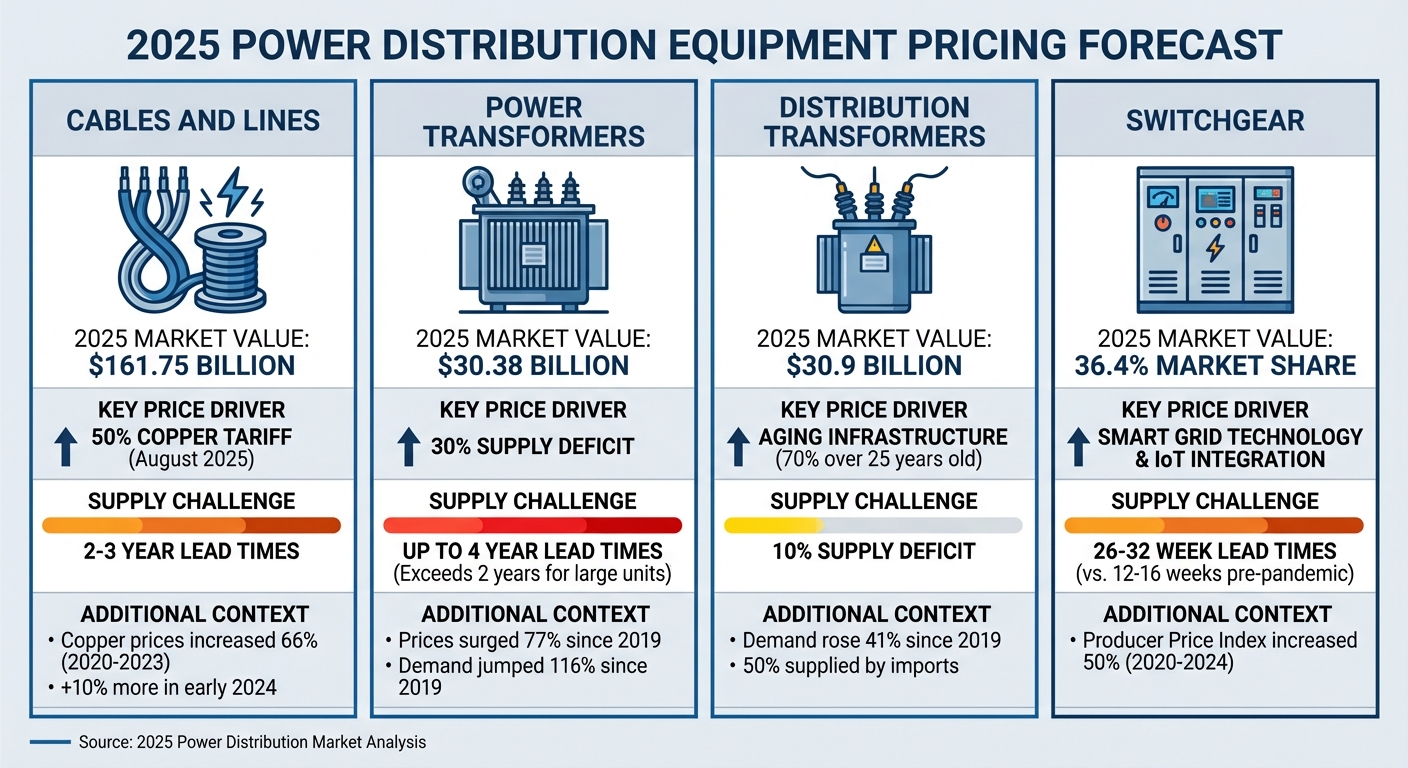
2025 Power Distribution Equipment Pricing Forecast by Category
The year 2025 brings a mix of challenges for equipment pricing, driven by supply chain disruptions, fluctuating raw material costs, and growing demand for renewable energy solutions. Each equipment type faces unique cost pressures, shaping procurement strategies for buyers. Here's a breakdown of the forecast for key equipment categories.
Cables and Lines
The low-voltage cable market is projected to reach $161.75 billion in 2025, with prices expected to climb further. Copper, a critical material for cables, saw a 66% price increase between 2020 and 2023, followed by an additional 10% rise in early 2024. A 50% copper tariff, set to take effect in August 2025, is likely to push costs even higher for both imported and domestic cables.
Underground cabling projects add to these cost pressures. For example, India’s Smart City Mission reported progress on the SCOUGEN project in June 2024, which aims to move overhead cables underground to improve resilience in cities like Ribandar and Panaji. While underground installations are more expensive than overhead lines, they offer better protection against extreme weather. By 2035, cables and lines are expected to account for 28.3% of the electric power transmission and distribution equipment market.
Demand for specialized cables is also rising, particularly for EV charging networks and smart city initiatives. To meet this demand, Prysmian Group completed a $4 billion acquisition of Encore Wire in July 2024, expanding its low-voltage cable production in North America.
Transformers
Transformers are seeing some of the steepest price increases across the sector. The power transformer market is valued at $30.38 billion in 2025, with prices surging by 77% since 2019 due to high demand and ongoing supply chain issues. The U.S. faces a 30% supply deficit for power transformers and a 10% shortfall for distribution transformers.
Ben Boucher, Senior Analyst at Wood Mackenzie, highlighted the challenges:
"This surging transformer demand has created a significant supply deficit, with domestic manufacturing capacity unable to keep pace... This market imbalance is escalating costs and lead times."
– Ben Boucher, Senior Analyst, Wood Mackenzie
Demand for power transformers in the U.S. has jumped 116% since 2019, while distribution transformer demand has risen by 41%. Imports are expected to supply 80% of power transformers and 50% of distribution transformers in 2025. Lead times for large power transformers now exceed two years, which could delay renewable energy projects. Meanwhile, the distribution transformer market, valued at $30.9 billion, faces challenges due to aging infrastructure, with 70% of transformers being over 25 years old.
Rising material costs, particularly for copper and grain-oriented electrical steel, are also driving up prices. The upcoming copper tariff in August 2025 is expected to further impact costs. Andreas Schierenbeck, CEO of Hitachi Energy, commented on the issue:
"Ramping up capacity is definitely an issue. It's not easy and it will probably not ramp up fast enough."
Switchgear
Switchgear is set to capture 36.4% of the power distribution component market in 2025. Prices have risen significantly, with the switchgear Producer Price Index increasing by 50% between 2020 and 2024. Lead times for medium-voltage switchgear now range from 26 to 32 weeks, compared to the pre-pandemic average of 12 to 16 weeks.
The adoption of smart grid technology is a major cost driver. Utilities are investing in IoT-enabled switchgear with advanced features like sensors and real-time diagnostics. While these systems come with higher upfront costs, they offer long-term benefits such as predictive maintenance and better operational efficiency. Additionally, stricter environmental regulations in Europe and North America are pushing manufacturers to replace traditional SF₆-based models with costlier alternatives.
Substations
Upgrades to digital infrastructure and high-voltage offshore projects are driving up substation costs. In July 2023, Schneider Electric signed a $152.5 million contract to modernize Serbia’s medium-voltage electrical distribution network, showcasing the scale of global grid upgrades.
Regional investments highlight the international push for grid modernization. For instance, Supreme Power Equipment Limited secured a $3.1 million order in September 2024 for transformer manufacturing and substation commissioning. Similarly, Hitachi Energy received a $22.8 million investment from the Canadian government in July 2024 to enhance its transformer factory and HVDC simulation center.
The growing demand for high-voltage direct current (HVDC) transmission is another factor. HVDC systems are essential for connecting offshore wind and solar farms, requiring specialized and expensive substations. In September 2023, Prysmian Group signed a $1.1 billion deal with 50Hertz for the NOR-11-1 submarine and DC31 underground cable projects in Germany, involving 1,000 km of cable for energy transmission.
| Equipment Category | 2025 Market Value | Key Price Driver | Supply Challenge |
|---|---|---|---|
| Cables and Lines | $161.75 billion | 50% copper tariff (Aug 2025) | 2–3 year lead times |
| Power Transformers | $30.38 billion | 30% supply deficit | Up to 4 year lead times |
| Distribution Transformers | $30.9 billion | Aging infrastructure | 10% supply deficit |
| Switchgear | 36.4% market share | Smart grid technology | 26–32 week lead times |
Regional Pricing Differences in 2025
North America
North America's power distribution market faces unique pricing challenges, largely due to the urgent need to replace aging infrastructure. The region holds a 32.8% market share and is expected to grow at a 6.5% CAGR through 2035. Modernization and infrastructure replacement projects dominated the landscape, accounting for 58.4% of the region's revenue in 2025.
The rising electricity demand from AI-driven data centers is a key factor driving costs. For instance, data centers in Northern Virginia consumed 3.2 GW in 2025, spurring $1.8 billion in substation investments through 2028. Additionally, extreme weather events have pushed utilities to invest in weather-resistant solutions like underground cabling and reinforced substations.
Supply chain issues are another major contributor to rising costs. Transformer lead times, for example, jumped from 50 weeks in 2021 to 120 weeks in 2024, with larger units taking as long as 210 weeks. On top of that, the U.S. Department of Energy allocated $10.5 billion in 2025 for transmission upgrades, fueling demand for high-voltage transformers and digital relays. Wholesale electricity prices in the U.S. are also set to climb by an average of 19% between 2025 and 2028.
Shifting gears to Asia Pacific, the region's pricing trends are shaped by rapid urbanization and large-scale infrastructure projects.
Asia Pacific
Asia Pacific's market share stood at 34.7% in 2024 and is projected to reach 52.6% by 2035. The region's pricing dynamics are heavily influenced by urbanization and ambitious greenfield projects, including smart city initiatives and renewable energy integration. China and India are leading the way, with projected CAGRs of 10.3% and 9.5%, respectively.
"Asia Pacific is estimated to command a 52.6% share by 2035 in the electric power transmission and distribution equipment market, propelled by rapid urbanization and large-scale investments in smart cities and smart grids."
– Research Nester
The region's competitive manufacturing capabilities help keep costs lower for standard equipment. For example, China was the top exporter of electrical machinery in 2022, with exports valued at $1.1 trillion. However, specialized equipment comes at a premium. The expansion of ultra-high-voltage (UHV) corridors in China, such as ±800 kV and ±1,100 kV systems, creates demand for high-value transformers and insulators capable of transmitting power over 2,000 kilometers with under 3% losses.
Several key projects highlight Asia Pacific's focus on new infrastructure. In September 2024, KEPCO and ABB signed an agreement to supply a high-inertia flywheel synchronous condenser for grid stability on Jeju Island. Similarly, Supreme Power Equipment Limited in India received a $3.1 million order in August 2024 for 10 units of 6 MVA transformers and a 110 kV substation. These examples emphasize the region's drive for expansion rather than replacement.
Global Comparisons
Globally, regional differences in market growth and regulatory priorities create distinct pricing trends. Europe, for instance, holds 28.4% of the market and is growing at a CAGR of 7.2–8.7%. Regulatory mandates, such as the EU's F-Gas regulation, are pushing for SF₆-free switchgear, which accounted for 35% of European orders in 2025. In August 2024, GE Vernova delivered the world's first 245 kV SF₆-free gas-insulated switchgear to RTE in France.
High-voltage equipment (35–220 kV) made up 43.1% of global revenue in 2025, while ultra-high-voltage gear (above 800 kV) is growing fastest, with a 9.8% CAGR. Rising raw material costs add another layer of complexity. For example, grain-oriented electrical steel prices rose by 35% between 2024 and 2025, and copper averaged $9,200 per ton in 2025. While these material costs affect all regions, Asia Pacific's strong domestic supply chains provide a cost advantage over import-heavy markets like North America.
| Region | 2024 Market Share | Projected CAGR (2025–2035) | Primary Pricing Driver |
|---|---|---|---|
| Asia Pacific | 34.7% | 10.3% (China) / 9.5% (India) | Urbanization, UHV expansion, smart cities |
| North America | 32.8% | 6.5% | Aging infrastructure, data centers, weather resilience |
| Europe | 28.4% | 7.2–8.7% | SF₆-free mandates, cross-border links, decarbonization |
What's Driving 2025 Pricing Changes
Several factors are pushing equipment prices higher in 2025. One major driver is renewable energy integration. With wind and solar expected to account for over 90% of the increase in global electricity demand in 2025, grid operators need more advanced switchgear and transformers. These systems must handle bi-directional power flows and fluctuating inputs, which leads to increased costs.
Adding to the challenge are supply chain disruptions. Power transformers are projected to face a 30% supply shortage in 2025, while distribution transformers will see a 10% deficit. This has caused lead times to stretch significantly since 2021. Ben Boucher from Wood Mackenzie notes that without action, these delays and rising costs could jeopardize grid modernization efforts.
Government policies and tariffs are also playing a role. The "One Big Beautiful Bill", set to take effect in August 2025, introduces a 50% copper tariff, driving up manufacturing expenses. Considering that 80% of power transformers in the U.S. are imported in 2025, these trade policies are having a noticeable impact.
Lastly, raw material challenges add to the pricing pressures. Copper's price volatility and port bottlenecks - adding 15–20% to logistics costs - are significant hurdles. On top of that, wholesale electricity prices are expected to rise by 19% between 2025 and 2028. Together, these factors create a perfect storm, amplifying the upward trend in equipment prices across the global power distribution market in 2025.
Buying Power Distribution Equipment on Electrical Trader
Procurement in 2025 comes with its fair share of challenges: limited manufacturing capacity, lengthy order backlogs, and rising federal tariffs are making it harder than ever to source essential equipment. As Aftab Khan, Executive Vice President of Operations, Planning & Security at PJM, explains:
"The demand for electricity is growing at the fastest pace in years, primarily from the proliferation of data centers, electrification of buildings and vehicles, and manufacturing".
This rapid growth has created an urgent need for dependable sources of critical components like switchgear, transformers, and circuit breakers. For buyers, finding reliable procurement solutions has become essential to keeping projects on track.
Electrical Trader steps in as a centralized marketplace designed to tackle these supply chain and pricing hurdles. The platform offers a wide range of inventory, including breakers, transformers, and both low and high voltage equipment. It caters to electricians, contractors, and facility managers who are grappling with extended lead times - now averaging between 12 and 26 weeks for complete system deliveries. By providing access to ready-to-ship inventory, including quality used equipment, Electrical Trader helps professionals meet tight deadlines and avoid costly delays.
The financial stakes are high, particularly as renewable energy integration drives demand for system upgrades. For medium-sized facilities, overhauls can cost anywhere from $2.5 million to $4 million. This underscores why procurement teams are turning to platforms that offer transparent pricing and a diverse range of options to suit various project needs.
Another key trend shaping 2025 is the push for grid modernization and digitalization. Over 65% of new equipment installations now feature connectivity for real-time monitoring and load balancing. Electrical Trader's inventory includes IoT-enabled components and smart meters, aligning with this shift toward smarter infrastructure. These technologies play a crucial role in predictive maintenance, potentially reducing downtime by up to 35% in automated facilities.
Economic pressures, such as rising wholesale electricity prices and copper costs, further highlight the importance of having both new and used equipment readily available. Electrical Trader's mix of inventory provides professionals with the flexibility to manage capital expenditures effectively while meeting growing capacity demands in a market where supply struggles to keep up with demand.
Conclusion: 2025 Power Distribution Pricing Summary
The power distribution market in 2025 is shaped by a mix of supply shortages, shifting policies, and rising demand. Key factors include increasing tariffs, aging infrastructure, and higher raw material costs. For example, a 30% shortage in power transformers and a 10% deficit in distribution transformers have driven up equipment prices significantly. On top of that, tariffs on Chinese power equipment have surged from 7.5% to 35%, and copper now faces a 50% tariff. These combined pressures are creating regional disparities and forcing procurement strategies to adapt.
Regional trends highlight the complexity of the market. In North America, aging infrastructure and the expansion of data centers are driving demand, while Asia-Pacific benefits from rapid industrial growth. Europe, on the other hand, faces pricing adjustments driven by strict efficiency standards. Adding to the challenge is the volatility in copper prices, which have spiked by 37%. These factors make it clear that procurement strategies need to be tailored to local conditions while accounting for unpredictable material costs.
Looking ahead, these challenges are unlikely to ease soon. Aging infrastructure, rising electricity demand, and supply chain vulnerabilities are expected to persist well into the 2030s. Additionally, the rapid growth of AI, electric vehicle (EV) infrastructure, and grid modernization continues to stretch manufacturing capacity. In this environment, securing flexible and reliable procurement channels is more critical than ever.
Platforms like Electrical Trader play a crucial role by offering access to both new and used equipment, providing much-needed sourcing flexibility. With over 65% of new installations now featuring IoT connectivity and modular solutions that can cut installation times by up to 60%, quick access to the right components is essential. Delays in sourcing can lead to substantial cost increases, making adaptable procurement strategies an absolute necessity in this evolving market.
FAQs
What should I order first in 2025 to avoid long lead times?
In 2025, it’s crucial to place orders for power transformers as soon as possible. These are expected to face a 30% supply shortage, making delays a significant risk. Distribution transformers could also see a 10% shortfall, driven by increased demand from infrastructure upgrades and renewable energy initiatives. Ordering early can ensure you have access to these essential components despite the anticipated shortages.
How will the August 2025 copper tariff affect my project costs?
Starting August 1, 2025, a 50% tariff on semi-finished copper products will go into effect. This change is expected to drive up material costs, which could directly impact project budgets - especially for tasks involving the replacement of copper components.
If you're planning projects that rely on copper, it's a good idea to anticipate higher expenses and adjust your budget accordingly to avoid surprises.
When does buying used equipment make sense for 2025 pricing?
Buying used equipment in 2025 could be a smart move, especially when factors like high demand, supply chain issues, or rising equipment prices come into play. This is particularly true for items like power transformers and electrical components, which are seeing increased demand due to infrastructure projects and evolving energy policies. By assessing current market conditions, you can decide if used equipment provides a more budget-friendly and practical alternative.