

STATCOM For Voltage Flicker Reduction
Voltage flicker can disrupt power systems, harming equipment and causing discomfort. STATCOM (Static Synchronous Compensator) offers a fast and reliable solution to this issue by stabilizing voltage and reducing flicker. Unlike older technologies like SVCs, STATCOM uses advanced power electronics to quickly supply or absorb reactive power, ensuring steady voltage even during sudden load changes. Key features include:
- Rapid response within 1–2 cycles.
- Effective voltage support even during low voltage conditions.
- Reduced harmonic distortion through PWM and MMC designs.
- Proven success in industrial applications like electric arc furnaces.
STATCOM stands out for its precision and efficiency, making it a preferred choice for addressing voltage flicker and improving power quality in industrial and distribution systems.
NEPSI Tech Talk Session 29: AMSC's DVAR VVO STATCOM - Mitigating Flicker On Distribution Feeders

sbb-itb-501186b
How STATCOM Reduces Voltage Flicker
STATCOM plays a crucial role in stabilizing voltage by continuously adjusting reactive power during load changes. Industrial loads, like arc furnaces or large motors, can cause sudden voltage drops. When this happens, STATCOM detects the issue and quickly injects reactive power to restore voltage levels, effectively minimizing the flicker that results from these fluctuations. Let’s break down how STATCOM achieves this through its reactive power strategies, advanced components, and fast control systems.
Reactive Power Compensation Principles
At the heart of STATCOM's operation is its ability to manage reactive power. It works by controlling voltage magnitude. Using a Voltage Source Converter (VSC), it generates an AC waveform that can either supply or absorb reactive power. When the STATCOM's voltage is higher than the grid voltage, it provides capacitive reactive power. Conversely, when its voltage is lower, it absorbs inductive reactive power. This exchange, facilitated by a coupling reactor or transformer, helps stabilize grid voltage in real time.
Unlike older reactive compensation devices that struggle as voltage drops, STATCOM maintains its full capacitive output even at very low voltage levels - down to 0.2–0.3 per unit (pu). This makes it particularly effective during critical grid conditions, ensuring reliable performance when it’s needed most.
STATCOM System Components
A STATCOM system includes several key components:
- A DC-side capacitor that stores energy.
- A high-speed Voltage Source Converter (VSC), typically using IGBT technology, to generate a controllable AC waveform.
- A coupling reactance (either an inductor or transformer) that enables reactive power flow.
Modern STATCOMs often utilize Modular Multi-level Converter (MMC) designs, which produce near-sinusoidal outputs with fewer harmonics. For example, distribution systems might use a 10 MVAR D-STATCOM with a PWM IGBT inverter operating at a carrier frequency of around 3 kHz for rapid pulse generation.
Real-Time Voltage Regulation
One of STATCOM's standout features is its ability to respond almost instantly - within one to two cycles, or 16–33 milliseconds on a 60 Hz system. This speed is achieved through advanced control algorithms that employ d-q (direct-quadrature) transformation. By separating current into active and reactive components, the system can independently and precisely manage reactive power.
The control system continuously monitors voltage and adjusts the VSC output in real time. For example, in a simulation of a 66/11 kV distribution system, a five-level diode-clamped D-STATCOM reduced voltage flicker from 2.09% to 0.29%. This brought fluctuations well below the 0.26% threshold where flicker becomes noticeable to the human eye at 10 Hz. These rapid corrections are essential for maintaining stable and high-quality power delivery.
STATCOM Performance in Practical Applications
STATCOM's ability to provide rapid, real-time voltage regulation has made it an effective solution for addressing voltage flicker issues in practical scenarios.
Voltage Flicker Mitigation in Industrial Systems
Electric arc furnaces are notorious for creating significant power quality challenges. These industrial systems generate rapid fluctuations in active and reactive power, typically ranging between 5 Hz and 35 Hz. Such variations lead to voltage drops, harmonics, and flicker, which can disrupt operations and damage equipment.
In 2016, researchers Mathieu Morati, Philippe Poure, and Shahrokh Saadate conducted field tests on a 60 MVAr industrial STATCOM installed to stabilize a 100 MVA Electric Arc Furnace at a European industrial site. The results showed a noticeable improvement in voltage stability, demonstrating STATCOM's capability in real-world conditions. Their findings also highlighted the benefits of incorporating both active and reactive current components into the STATCOM's control strategy:
The STATCOM's current reference includes both active and reactive current components. The performance of the STATCOM in voltage flicker mitigation is highly improved by applying this control strategy which uses the dc voltage margin of the VSC to provide for an active compensating current without oversizing the STATCOM converters capacitor.
These observations paved the way for further research comparing STATCOM's performance against other compensation technologies.
Research Study Results
Comparative studies consistently highlight STATCOM's advantages over older technologies like Static Var Compensators (SVCs). In November 2015, researchers Haidar Samet and Mohammad Amin Jarrahi analyzed data from the Mobarakeh Steel Company in Esfahan, Iran. Using actual voltage and current records from electric arc furnaces, they compared the performance of STATCOM and SVC systems. Their findings underscored STATCOM's superior response time, as SVCs were hindered by measurement delays and thyristor ignition lag:
STATCOM may be considered as a high performance candidate for flicker mitigation due to its fast and flexible response.
The study also revealed that active power variations in electric arc furnace loads are nearly as impactful as reactive power variations. This realization has driven the adoption of advanced control strategies that address both components simultaneously. Among these, modern hysteresis current control methods have shown exceptional results, offering faster dynamic responses and greater stability margins compared to traditional PI controllers [12, 13].
STATCOM vs. Other Compensation Methods
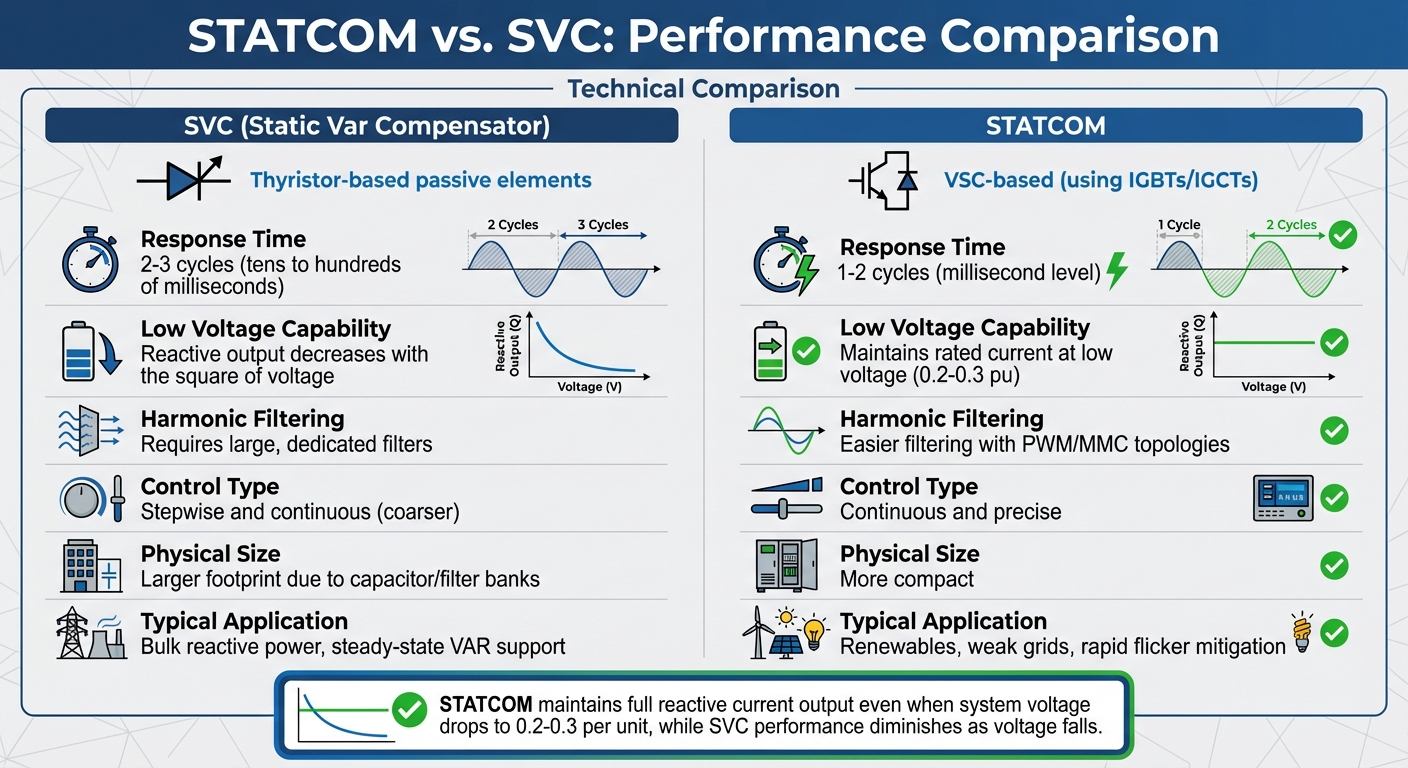
STATCOM vs SVC Performance Comparison for Voltage Flicker Reduction
STATCOM stands out for its superior performance when compared to traditional compensation methods like Static Var Compensators (SVCs). Its edge lies in the advanced technology it employs: while SVCs use thyristor-switched passive components such as capacitors and reactors, STATCOMs leverage Voltage Source Converters (VSCs) powered by high-speed power electronics like IGBTs or IGCTs. This fundamental difference translates into clear advantages across several performance areas.
Response Time Comparison
STATCOMs are lightning-fast, responding within 1–2 cycles (milliseconds), compared to the 2–3 cycles (tens to hundreds of milliseconds) typical for SVCs. This rapid reaction is especially important for managing sudden voltage fluctuations caused by nonlinear industrial loads. The high-speed switching capability of IGBTs gives STATCOMs an edge over the slower thyristors used in SVCs. Moreover, STATCOMs maintain their full reactive current output even when system voltage drops to 0.2–0.3 per unit, whereas SVC performance diminishes as voltage falls.
Harmonic Reduction Performance
When it comes to harmonics, STATCOMs outperform SVCs by a wide margin. SVCs, particularly those using Thyristor Controlled Reactors (TCR), generate significant harmonic distortion due to their phase-angle control mechanism, requiring large filters to mitigate the issue. In contrast, STATCOMs utilize advanced techniques like Pulse Width Modulation (PWM) or Multi-Modular Converter (MMC) configurations, which produce a much cleaner output. Sophisticated designs, such as 12-pulse or 48-pulse systems, further minimize harmonic distortion, making STATCOMs a more efficient choice for harmonic suppression.
STATCOM vs. SVC Comparison Table
| Feature | Static Var Compensator (SVC) | STATCOM |
|---|---|---|
| Technology | Thyristor-based passive elements | VSC-based (using IGBTs/IGCTs) |
| Response Time | 2–3 cycles (tens to hundreds of milliseconds) | 1–2 cycles (millisecond level) |
| Low Voltage Capability | Reactive output decreases with the square of voltage | Maintains rated current at low voltage |
| Harmonic Filtering | Requires large, dedicated filters | Easier filtering with PWM/MMC topologies |
| Control Type | Stepwise and continuous (coarser) | Continuous and precise |
| Physical Size | Larger footprint due to capacitor/filter banks | More compact |
| Typical Application | Bulk reactive power, steady-state VAR support | Renewables, weak grids, rapid flicker mitigation |
This table highlights the key differences, making it clear why STATCOM is often the preferred choice for applications requiring fast response times, compact design, and effective harmonic reduction.
Distribution STATCOM (D-STATCOM) Design and Implementation
D-STATCOM Features
A D-STATCOM is a versatile device designed to handle multiple power quality issues at the distribution level. It provides voltage regulation, reactive power support, power factor correction, and harmonic filtering, all within a single unit. Unlike traditional shunt capacitors, D-STATCOMs avoid resonance problems while offering these multifunctional benefits.
One of its key advantages is modular deployment. Multiple units can be installed and coordinated to meet increasing load demands without requiring significant upgrades to the existing infrastructure. Modern D-STATCOMs rely on voltage measurements at the Point of Common Coupling (PCC), using an indirect control method. This eliminates the need for complex reactive power or current sensors, making installation and operation simpler.
"The D-STATCOM controller continuously monitors the load voltages and currents and determines the amount of compensation required by the AC system for a variety of disturbances." – IJERT
Beyond mitigating voltage flicker, D-STATCOMs integrate smoothly with other power quality solutions. These features make them a highly effective tool for improving overall system performance, as explored in the deployment strategies below.
Distribution System Deployment Strategies
D-STATCOM deployment in distribution systems is tailored to the specific network configuration. The choice of topology depends on the system's design. For example:
- Three-phase three-wire (3P3W) systems: These focus on reactive power and harmonic compensation. They typically use standard coupling transformers and three-leg Voltage Source Converters (VSCs).
- Three-phase four-wire (3P4W) systems: These require specialized transformers, such as zig-zag, T-connected, or star/hexagon types, to handle neutral currents and unbalanced loads. This setup is particularly useful in commercial and mixed residential areas.
Control strategies must align with the system's needs. While PI controllers work well in steady-state conditions, Fuzzy Logic Controllers are better suited for managing dynamic loads. For 11 kV systems, a switching carrier frequency of about 1,075 Hz is standard. Additionally, careful sizing of DC capacitors during the design phase is crucial to maintain bus voltage stability during transients. These strategies enable the D-STATCOM to quickly address voltage flicker and other power quality challenges across diverse distribution scenarios.
Conclusion
STATCOM has shown to be a highly effective tool for addressing voltage flicker in distribution systems. Research highlights that it surpasses traditional methods like Fixed Capacitor Thyristor Controlled Reactor (FCTCR) systems in both efficiency and performance. Its ability to deliver fast and precise reactive power compensation makes it especially beneficial for industrial facilities managing dynamic and fluctuating loads.
"The obtained results show that STATCOM is very efficient and effective for the flicker compensation." – IEEE
Beyond flicker mitigation, STATCOM contributes to improving overall power quality. It strengthens voltage stability and reduces harmonic distortion. For example, 12-pulse configurations are particularly effective in lowering Total Harmonic Distortion, while advanced control methods, such as Fuzzy Logic controllers, enhance performance in distribution systems. This makes STATCOM an excellent choice for industrial facilities and distribution networks dealing with variable load conditions.
The benefits of STATCOM go beyond technical improvements. Voltage flicker impacts more than just equipment - it also affects people. Flicker can lead to fatigue, stress, and reduced focus, which can hinder productivity. Additionally, sensitive electronic devices that rely on stable voltage are better protected with STATCOM. Its quick response and versatile capabilities make it a key technology for modernizing electrical distribution systems.
For those looking to upgrade their power distribution systems with STATCOM or similar solutions, platforms like Electrical Trader (https://electricaltrader.com) offer a wide selection of transformers, voltage equipment, and power generation tools to support these advancements.
FAQs
How do I know if voltage flicker is a reactive power problem or something else?
Voltage flicker caused by fluctuating loads is often tied to reactive power challenges. Solutions like STATCOM are designed to tackle this issue by swiftly adjusting reactive power, helping to stabilize voltage levels and enhance overall power quality.
What does STATCOM sizing (MVAr) depend on for flicker mitigation?
The sizing of a STATCOM (measured in MVAr) for flicker mitigation primarily hinges on two factors: the magnitude and variability of voltage fluctuations caused by the load. Additionally, it takes into account the system's reactive power requirements to ensure dynamic voltage regulation and minimize flicker effects effectively.
Where should a D-STATCOM be installed in a distribution system for best results?
For the best results, a D-STATCOM should be positioned at the point of common coupling or near the load where voltage flicker needs to be addressed. This location allows it to effectively reduce voltage fluctuations and enhance power quality within the distribution network.