




Reactive Power Compensation: Cost vs Savings
Reactive power compensation helps reduce electricity costs by improving power factor and avoiding utility penalties. Industrial facilities often face surcharges if their power factor drops below 0.85–0.95, with costs increasing by up to 20% when it falls below 0.80. Compensation systems, such as fixed capacitors or dynamic solutions like STATCOM, counteract reactive power, improving efficiency and reducing heat losses.
Key Takeaways:
- Fixed Capacitor Systems: Cost-effective for steady loads, priced at $30–$45 per kVAr. Payback periods range from 10.5 to 27 months.
- Dynamic Systems (e.g., STATCOM): Ideal for fluctuating or harmonic-heavy loads, offering precise control but at higher costs.
- Correcting a power factor from 0.7 to 0.95 reduces kVA demand by 35% and heat losses by 45%.
- Conduct a load survey before investing, especially if harmonic distortion exceeds 5%.
Choosing the right system depends on load stability, harmonic levels, and budget. Fixed systems suit stable operations, while dynamic solutions excel in challenging environments.
1. Fixed Capacitor Systems
Initial Costs
Fixed capacitor banks are a budget-friendly option for three-phase systems with steady loads, typically priced at $30–$45 per kVAr for standard 480V installations. This price generally covers the capacitor units, installation labor, and any required permitting or inspections, especially for systems operating above 600V.
However, costs can rise significantly if your system has high harmonic levels. For example, when Total Harmonic Distortion (THD) exceeds 5% - a frequent issue in facilities with variable frequency drives (VFDs) or electronic power supplies - detuned capacitor banks with series reactors are often necessary. These come with a 20% to 30% price premium compared to standard units. A harmonic assessment before purchasing is critical to avoid expensive premature replacements.
| Component/Type | Estimated Cost Impact | Best Application |
|---|---|---|
| Fixed Capacitor Bank | Base Cost (Lowest) | Constant loads, individual motors < 100 kW |
| Automatic Bank | 1.5x – 2.0x Base Cost | Variable loads (>20% variation) |
| Detuned Reactor | +20% – 30% Premium | Systems with THD > 5% or many VFDs |
| Installation (480V) | $30 – $45 per kVAr (Total) | General industrial/commercial setups |
While the upfront costs may vary, these systems quickly pay for themselves through utility savings.
Annual Savings
Improving the power factor with fixed capacitors eliminates utility penalties for low power factor levels, often triggered below 0.85–0.90. For example, correcting a power factor from 0.7 to 0.95 can reduce kVA demand by 35%, leading to lower utility bills and a 45% reduction in line heat losses.
The benefits extend beyond just penalty avoidance. Operational efficiency improves as well. Take a 1,000 kVA transformer running at 700 kW with a 0.7 power factor: correcting it to 0.95 frees up an additional 250 kW of usable capacity.
"The most common mistake I see is engineers sizing capacitors based on average load instead of peak demand... The result is undercorrection at peak hours - exactly when penalties are calculated." - Sarah Martinez, P.E., Licensed Electrical Engineer
To maximize savings, size your capacitor bank to match the highest 15-minute peak demand shown on utility bills, not the monthly average. For facilities with load variations greater than 20%, fixed capacitors can cause overcorrection during light-load periods (like nights or weekends), leading to voltage rises and possible utility penalties.
Maintenance Requirements
Fixed capacitor systems are low-maintenance but still require periodic checks to ensure optimal performance. Maintenance tasks include quarterly power factor checks and an annual power quality audit to confirm the system maintains a target power factor of 0.95–0.98 lagging. Inspections should also address discharge paths and arc flash hazards, following NFPA 70E and OSHA standards.
One key risk is overcorrection during off-hours when loads drop significantly. This can push the power factor into leading territory, potentially damaging equipment and incurring utility penalties. Regular monitoring or upgrading to automatic banks is advisable if load variations exceed 20%.
Return on Investment
Fixed capacitor systems offer a solid return on investment, with payback periods typically ranging from 10.5 to 27 months, depending on your utility's billing structure (kVArh charges versus kVA demand charges). Installation complies with NEC standards, and compliance costs are already factored into these payback estimates.
This quick payback period highlights how fixed capacitor systems can deliver both technical and financial benefits. They are particularly well-suited for operations with steady load patterns and minimal harmonic distortion, making them one of the most cost-effective upgrades for electrical systems.
sbb-itb-501186b
Power Factor Correction ROI Explained - How Soon Will You See Results?
2. Dynamic Reactive Power Compensation Systems (e.g., STATCOM, DVR)
Dynamic reactive power systems, such as STATCOM and DVR, offer a cutting-edge alternative to fixed capacitor banks. These systems stand out for their ability to respond almost instantly to changes, making them especially useful in environments with fluctuating loads or significant harmonic issues.
Initial Costs
Dynamic systems like Static VAR Compensators (SVC) and Active Power Filters (APF) rely on advanced power electronics, such as thyristors and IGBTs, to deliver millisecond-level response times. This level of sophistication comes at a higher price. While fixed capacitor banks cost around $30–$45 per kVAr, dynamic systems fall into the "High" to "Highest" cost categories. SVCs typically represent the lower end of this spectrum, whereas APFs, which also address harmonic mitigation, occupy the upper end.
The higher upfront cost reflects the complexity of the technology, which enables real-time adjustments. Unlike fixed systems, dynamic compensators continuously adapt their output, making them ideal for industries with rapidly changing power demands or environments prone to harmonic distortion.
Annual Savings
Dynamic systems deliver savings in two key ways: avoiding utility penalties for poor power factors and reducing line losses. By improving voltage regulation and minimizing heat-related losses, these systems help optimize operational efficiency. The formula ΔU = I (R cos φ + L sin φ) illustrates how these systems reduce voltage drops. For instance, improving the power factor from 0.7 to 0.95 can slash ohmic losses by 45% and decrease the apparent power requirement by 35% for the same active power output.
Beyond direct energy savings, these systems free up additional capacity within the electrical infrastructure. This can delay the need for costly upgrades to transformers or service lines, a significant advantage for facilities with variable or peak loads where fixed systems may fall short.
Maintenance Requirements
To ensure a service life of approximately 15 years, annual inspections are crucial. These inspections involve checking capacitors, monitoring contact wear, securing connections, and verifying controller performance. STATCOM systems using Voltage Source Converter (VSC) technology with Pulse Width Modulation (PWM) require fewer harmonic filters compared to older designs. This not only reduces their physical footprint but also simplifies maintenance.
Proper maintenance enhances reliability by limiting current flow and reducing heat in conductors and transformers. This helps prevent unexpected equipment failures, minimizing costly downtime. Additionally, modular designs allow for capacity expansion without requiring a complete system overhaul.
Return on Investment
For many industrial facilities, the payback period for dynamic reactive power compensation systems is often less than three years. The financial benefits go beyond avoiding utility penalties. These systems also extend equipment life by reducing thermal stress, free up capacity in cables and transformers, and minimize downtime. For facilities with variable loads or high harmonic content, these advantages make dynamic systems a compelling choice, offering long-term cost-efficiency compared to fixed solutions.
Pros and Cons
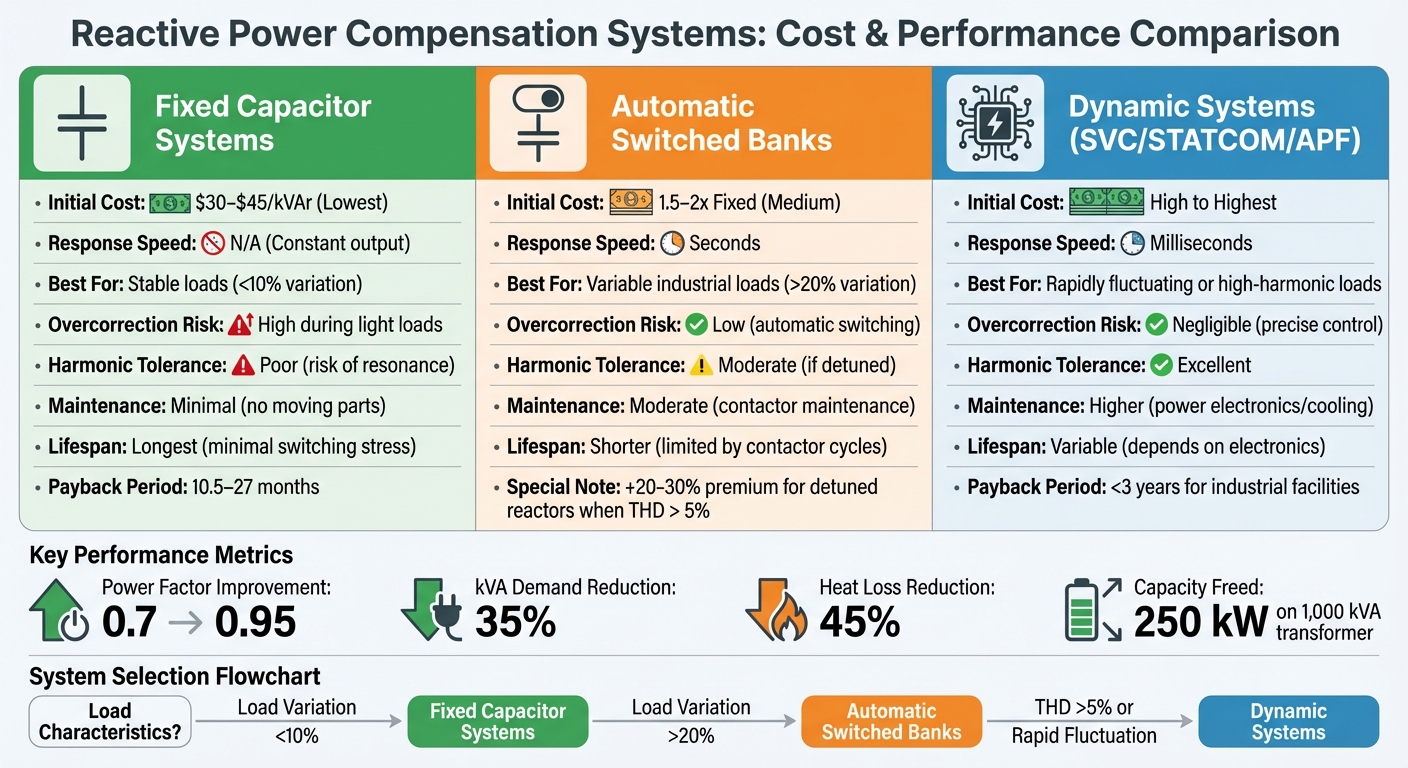
Reactive Power Compensation Systems: Cost and Performance Comparison
Choosing the right reactive power compensation technology depends heavily on your facility's operating conditions. Fixed capacitor systems are the most affordable option, costing around $30–$45 per kVAr. However, they come with the risk of voltage overcorrection during periods of light load. On the other hand, automatic switched capacitor banks, which cost 1.5 to 2 times more than fixed systems, adjust in real-time to prevent overcorrection, making them a better fit for facilities with load variations exceeding 20%.
"For any facility with >20% load variation, I always recommend automatic capacitor banks, even if the initial cost is higher".
Dynamic systems, such as STATCOM or APF, are designed to handle rapidly fluctuating loads and high harmonic distortion. While these systems require the largest financial investment, they excel in environments with harmonic distortion above 5%, where standard capacitors often fail. Their near-instantaneous response - measured in milliseconds - makes them indispensable for applications like arc furnaces and other rapidly changing loads.
Here’s a quick comparison of the key features across these systems:
| Feature | Fixed Capacitor Systems | Automatic Switched Banks | Dynamic Systems (SVC/STATCOM/APF) |
|---|---|---|---|
| Initial Cost | Lowest ($30–$45/kVAr) | Medium (1.5–2x Fixed) | High to Highest |
| Response Speed | N/A (Constant output) | Seconds | Milliseconds |
| Application | Stable loads (<10% variation) | Variable industrial loads (>20% variation) | Rapidly fluctuating or high-harmonic loads |
| Overcorrection Risk | High during light loads | Low (automatic switching) | Negligible (precise control) |
| Harmonic Tolerance | Poor (risk of resonance) | Moderate (if detuned) | Excellent |
| Maintenance | Minimal (no moving parts) | Moderate (maintenance of contactors) | Higher (power electronics/cooling) |
| Operational Lifespan | Longest (minimal switching stress) | Shorter (limited by contactor cycles) | Variable (depends on electronics) |
For facilities dealing with THD levels above 5%, detuned capacitor banks can be an option, though they come with a 20–30% cost premium. Alternatively, active systems like STATCOM or APF handle harmonics without the risk of resonance. Ultimately, the choice should align with your load stability, harmonic challenges, and budget. This comparison helps clarify how different systems balance cost, performance, and operational needs.
Conclusion
Selecting the right reactive power compensation system means finding a balance between upfront costs and long-term savings. For smaller operations with stable loads, like a single large motor, fixed capacitor systems are a practical choice, costing around $30–$45 per kVAr installed. On the other hand, automatic switched banks, priced at 1.5 to 2 times more, are better suited for facilities with variable loads, as they help prevent issues like overcorrection and voltage instability. For environments with significant harmonics, dynamic systems are the most expensive option but provide essential performance where standard capacitors might fall short. Matching the system to your facility's load profile is key to achieving the best results.
The financial benefits are hard to ignore. Boosting the power factor from 0.7 to 0.95 can cut ohmic losses by 45% and free up 250 kW of usable capacity on a 1,000 kVA transformer. Payback periods generally range from 10.5 to 27 months, depending on your utility's penalty structure and rate schedule. Beyond avoiding surcharges, reactive power compensation allows you to expand your facility without costly upgrades to transformers or cables.
- Small workshops with steady motor loads should install fixed capacitors directly at motor terminals to maximize feeder relief.
- Large industrial plants with fluctuating demands benefit from automatic switched banks at the main bus, ensuring efficient response to load changes.
- Data centers and high-tech facilities, which often face non-linear loads and harmonics, should opt for dynamic systems to avoid harmonic resonance issues.
Before investing in any equipment, conduct a load survey using a power quality analyzer. If total harmonic distortion exceeds 5%, standard fixed capacitors may not be the right fit.
For sourcing equipment, Electrical Trader offers a one-stop marketplace for capacitor banks, detuned reactors, and specialized APFC units. Using high-quality components ensures compliance with IEEE 519-2022 and NEC Article 460 standards, reducing the risk of system failures and enhancing reliability. Aim for a power factor between 0.95 and 0.98 to avoid voltage instability and relay misoperation.
FAQs
How do I figure out how many kVAr I actually need?
To calculate the kVAr needed for reactive power compensation, you'll need your system's real power (measured in kW), the current power factor, and the desired target power factor. The formula you can use is:
Qc = P × (tan φ₁ − tan φ₂)
Here:
- P is the active power in kW.
- φ₁ is the angle corresponding to the current power factor.
- φ₂ is the angle for the target power factor.
If this seems too complex, don't worry - there are online calculators that can do the heavy lifting. Just input your system's real power and power factor details, and they'll estimate the kVAr requirements for you.
When should I choose automatic switched banks instead of fixed capacitors?
For facilities with variable or fluctuating loads, automatic switched capacitor banks are the way to go. These systems adjust in real-time to match changing reactive power needs, making them perfect for dynamic environments like manufacturing plants or mining operations.
In contrast, fixed capacitor banks deliver a constant level of reactive power, making them better suited for facilities with steady, predictable loads. This setup minimizes the risk of overcorrection and eliminates the need for frequent manual adjustments.
Do harmonics mean capacitors could fail in my facility?
Harmonics can put capacitors at risk by generating excessive heat and stress, particularly when harmonic levels go beyond 5%. This extra strain damages the dielectric material inside the capacitors, ultimately shortening their lifespan.
Facilities that rely on inductive loads, such as motors and transformers, are especially susceptible to harmonic distortion. To reduce this risk, you can implement harmonic filters or use equipment specifically designed to manage higher harmonic levels.





