

Impact of Load Changes on Voltage Stability
Voltage stability ensures that a power system can maintain steady voltage levels, even during disruptions like demand surges or equipment failures. When load demands fluctuate - whether due to industrial operations, EV chargers, or weather-related spikes - power grids face challenges in maintaining this balance. Without proper management, these changes can lead to voltage collapse, equipment failures, and widespread outages.
Here’s what you need to know:
- Sudden Load Increases: Rapid demand surges strain reactive power, causing voltage drops or collapses.
- Load Types Matter: Constant power loads (e.g., motor drives) destabilize grids, while impedance loads (e.g., heaters) help stabilize them.
- Equipment Stress: Devices like On-Load Tap Changers (OLTCs) and induction motors can exacerbate instability during voltage dips.
- Reactive Power Shortages: Insufficient reactive power is a leading cause of voltage instability, worsened by inverter-based resources.
- Overloaded Infrastructure: Transmission lines and transformers operating beyond capacity increase reactive power losses.
Solutions:
- Reactive Power Devices: Tools like STATCOMs and synchronous condensers quickly stabilize voltage.
- Load Shedding: Automated systems disconnect non-critical loads during voltage drops to prevent collapse.
- Equipment Upgrades: Modern transformers and voltage regulators improve grid reliability.
- Energy Storage: Inverter-based systems provide dynamic support during fluctuations.
- Dynamic Monitoring: Real-time simulations and advanced control systems predict and mitigate risks.
By combining modern technology, precise load management, and infrastructure improvements, power grids can better handle the challenges of fluctuating demand and maintain voltage stability.
ETAP Voltage Stability Analysis
How Load Changes Affect Voltage Stability
How Different Load Types Affect Power Grid Voltage Stability
Sudden Load Increases and Voltage Drops
When a sudden surge in demand occurs - like a large industrial facility starting operations - the system is forced to deliver extra reactive power. This can cause a rapid drop in voltage, potentially leading to a collapse. Such voltage declines can spread across regions, especially in areas identified as "voltage weak" through modal analysis. For instance, a study of the Slovak Republic's power grid revealed that the system could handle about 2.04 to 2.27 times the initial base load before reaching the point of steady-state divergence, where voltage collapse becomes unavoidable.
This highlights the importance of accurate load modeling. If operators depend on flawed models, any stability measures they implement might fail during an actual event.
How Different Load Types Affect Stability
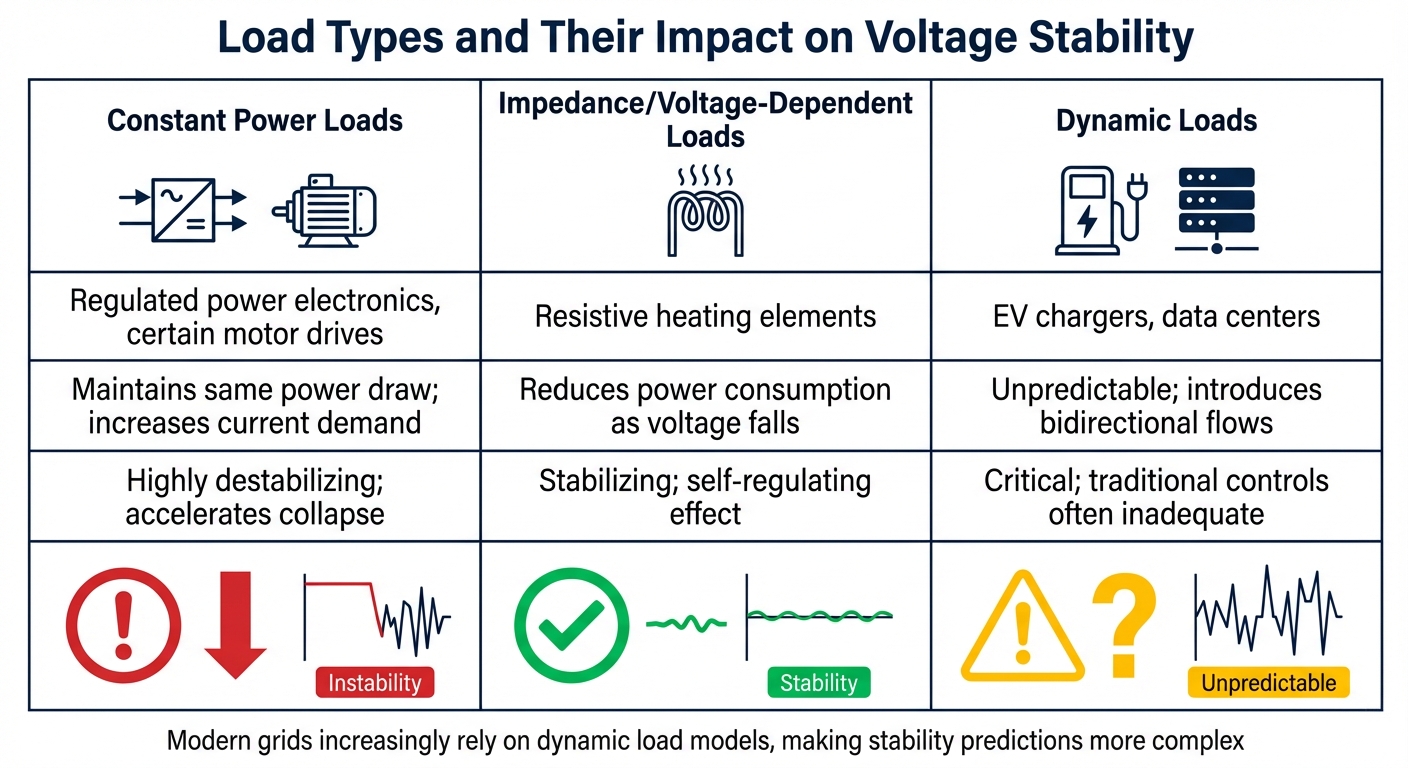
The way loads respond to voltage drops plays a key role in overall stability. Constant power loads - like regulated power electronics and certain motor drives - are particularly challenging. They maintain the same power draw even as voltage decreases, which forces them to draw more current. This behavior is highly destabilizing and can speed up a voltage collapse.
On the other hand, impedance loads, such as resistive heating elements, naturally reduce their power consumption when voltage drops, offering a slight stabilizing effect. Voltage-dependent loads fall in between, adjusting their demand based on available voltage. Modern grids increasingly rely on dynamic load models, driven by the growth of EV chargers and data centers. These models introduce uncertainties that make stability predictions more complex.
| Load Type | Behavior During Voltage Drop | Stability Impact |
|---|---|---|
| Constant Power | Maintains same power draw; increases current demand | Highly destabilizing; accelerates collapse |
| Impedance/Voltage-Dependent | Reduces power consumption as voltage falls | Stabilizing; self-regulating effect |
| Dynamic (EV chargers, data centers) | Unpredictable; introduces bidirectional flows | Critical; traditional controls often inadequate |
Beyond the characteristics of loads, the behavior of equipment under stress also plays a significant role in voltage stability.
Equipment Behavior Under Load Stress
Equipment under severe load stress can worsen instability. For instance, voltage-regulating devices like On-Load Tap Changers (OLTCs) with Automatic Voltage Regulators are designed to maintain distribution voltage (e.g., at 110 kV) even when transmission voltage drops. While this temporarily benefits local consumers, it forces the tap changer to draw more current and reactive power from the already-stressed transmission system, which can accelerate a systemwide collapse. The UCTE Recommendation 11 emphasizes:
The blocking of On Load Tap Changers (OLTC) of transformers in case of severe voltage drop should be accepted practice.
Induction motors add another layer of risk. These motors require reactive power to maintain torque, and under falling voltage, they draw higher currents. If the voltage drops too much, the motors can stall completely, causing a sharp surge in reactive power demand and immediate local voltage collapse. Meanwhile, synchronous generators, which are critical for providing reactive power support, have physical limits. Once a generator reaches its overexcitation limit, it can no longer support voltage, creating a critical "knee point" where stability rapidly deteriorates, pushing the system closer to collapse.
What Causes Voltage Instability During Load Fluctuations
Insufficient Reactive Power
Voltage instability often begins with a lack of reactive power. When load demand spikes, the system needs an immediate boost of reactive power to maintain stable voltage levels. If generators and compensators hit their reactive power limits, the system can't sustain the voltage, leading to instability.
Modern grids face even more difficulties due to unpredictable reactive power demands from newer types of loads. The IEEE PES Voltage Optimization Working Group highlights this issue:
Traditional Volt/Var control strategies - largely designed around synchronous generators and predictable load patterns - are increasingly inadequate.
This problem worsens as power systems shift from synchronous generators to inverter-based resources. Unlike traditional generators, these resources provide less inherent support for reactive power during periods of stress. This shift creates additional hurdles for transmission systems and complicates load restoration efforts.
Overloaded Lines and Transformers
Voltage instability isn't just about reactive power - it’s also tied to the physical limits of the grid. Overloaded transmission lines and transformers increase reactive power losses, which grow exponentially with the square of the current (I²X). For example, doubling the current can quadruple the losses, further draining the reactive power needed to stabilize voltage.
When the system tries to deliver power beyond the maximum capacity shown on a P-V curve, the risk of instability rises. Cadence provides a clear explanation:
An overload scenario occurs when load dynamics attempt to restore power consumption beyond the capacity of the transmission network and connected generation, ultimately causing voltage instability.
Operating transformers or transmission lines above their rated capacity can lead to equipment failure. Under long-term stress, failures may occur within 0.5 to 30 minutes, while in cases involving stalled motors, failures can happen in as little as 3 to 15 seconds.
Dynamic Load Restoration Problems
Voltage disturbances also create challenges during load restoration. After a disturbance, devices like thermostatic loads and On-Load Tap Changers kick in to restore power consumption, but this can further destabilize the grid. Thermostatic loads, such as space heaters and refrigerators, automatically draw more power to compensate for voltage dips, putting extra strain on the system. Similarly, On-Load Tap Changers may pull excessive current from already overloaded transmission networks, worsening the situation.
Reduced system inertia adds another layer of complexity, making grids more vulnerable to rapid voltage drops during these restoration efforts. Without proper coordination among automatic voltage regulators, tap changers, and excitation systems, these corrective measures can unintentionally amplify instability. Together, these dynamics make managing voltage during load fluctuations an even greater challenge for modern power systems.
sbb-itb-501186b
Solutions to Prevent Load-Induced Voltage Instability
Tackling voltage instability requires a combination of advanced technologies, precise load management, and infrastructure improvements. Each plays a critical role in maintaining a stable and reliable power grid.
Reactive Power Compensation
Fast and dynamic reactive power compensation is essential for managing sudden load changes. Devices like Static Synchronous Compensators (STATCOMs) and Static Var Compensators (SVCs) can respond to voltage disturbances within milliseconds, outperforming traditional static capacitor banks. These tools are especially valuable in grids that rely on renewable energy sources, which often have reduced inertia.
Solar PV inverters also contribute by offering "night-mode" reactive power support, even during periods of low solar generation. This feature is particularly helpful during evening load peaks when solar output is minimal. Additionally, synchronous condensers provide both reactive power and physical inertia, adding another layer of stability. For example, Vermont Electric Company's Granite Substation installed four +25/–12.5 Mvar synchronous condensers to prevent voltage collapse during outages. These units delivered more than twice their rated output for up to 10 seconds during critical events, ensuring low-voltage ride-through capability.
Coordinated control of these devices is key. Traditional manual approaches are no longer sufficient to handle the unpredictable demands of modern grids, such as those from data centers and EV chargers. Instead, real-time hierarchical voltage regulation and optimization-based dispatch are now indispensable.
While reactive power solutions are critical, they work best when paired with effective load management strategies.
Load Balancing and Shedding
When voltage drops threaten system stability, Under-Voltage Load Shedding (UVLS) acts as a safety measure. These automated systems disconnect specific percentages of load when voltage dips below a preset threshold - typically 0.9 per-unit (pu) - for a defined duration, such as 1.5 seconds. In simulations, shedding just 5% of the total load under these conditions successfully stabilized the grid during a 500 kV line trip.
The success of load shedding depends on when and where it occurs. Optimization models use DVPS analysis to pinpoint "weak buses" where shedding will have the greatest impact. Multi-step shedding strategies ensure that only the minimum necessary load is cut to restore stability. Additionally, coordinating UVLS with On-Load Tap Changers (OLTCs) is critical. Blocking tap changers during voltage events prevents them from drawing excessive current while attempting to restore voltage, which could otherwise worsen the situation.
Equipment Upgrades and Sourcing Options
Upgrading outdated equipment is another crucial step in addressing voltage instability. Aging transformers and insufficient backup generation create vulnerabilities during load fluctuations. Replacing older transformers with models that feature adaptive On-Load Tap Changer (OLTC) control logic can help maintain voltage stability at the distribution level during transmission-side disturbances . For instance, at Korea Electric Power Company's Jeju Converter Station, the installation of two +50/–25 Mvar synchronous condensers strengthened the grid while enabling the retirement of older gas turbine condensers.
Balancing static shunt capacitors with dynamic devices like STATCOMs ensures steady support during normal conditions and quick response during transient events. For utilities and industrial facilities planning these upgrades, platforms such as Electrical Trader provide access to both new and used transformers, backup generators, and other essential equipment. These centralized marketplaces help reduce procurement delays, enabling quicker implementation of stability improvements.
Steps to Maintain Voltage Stability
Ensuring voltage stability in systems with variable loads involves taking proactive and well-defined measures. Below are key strategies to help prevent instability and maintain grid reliability.
Dynamic Monitoring and Simulations
Addressing the challenges of reactive power requires real-time monitoring and advanced simulations to predict and mitigate voltage drops before they escalate.
An essential step is simulating how the system responds immediately after a disturbance. These mid-term voltage response (MTVR) simulations must account for the transient behavior of plant equipment, slow-acting on-load tap changers (OLTCs), and generator overexcitation limiters (OXL). Modern grids, with their reliance on renewable energy sources and dynamic loads like electric vehicle (EV) chargers, demand real-time adaptive control systems - traditional static methods are no longer enough.
Voltage modal analysis plays a crucial role in pinpointing the buses most at risk of collapse. By calculating participation factors, operators can identify which areas contribute most to potential instability and prioritize them for reactive power compensation. Additionally, determining the reactive power margin - the buffer between the current operating point and voltage collapse - serves as an early warning system.
Technologies like digital twins and hardware-in-the-loop (HIL) simulations further enhance preparation by validating the performance of devices like STATCOMs and SVCs before they are deployed. These tools ensure equipment can handle extreme conditions, reducing the risk of failure during critical moments.
Regular Component Maintenance
Consistent maintenance of transformers, circuit breakers, and reactive power devices is essential to prevent voltage instability. Regular testing of OLTCs and capacitor banks ensures they remain responsive to sudden load changes . Similarly, scheduled inspections of overexcitation limiters (OXL) and automatic voltage regulators (AVR) are vital, as their performance directly impacts both short-term and long-term voltage stability.
"The report highlights the importance of rigorous validation, patch management, and training to ensure reliable operation and integration of advanced reactive power devices." - IEEE PES Voltage Optimization Working Group
Maintenance efforts now extend beyond physical components to include cybersecurity and digital control systems. For example, factory and site acceptance testing of FACTS devices ensures they perform reliably under extreme conditions. This simulation-driven commissioning approach guarantees that STATCOMs and other dynamic equipment are properly integrated with the existing grid. Preventing line trips through regular equipment maintenance is critical, as line trips are a leading cause of dynamic voltage collapse during periods of high load stress.
In addition to robust maintenance practices, incorporating energy storage solutions can further enhance grid stability.
Adding Energy Storage Solutions
Energy storage systems, classified as inverter-based resources (IBRs), offer dynamic and precise reactive power support to counteract voltage fluctuations. These systems are particularly effective in addressing reduced system inertia, a common issue in grids with high renewable energy penetration. Battery-coupled inverters and advanced STATCOMs provide real-time, adaptive control, outperforming traditional manual methods.
Energy storage systems work in tandem with reactive power compensators to create a balanced stabilization strategy across the grid. Notably, inverter-based storage can operate in "night mode", maintaining system voltage during periods of low or no generation, such as evening load peaks when solar output is unavailable. Their rapid response capabilities help address all three types of voltage stability challenges: steady-state issues, mid-range oscillations, and transient instabilities.
To ensure seamless integration, energy storage systems must be carefully coordinated with existing reactive power devices. Plant-level control systems should synchronize multiple reactive devices, ensuring that energy storage and solar inverters collaborate effectively to support weaker grids. Using HIL simulations and digital twins to validate performance before installation helps avoid costly missteps. For facilities planning to incorporate energy storage, platforms like Electrical Trader provide access to transformers, backup generators, and other equipment that complement these installations.
Conclusion: Maintaining Voltage Stability During Load Changes
Keeping voltage stable during sudden load changes boils down to managing reactive power effectively and ensuring fast system response. When demand soars unexpectedly or renewable energy output dips, systems can hit their reactive power limits, causing voltage drops that might spiral into widespread instability. To address this, combining static P-V curve analysis with dynamic simulations can help predict how equipment will perform under stress. Tackling these challenges requires integrated, real-time control solutions.
The growing reliance on inverter-based resources like solar and wind, coupled with unpredictable loads from data centers and EV charging stations, has made traditional control methods less reliable. As highlighted by the IEEE PES Voltage Optimization Working Group:
Traditional Volt/Var control strategies - largely designed around synchronous generators and predictable load patterns - are increasingly inadequate.
This shift calls for advanced control techniques, including real-time systems, digital twins, and hardware-in-the-loop simulations, to test and validate equipment performance before deployment.
Managing voltage stability effectively requires coordination across multiple levels. Transmission and distribution operators must align their efforts with device-level strategies, such as utilizing smart inverters, STATCOMs, and transformers equipped with adaptive On-Load Tap Changers (OLTCs). For instance, optimizing the placement and operation of load-following units can significantly enhance a system’s ability to handle sudden load changes. Additionally, routine maintenance of critical components like transformers, circuit breakers, and reactive power devices is essential to prevent failures during high-stress periods.
When upgrading infrastructure, platforms like Electrical Trader can help source reliable equipment, from transformers and backup generators to voltage regulation tools. Whether you're implementing energy storage systems or replacing outdated capacitor banks, using dependable equipment ensures your voltage control measures remain effective when needed most.
Proactive monitoring and coordinated maintenance are crucial for safeguarding voltage stability. Delays in addressing these issues can lead to rapid system failures and emergency load shedding. By investing in advanced tools and strategies now, operators can maintain consistent voltage levels, even as load demands grow more unpredictable.
FAQs
What happens to voltage stability when there’s a sudden increase in load?
A sudden spike in electrical load can seriously affect voltage stability, often causing voltage levels to dip. This happens because the power system struggles to keep supply and demand in balance, potentially leading to voltage fluctuations or, in severe situations, a complete voltage collapse.
To address these challenges, power systems use tools like voltage regulators, reactive power compensation, and system upgrades to manage higher loads efficiently. Additionally, thorough planning and advanced monitoring technologies play a key role in maintaining stability as load conditions change.
How do different types of electrical loads impact voltage stability?
Different types of electrical loads significantly influence voltage stability in power systems. For instance, resistive loads like incandescent bulbs naturally reduce their power consumption when voltage drops, which can help stabilize the system. In contrast, devices such as motors and electronics often draw more current during voltage fluctuations, potentially leading to instability.
The behavior of loads becomes even more critical during sudden changes or disturbances. Loads with fast-acting control mechanisms - like those used for voltage regulation - can enhance stability by adjusting their power demand in real-time. However, unresponsive or poorly managed loads may worsen instability, especially during rapid shifts in demand. Addressing these challenges often involves strategies like load shedding or using voltage support devices, such as STATCOMs, to ensure the power system remains stable.
Why is reactive power important for maintaining stable voltage in power systems?
Reactive power is essential for keeping voltage levels stable in power systems. It ensures that voltage stays within safe limits, especially when there's a shift in demand or load on the system.
If there's not enough reactive power, voltage can become unstable, which might lead to disruptions or even outages. By managing reactive power effectively, utilities can deliver a steady and dependable power supply, even when loads fluctuate.