

Emergency Power Standards for Hospital UPS Systems
In hospitals, even a brief power outage can jeopardize lives. Critical systems like ventilators, monitors, and surgical tools depend on uninterrupted electricity. To ensure this, hospitals use Uninterruptible Power Supply (UPS) systems alongside emergency generators. UPS systems provide instant backup power during the 10-second gap it takes for generators to activate, preventing disruptions in vital areas such as operating rooms and ICUs.
Hospitals must follow strict standards to maintain reliable power systems. Key regulations include:
- NFPA 99: Defines risk categories for hospital spaces and requires power restoration within 10 seconds for high-risk areas.
- NFPA 110: Sets technical requirements for emergency power systems, including maintenance and testing schedules.
- NFPA 70 (NEC Article 517): Specifies how UPS systems integrate with hospital electrical setups.
Compliance ensures patient safety and allows hospitals to retain accreditation and funding. Regular testing, maintenance, and redundancy (e.g., N+1 configurations) are essential to meet these requirements. UPS systems are indispensable for bridging power gaps and maintaining uninterrupted care.
Electrical contractor series working in healthcare facilities: Codes and standards
NFPA Standards for Hospital UPS Systems
Hospital UPS systems must adhere to three essential standards that ensure reliable emergency power. These codes outline the minimum requirements for equipment classification, system design, and operational readiness.
NFPA 99: Health Care Facilities Code

NFPA 99 uses a risk-based approach to determine electrical requirements based on the consequences of power failure. It categorizes hospital spaces by the potential impact on patients and staff, forming the foundation for designing systems that ensure uninterrupted patient care.
Category 1 spaces, such as operating rooms, ICUs, emergency departments, and cardiac labs, require Type 1 Essential Electrical Systems (EES) to restore power within 10 seconds due to the high risk of severe injury or death from power loss. Meanwhile, Category 2 spaces, like patient rooms, pharmacies, and diagnostic imaging areas, need Type 2 EES since power interruptions in these areas typically result in minor injury or discomfort.
NFPA 99 divides the Essential Electrical System into three branches:
- Life Safety Branch: Powers critical systems like exit signs, egress lighting, and alarms.
- Critical Branch: Supplies power to essential devices such as ventilators and patient monitors.
- Equipment Branch: Supports mechanical systems like HVAC and suction pumps, where restoration may be delayed or manual.
Both the Life Safety and Critical branches must restore power within 10 seconds of an outage. UPS systems play a vital role here by bridging the gap between utility power loss and emergency generator startup. For Category 1 spaces, the code also requires two levels of ground-fault protection to isolate faults and mandates a minimum on-site fuel supply for 96 hours.
| NFPA 99 Risk Category | Impact of Power Failure | Required EES Type | Typical Hospital Areas |
|---|---|---|---|
| Category 1 | Severe injury or death | Type 1 | Operating Rooms, ICUs, ERs, Cardiac Labs |
| Category 2 | Minor injury or discomfort | Type 2 | Patient Rooms, Pharmacies, Diagnostic Imaging |
| Category 3 | No injury, but discomfort | None required* | Administrative Offices, Storage |
| Category 4 | No impact on patient care | None required* | Corridors, Public Spaces |
*Note: As of the 2015 edition, Category 3 and 4 spaces are no longer required to have an EES.
These classifications connect directly to NFPA 110, which defines performance standards for emergency power systems.
NFPA 110: Emergency and Standby Power Systems
NFPA 110 sets the technical requirements for emergency power systems, distinguishing between the Emergency Power Supply (EPS) - such as generators or fuel cells - and the Emergency Power Supply System (EPSS), which includes conductors, transfer switches, and protective devices.
Hospitals typically require Level 1 systems, where failure could lead to serious injury or loss of life. These systems must meet Type 10 standards, meaning power must be restored to critical loads within 10 seconds of a primary power failure. Hospitals are classified as Class X, with runtime requirements ranging from 24 to 96 hours, depending on local regulations.
Chapter 6 of NFPA 110 specifies the sequence for load transfers: emergency loads within 10 seconds, legally required standby loads within 60 seconds, and optional loads afterward. It also requires fuel supplies to be sized at 133% of the generator's designated runtime. Brian O'Connor, Technical Services Engineer at NFPA, explains:
"The emergency power supply is the source of the electrical power and includes everything necessary to generate the power."
Routine maintenance is also mandated, including weekly inspections, monthly generator tests, and a comprehensive system test every 36 months. Special attention is given to maintaining starting batteries.
NFPA 70 (NEC Article 517): Hospital Electrical System Requirements
NEC Article 517 complements NFPA 99 and 110 by addressing how UPS systems integrate into hospital electrical setups. It requires strict separation from the normal electrical system and defines how UPS systems should work with emergency power infrastructure.
UPS systems are recognized as valid emergency power sources under Type U (Uninterruptible) requirements, which ensure continuous power without the typical 10-second delay of generator-only systems. These systems are integrated into the Life Safety and Critical branches of the EES, supporting sensitive medical equipment and life-support systems that cannot tolerate power interruptions.
Mike Feyler of Code Red Consultants highlights this integration:
"The supply system is defined as the Emergency Power Supply (EPS) and may include: Storage Batteries, Generator Sets, Uninterruptible Power Supplies (UPS), DC Microgrid Systems, Fuel Cells and/or Separate Utility Power Sources."
To meet these standards, UPS systems must be classified as Type U and have battery runtimes coordinated with the facility's Class requirements. Additionally, the UPS and its transfer equipment must be rated for Level 1 installation. NEC Article 517 aligns with NFPA 110 Level 1 standards, ensuring systems critical to life safety meet rigorous performance and maintenance expectations.
How UPS Systems Work with Hospital Emergency Power Supply Systems (EPSS)
UPS systems play a critical role in hospitals by ensuring a seamless transition during power outages. When utility power fails, these systems provide an almost instant source of electricity to essential medical equipment, bridging the gap until backup generators activate. This ensures that life-support devices, surgical tools, and patient monitors remain operational without interruption. Let’s explore how UPS systems manage this crucial transition and support hospitals during generator startup delays.
UPS Support During Generator Startup Delays
A hospital's UPS system is designed to handle the "10-second gap" - the brief period between a power outage and the activation of emergency generators. During this time, the UPS ensures uninterrupted power to critical equipment. According to NFPA 110, the Emergency Power Supply System (EPSS) must detect the power failure, start the generator, and transfer power to the Essential Electrical System (EES) branches within 10 seconds or less. As The Joint Commission explains:
"Utilization of a UPS is typically to bridge the 10 second gap from power interruption to generator start time and is not to be considered a SEPSS".
This highlights the UPS's role as a temporary safeguard, ensuring no disruption to vital systems while the generator stabilizes.
Medical-Grade UPS Standards and Compliance
Hospitals must also adhere to strict standards for UPS performance, especially in patient care settings. Medical-grade UPS systems must comply with UL 60601-1 standards, which limit cumulative leakage current to under 100 µA to protect patient safety. These systems are specifically designed for critical applications like clinical labs, diagnostic imaging, and life-support equipment. Many feature advanced technologies such as line-interactive operation or double-conversion systems, which stabilize voltage fluctuations without draining the battery. Additionally, built-in Faraday shielding offers full line isolation and noise filtering, ensuring reliable functionality for sensitive diagnostic tools.
Integration with Essential Electrical System (EES) Branches
UPS systems are seamlessly integrated into a hospital’s electrical infrastructure, particularly the Life Safety and Critical branches. The Life Safety branch powers essential systems like exit signs, emergency lighting, and fire alarms, while the Critical branch supports ventilators, operating room lights, ICU monitors, and nurse call systems. The Equipment branch, which handles systems like HVAC, medical air compressors, and vacuum pumps, connects with a delayed automatic or manual setup to avoid overloading the generators with high inrush currents. UPS systems must be carefully sized to manage immediate loads while ensuring compliance with the 10-second restoration requirement as outlined by NFPA 70 and NFPA 99.
sbb-itb-501186b
Testing, Maintenance, and Compliance for Hospital UPS Systems
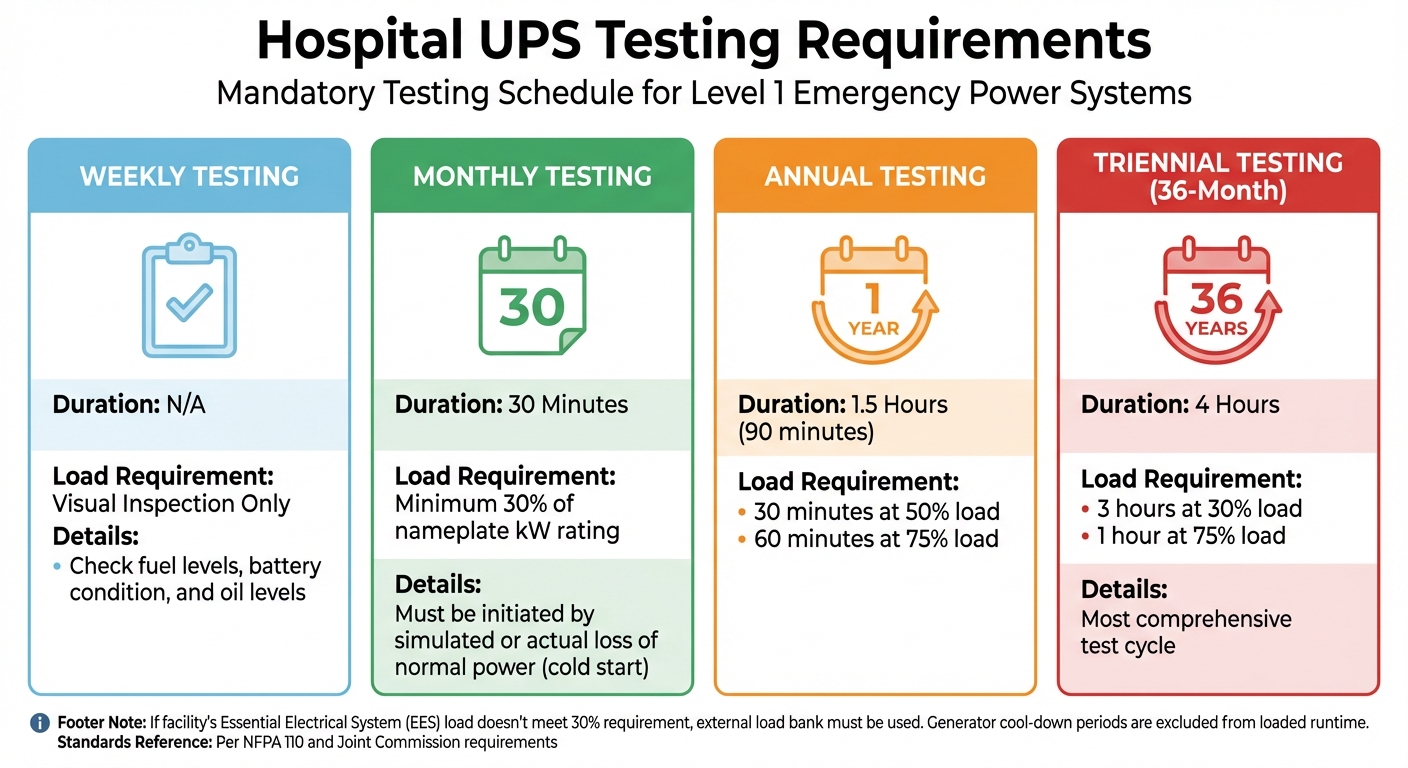
Hospital UPS Testing Schedule and Load Requirements by Frequency
Once UPS systems are integrated with emergency power supplies, keeping them reliable requires thorough testing and regular upkeep. Scheduled inspections, tests, and maintenance are not just best practices - they’re mandatory. Standards like NFPA 110 and NFPA 111 outline these requirements, while organizations like the Joint Commission and CMS enforce them during facility evaluations. Consistent testing and detailed documentation are critical to maintaining patient safety. Below, we break down the specific practices needed to stay compliant.
Routine Testing Requirements
Hospital UPS systems follow a structured testing schedule, ranging from quick weekly checks to more intensive, multi-hour load tests. Weekly inspections focus on visual checks of battery, fuel, and oil levels to confirm the system is ready to function when needed. Monthly tests require running the system for at least 30 minutes at a minimum of 30% load. The Joint Commission provides clear guidelines on how this test should be conducted:
"The monthly emergency power system load test is to be initiated by a simulated or actual loss of normal electrical power".
This means starting the generator cold - without any warm-up - using the test switch on the Automatic Transfer Switch (ATS) or by opening the circuit breaker feeding the ATS. Annual load tests step things up with a 1.5-hour test: 30 minutes at 50% load, followed by one hour at 75% of the system’s nameplate rating. Every three years, facilities must complete a four-hour load test, running the system at no less than 30% load for the first three hours and 75% for the final hour.
| Testing Frequency | Duration | Load Requirement |
|---|---|---|
| Weekly | N/A | Visual Inspection (fuel, battery, oil) |
| Monthly | 30 Minutes | Minimum 30% of nameplate kW rating |
| Annual | 1.5 Hours | 50% for 30 minutes; 75% for 1 hour |
| Triennial (36-Month) | 4 Hours | 30% for 3 hours; 75% for 1 hour |
If the facility’s Essential Electrical System (EES) load doesn’t naturally meet the 30% monthly requirement, an external load bank must be used to ensure compliance. Importantly, only the loaded runtime counts - generator cool-down periods are excluded.
Maintenance Guidelines for Level 1 Systems
Level 1 systems, where a failure could endanger lives, have the strictest maintenance requirements under NFPA 110. These facilities often need at least 96 hours of on-site fuel to support the full essential load. Weekly inspections focus on the health of batteries and control systems, while monthly tests include checks of UPS batteries and starting systems. Annual maintenance involves running the system at full capacity for two hours and verifying emergency lighting for its required duration.
Key components to inspect include:
- Batteries and Chargers: Ensure reliable starting power and consistent performance under load.
- Automatic Transfer Switches (ATS): Check for proper timing, logic, and alignment with the generator start sequence.
- Control Systems: Verify microprocessor controls and remote monitoring systems to ensure alarms are routed correctly, especially after hours.
Every inspection, test, and repair must be documented to prepare for audits by the Joint Commission or CMS.
Meeting Redundancy Standards
Beyond routine maintenance, redundancy is crucial to ensure uninterrupted operation. In hospitals, even a momentary power loss can have serious consequences. N+1 redundancy configurations are standard, allowing the system to handle the entire load if one UPS unit fails or requires maintenance. In critical areas like ICUs, operating rooms, and neonatal units, some facilities adopt 2N redundancy, which provides two completely independent power sources.
Joint Commission Element EC.02.05.07 emphasizes the need for strict inspection, testing, and documentation. For Stored Emergency Power Supply Systems (SEPSS), quarterly functional tests lasting five minutes are required, while annual tests must include a full load test at 60% of the system’s rated class duration. If an EES test fails, immediate repairs and a follow-up test are mandatory.
For example, a hospital recently installed a 1,250kW diesel generator with a 72-hour fuel tank and a new main ATS to support four operating rooms. The system was designed to manage the full load within a transfer time of under six seconds. After undergoing a four-hour load bank test to confirm its performance, the facility passed its Joint Commission survey with no issues related to its emergency power system.
For hospitals in need of UPS systems and emergency power components that meet these stringent standards, Electrical Trader offers a wide range of reliable products and resources.
Conclusion
When it comes to hospital emergency power systems, failure is not an option. Even a momentary lapse in power can have life-threatening consequences. To safeguard lives, facilities must adhere to strict regulations like NFPA 99, NFPA 110, and NEC Article 517. These standards ensure that critical systems remain operational during outages. A key component in this safety net is the UPS system, which bridges the gap by delivering immediate backup power until generators kick in, keeping life-support equipment running without interruption.
Compliance isn't just about safety - it’s also tied to accreditation. Hospitals must meet these standards to maintain accreditation from The Joint Commission, which is crucial for securing federal funding through the Centers for Medicare & Medicaid Services (CMS).
Routine testing and thorough documentation are equally important. Monthly and triennial load tests confirm that power systems will function as needed during emergencies, reinforcing both patient safety and adherence to regulatory requirements.
FAQs
What is the purpose of UPS systems in hospital emergency power setups?
UPS (Uninterruptible Power Supply) systems are essential in hospital emergency power setups, ensuring that vital equipment remains powered during outages. They deliver immediate backup power to life-support systems, medical devices, and other crucial infrastructure, acting as a bridge until backup generators kick in or the main power supply is restored.
This quick response is key to protecting patient safety and keeping critical hospital functions running smoothly, particularly in critical areas like operating rooms and intensive care units, where even a momentary power loss could have serious consequences.
What role do NFPA standards play in designing and maintaining hospital UPS systems?
NFPA standards are essential for ensuring hospital UPS systems are built and maintained to provide reliable emergency power when it's needed most. NFPA 110, the Standard for Emergency and Standby Power Systems, establishes key requirements for installing, operating, and maintaining emergency power systems like UPS units. It covers critical aspects such as transfer switches, monitoring controls, and routine testing to confirm the systems are prepared to handle power outages effectively.
Similarly, NFPA 99, the Health Care Facilities Code, highlights the critical role of backup power in healthcare environments. It mandates that hospitals use UPS systems capable of supporting life safety systems and vital operations. These guidelines assist engineers in selecting appropriate UPS configurations, setting up maintenance schedules, and conducting regular performance evaluations. This ensures continuous power supply and compliance with safety standards in healthcare facilities.
What are the requirements for testing and maintaining hospital UPS systems?
Testing and maintaining hospital UPS systems is crucial to ensure they perform reliably during power outages. Monthly testing should simulate a power failure, requiring the generator to run for at least 30 minutes under a load of 30% of its rated capacity, not including cool-down time.
For annual tests, higher loads are often necessary. These tests typically involve running the generator at 50% load for 30 minutes and 75% load for one hour, making the total test duration at least 1.5 hours.
Every three years, diesel-powered emergency power supplies, including UPS systems, must undergo a 4-hour continuous load test. During this test, the first three hours should maintain a 30% load, followed by a final hour at 75% load.
Routine maintenance is equally important and includes checking batteries, circuitry, and control systems to confirm everything is in proper working order. Adhering to these practices ensures hospitals meet standards and that critical systems are prepared for emergencies.