

Emergency Power Redundancy: Key Design Tips
When designing emergency power systems, redundancy is the backbone of reliability. Whether it’s for hospitals, data centers, or industrial facilities, ensuring uninterrupted power during outages is critical. Here’s what you need to know:
- Redundancy prevents single points of failure, ensuring life-safety equipment remains operational.
- NFPA 110 standards govern the design, installation, and maintenance of Emergency Power Supply Systems (EPSS).
- Systems are classified by Level (criticality), Class (runtime), and Type (transfer time).
- Key requirements include the 10-second rule for life-safety loads, fire-rated generator rooms, and proper load prioritization.
- Regular maintenance and testing are mandatory to ensure system readiness.
Whether you’re building a new system or upgrading, following these principles ensures compliance and reliability. Let’s dive into the specifics.
Data Center Redundancy Explained: N, N+1, and 2N Systems
sbb-itb-501186b
Classifying Emergency Power Supply Systems
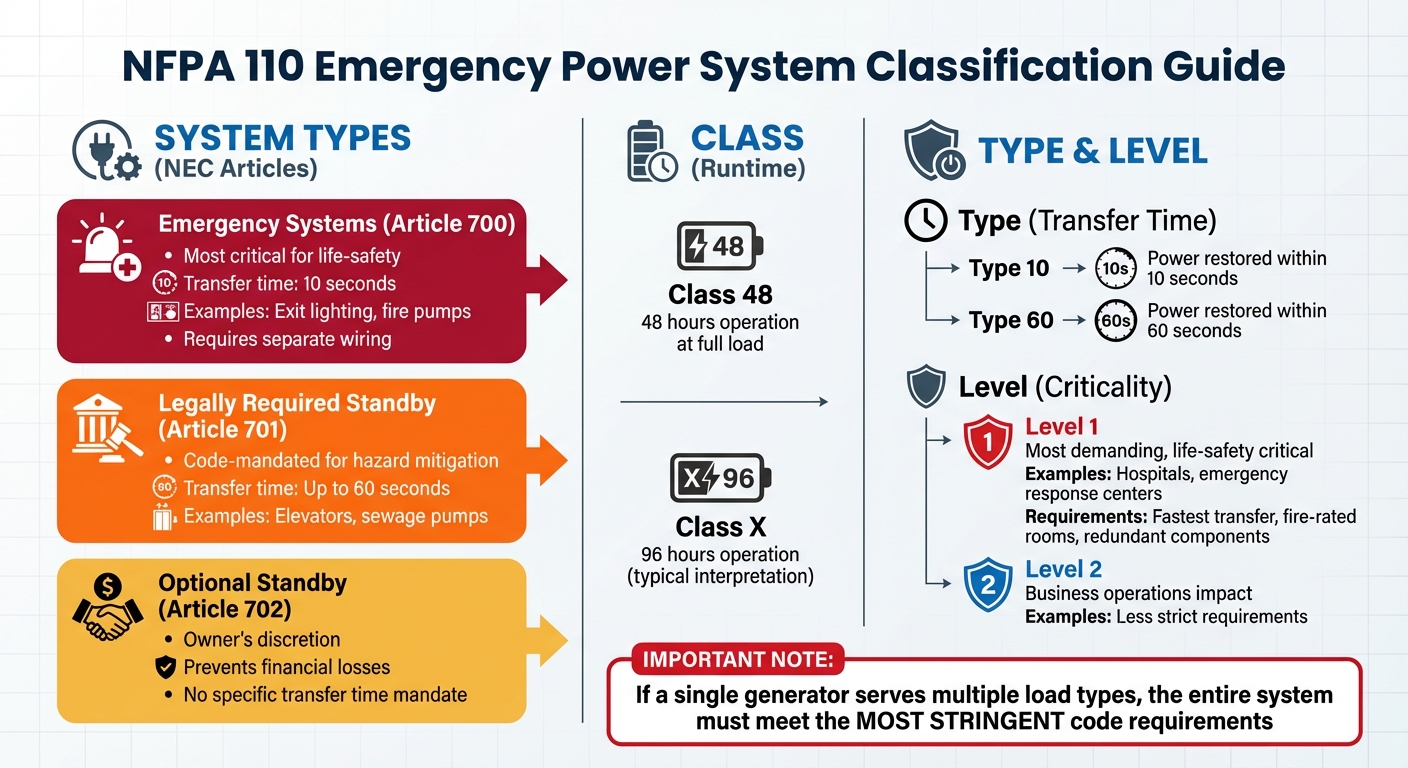
NFPA 110 Emergency Power System Classification Guide
Before diving into the design of a redundant emergency power system, it's crucial to properly classify your system. The NFPA 110 standard breaks this down into three key categories: Level, Class, and Type. As one Consulting-Specifying Engineer explains:
"The first step to design an emergency power supply system is to identify the operational requirements of the essential loads to properly classify the EPSS and select the appropriate type of equipment".
Misclassification can lead to serious issues, like non-compliance, failed inspections, or inadequate protection for life-safety systems. These classifications serve as the backbone for all subsequent design decisions.
3 Types of EPSS: Emergency, Legally Required, and Optional Standby
Emergency power supply systems (EPSS) are divided into three categories, as outlined by NFPA 110 and the National Electrical Code (NEC). Each category has distinct redundancy and performance requirements:
- Emergency Systems (NEC Article 700): These are the most critical systems, ensuring life-safety equipment like exit lighting and fire pumps remain operational. They must transfer power within 10 seconds and require separate wiring from normal power to avoid a single fault disrupting both sources.
- Legally Required Standby Systems (NEC Article 701): These systems power equipment that mitigates hazards or aids in rescue operations, such as elevators and sewage pumps. While still code-mandated, they allow transfer times of up to 60 seconds.
- Optional Standby Systems (NEC Article 702): Installed at the owner's discretion, these systems aim to prevent financial losses rather than meet statutory safety requirements. There are no specific mandates for transfer time or wiring separation.
Important Note: If a single generator serves multiple load types, the entire system must meet the most stringent code requirements. For instance, a system powering both Emergency and Optional loads must comply with the stricter standards of Article 700.
Classes and Levels of EPSS
The Class of an EPSS defines how long it can operate without refueling. For example:
- Class 48: Requires 48 hours of operation at full load.
- Class X: Typically interpreted as 96 hours, depending on the Authority Having Jurisdiction (AHJ).
The Type refers to the maximum time allowed for power restoration:
- Type 10: Power must be restored within 10 seconds.
- Type 60: Power must be restored within 60 seconds.
The Level indicates the criticality of the loads:
- Level 1: These systems are the most demanding, required in environments where failure could result in loss of life or serious injuries. Examples include hospitals and emergency response centers. They require the fastest transfer times, fire-rated rooms, and redundant components.
- Level 2: Used for systems where failure impacts business operations but doesn’t pose immediate safety risks. These have less strict requirements.
Always confirm the necessary Class, Type, and Level with your local AHJ before finalizing your design. The AHJ has the ultimate authority on system classification.
Designing Redundant Power Sources
After classifying your system, the next step involves selecting and configuring power sources. This means choosing the right generators and distributing loads to ensure reliable performance without overburdening capacity.
Selecting Backup Generators
Choosing a generator starts with understanding duty cycle ratings. According to NFPA 110, standby generators are suited for lighter duties, while mission-critical and continuous generators are designed to handle higher loads over extended periods. For systems requiring high reliability, an N+1 redundancy configuration is ideal. This setup ensures that if one generator fails or needs servicing, the remaining units can still handle the full load without interruptions.
When using multiple generators in parallel, a control system must prioritize loads. For Level 1 life-safety loads, power should be restored within a critical 10-second window after voltage and frequency stabilize. These systems typically need fuel storage sufficient for 96 hours of operation, combining day tank and main tank capacities.
Generator placement is equally important. Installations should consider flood elevations and protection against natural disasters. Proper ventilation, as specified by the manufacturer, is critical to prevent engine overheating.
Once generators are selected and set up, the next step is to focus on accurate load sizing and distribution to maintain seamless operation.
Load Sizing and Distribution
Start by identifying all essential loads in terms of kW and kVA, and factor in diversity and growth. For instance, data centers often include a 20–25% capacity margin to handle both critical loads and potential future expansions. Oversizing can lead to fuel waste and issues like wet stacking - unburned fuel accumulating in the exhaust. On the other hand, undersizing risks system failures.
Load prioritization is especially important in paralleled systems. Divide loads into three tiers: Level 1 (Emergency), Level 2 (Legally Required Standby), and Optional Standby. When the generator bus activates, Level 1 loads should connect first. If a generator fails, the system should automatically shed lower-priority loads in reverse order to keep critical equipment powered. Adding time delays between load steps allows generators to stabilize voltage and frequency, reducing the chance of nuisance tripping during the transfer process.
Physical separation of components further strengthens system reliability. Emergency feeders and overcurrent protective devices (OCPDs) should be isolated from normal service equipment to prevent a single fault from affecting both power sources. For generators configured as separately derived sources, using 4-pole transfer switches ensures proper neutral isolation, minimizing issues with stray neutral currents.
Transfer Switch Design and Load Transfer Timelines
When it comes to emergency power systems, selecting the right transfer switch design is just as important as choosing the generator. These switches are the backbone of ensuring power continuity during outages, seamlessly shifting critical loads to backup power.
Types of Transfer Switches for Redundant Systems
Automatic Transfer Switches (ATS) are the go-to option for most emergency systems. They monitor the primary power source and, when a failure is detected, automatically activate the generator and complete the transfer once voltage and frequency stabilize.
For systems requiring maintenance without disrupting power, bypass-isolation switches are a smart choice. These include a secondary manual switch, allowing technicians to service the ATS while keeping critical loads powered.
Transfer methods differ based on system needs:
- Open Transition: Disconnects from one source before connecting to another.
- Delayed Transition: Pauses to allow inductive loads to discharge before switching.
- In-Phase Transition: Synchronizes the power sources, completing the transfer in about 150 milliseconds.
- Closed Transition: Overlaps both sources for less than 100 milliseconds, ensuring no interruption. This is especially important for environments like hospitals or data centers where even a brief power loss is unacceptable.
For systems with separate grounding requirements, 4-pole switches are a better fit than 3-pole switches. They help avoid neutral bonding issues and prevent circulating currents, which can interfere with ground fault detection.
These features directly affect how quickly loads are transferred, which is critical for meeting emergency power standards.
Meeting the 10-Second Load Transfer Requirement
NFPA 110 outlines strict timelines for transferring loads during an outage. Emergency loads must be powered within 10 seconds of generator availability, legally required standby loads within 60 seconds, and optional standby loads after that.
Since generators often take 8–15 seconds to stabilize, battery-backed emergency lighting is typically needed to cover the gap. In systems with multiple generators, lower-priority loads should automatically shed if a generator fails, ensuring power is preserved for critical 10-second loads.
Another key consideration is the Withstand and Close-on Rating (WCR). This ensures the ATS can handle the available fault current at its location for the duration specified in the coordination study. If instantaneous trip functions are disabled for selective coordination, the ATS must still handle the adjusted fault duration.
"NEC 700.5(D) prohibits a transfer switch that serves emergency loads from serving any other kind of load." - Tom Divine, PE, Johnston, LLC
To comply with regulations, use an ATS specifically listed for emergency service and equipped with mechanical interlocking to prevent accidental power interconnection. Additionally, generator start conductors should be protected with two-hour fire-rated wiring.
Lastly, once utility power is restored, NFPA 110 requires a minimum 5-minute delay before switching back to normal power. A 5-minute cool-down period for the generator is also mandatory before it shuts down.
Maintenance and Testing for System Reliability
To ensure emergency power systems function when needed, consistent maintenance and testing are just as important as a well-designed setup. Without these, even the most robust systems can fail.
"Random inspection and testing are not a basis for maintaining the dependability of an EPSS. The continued reliability of the EPSS is dependent on an established program of routine maintenance and operational testing".
Routine Maintenance Best Practices
One of the most common culprits in generator failures is battery issues. To avoid problems, batteries should undergo weekly visual checks for electrolyte levels or voltage. Additionally, monthly tests, such as conductance or specific gravity checks, are essential to catch early signs of deterioration.
Fuel quality is another critical factor. Over time, diesel fuel can degrade, becoming contaminated with water or microbes. To address this, annual fuel quality testing is required by NFPA 110, following ASTM D 975 standards. If tests reveal contamination, fuel polishing can restore its usability and prevent costly generator failures.
It’s also a good idea to store duplicate manuals, spare parts, and essential tools in a secure area near the generator. This ensures technicians can quickly respond to issues during an outage. For Level 1 systems, circuit breakers should be exercised annually while the generator is off to prevent them from sticking.
Here’s a quick overview of maintenance activities and their schedules:
| Testing Schedule Summary | Component/Action | Requirement Detail |
|---|---|---|
| Weekly | EPSS Components | Visual inspection of generator, batteries, and fuel levels |
| Monthly | Operational Test | 30-minute run under load; rotate initiating ATS |
| Annually | Fuel Quality | ASTM D 975 standard test for diesel fuel |
| Annually | Load Bank Test | Required if monthly load <30%; 1.5 hours total duration |
| 36 Months | Triennial Test | 4-hour continuous run for Level 1 systems |
Following these guidelines not only helps meet NFPA 110 standards but also ensures the system is ready when emergencies strike.
Testing Protocols for Redundant Power Systems
Regular inspections are crucial, but operational testing is what truly confirms a system’s readiness. Monthly tests are mandatory and involve running generators for at least 30 consecutive minutes under load. For diesel generators, this means hitting at least 30% of the standby nameplate kW rating or the manufacturer’s recommended exhaust gas temperature. Running below this level can lead to "wet stacking", where unburned fuel and carbon build up in the exhaust, potentially reducing the engine’s effectiveness during a real emergency.
Monthly tests should always be initiated via the ATS test switch, not the generator control panel. This ensures the entire system - from power loss detection to load transfer - is functioning correctly. For systems with multiple transfer switches, rotate which ATS is used each month to confirm all switches operate as intended.
If a diesel generator doesn’t reach a 30% load during monthly tests, an annual load bank test becomes necessary. This involves running the system for 30 minutes at 50% load, followed by 60 minutes at 75% load. The 2025 edition of NFPA 110 has simplified this process by removing the 25% load step.
For Level 1 systems, a triennial test is required every 36 months. This involves running the generator continuously for at least four hours, matching the system’s assigned class. Healthcare facilities have even stricter testing requirements under NFPA 99, mandating 12 tests per year, spaced 20 to 40 days apart.
Detailed records of all inspections, tests, and repairs should be maintained, noting dates, personnel involved, and any issues found. Digital logs are especially useful for audits by the Authority Having Jurisdiction (AHJ). All maintenance and testing should be performed by qualified personnel with the necessary training to handle live electrical equipment safely.
Sourcing Compliant Equipment on Electrical Trader
After designing a redundant emergency power system that aligns with NFPA 110 standards, the next step is sourcing the right equipment. Electrical Trader simplifies this process by centralizing NFPA 110-approved components, making it easier to find exactly what you need.
Products Available for Redundant Power Systems
Once your system design is ready, choosing equipment that meets compliance and reliability standards is critical. Electrical Trader provides a wide selection of generator sets, including diesel, natural gas, and spark-ignited models. Diesel generators are often preferred because of their quick load acceptance and dependable performance during fuel supply interruptions. The platform features products from top manufacturers like Caterpillar, Cummins, Doosan, Multiquip, and Kohler, with power ratings ranging from 35 kW to 3,000 kW, accommodating facilities of all sizes.
In addition to generators, Electrical Trader offers automatic transfer switches (ATS) that meet NFPA 110 (6.1.6) standards as factory-assembled and tested units. The marketplace also includes uninterruptible power supplies (UPS), particularly on-line (VFI) systems, which ensure zero transfer time - making them ideal for data centers and critical medical applications. Other essential components available include circuit breakers, transformers, control panels, and fuel system accessories to complete your redundant power system.
Benefits of Using Electrical Trader for Equipment Sourcing
Electrical Trader offers more than just variety - it provides practical advantages for sourcing equipment. One standout feature is the availability of pre-owned industrial generators, which offer a budget-friendly alternative to new equipment without compromising reliability. These pre-owned units undergo rigorous testing, including 100% load bank testing and comprehensive multi-point inspections, ensuring their performance. This is particularly helpful for facilities upgrading their systems or working within tight budgets.
To ensure compliance, request key documentation such as the manufacturer's letter of compliance (NFPA 110, 5.6.10.5), prototype testing results for Level 1 systems (5.2.1.2), and certifications for rated load testing. Additionally, confirm that transfer switches include all features required by NFPA 110. This approach not only ensures your equipment meets strict NFPA 110 standards but also facilitates coordination with the Authority Having Jurisdiction (AHJ) for final system approval.
Conclusion
Key Design Tips Recap
To align with NFPA 110 standards, make sure to classify your system by Level, Type, and Class.
Choose an automatic transfer switch (ATS) that is emergency-rated, factory-tested, and mechanically interlocked. This ensures compliance with the 10-second rule for Level 1 loads.
"NFPA 110 standard compliance is not just a legal formality but a necessary requirement to ensure there are no losses, be it of any important data, business revenue, or something much worse (the loss of a life)." – Curtis Power Solutions
Stick to strict maintenance and testing schedules. This includes monthly generator exercises at no less than 30% load to prevent wet stacking, annual load bank testing at 100% capacity for at least two hours, annual fuel quality testing, and full-duration testing every 36 months for Level 1 systems.
With these design basics covered, it's time to focus on acquiring reliable, compliant equipment.
Next Steps for Sourcing with Electrical Trader
Electrical Trader makes it easy to find NFPA 110-compliant equipment. The platform offers a wide range of generators, from 35 kW to 3,000 kW, sourced from trusted manufacturers like Caterpillar, Cummins, and Kohler. Additionally, you can find NFPA 110-compliant automatic transfer switches. Whether you're in the market for new or used equipment, Electrical Trader provides a centralized solution for all your redundant power system needs.
FAQs
How do I confirm the right NFPA 110 Level, Class, and Type for my facility?
To figure out the right NFPA 110 Level, Class, and Type for your facility, start by examining the standard's performance and classification guidelines. Consider your facility's critical load requirements, the level of reliability you need, and any local regulations that apply. Working with a qualified engineer who understands NFPA 110 can be invaluable for ensuring compliance and designing the right system. Tailor your decision to your facility’s operational demands and the rules in your area to make the best choice.
When is N+1 generator redundancy worth the added cost and complexity?
N+1 generator redundancy is a smart investment for facilities where high reliability and availability are absolutely essential. In mission-critical environments, even a brief power outage can cause major operational disruptions or pose safety risks. Redundancy ensures that power remains uninterrupted, providing an extra layer of security when it matters most.
What documentation should I request to prove generators and ATS equipment are NFPA 110-compliant?
To ensure compliance with NFPA 110 standards, request certification documents or compliance reports for the generators and automatic transfer switch (ATS) equipment. These reports should explicitly confirm that the equipment aligns with the guidelines established for emergency power systems. Make sure the documentation provides clear evidence of adherence, including any relevant testing results or evaluations.