

Common Lockout/Tagout Mistakes to Avoid
Every year, workplace injuries and fatalities occur because machines aren’t properly shut down during maintenance. Lockout/Tagout (LOTO) procedures are designed to prevent these incidents, yet compliance issues remain widespread. In 2023 alone, OSHA issued 2,554 LOTO citations - a 17% increase from the previous year - with penalties reaching up to $161,323 for repeated violations.
Here’s what you need to know to avoid LOTO mistakes:
- Generic procedures fail: Each machine needs specific steps for isolating energy sources.
- Hidden energy hazards: Workers often miss hydraulic, pneumatic, or thermal energy.
- Skipping verification: Always confirm that energy is fully isolated before starting work.
- Improper devices: Tags are not substitutes for locks, and shared locks undermine safety.
- Training gaps: Employees must understand their roles and responsibilities.
Ten Common Mistakes That Result in Serious Injuries
sbb-itb-501186b
Core LOTO Compliance Requirements
Understanding the key compliance requirements for Lockout/Tagout (LOTO) is essential to avoiding common mistakes. Under OSHA 29 CFR 1910.147, every compliant LOTO program must include three critical components: written energy control procedures, employee training, and periodic inspections. These elements are not optional - they work together to ensure safety. OSHA inspectors frequently uncover lapses in these areas, as shown by their citation records.
Key Elements of a LOTO Program
A proper LOTO procedure must outline specific details, including its purpose, step-by-step instructions for shutdown and isolation, the correct handling of devices, and the necessary verification steps. For electrical equipment, only physical disconnects qualify as energy-isolating devices (EIDs). Devices like push buttons, selector switches, and interlocking gates are not acceptable substitutes for LOTO compliance.
Verification is a non-negotiable step. After applying locks, a qualified person must confirm that the circuit is completely de-energized using tools like a voltmeter. This includes checking for any residual energy, such as that stored in capacitors. The LOTOTO method takes this a step further by requiring a physical tryout of the lock after it’s applied.
Annual inspections are also required. These must be conducted by an authorized employee who is not the one currently using the specific procedure. This independent review ensures compliance and builds an extra layer of safety into the process.
"Authorized employees must know and understand how to control hazardous energy effectively when they service or maintain machinery and equipment. Detailed procedures are required because over generalization does not provide the level of information necessary for an employee to use the procedure to effectively isolate hazardous energy." - Richard E. Fairfax, Director, Directorate of Enforcement Programs
Roles and Responsibilities in LOTO
Clearly defining roles is another critical aspect of compliance. One of the most common gaps in LOTO programs is the lack of role clarity. OSHA categorizes employees into three distinct groups, each with specific responsibilities and training needs:
| Employee Type | Role in LOTO | Training Focus |
|---|---|---|
| Authorized | Applies locks/tags; performs servicing/maintenance | Identifying hazardous energy types, magnitudes, and isolation methods |
| Affected | Operates or works near the equipment being serviced | Understanding why LOTO is in place; never restarting locked-out equipment |
| Other | Works in areas where LOTO is active | Awareness of the program; prohibition against tampering with locks or tags |
Employers must assign these roles from the start and maintain an updated list of designations. Tailored training for each category helps eliminate confusion and reduces safety risks.
For tasks involving electrical work, there’s an additional layer of distinction. While authorized employees can apply LOTO devices, only a qualified person - trained under §1910.332 - is allowed to use testing instruments to verify that circuits are de-energized. Confusing these roles is a serious compliance risk.
"The incoming employee should not have to depend on the actions of another employee or supervisor, particularly the one who has left the workplace for the day, for assurance that it is safe to work on the machinery or equipment." - OSHA eTool
This is especially important during shift changes, which require written procedures to ensure a safe handoff of LOTO devices between outgoing and incoming workers. Without this documentation, the risk of accidents increases. These clearly defined roles and responsibilities form the backbone of an effective and safe LOTO program.
Common LOTO Mistakes and How to Fix Them
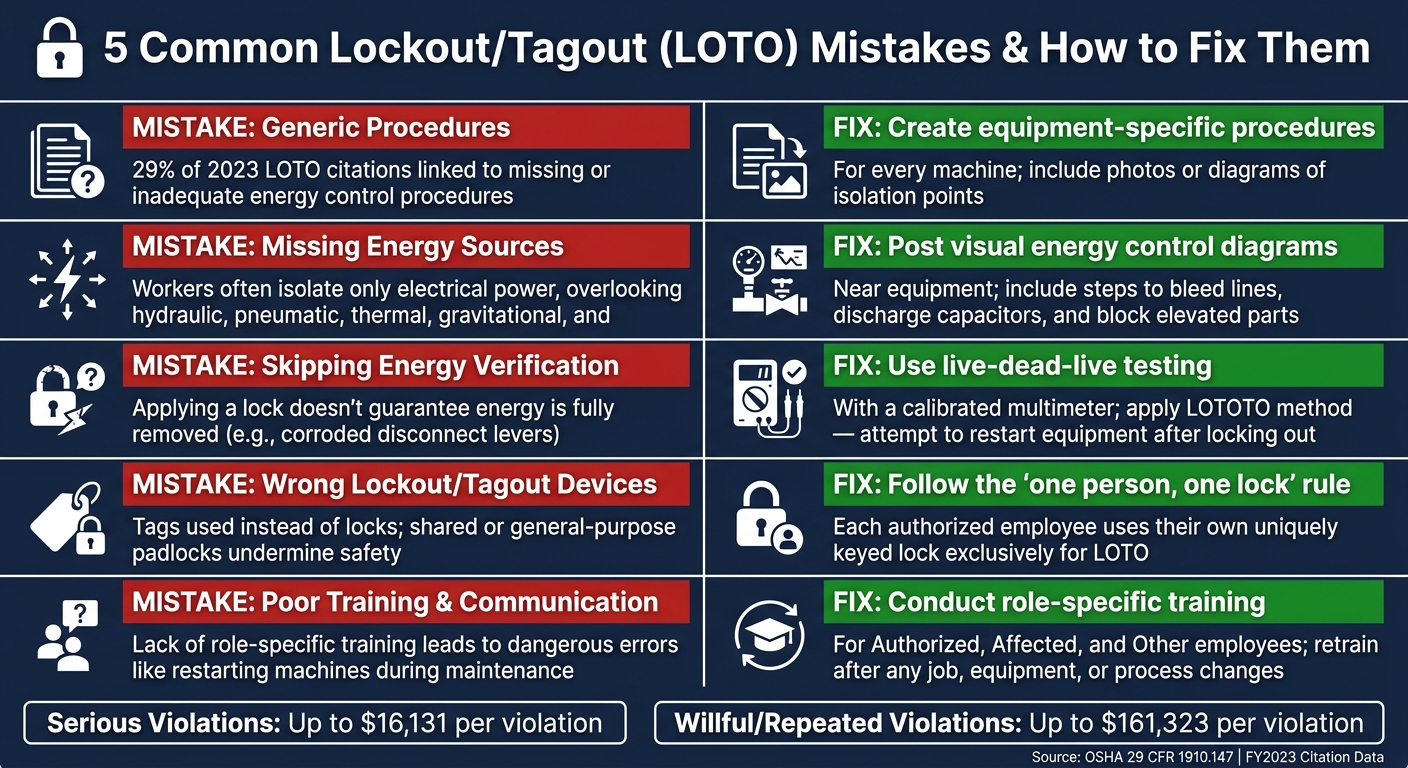
5 Common Lockout/Tagout Mistakes & How to Fix Them
Even the best safety programs can fall short when the finer details are overlooked. In fiscal year 2023, OSHA issued 2,554 LOTO citations - a 17% jump compared to the previous year. For over a decade, this standard has consistently ranked among OSHA's Top 10 most-cited violations. Many of these citations stem from recurring, correctable mistakes. Below, we’ll break down these common errors and practical ways to address them.
Mistake 1: Using Generic Instead of Equipment-Specific Procedures
One of the most frequent issues is relying on generic LOTO procedures. In 2023, 29% of all LOTO citations were linked to missing or inadequate energy control procedures. Why is this a problem? Generic procedures fail to account for specific details like a machine's unique isolation points, energy types, or shutdown sequence. This leaves workers guessing, which can lead to dangerous oversights.
The solution is simple: perform an equipment inventory and ensure every machine with hazardous energy has its own tailored procedure. If you notice gaps, create detailed, equipment-specific instructions. Including photos or diagrams of isolation points can make these procedures much clearer and reduce errors during lockout.
Let’s move on to a related issue: incomplete isolation of all energy sources.
Mistake 2: Missing Energy Sources During Isolation
Many workers stop after cutting electrical power, but machines often store other, less obvious forms of energy. These include compressed air in pneumatic lines, pressurized hydraulic fluid, tensioned springs, elevated components, or residual heat in steam lines. Overlooking these energy sources can lead to serious accidents. For instance, a secondary circuit from an adjacent conveyor feeding into the same machine might go unnoticed.
| Energy Source | Common Oversight | Mitigation Step |
|---|---|---|
| Mechanical | Springs under tension, kinetic energy in flywheels | Release tension; apply blocks or brakes |
| Hydraulic | Pressurized fluid in accumulators or cylinders | Bleed lines to zero pressure |
| Pneumatic | Compressed air in tanks or lines | Vent air to atmosphere |
| Gravitational | Elevated rams, platens, or suspended loads | Use safety pins, blocks, or stands |
| Thermal | Residual heat in pipes or surfaces | Allow sufficient cooling time |
To address this, procedures must include steps to bleed pressurized lines, discharge capacitors, and block elevated parts. Posting a visual energy control diagram near equipment can help workers identify all isolation points and energy types, making it easier to catch what a checklist might miss.
Mistake 3: Skipping Energy Verification
Even with proper procedures in place, failing to verify de-energization can render the entire system ineffective. Applying a lock doesn’t guarantee that energy has been fully removed. For example, a corroded disconnect lever might appear to be in the "off" position while still energizing contacts. Skipping this critical step assumes everything worked as planned - a risky assumption.
"A missed energy source discovered during verification is a near-miss. A missed energy source discovered during maintenance is an incident." - LOTOBuilder
The gold standard for electrical systems is live-dead-live testing. This involves using a calibrated multimeter to check for zero voltage, testing a known live source to ensure the meter is working, and then re-testing the circuit. For mechanical and pneumatic systems, workers should physically inspect pressure gauges and open bleed valves. The LOTOTO method adds an extra layer of safety: after locks are applied, the authorized employee attempts to start the equipment using normal controls to confirm it won’t cycle.
Mistake 4: Using the Wrong Lockout/Tagout Devices
Tags are not a substitute for locks. Using a tag where a lock could be applied is a compliance violation. Tags can be ignored, torn, or removed, while locks provide a physical barrier. Additionally, using a shared lock or a general-purpose padlock undermines the integrity of the system.
"The energy control lock's only purpose is for energy control during servicing and maintenance. Every employee must respect the hazardous energy control lock." - ISHN
Follow the "one person, one lock" rule: every authorized employee should have their own uniquely keyed lock, used exclusively for LOTO. In group lockout situations, each worker must attach their personal lock to a group lockbox rather than relying on a single lock applied by a coordinator.
Mistake 5: Poor Training and Communication
Inadequate training leads to dangerous situations - like when an affected employee restarts a machine while someone is still working on it, or when an authorized employee applies LOTO without verifying de-energization. These errors often arise from a lack of role-specific training.
OSHA mandates retraining whenever there are changes in job assignments, equipment, or processes that introduce new hazards. Training isn’t a one-and-done event. The penalties for serious violations can reach up to $16,131 per violation, while willful or repeated violations can cost as much as $161,323. By comparison, investing in proper training is a small price to pay.
Incorporating LOTO into Electrical Equipment Maintenance
Integrating Lockout/Tagout (LOTO) into every stage of an equipment's lifecycle - installation, operation, maintenance, and decommissioning - is essential. Failing to do so contributes to the alarming number of hazardous energy-related incidents in U.S. workplaces, which result in 120 fatalities and 50,000 injuries annually.
Equipment Features That Support LOTO
The most efficient LOTO programs rely on equipment designed for easy isolation. Machines equipped with dedicated disconnect switches, lockable circuit breakers, and clearly labeled isolation points make it much easier to create precise, equipment-specific procedures. For instance, having local disconnects for individual components, such as a main drive motor, allows workers to isolate specific parts without shutting down an entire production line.
Other helpful design features include:
- Bleed valves for pneumatic or hydraulic lines
- Capacitor discharge circuits
- Accessible test points
- Pressure gauges
These features not only streamline verification but also enhance safety. Permanently marking isolation points with asset ID numbers and integrating them into energy control diagrams - posted directly on the machine - can significantly reduce errors and speed up procedure development.
"Built-in technology can help prevent and reduce electrical injuries and fatalities by designing out electrical hazards and risks." - Ray Chishti, J.D., Workplace Safety Editor, J. J. Keller & Associates Inc.
By incorporating these features, companies can simplify both maintenance planning and sourcing while improving overall safety. This is a challenge effectively addressed by Electrical Trader.
How Electrical Trader Supports Maintenance Planning

Finding replacement components that align with your LOTO program is critical. For example, a disconnect switch or circuit breaker that doesn’t fit your existing lockout hasps or lacks a locking tab can lead to risky workarounds. Electrical Trader offers a wide selection of new and used power distribution components - like breakers, disconnects, and transformers - making it easier to source parts that meet your system's specifications and safety requirements. This approach ensures fewer workarounds and strengthens the integrity of your LOTO program.
Additionally, having well-documented equipment with known energy characteristics simplifies the process of creating accurate, equipment-specific LOTO procedures right from the start.
LOTO During Decommissioning and Recommissioning
LOTO practices must also be adaptable during decommissioning and recommissioning. When decommissioning equipment, residual energy - stored in elements such as capacitors or pressurized lines - can remain a hazard even after the machine is retired. Similarly, recommissioning requires reviewing and updating existing procedures and diagrams to account for any modifications made to the equipment. Regular audits by authorized personnel are essential to identify and address any gaps in the LOTO process before they lead to incidents.
Conclusion: Keeping LOTO Practices on Track
The issues discussed - like relying on generic procedures, overlooking energy sources, skipping verification, using the wrong devices, and skimping on training - often arise when lockout/tagout (LOTO) is treated as a formality rather than a critical safety measure. The stakes are high, as violations can result in hefty penalties, with fines escalating for repeated offenses.
To strengthen your LOTO program, focus on making meaningful changes. Start by creating machine-specific procedures for every piece of equipment. Train all employees - not just those directly involved in applying locks - and make sure every worker uses their own personal lock to avoid confusion or misuse.
Verification is absolutely essential. Use the LOTOTO method, which involves attempting to restart the equipment after locks are applied, to confirm that energy sources are fully isolated. As LOTOBuilder aptly puts it:
"A missed energy source discovered during verification is a near-miss. A missed energy source discovered during maintenance is an incident."
Beyond daily practices, regular audits and updates are crucial to staying compliant. OSHA mandates that inspections involve observing authorized employees performing lockout procedures - not just reviewing documentation - and these inspections must occur at least once a year. By prioritizing audits, keeping procedures current, and fostering a workplace culture that discourages shortcuts, you can enhance compliance and, most importantly, protect your workers.
FAQs
When is a tag allowed instead of a lock?
If an energy-isolating device can be locked, a lock must be used. Tags can only replace locks when the device cannot be physically locked out. However, if you opt to use a tagout system on a lockable device, you must provide documented justification showing that tagout provides the same level of safety as a lockout. Additionally, extra safety precautions - like blocking a switch or removing a circuit component - must be implemented to ensure proper compliance and maintain safety standards.
Who can verify zero energy with a meter?
Only a qualified individual trained under the Electrical Safety-Related Work Practices standard (29 CFR 1910.332) is permitted to confirm that an electrical circuit is de-energized. While an authorized employee can handle lockout/tagout procedures, verifying zero energy demands specific training. The qualified individual must use properly rated testing equipment, such as a CAT III/IV meter, to conduct a live-dead-live test and ensure the circuit is safe.
What should we do during LOTO shift changes?
During lockout/tagout (LOTO) shift changes, it's critical to stick to a written procedure to maintain safety during the transfer of energy control between workers. These transitions come with significant risks, so there's no room for improvisation. The procedure should guarantee that the incoming employee is fully secured with their lock or tag in place before the outgoing worker removes theirs. This approach ensures seamless safety coverage and eliminates any potential gaps in energy control.