




Top 7 Electrical Hazards in Workplaces
Electrical accidents are a major workplace risk, often overlooked but potentially deadly. From 2011 to 2024, over 2,000 workplace fatalities in the U.S. were caused by electrical contact, with construction workers being the most affected. These hazards range from overhead power lines to damaged tools, frayed cables, and improper grounding, leading to electrocution, burns, and even explosions.
Here’s a quick overview of the seven most common electrical hazards and how to prevent them:
- Overhead Power Line Contact: Responsible for nearly half of all electrical fatalities. Maintain a 10-foot distance and use non-conductive tools.
- Damaged Tools and Equipment: Inspect for frayed cords or missing grounding pins. Remove faulty tools immediately.
- Frayed or Exposed Cables: Replace damaged cords; never use temporary fixes like tape.
- Electrical Equipment Near Water: Install GFCIs and keep cords away from wet areas.
- Overloaded Sockets and Extension Cords: Avoid daisy-chaining cords and use surge protectors.
- Improper Grounding: Ensure grounding pins are intact and use GFCIs in high-risk areas.
- Arc Flash and Burns: De-energize equipment and wear protective gear.
These hazards are preventable with proper training, regular inspections, and adherence to OSHA standards. Start by identifying risks in your workplace and implementing safety measures to protect your team.
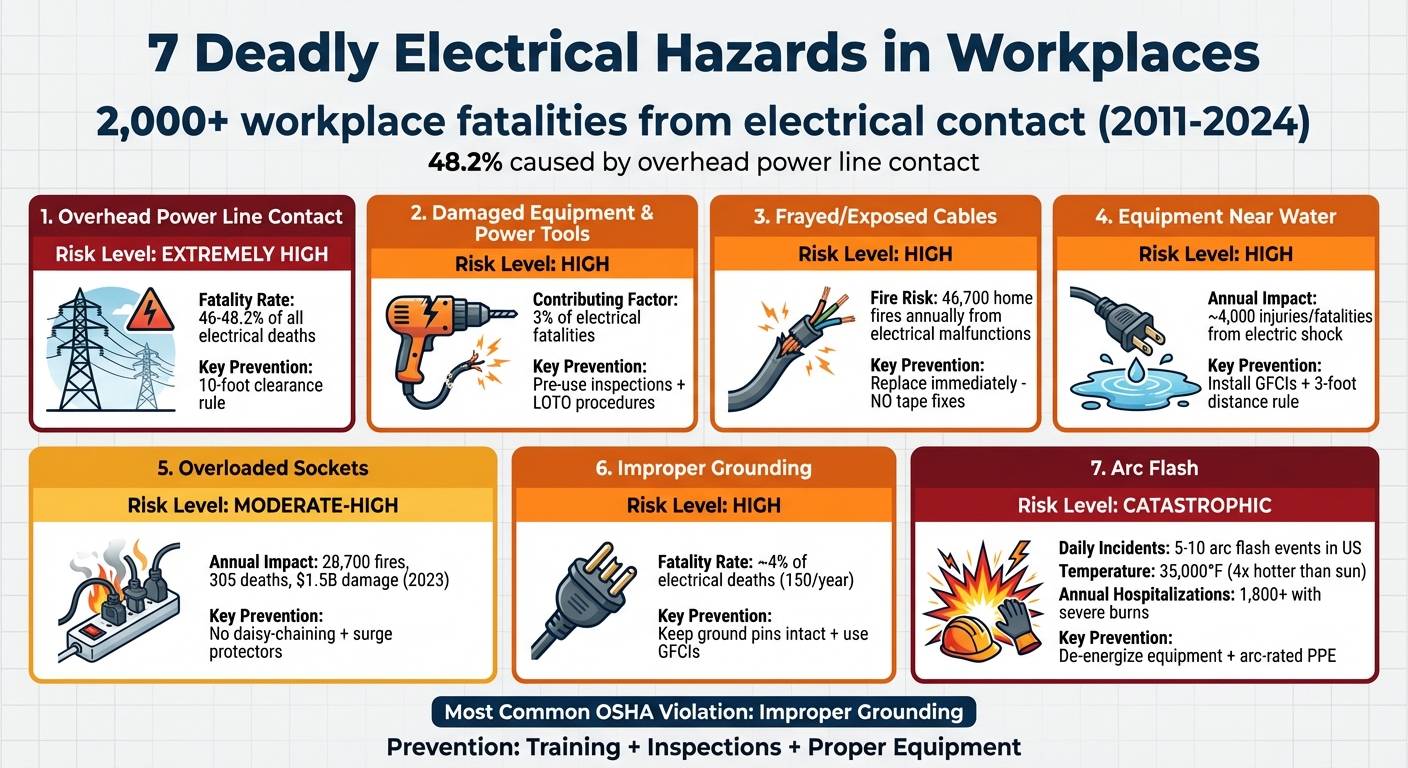
7 Common Workplace Electrical Hazards: Risk Levels and Prevention Strategies
1. Overhead Power Line Contact
Risk Level
Overhead power line contact is one of the deadliest electrical hazards in workplaces, responsible for around 46% to 48.2% of all electrical fatalities. What’s even more alarming is that 57% of these fatalities involve non-electrical workers - such as construction laborers, roofers, and tree trimmers - who often lack the necessary training to handle such risks.
These power lines carry extremely high voltages, with long-distance transmission lines often exceeding 138,000 volts. Even without direct contact, electricity can arc through the air, energizing nearby objects like metal tools or heavy machinery (e.g., cranes, ladders, boom lifts, scaffolding). If a person touches these energized objects, they can become part of the electrical path to the ground.
"Overhead power lines are un-insulated and can carry tens of thousands of volts, making them extremely dangerous to employees who work in their vicinity." - OSHA
Potential Injuries
Contact with overhead power lines can result in instant electrocution or long-term, life-altering injuries. The primary dangers include electric shock, arc flash burns, thermal burns, cardiac arrest, and severe damage to muscles, nerves, and internal organs. There are also secondary risks: electric shocks can trigger involuntary muscle spasms, leading to falls from heights. Falls often cause additional injuries, and arc blasts may result in hearing loss or other trauma. Fatalities and severe injuries are common, underscoring the need for strict preventive measures.
Prevention Strategies
To stay safe around overhead power lines, follow the "10-foot rule" - always maintain at least 10 feet of clearance from lines carrying up to 50 kV, and increase the distance for higher voltages. For downed lines, stay at least 35 feet away. Assume all lines are energized unless confirmed otherwise by the utility company.
Here are some key precautions to minimize the risks:
- Use a spotter: Assign someone to monitor the distance between heavy equipment and power lines, as operators may have blind spots.
- Handle tools carefully: Move ladders and long tools horizontally, and use non-conductive materials like fiberglass or treated wood.
- Survey the site: Before starting work, identify all overhead lines, and mark them with warning signs, flags, or barriers.
- Coordinate with utilities: Whenever possible, request the utility provider to de-energize and ground power lines before beginning work.
"If you feel unsafe performing a job, say something. All electrical work should be completed by qualified workers with proper training." - ESFI
sbb-itb-501186b
Electrical Safety Basics for Employees - From SafetyVideos.com

2. Damaged Equipment and Power Tools
After overhead power lines, damaged equipment ranks high on the list of workplace electrical hazards.
Risk Level
Faulty tools and equipment pose a serious threat, especially in industries like construction and manufacturing. From 2011 to 2023, the U.S. recorded 1,940 electrical fatalities, with damaged wiring or equipment accounting for around 3% of these deaths. When safety features like insulation or grounding are compromised - due to frayed cords or cracked casings - tools can become dangerous conductors of electricity.
Signs of damage to watch for include frayed or cracked cord insulation, exposed wires, missing grounding pins on plugs, and cracked tool casings. Even a mild tingling sensation while using a tool signals an internal electrical fault that needs immediate attention.
Potential Injuries
Using damaged equipment can lead to electric shock, electrocution, and burns - both electrical and thermal. These shocks can also trigger involuntary muscle movements, potentially causing falls from ladders or scaffolding. Additionally, faulty wiring or short circuits can ignite nearby materials, increasing the risk of fires and explosions.
Prevention Strategies
Before using any equipment, visually inspect cords, plugs, and casings for signs of damage. Remove and tag any tools with frayed insulation, exposed wires, missing grounding pins, or cracks. Avoid temporary fixes - damaged tools should only be repaired by qualified professionals. For added safety, choose double-insulated tools, which are clearly marked to indicate their extra layer of protection.
During maintenance, implement Lockout/Tagout (LOTO) procedures to ensure equipment isn’t accidentally energized while being serviced. These steps can significantly reduce the risks associated with damaged tools and equipment.
3. Frayed, Loose, or Exposed Electrical Cables
Frayed cables occur when insulation wears down, exposing live wires. This can result from regular use, environmental factors, or mishandling.
Risk Level
While hazards from power tools are well-known, maintaining cable integrity is just as critical to avoid electrocution risks.
High. Exposed wires are a serious, immediate danger. Historical data highlights the severe risks of damaged wiring. The situation becomes even more dangerous in wet conditions, where water can carry electrical current from exposed wires to a person, even without direct contact. Even small currents from exposed wires can be deadly.
Potential Injuries
Coming into contact with frayed cables can lead to electric shocks, electrocution, and severe burns. Shocks may cause involuntary muscle contractions, increasing the likelihood of secondary injuries like falls from ladders or scaffolding. Internal injuries can include cardiac arrest, respiratory failure, and nerve damage. Additionally, damaged cables can spark fires; electrical malfunctions are linked to approximately 46,700 home fires every year.
Prevention Strategies
Keeping cables in good condition is just as important as maintaining equipment.
Inspect all power cords and extension cables for cracks, cuts, abrasions, or exposed wires. Catherine Tims from EHS Insight advises:
"Any damaged cords should be replaced right away, no questions asked".
Replace damaged cords immediately. Do not use electrical tape to "fix" frayed insulation - this method does not eliminate the risk of shock or fire. Instead, label damaged cables as "defective" and remove them from use following Lockout/Tagout procedures. Perform regular inspections, replace faulty cables promptly, and store cords properly to avoid tight bends or placing them in high-traffic areas.
4. Electrical Equipment Near Water or Wet Conditions
Water and electricity are a dangerous combination, especially in the workplace. Since the human body is about 70% water, moisture can create a direct path for electrical current, significantly increasing the risk of injury or death. As Afnan Tajuddin points out:
"Electrical shock is the most immediate danger when electrical equipment is exposed to moisture."
Risk Level
High. Wet conditions turn electrical risks into severe, life-threatening hazards . From 2011 to 2023, there were 1,940 electrical fatalities in the U.S. alone . Moisture reduces the skin's natural resistance, making it easier for electrical currents to penetrate and harm internal organs. Water also acts as an excellent conductor, allowing electricity to travel through puddles, damp surfaces, or wet materials, potentially reaching workers who aren’t directly touching energized equipment . In these situations, strict safety protocols are critical to reducing the heightened risks posed by water.
Potential Injuries
Electric shock in wet environments can lead to muscle paralysis, which may result in Electric Shock Drowning (ESD) if the victim is in water and unable to move. Each year, about 4,000 people in the U.S. experience injuries or fatalities from electric shock. Secondary injuries, such as falls caused by sudden muscle contractions, are also common. Additionally, moisture accelerates the corrosion of electrical components, increasing the likelihood of short circuits, equipment failures, and even fires .
Prevention Strategies
To address these dangers, workplaces should adopt specific safety measures for wet conditions:
- Install Ground Fault Circuit Interrupters (GFCIs): These devices can quickly detect current leaks and shut off power, preventing electrocution in areas like kitchens, bathrooms, and outdoor job sites .
- Maintain Distance from Water Sources: Keep electrical outlets, appliances, and cables at least three feet away from sinks, bathtubs, or other water sources. In areas prone to pooling water, elevate cables using scaffold stands .
- Use Properly Rated Wiring: Ensure all wiring in wet locations is marked with a "W", indicating it’s designed to resist moisture.
- Weatherproof Outdoor Devices: Use NEMA-rated enclosures to protect outdoor electrical equipment from the elements.
- Practice Safe Handling: Avoid operating switches or plugging in appliances with wet hands, and always dry work surfaces thoroughly before using electrical tools .
- Inspect Equipment Regularly: Check cords for cracks or frayed insulation, as these issues are especially dangerous in damp conditions .
5. Overloaded Electrical Sockets and Extension Cords
Overloading electrical outlets is a common workplace mistake that carries serious risks. This happens when the electrical current drawn exceeds the outlet's capacity (usually 15–20 amps). The result? Excessive heat that can melt insulation, leading to short circuits, electrical arcs, and even fires. Extension cords, designed for temporary use, become especially hazardous when used as permanent solutions. Over time, this misuse increases wear and tear, adding to the fire risk. These dangers build on earlier concerns about damaged or exposed wiring, highlighting the importance of proper load management.
Risk Level
Overloaded circuits are a major hazard due to the heat they generate. High. In 2023 alone, socket overloads and improper use of extension cords caused around 28,700 fires in the U.S., resulting in 305 deaths, 800 injuries, and $1.5 billion in property damage. The risk is even greater when workers "daisy-chain" extension cords - plugging one into another - which significantly raises the chance of overload and fire.
"Electrical circuits that are overloaded pose both an electrocution hazard and a fire hazard. Overusing an outlet can lead to overheating or a power shortage."
Potential Injuries
The dangers of overloaded circuits go beyond fires. They can cause thermal burns from hot components, arc flash burns, and electric shocks. Secondary injuries, like falls triggered by unexpected electrical events, are also common. Electrical fires are particularly dangerous because they often start in hidden areas, such as behind walls or inside sockets, making them harder to detect until they’ve already spread.
Prevention Strategies
Be alert to signs of an overloaded circuit. These include warm wall plates, discoloration or scorch marks around outlets, buzzing or crackling sounds, flickering lights when appliances are turned on, frequently tripped breakers, and burning smells near sockets. If you notice any of these, stop using the outlet immediately.
Here are some key safety tips:
- Assign one wall outlet per high-power appliance. Devices like space heaters, microwaves, refrigerators, and air conditioners should never share a socket or operate through an extension cord.
- Fully extend cords during use to prevent heat buildup.
- Avoid running cords under rugs, through doorways, or across walkways where they could be pinched or damaged.
- Regularly inspect cords for issues like frayed wires, cracked insulation, or missing grounding pins.
For permanent electrical needs, hire a licensed electrician to install additional wall outlets. According to OSHA:
"Flexible cords may not be used as a substitute for the fixed wiring of a structure".
Consider using multi-way extension strips with built-in fuses or surge protectors instead of unfused block adapters. Installing Ground Fault Circuit Interrupters (GFCIs) and Arc Fault Circuit Interrupters (AFCIs) can also improve safety by automatically cutting power in dangerous situations.
6. Improper Grounding or Earthing
Grounding provides a safe, low-resistance path that redirects unwanted electrical current into the earth, reducing the risk of shock, injury, or even death. Without proper grounding, electricity from a short circuit or malfunction can take unintended routes - through metal surfaces, structural components, or even people. The danger is heightened by the fact that grounding issues often remain unnoticed, with factors like corrosion, loose connections, or shifting soil conditions silently compromising the system. This section highlights the dangers and outlines key practices for maintaining effective grounding.
There are two main types of grounding systems to consider. The System/Service Ground focuses on protecting machines and insulation by grounding the neutral conductor, while the Equipment Ground safeguards workers by providing a path for current if a tool's metal casing becomes energized. These systems must work in tandem, with proper bonding ensuring that electrical potential is equalized between conductive parts to avoid dangerous voltage gaps.
Risk Level
High. Improper grounding is among OSHA's most frequently cited electrical violations. Ground faults are responsible for about 4% of workplace electrical fatalities, contributing to an average of 150 deaths annually in the U.S. between 2011 and 2023. The hidden nature of grounding failures makes them especially hazardous. As Howard Williams, Associate Editor at Electrical Safety Forum, explains:
"Grounding is rarely noticed during normal operation, but during a fault, it determines whether electrical energy is contained or uncontrolled".
Potential Injuries
The consequences of grounding failures can be devastating. Electrical currents as low as 23 milliamps can cause respiratory paralysis, while 100 milliamps can lead to heart ventricular fibrillation. Workers may also face severe injuries such as thermal burns from fault currents, arc flash incidents, muscle contractions, cardiac arrest, or secondary injuries like falls caused by shocks. Additionally, fault currents entering the earth can create "step and touch potentials" - voltage differences on the ground that can harm individuals even without direct contact with equipment.
Prevention Strategies
To reduce the risks associated with improper grounding, consider these essential practices:
- Keep the third ground prong intact. This metallic pin plays a critical role in safely directing stray voltage to the ground.
- Inspect equipment regularly. Check for missing ground pins, damaged cables, or compromised cases. Ensure the grounding path is continuous and free from coatings like paint or enamel.
- Use Ground-Fault Circuit Interrupters (GFCIs). These devices are especially important in wet areas and construction sites, as they stop current flow when leaks exceeding 5 milliamps are detected - acting much faster than standard breakers.
- Implement an Assured Equipment Grounding Conductor Program (AEGCP). This program ensures temporary wiring on construction sites is inspected and verified for intact grounding paths.
- Follow the 25-ohm rule for grounding electrodes. If resistance exceeds 25 ohms, install a second electrode at least 6 feet away.
- Opt for double-insulated tools. These tools eliminate the need for a three-wire cord, reducing grounding-related risks.
7. Arc Flash and Thermal Burns
An arc flash is an intense burst of electrical energy caused when a fault creates a conductive path through the air. Unlike electrocution, which involves current traveling through the body, arc flash injuries stem from extreme heat, explosive energy, and molten metal flying through the air. These incidents occur in mere fractions of a second and don’t require direct contact with electrical equipment. Common causes include dropped tools, accidental contact with energized parts, equipment malfunctions due to loose connections or corrosion, and environmental factors like dust or moisture.
Risk Level
High. In the United States, an estimated 5 to 10 arc flash events occur daily, leading to over 1,800 workers being hospitalized annually with severe burns. Arc flashes can hit temperatures exceeding 35,000°F (19,400°C) - about four times hotter than the sun’s surface - and generate blast waves louder than 140 decibels, enough to rupture eardrums. Anthony LaFazia, Founder of Atlantic Training, highlights the danger:
"An arc flash isn't just a 'spark.' It is a catastrophic release of energy that can reach temperatures of 35,000°F, four times hotter than the surface of the sun, in a fraction of a second".
Potential Injuries
The aftermath of an arc flash extends beyond burns. Thermal burns from the intense heat can cause second- and third-degree injuries, sometimes with clothing melting into the skin. Eye injuries from UV and infrared radiation can lead to flash blindness, permanent retinal damage, or vision loss. Hearing damage is also common, as the pressure waves can rupture eardrums and cause long-term hearing issues. The explosive force can result in shrapnel trauma, with flying molten metal and debris causing lacerations or broken bones. Additionally, inhaling vaporized metal and toxic gases can lead to respiratory damage, including lung injuries and throat burns. Even low-voltage systems (120/208V) can generate arcs powerful enough to cause fatal injuries, according to OSHA. Alarmingly, most burn injuries in arc flash incidents result from flammable clothing igniting, not the arc itself.
Prevention Strategies
The best way to prevent arc flash incidents is to work on de-energized and locked-out equipment (LOTO). If working on live equipment is unavoidable, adhere to NFPA 70E guidelines, including maintaining proper approach boundaries like the Arc Flash Protection Boundary. Workers must also use appropriate personal protective equipment (PPE).
Energized equipment should be clearly labeled with arc flash labels that detail incident energy levels, voltage, and required PPE. Choose arc-rated (AR) clothing, face shields, and insulated gloves based on calculated incident energy levels. These range from Category 1 (4 cal/cm² for basic tasks) to Category 4 (40 cal/cm² for high-energy operations). Avoid wearing synthetic materials like polyester or nylon under AR gear, as they can melt into the skin. Instead, opt for 100% cotton or wool.
Regular maintenance is also key. Inspect equipment for loose wires, corrosion, or dust buildup, as these can compromise insulation and trigger arcs.
This hazard highlights the critical need for rigorous safety protocols in electrical work. Proper training and strict adherence to guidelines are essential to minimize risks.
Comparison Table
Here’s a quick recap of the electrical hazards and prevention methods discussed earlier. This table lays out the seven hazards, their severity, possible injuries, and the safety measures you can take to minimize risks in your workplace.
| Hazard | Risk Level | Potential Injuries | Key Prevention Strategies |
|---|---|---|---|
| Overhead Power Line Contact | Extremely High / Fatal | Electrocution, severe third-degree burns, respiratory paralysis | Maintain a 10 ft distance, use warning signs and barricades, and opt for fiberglass ladders |
| Damaged Equipment and Power Tools | High | Electric shock, burns, secondary injuries from falls | Conduct pre-use inspections, follow LOTO procedures, and ensure repairs are done by qualified personnel |
| Frayed, Loose, or Exposed Electrical Cables | High | Electrical fires, shock, thermal burns | Practice proper cable management, replace damaged cords immediately, and avoid temporary fixes like tape |
| Electrical Equipment Near Water or Wet Conditions | High | Severe electrocution, heart fibrillation | Use GFCIs, keep cords away from water, and ensure hands and surfaces are dry |
| Overloaded Electrical Sockets and Extension Cords | Moderate to High | Fire-related injuries, thermal burns, arc flash | Avoid daisy-chaining, use surge protectors, and perform fire risk assessments |
| Improper Grounding or Earthing | High | Electrocution, electric shock | Never remove ground pins, use GFCIs, and perform regular continuity tests |
| Arc Flash and Thermal Burns | Catastrophic | Severe burns, hearing loss, blindness, shrapnel injuries, cardiac arrest | De-energize equipment, wear arc-rated PPE, and maintain a 3 ft clearance around panels |
Overhead Power Line Contact stands out as the most dangerous hazard, contributing to 48.2% of all electrical workplace fatalities in the U.S.. On the other hand, Improper Grounding or Earthing is the most frequently cited OSHA electrical violation, emphasizing how often this critical safety step is overlooked.
Use this table to pinpoint hazards and implement the right safety practices for your team.
Conclusion
Electrical hazards have tragically claimed thousands of lives in the U.S. over recent years. Yet, the majority of these incidents can be avoided with the right precautions, awareness, and equipment. Simple steps like keeping a safe distance from overhead power lines, replacing damaged cords, and ensuring proper grounding can go a long way in protecting your team from harm.
Beyond these preventive measures, thorough training plays a critical role in reducing risks. Programs like NFPA 70E and OSHA-certified training equip workers with the knowledge to identify hazards before they escalate. Pair this with routine inspections of tools, cables, and electrical panels to catch issues like overloaded circuits or exposed wiring early. Brian Andringa, District Manager at City Electric Supply, emphasizes the importance of vigilance:
"Paying attention to warning signs is one of the most important things everyone on a job site can do to work safely".
Another essential component of workplace safety is using certified electrical equipment that meets established standards. High-quality tools - such as properly rated breakers and Ground Fault Circuit Interrupters - help ensure your systems can handle electrical loads without increasing the risk of shocks or fires. For those looking to source reliable new or used electrical components, Electrical Trader offers products like breakers, transformers, and power distribution equipment to help maintain a safe and compliant workplace. Investing in dependable, certified equipment reinforces the foundation of your safety practices.
FAQs
When do I need to use a GFCI at work?
A Ground Fault Circuit Interrupter (GFCI) is essential in places where moisture is present, like bathrooms, kitchens, outdoor outlets, or any area with a higher risk of electrical shock. Its primary purpose? To quickly cut off power if it detects an imbalance in the electrical current, reducing the chance of serious injury.
By 2026, the National Electrical Code (NEC) mandates the use of GFCIs in these locations, ensuring better safety standards for everyone.
How can I tell if a circuit is overloaded?
Frequent breaker trips, flickering or dim lights, warm or discolored outlets, and a burning smell near outlets or appliances are all signs of an overloaded circuit. These warning signals mean the circuit is carrying more electricity than it’s built to handle, which can cause overheating and even fire hazards. Keeping an eye out for these issues is a simple but effective way to stay safe and avoid potential problems.
What’s the difference between shock and arc flash?
The main distinction lies in the type of hazard and the resulting injuries. Electric shock happens when electrical current flows through the body due to direct contact with live components, which can lead to burns, serious injuries, or even death. On the other hand, an arc flash is a sudden, violent release of energy caused by an electrical fault. This event generates extreme heat, intense light, and pressure waves, causing severe burns and other injuries - even without direct physical contact.





